Placeholder17
Well-known member
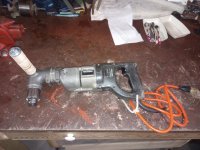
During another Facebook Marketplace trawl during lunch at work, I saw a late 70's Black & Decker right-angle drill for $10, with only one photo.
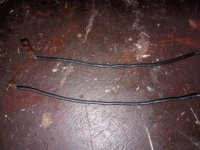
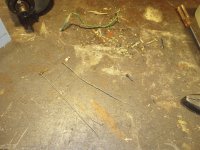
Checking it out in person that night, it became apparent why: chuck rusted and practically frozen, exterior housing covered in a partially wet oil/grease film, stator/rotor housing clogged with oily sawdust, and the power cord had that rubberized wire insulation that dries rock-hard and shatters upon bending. However, the chuck would just barely turn with the key, so I figured it would come off and bought it.
It took forever to scrub clean off all the grease, but the gearbox itself was jammed full of still-wet grease and the only dry bearing was the rear rotor bearing. I wanted to take apart the adapter to check the bearings/gearbox, and the bearings do slip in and out by hand about 1/8", but the outer bore of the aluminum body has been ever so slightly warped, probably from the drill being dropped, and the bearings get stuck on their way out. Otherwise, the drills fine perfectly after cleaning, and the chuck came apart and it turned out the caked grease inside had protected the guts from moisture.
The handle was missing and the threads were stripped out, so I drilled out the threads, retapped to the next size up, and made a handle from threaded rod and hole-saw plugs.
I posted recently about a Rockwell right-angle drill I had bought because the quick-change chuck (to change speeds on the right-angle adapter by flipping it around) was a a finely machined coupling assembly.
https://www.garagejournal.com/forum...-right-angle-drill-cool-chuck-adapter.552112/
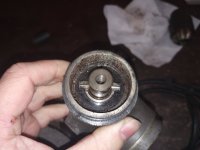
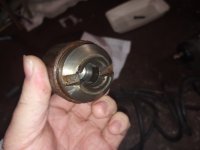
The Black and Decker drill uses the same concept, with with roll pins in the shafts instead of a machined head to save cost. The female ends of the coupling are slightly dented from the force concentration on the tangent edge of the roll pin, but it's minor considering this drill appears to have been well used.
For future reference of anyone reading this, the set screw in the chuck keeping it from sliding axially off the shaft is standard right-hand threaded for both the Rockwell and Black & Decker right-angle drills. Both are triple-gear reduction.
They have different speeds though... the Rockwell is 600 RPM base drill with the adapter changing speed to 900 RPM / 450 RPM, and the Black & Decker is 450 RPM base drill with the adapter changing speed to 300 RPM / 700 RPM.
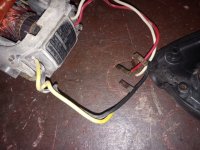
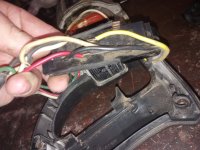
One last thing for reference...the Black & Decker switch uses custom flat-prong wire connectors instead of screws and fork/ring connectors. DO NOT throw away the connectors crimped onto the power cord. You could cut them off with say 1" of wire remaining and solder them to the replacement cord, but I cut them off with about 6" of wire, stripped off the cracking insulation, applied 2 layers of heat-shrink tubing, and connected them to a new cord with wire nuts.
Checking it out in person that night, it became apparent why: chuck rusted and practically frozen, exterior housing covered in a partially wet oil/grease film, stator/rotor housing clogged with oily sawdust, and the power cord had that rubberized wire insulation that dries rock-hard and shatters upon bending. However, the chuck would just barely turn with the key, so I figured it would come off and bought it.
It took forever to scrub clean off all the grease, but the gearbox itself was jammed full of still-wet grease and the only dry bearing was the rear rotor bearing. I wanted to take apart the adapter to check the bearings/gearbox, and the bearings do slip in and out by hand about 1/8", but the outer bore of the aluminum body has been ever so slightly warped, probably from the drill being dropped, and the bearings get stuck on their way out. Otherwise, the drills fine perfectly after cleaning, and the chuck came apart and it turned out the caked grease inside had protected the guts from moisture.
The handle was missing and the threads were stripped out, so I drilled out the threads, retapped to the next size up, and made a handle from threaded rod and hole-saw plugs.
I posted recently about a Rockwell right-angle drill I had bought because the quick-change chuck (to change speeds on the right-angle adapter by flipping it around) was a a finely machined coupling assembly.
https://www.garagejournal.com/forum...-right-angle-drill-cool-chuck-adapter.552112/
The Black and Decker drill uses the same concept, with with roll pins in the shafts instead of a machined head to save cost. The female ends of the coupling are slightly dented from the force concentration on the tangent edge of the roll pin, but it's minor considering this drill appears to have been well used.
For future reference of anyone reading this, the set screw in the chuck keeping it from sliding axially off the shaft is standard right-hand threaded for both the Rockwell and Black & Decker right-angle drills. Both are triple-gear reduction.
They have different speeds though... the Rockwell is 600 RPM base drill with the adapter changing speed to 900 RPM / 450 RPM, and the Black & Decker is 450 RPM base drill with the adapter changing speed to 300 RPM / 700 RPM.
One last thing for reference...the Black & Decker switch uses custom flat-prong wire connectors instead of screws and fork/ring connectors. DO NOT throw away the connectors crimped onto the power cord. You could cut them off with say 1" of wire remaining and solder them to the replacement cord, but I cut them off with about 6" of wire, stripped off the cracking insulation, applied 2 layers of heat-shrink tubing, and connected them to a new cord with wire nuts.
Attachments
-
 IMG_20251127_085958776.jpg967 KB · Views: 5
 -
 IMG_20251125_210836534.jpg1.1 MB · Views: 4
 -
 IMG_20251126_180113365.jpg341.1 KB · Views: 3
 -
 IMG_20251126_180121308.jpg487.8 KB · Views: 2
 -
 IMG_20251126_180154753.jpg553.1 KB · Views: 1
 -
 IMG_20251126_180210398.jpg363.1 KB · Views: 0
 -
 IMG_20251127_085646971.jpg657.3 KB · Views: 0
 -
 IMG_20251127_085954197.jpg782.4 KB · Views: 2