To avoid these ads, REGISTER NOW!

Latest hex key technology

rick carpenter

Well-known member
Joined
Jan 20, 2011
Messages
3,767
Location
Huntsville, East Texas
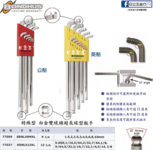
Can someone run down for me the latest hi torque ball end hex key technology? I just got in a Wise SBL-1000 metric super ball hex key set. They advertise that their version of ball end keys allow for 'final tightening'. I'm gonna be taking them at their word... and hopefully never approach their max torque numbers. But now I need an sae set and Wise doesn't carry sae. Eight Tools from Japan has a TEL-S9ZD sae tapered head hex key set. Similar language to the Wise set regarding how much torque they can handle.

I wanna relegate all the generic hex keys I've collected over the years to either garage sale stock or to "go bag" type sets.
 
To avoid these ads, REGISTER NOW!

Dave455

Well-known member
Joined
Mar 19, 2013
Messages
5,800
Location
Sussex, England
To quote Daniel Craig in “Layer Cake” - “That’s a very…Expansive…question”.

Been using hex keys, often in demanding situations, for decades. Got a fair collection - Unbrako, Eklind, Bondhus, PB Swiss, Wiha (German), Wera, Facom, Vessel… If you get really into them, they all have their advantages. No Wise though.

I don’t know the answer to the question. You’d have to take one of each size and overload them to breaking point to find out, but even then you wouldn’t get the full story.

I can tell you, from experience, that repetitive high loads take more of a toll than you might think. I’ve broken 3 Wiha drivers and a box full of Wera 2.5mm ball hex bits, each one at a similar number of cycles, before switching to PB Swiss which survived to this day.

So PB Swiss would be my best guess. By no means the latest, but newer isn’t always better. Imperial sizes are available.

Facom and Asahi are probably also up there. There’s something special about the Facom, maybe the steel, and they have the best fit (by a frac).

Asahi are probably close to PB Swiss for “best overall”. Bondhus are pretty decent. They invented the concept and are probably “best value”.
 

Samuel D

Well-known member
Joined
Apr 9, 2019
Messages
638
I think the idea behind high-torque ball ends is just to elongate the ball.

Does that visually match the tools you’re looking at?

That way you get longer contact lines inside the fastener head under load (after elastic compression of tool and fastener around the initial theoretical points of contact).

Downsides would be a lower max angle of use off the fastener axis; maybe a faster fall-off of max torque as the angle goes up, eventually to a lower max than even a regular ball shape; and greater losses to friction (so higher input torque needed for a given fastener torque, not that there’s any way to guess how much is being lost).

That set of benefits and compromises does not appeal to me.

I’ll take a regular ball and flip it to a straight-sided hex end the moment I need any torque at all.
 

RoninB4

Well-known member
Joined
Jul 22, 2020
Messages
3,488
Location
Under My House
-I don't think I can answer your question but perhaps can offer some insight on ball end hex keys. I spearheaded the ball driver project for Eklind Tool in the 90's when the patent for Bondhus ball drivers was going to expire. The design was experimented with and I designed/made several prototypes with different shapes/features to explore as many options as possible before deciding the final configuration.

Samuel D gave a fairly descriptive explanation of the compromises encountered as the shapes change, neck size/shape also greatly affects the angle. I'm not familiar with Wise so I can't comment on type of steel used, hardness of heat treating, or torque limits. Just based upon my own experience, in order to gain a significant rise in the torque ceiling the steel/heat treating can't have as much effect as the "ball" shape and neck size/shape. With the reduced angle in mind I don't see much advantage using a ball driver over a regular end type. There's also the wear on both the socket head of the fastener AND the ball driver itself. All hex keys are considered perishable tooling regardless of the maker. While it's nice to go off angle to spin a fastener in/out with a ball-type driver I'd never consider using one to set or break the torque, especially if it enhances the end-of-life on a perishable tool like a ball driver. Just my opinion but you do you.
 

Pinne

Well-known member
Joined
Oct 8, 2024
Messages
335
Curious to hear OP's thoughts on the Wise hex keys.

Hex keys / bits / bit sockets are my most used tools by far so I'm pretty interested about this on the whole. I use a lot of Wera for keys and bits as the fit is good and they have a reasonable service life. The PB Swiss stuff is quite nice as well, but I don't think the cost always makes sense given that these tools are wear items.

For bit sockets I mainly use Snap-on, fit is great and I like their long ball hex bits.
 

BWWgarage

Well-known member
Joined
Feb 9, 2023
Messages
323
-I don't think I can answer your question but perhaps can offer some insight on ball end hex keys. I spearheaded the ball driver project for Eklind Tool in the 90's when the patent for Bondhus ball drivers was going to expire. The design was experimented with and I designed/made several prototypes with different shapes/features to explore as many options as possible before deciding the final configuration.

Samuel D gave a fairly descriptive explanation of the compromises encountered as the shapes change, neck size/shape also greatly affects the angle. I'm not familiar with Wise so I can't comment on type of steel used, hardness of heat treating, or torque limits. Just based upon my own experience, in order to gain a significant rise in the torque ceiling the steel/heat treating can't have as much effect as the "ball" shape and neck size/shape. With the reduced angle in mind I don't see much advantage using a ball driver over a regular end type. There's also the wear on both the socket head of the fastener AND the ball driver itself. All hex keys are considered perishable tooling regardless of the maker. While it's nice to go off angle to spin a fastener in/out with a ball-type driver I'd never consider using one to set or break the torque, especially if it enhances the end-of-life on a perishable tool like a ball driver. Just my opinion but you do you.
The experts on GJ continue to impress!
 

GeoBruin

Well-known member
Joined
May 5, 2018
Messages
3,733
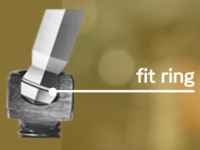
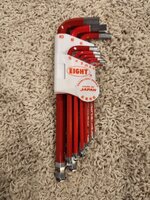
For what it's worth, I've been really impressed with my "eight", though a different series than you linked. They're the ones with the little retaining ring on the ball end.
 
OP
R

rick carpenter

Well-known member
Joined
Jan 20, 2011
Messages
3,767
Location
Huntsville, East Texas
Thanks for all responses. Wise is a Fujiya brand, and made in Japan. They are made of SNCM20V chrome vanadium steel, hardness HRC 59-61. The 10mm necks down to 8.15mm. I know not to actually use them for breaking torque or for final fastening, but I was curious about Wise's claims to be able to do so.

@RoninB4, I used a lot of Bondhus hex tools when I worked in the printshop, from regular L keys to ball end screwdriver handles & t-handles. I never worried a bit about them or the longevity of the handles when I was elbow-deep in chemicals.
EDIT: Your comment on perishable tooling: agreed! Some tooling just takes longer to wear because it's made better, some tooling requires a more knowledgeable user thus taking longer to wear, some is more expensive and thus beater tools are used until the $$ tools are finally used, yadda yadda yadda.. There's a lot that goes into 'perishable tooling"! (Thanks)

@GeoBruin, I'm looking at a set of Eight hex keys, most like the taper head set. Some Eight sets include a pair of cheater handles, hence my question on the latest ball end technology.

@Pinne, sorry to say I haven't used them yet. Bought them in advance of needing them for my Tacoma. OTOH, there are enough sae hex socket bolts and set screws still around to warrant a good set. I currently use my hodge-podge mix of L keys. I'd like to sort and sell them off

Wiser01.jpg

Wiser02.jpg
 
Last edited:

RoninB4

Well-known member
Joined
Jul 22, 2020
Messages
3,488
Location
Under My House
EDIT: There's a lot that goes into 'perishable tooling"! (Thanks)
-You're welcome, glad to help when I can. I didn't presume you needed to hear about the limits of ball drivers but I never know the experience level or who else is reading so I often write/type for those with the least experience. I've read/seen numerous incidents of someone snapping a ball off in the socket (not that I've ever done that around witnesses of course....) and now the ball is a bit difficult to extract. Everybody works differently and can do what they want to, I just try to offer some cautionary guidelines when I think I know something. Unfortunately my replies get a bit long winded (like this one is) as I try to explain. I hope I'll be excused for this if I can help inform somebody.

-The offerings by Wise and Bondhus are somewhat interesting, they both are attempting to offer a feature to make them stand out in the crowd of competitors. There's dubious merits to the steel and heat treating, same for the surface finish/coloration. Selling by price alone is a race to the bottom so features were developed as selling points.

-Wise counters the issue of breaking off the ball by reducing the entry angle and increasing the neck that allows for greater strength. How significant that strength (original question by the OP) is unknown without direct comparison to other brands. The selling point of access in confined areas is what Bondhus is marketing by a shortened "L" and a 100° bend allowing an entry angle of 15°. How important these features are to a buyer only the companies will know, neither would compel me to buy but we all have different priorities for purchases.

-Ever since Eklind developed a new and much faster automated method for creating ball drivers (1995) the unique lock on the market that Bondhus had went out the window. Other makers jumped on the new process during development (industrial espionage I witnessed in Germany) and that put all hex key makers on equal footing which required marketing to pitch either price point or features to capture sales. Entry angle was the selling point that Eklind used to decide the final design configuration, my other designs ended up as toolmaker "trophies" in my tool chests.

-When hex keys got rounded corners and were no longer useful I never tossed them out. I ground them back past the deformed section for further use or particularly for those rare instances where confined access occurred. When the "L" leg was simply too short I'd cut the leg off and use the straight section with a wrench, press on a knurled knob/handle for finger spinning, or mount in a socket. The really cheap hex keys made from Chinesium were always given away to those without. But if the steel was decent it was worth keeping/altering.

-Hope this helps somebody, I'll go sit down now.
 
Last edited:

KnurledNut

Well-known member
Joined
Jan 28, 2011
Messages
8,096
Location
n/a
The selling point of access in confined areas is what Bondhus is marketing by a shortened "L" and a 100° bend allowing an entry angle of 15°.
The short arm ball has less max angle because it is thicker at the neck allowing for greater strength. Adding the 100° bend offsets this lacking angle by giving a compound angle and providing closer to a standard ball angle of +/-25°.
 

RoninB4

Well-known member
Joined
Jul 22, 2020
Messages
3,488
Location
Under My House
The short arm ball has less max angle because it is thicker at the neck allowing for greater strength. Adding the 100° bend offsets this lacking angle by giving a compound angle and providing closer to a standard ball angle of +/-25°.
- You're observant and correct. I still feel that only an idiot would place a mounting SHCS (instead of a HHCS) in a location like that. I have encountered this on limit switch brackets now and then. Hope things are well for you and yours.
 

KnurledNut

Well-known member
Joined
Jan 28, 2011
Messages
8,096
Location
n/a
- You're observant and correct. I still feel that only an idiot would place a mounting SHCS (instead of a HHCS) in a location like that. I have encountered this on limit switch brackets now and then. Hope things are well for you and yours.
I have come across these situations on equipment I service where components were added that block the original engineered access. Cussworthy at times.
That being said, I prefer bits over keys when possible, especially in smaller sizes. Low profile bits will sometimes access where a ball key is needed.
I appreciate your experience and time taken to share your thoughts.
 

AEAdam

Well-known member
Joined
May 27, 2023
Messages
2,729
Location
SE PA
Confused about the application. Hi torque hex keys? How much torque can you put into a hex key? What am I missing?

I have ball end sockets I’ve used on cars and machines. I thought you guys were talking about sockets, not keys. Why would you need a stronger hex key?
 

RoninB4

Well-known member
Joined
Jul 22, 2020
Messages
3,488
Location
Under My House
Confused about the application.
-That's ok, I'm confused most of the time. If I understood the OP correctly he/she was asking about a marketing claim by Wise that you could fully set the torque on a SHCS with their ball driver or perhaps even crack the torque loose. I had to add my .02 that didn't actually answer the original question and the discussion morphed/changed from there.
Why would you need a stronger hex key?
-My contention was that this was a marketing based move to make their product stand out from the competitors, as did Bondhus in a different feature. Post #11 was some of the back story from my experience developing the ball drivers for Eklind. Why a stronger hex key? The common ball drivers are known to be prone to breaking off the ball itself when a certain torque level has been reached that's way less than non-ball ends.

-Now if you mean stronger as in less deformation of the hex then that's a different discussion about steel type and heat treating. Eklind had to lower the hardness (Rc) on their keys at one point while I worked there due to a lawsuit conference call from a lawyer. The lawsuit went nowhere (attempted fraud) but we lowered the hardness a few points anyway to avoid liability. Less hard is less prone to fracture planes from stress risers. The result of this was I noticed some of the keys deforming after repeated duty sooner than usual. That's often the trade off with ductile vs. brittle. A metallurgist could offer a better explanation but I'm just a shop donk.
 

Pinne

Well-known member
Joined
Oct 8, 2024
Messages
335
Confused about the application. Hi torque hex keys? How much torque can you put into a hex key? What am I missing?

I have ball end sockets I’ve used on cars and machines. I thought you guys were talking about sockets, not keys. Why would you need a stronger hex key?
It's all relative - but the Wise keys come with what is basically a wrench extender to allow for more torque to be applied while using the ball end. High torque compared to what would usually be applied to a ball end.

What makes a hex key work well (especially off angle) should also make a hex bit work well. I have an interest in bits for off angle access. To me, extreme torque loading isn't necessarily what I need in a ball hex bit. Better designs that lower the risk of deformation and rounding would be beneficial to me, especially in smaller fasteners. I have a handful of very short / low stack height hex keys but a ball hex bit would often be more convenient.
 
OP
R

rick carpenter

Well-known member
Joined
Jan 20, 2011
Messages
3,767
Location
Huntsville, East Texas
Quite a bit of info & observations. Thanks again y'all, and keep it up!

I'm confident using the metric hex keys for general garage stuff and automotive. Regardless, any specific torque values needed would have to be applied with a torque wrench & bits. Planning on an sae key set for garage & household stuff, prolly from Eight since I'm on a Japanese tool kick. I want to sort and sell off the loose keys I've accumulated over the years, but will cut down some of the long leg shafts to try to gin up some beater socket hex bits.
 
To avoid these ads, REGISTER NOW!

Samuel D

Well-known member
Joined
Apr 9, 2019
Messages
638
Ko-ken 2430M (1/4″-drive swivel bit sockets) might solve some of these problems from a different angle?

Or Snap-on TUAM series (ditto – a bit shorter if you really need best access).

Inch sizes available too.

Guessing most people in this thread are aware of such options, but just in case someone isn’t …
 

AEAdam

Well-known member
Joined
May 27, 2023
Messages
2,729
Location
SE PA
-That's ok, I'm confused most of the time. If I understood the OP correctly he/she was asking about a marketing claim by Wise that you could fully set the torque on a SHCS with their ball driver or perhaps even crack the torque loose. I had to add my .02 that didn't actually answer the original question and the discussion morphed/changed from there.
Where’s my little chart? I think some of the larger Allens get pretty significant torque. Taking a break from carpentry and too lazy to look up my own stuff. I feel like some of the std size cap head screws get 30+ftlbs. On a 6” long rod of steel, that’s some serious hand pressure.

As an engineer, I love the whole better mouse trap thing, so don’t let me put you guys off. Not throwing shade, I’m interested.
Eklind had to lower the hardness (Rc) on their keys at one point while I worked there due to a lawsuit conference call from a lawyer. The lawsuit went nowhere (attempted fraud) but we lowered the hardness a few points anyway to avoid liability.

Wow! That’s an internet myth come true. As a woodworker I’ve long held that many basic hand tools were dumbed down (loss of functionality) due to lawsuits by dumbasses. Chisels are one of my pet peeves. Thin hard chisels are demonstrably better than thick soft chisels (only kind you can buy now).
I want to sort and sell off the loose keys I've accumulated over the years, but will cut down some of the long leg shafts to try to gin up some beater socket hex bits.
Careful! I recently bought a fresh set of bondhus tee handles for my machine shop. My ancient craftsman set is missing a couple sizes I need. So I thought I’d splurge on a new set. I’m not sure the new Bondhus are better than (or as nice as) my old craftsmans. In fact they feel a bit loose in the few screws I’ve used them on.

Maybe you’d be better off keeping what you have. As @RoninB4 revealed, manufacturers might be dumbing tools down. Dumbasses don’t have to file suits any more. They can go on social media rampages. What a world.

PS I use almost zero new woodworking (hand) tools for this reason. The China stuff (my stiletto hammer excepted) is ****, but some of the USA stuff including and especially Stanley isn’t what it was just 10 yrs ago

(Oh no, I think I’m turning into a grumpy old man “everything new is bad yada blah whatever” Sorry guys)

Bottom line: for kick *** SHCS I typically reach for the yellow chrome “heavy duty” Snap on bit sockets. I use tee handles pretty exclusively in the machine shop and pretty much never reach for the allen keys.
 

RoninB4

Well-known member
Joined
Jul 22, 2020
Messages
3,488
Location
Under My House
Where’s my little chart? I think some of the larger Allens get pretty significant torque. I feel like some of the std size cap head screws get 30+ftlbs. On a 6” long rod of steel, that’s some serious hand pressure.
-This is just for entertainment: The lawyer for the complainant flatly stated that his client had broken off a 5/16 hex key using only his hand and got a 10mm gash in his arm requiring stitches when it broke off. The VP of Eklind called me and another diemaker into his office and asked if it was possible to do this. We both doubted this (I stood atop one in the shop to verify) and I said if it is possible I wouldn't want to shake hands with the guy. We listened to the conference call and formed theories in evolution for the guy after.
 

Dagny

Well-known member
Joined
Jul 25, 2014
Messages
2,980
Location
Northern Wi.
Many bulk milk cooler agitators are held on with small set screws that get water spray daily. along time ago I bought a set of allen wrenches that are straight and come with a handle that slips over the hex part so you can slide it up tight to the screw eliminating the twist. They are about a foot long and also handy for fan blades. They come in a plastic tube with a screw cap and I have several sets because the 1/8 inch ones get beat up. Never had much interest in ball ends just seemed like a good way to ruin the set screw.
 

AEAdam

Well-known member
Joined
May 27, 2023
Messages
2,729
Location
SE PA
-This is just for entertainment: The lawyer for the complainant flatly stated that his client had broken off a 5/16 hex key using only his hand and got a 10mm gash in his arm requiring stitches when it broke off. The VP of Eklind called me and another diemaker into his office and asked if it was possible to do this. We both doubted this (I stood atop one in the shop to verify) and I said if it is possible I wouldn't want to shake hands with the guy. We listened to the conference call and formed theories in evolution for the guy after.
Something is fishy about that story. How does one get a 10mm gash from a 5/16” Allen wrench? I could believe a 3/8” gash. Maybe the Allen wrench in question was actually an 8mm?

If you measure your gash in mm, that tells me you are in France or Germany. So no way you’d even be allowed to own a 5/16” Allen.
 

RoninB4

Well-known member
Joined
Jul 22, 2020
Messages
3,488
Location
Under My House
Something is fishy about that story. How does one get a 10mm gash from a 5/16” Allen wrench?
-Follow through after the break like in golf? Wonder if he replaced his divot?
I could believe a 3/8” gash. Maybe the Allen wrench in question was actually an 8mm?
-Just repeating what I heard on the conference call with the lawyer. Breaking it barehanded (no cheater pipe) was the question. Reported world record for one-handed curl is 134 pounds.
If you measure your gash in mm, that tells me you are in France or Germany.
-The call to Eklind (Chicago) came from a lawyer in the U.S. Could have been a metric patient? Maybe hospitals and lawyers use metric units? Who knows, it was legal-speak and the whole story sounded fishy.
So no way you’d even be allowed to own a 5/16” Allen.
-This was in 95 and proof of citizenship wasn't rigidly enforced.
 

F-22

Well-known member
Joined
Jan 23, 2022
Messages
1,830
I have bought a set of Vessel ones, thinking their off corner engagement will be really nice. To be fair I do not like it all too much. Wera is somehow much better. The vessel seems to wedge in too much. Not sure which works better.
 

neophyte

Well-known member
Joined
Apr 23, 2012
Messages
9,557
Location
Pennsylvannia
Why not just buy wrench sizes you use, from a decent but readily available manufacturer, by the dozen ?
Then if you specifically need the ball end, and that has broken off, find a practical use for the broken hex wrench?
 

Beerhippie

Well-known member
Joined
Oct 13, 2023
Messages
9,664
Location
Far NE Oregon
Well, I can tell you for certain that those ball ends are NOT for "final torquing" of non-ferrous set screws (the type you find on electrical equipment).
That's kind of what I'm wondering. What kind of hex socket screws are you all using that don't strip the head out before the ball-end breaks off the wrench? Not the kind I usually encounter, fer sure.
 

2ndGearRubber

Well-known member
Joined
Mar 24, 2014
Messages
14,185
Location
Pittsburgh
That's kind of what I'm wondering. What kind of hex socket screws are you all using that don't strip the head out before the ball-end breaks off the wrench? Not the kind I usually encounter, fer sure.

What you're risking is fatigue failure.

The tool gets used over and over, and eventually fails below "normal" operating load from sustained use. Consider that a 6mm ball hex may have a 5mm or smaller profile at the transition to the ball section. While I would agree hex is a garbage fastener type inherently, you can find 10.9 hex fasteners on cars holding axles/driveshafts/bellhousings and similar silly tight things in place. I've installed specialty driveshafts which come with ball hex bits included as that is the only way to actually install the unit.


If you want stress, try ball-torx some time.
 

F-22

Well-known member
Joined
Jan 23, 2022
Messages
1,830
If you want stress, try ball-torx some time.
It does make the tool weak, though ball torx probably still won't slip as easily as a ball hex? More likely to break the tool and less likely to strip out the fastener.

At least that's what I assume. I have a set of Wera ball torx drivers and they are super useful.
 

RoninB4

Well-known member
Joined
Jul 22, 2020
Messages
3,488
Location
Under My House
That's kind of what I'm wondering. What kind of hex socket screws are you all using that don't strip the head out before the ball-end breaks off the wrench? Not the kind I usually encounter, fer sure.
-What kind "rounds out" the hex socket before breaking off the ball end (custom made by Snap-Off)? I have no scientific testing data to present but my experience/opinion is: It depends.

-There's a lot of interaction between the hex key and the fastener involved despite the appearance of simplicity. Just twist in/out and that's it right? Not really IMO. The hex key steel and heat treated hardness are obvious factors as is the hex key condition itself. These factors apply to the fastener too. The variety of socket driven fasteners (SHCS, RHCS, FHCS, LHCP, set screws, shoulder bolts, etc.) seem to make a difference too. Depth of socket engagement with the hex key seems more shallow with a flat head (FHCS) than a bog standard cap screw (SHCS) and seem more prone to socket deformation. Button/round head (BHCS) also fall into this category when I encounter them. Set screws seem more brittle and tend to fracture before they deform but that may be a matter of heat treating a thinner cross section at the socket (case hardening).

-What I'm suggesting is that the fastener itself needs to be considered as much, if not more, than the hex key. There can be a big difference in the fasteners, we've all dealt with fasteners that twist off with minimal torque. Hex drive fastener quality used to be somewhat of a standard 40 years ago. The only fasteners of dubious integrity came from Japanese auto makers using a steel that met the minimum torque values for the application. This was a cost cutting measure IMO. There were also a few companies (HK, Unbrako) with perceived better made products but their superiority may just have been perception after 1975 or so. Everybody seemed to hop on the cost reduction bandwagon at some point and that meant lowering standards rather than producing a superior product. In stamping dies there's a lot of disassembly/reassembly so certain key fasteners were subjected to in/out cycles on a regular basis. I noticed 40 years ago that some fastener brands would require replacement sooner than others. This was not a coincidence, it was the change coming to all aspects of manufactured products.

-Fastener application also seemed to make a difference. Low profile heads (FHCS/BHCS/LHCS) securing a guide rail weren't subjected to the torque levels a shoulder bolt holding a stripper plate on. This might have meant the steel and the heat treating were different for less demanding applications. Shoulder bolts are often subjected to contact applications where abrasive wear is important so steel used and heat treating would be more critical. When designing machinery the fastener application was something I always had to consider and I expect other designers would do as well. The only people that really know the differences/changes would have worked for cold heading companies for the last 40 years. I'm just speculating from my experiences.

-The last aspect I'll comment on is the fitment of the hex key in the fastener socket. When replacing fasteners I've noticed a difference in fitment for the replacement fastener to the same hex key. Some believe it's all in the hex key. The amount of clearance between a male hex and a female socket translates to rotational play. This affects where the hex corners "bite" and plenty has been explored by makers in advertised features (Flank Drive, Wera Plus, etc.) The differences in fitment might even just be a matter of how crisp the corners are in either/both socket or hex key. There's also a question of draft (taper) in the socket opening that would/could mean less wear/cost in tooling. A hex key is easy enough to check for size across the flats for a known value. How many people have checked the socket opening? I have and found differences that explained the looser fitment on a few occasions. Was this a manufacturing error with incorrect tooling? I didn't have time to fully explore any of these questions as I had to get the die ready for the next production run. There are also 2-3 commonly used hex sizes in inch that are very close to a metric size that would suggest an attempt to consolidate in order to cut tooling costs. Was this a batch error or an intentional difference from size consolidation? Only the cold header knows for sure.

-Short answers seldom explain the variations in manufacturing. I'll offer a apology for my long winded explanations and go sit down now. Hope this was of interest to someone.
 

KnurledNut

Well-known member
Joined
Jan 28, 2011
Messages
8,096
Location
n/a
Short answers seldom explain the variations in manufacturing. I'll offer a apology for my long winded explanations and go sit down now. Hope this was of interest to someone.
Lots of thoughts to consider in your above post, especially for the inexperienced one.
If you wrote a book about your in-hex experiences, stories, expertise and theories, I would enjoy reading it. No apology necessary here.
(y)(y)
 

RoninB4

Well-known member
Joined
Jul 22, 2020
Messages
3,488
Location
Under My House
Lots of thoughts to consider in your above post, especially for the inexperienced one.
-Very kind of you to voluntarily give your time to read my miscellaneous ramblings that border on being cluttered and incoherent. As a former instructor of mine once commented "things that appear to be simple are often not so simple". I wish I had the ability to condense my thoughts when I post but my experiences are usually taken from a rabbit hole I went down. If I've sparked some thoughts for you, or anybody else, to consider in my post then I'm happy I could contribute something to this website.
If you wrote a book about your in-hex experiences, stories, expertise and theories, I would enjoy reading it. No apology necessary here.
(y)(y)
-I did keep a journal for reference and documentation during the frequent trips to Europe on assignment . I briefly considered contacting the Chicago Tribune to work up a piece for their Travel section of the Sunday edition. After boring most of my friends with stories/photos from my travels I came to regard all of it as self indulgent and beyond the interest of anybody I knew. A good amount of the "in-hex" details can be found in various posts I've made here at GJ through several postings/replies. The rest of the stories about Amsterdam hookers, Neo-Nazis in Germany, the Eiffel Tower, the labyrinth of Paris subways, Bronze Age/Roman ruins in Spain, Venice after sundown, the Eiskapelle in the Watzmann mountain range, etc. are all just personal recounting I didn't think anybody but me would be interested in. I don't mind sharing any of those stories if someone asked, I'm just hesitant to volunteer an off topic post that would sound/read like I'm tooting my own horn or appearing to need the attention of others. I sorta wish you and I were just having a beer and conversation, it would seem less ego driven that way. If there's something related you want to hear about the travels of a lowly toolmaker from Chicago let loose on the Old World you can ask. It would feel less like pretentious braggadocio, which is bad form in any gathering.
 

GeoBruin

Well-known member
Joined
May 5, 2018
Messages
3,733

Yes, they're very cool. It's a bit hard to figure out how to view all their products on their site, but I think the ones I have are part of their "excellent series".

I've come to realize they're a specialty tool. They're quite handy when you've got a shcs or similar in a hard to reach spot or down in a recess because they will grab the fastener and pull it out when it's unthreaded. That said, the little ring is kind of spring loaded so you have to apply axial pressure to seat the ring in the hex. That adds an extra step and it actually prevents the tool from engaging the fastener until you do it, so unless you need the feature, a standard ball end hex is sometimes preferred.
 

Attachments

  • 20250806_070710.jpg
    20250806_070710.jpg
    865.9 KB · Views: 23
  • 20250806_070733.jpg
    20250806_070733.jpg
    929.5 KB · Views: 25

Dave455

Well-known member
Joined
Mar 19, 2013
Messages
5,800
Location
Sussex, England
All these threads are a total rabbit hole for me.

I wrote a thread about my own experiences with the 10+ different makes of hex keys I own, which I thought was a lot, but when you use them a lot, you get to appreciate the subtle differences from maker to maker.

I thought that had to cover just about any eventuality.

But after the contributions from this forums members I realised I needed tools from at least three other makers!

Always appreciate all the experiences from all the contributors, but in this regard particularly RoninB4. It’s very seldom we hear the experiences of someone intelligent from the manufacturing side, and I devour everything written, even if I don’t comment!

Now, I need to source about four types of Asahi keys, and a couple of sets of “Eight”….!
 
To avoid these ads, REGISTER NOW!
Top Bottom