To avoid these ads, REGISTER NOW!

Lathe people...

white91formula

Well-known member
Joined
Dec 11, 2012
Messages
424
Location
Boston, MA
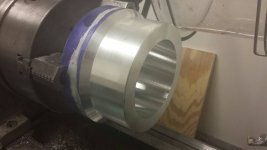
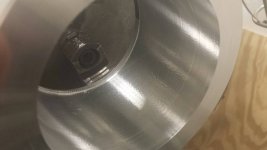
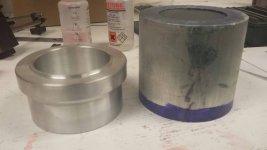
Turning this piece at work. We'll boring the ID more specifically and cannot seem to get a good surface finish by doing so. Lathe is running at 450 rpm and I have tried a few boring bars with different radius inserts different angles, different feed speeds and different rpms. Any suggestions? The ID is 3.5" aluminum. I'm very close to where I need to be just want to take a finish cut to clean it up. The OD is 5.5" and cut like butter at same speed and looks good. uploadfromtaptalk1397005673733.jpguploadfromtaptalk1397005700025.jpg

Sent from my SCH-I545 using Tapatalk
 
To avoid these ads, REGISTER NOW!

OccupantRJ

Well-known member
Joined
May 15, 2009
Messages
10,906
Location
Eastern North Carolina
On a large bore I use a one inch diameter boring bar with the least overhang possible attached to the compound with a custom toolpost to help dampen the "diving board" quiver. I can't help with inserts, as I am old school and grind all my cutter profiles to suit myself. The bar I use clamps a standard 1/4" lathe tool bit as the cutter. Rigidity is the key. Low pressure air blown into the bore will help prevent chips tumbling around and affecting the cutting edge, causing surging at the cut.
 
Last edited:

zkling

Well-known member
Joined
Jan 23, 2007
Messages
16,939
Hard to see from pics, but it looks like you have a friction weld, rubbing possible chatter problem. Are you sure the only part of the boring bar contacting the cut is the cutting edge? I think you have an issue with tool setup.
 

OccupantRJ

Well-known member
Joined
May 15, 2009
Messages
10,906
Location
Eastern North Carolina
Boring bar is removing material from a concave surface. OD turning is removing material from a convex surface. Different clearance angles and reliefs needed between the two. Ponder on this a bit.
 

iajonesy

Well-known member
Joined
Feb 8, 2009
Messages
2,467
Location
Iowa
Could the boring bar be rubbing the surface under the cutter just a little. I've had that happen and it causes a rough surface finish.

Mike
 

A_Pmech

Well-known member
Joined
May 8, 2007
Messages
8,002
Location
IL
You have a boring bar chatter problem.

Things that will rectify the problem:

Reduce the speed and / or increase the feed rate.
Check that the boring bar is on center or slightly above center.
Use a larger diameter boring bar.
Change insert geometry to a positive finishing insert.
Change to an insert with the smallest nose radius.
Switch to a carbide shank boring bar.

Failing all of the above with the equipment you have on hand, drop carbide completely and switch to a boring bar with a dead sharp HSS tool with about a .020 nose radius.

It won't help the chatter, but a spritz of WD-40 will improve the surface finish at lower speed ranges.
 
Last edited:

coppersmith

New member
Joined
Dec 7, 2013
Messages
4
Location
nh
try feeding from the bottom out, instead of from face to bottom. or in other words instead of from right to left, try from left to right.
 

imperialman67

Well-known member
Joined
Sep 29, 2007
Messages
1,131
Location
Minnesota
Sometimes lightly laying a file the opposite way on the od of the part (the wooden handle) while boring will stop any vibration you might have. I do't know what inserts you have available , but I get great finishes on Aluminum with 1/64 radius Kennametal inserts
 

NASTYZEN

Well-known member
Joined
Jun 11, 2010
Messages
2,823
Location
St-Colomban,Que. Canada
I always perform the internal machining first, before the OD while there is lots of material. The thinner the wall thickens, the more the part is like a bell and resonates and makes the cutter chatter.
I'm making some shock mount ends now that are really thin walled that even the OD was chattering like crazy until I machined a plastic plug that I inserted in the pre bored hole to stop it from ringing like a bell while cutting the OD.
 

Kevin54

MEMBER EMERITUS
Joined
Jan 12, 2005
Messages
29,341
Location
Urbana, Ohio
Like Nasty, I always do the internal work first too. This leaves more meat for less chatter.

Some of your problem can be the aluminum. I would get the larges diameter boring bar that you can, raise the cutting edge of the tool above center. You can raise it an 1/8" above on a bore that size. Do not use a tool with too large of a radius on the edge, but you don't want a sharp tool either. Something as small as a .010 radius will leave a good finish.

And if you can't get a good finish feeding in, start at the inside and feed out.

And as I said, some aluminums will leave a finish like you are showing, only not quite as bad. The groove you see around the diameter about a third of the way in is where a chip got caught between the material and the boring bar. That's why at times I like to feed out instead of in. Less chance of a chip getting caught on a finish cut.

If you are down to where you only have a few thousandths left, feed from the inside out, and use some oil on the inside surface. Slow your feed and speed way down. I'd probably slow the speed down to somewhere around 200.

Worse case......leave about .001-.002 and finish things off with some scotch-brite to polish the surface up.
 
OP
W

white91formula

Well-known member
Joined
Dec 11, 2012
Messages
424
Location
Boston, MA
The groove you see around the diameter about a third of the way in is where a chip got caught between the material and the boring bar. That's why at times I like to feed out instead of in. Less chance of a chip getting caught on a finish cut.

That was actually from where i tried a different boring bar and did not take a full pass. I wanted to see if the surface finish was any different. It was slightly better but not much


As for inserts i am very limited here, but I had a slightly larger bar with smaller radius tip at home in my box of stuffs so i am going to try that today. I am going to try raising the bar up a but off of the center and slowing down the piece to around 200 and see where that gets me.

I definitely have a chatter problem and could not seem to kick it last night and i was getting frustrated so I stopped.

As for doing the internal work first I was not planning on even doing it last night i wanted to get the OD done on the side I did and then i was going to flip it and do the ID and then do the OD and face on the other side. I had it setup and saw I had some clearance so I started doing it.

As for the actual boring bar and the angle of it relative to the work piece what should i be looking at ?
 

NASTYZEN

Well-known member
Joined
Jun 11, 2010
Messages
2,823
Location
St-Colomban,Que. Canada
As a lube for Alu. half mineral spirits with oil or coolant works well to keep the Alu. from sticking to the tool.
Bummer your OD is already done..could always wrap some cardboard tight around the part to keep the chatter down. And tape it up for safety.
BUT USE CAUTION when you do this.
 
OP
W

white91formula

Well-known member
Joined
Dec 11, 2012
Messages
424
Location
Boston, MA
What's the condition of the machine?

its rough around the edges for sure. used well and not taken care of.


so i just tried my boring bar which is a 5/8 bar and still getting chatter. I adjusted the bar to 1/8 over the center line and tried feeding it by hand and with the auto feed. I also tried feeding it backwards from the bottom out. Nothing better as far as finish

I also tried slowing it down more and apparently the low gear selection on the lathe is locked up and wont work. So i am limited to 240rpm in the high gear. I am getting a good consistent string off of the cut, its not breaking up into chips but it is still not a good finish. WD40 did nothing for the finish and I dont have anything else available for lube/coolant

I actually have more material than i thought to remove as the ID is only at 90mm and i am going to 95mm so i do have some room to work with here for cuts.

Any other thoughts ?
 

Kevin54

MEMBER EMERITUS
Joined
Jan 12, 2005
Messages
29,341
Location
Urbana, Ohio
What type of aluminum are you making the piece out of? I'm guessing by the looks it's 6061-T6? It looks like you have things beefy enough that you aren't getting the chatter that really screams a high pitch. A lot of times, a hard alloy will give you what you are showing. And at times it takes some experimentation to figure things out. And to try and analyze a problem like that over the web is hard, without seeing things in person, or hearing what everything sounds like in person.

Hopefully, you still have enough material to make a couple of adjustments before you get down to the final ID that you need.

I would definitely move your tool up above centerline, use a little lube, slow your speed down, slow your feed down, feed from left to right, and have a slight radius on the tip of your tool.

attachment.php
 

Attachments

  • lathe.jpg
    lathe.jpg
    74.5 KB · Views: 460

Kevin54

MEMBER EMERITUS
Joined
Jan 12, 2005
Messages
29,341
Location
Urbana, Ohio
its rough around the edges for sure. used well and not taken care of.


so i just tried my boring bar which is a 5/8 bar and still getting chatter. I adjusted the bar to 1/8 over the center line and tried feeding it by hand and with the auto feed. I also tried feeding it backwards from the bottom out. Nothing better as far as finish

I also tried slowing it down more and apparently the low gear selection on the lathe is locked up and wont work. So i am limited to 240rpm in the high gear. I am getting a good consistent string off of the cut, its not breaking up into chips but it is still not a good finish. WD40 did nothing for the finish and I dont have anything else available for lube/coolant

I actually have more material than i thought to remove as the ID is only at 90mm and i am going to 95mm so i do have some room to work with here for cuts.

Any other thoughts ?

You posted while I was making my reply. If you are getting a constant long shaving off of the piece, then you are not having chatter, and you are now dealing with the characteristics of the material itself. If you were getting chatter, you would not have a long strand of material coming off of the part, and would end up with finer chips.

How much material do you have to play with before you get down to your final ID? Man, it's hard to do over the internet. :lol: Can you take a pic of your boring bar setup and post it?

You will need a very sharp tool. When problems like what you are having comes along, I like to start out with a new tool, then if you are using carbide, ever so slightly take a diamond hone and just breaks the sharp nose of the tool.

If you can, post a pic of your setup, and that may help us on this side of the fence to better make a recommendation.
 
OP
W

white91formula

Well-known member
Joined
Dec 11, 2012
Messages
424
Location
Boston, MA
You posted while I was making my reply. If you are getting a constant long shaving off of the piece, then you are not having chatter, and you are now dealing with the characteristics of the material itself. If you were getting chatter, you would not have a long strand of material coming off of the part, and would end up with finer chips.

Thats why i was confused. i can hear some noise when its cutting but its getting a good string. Surface finish is as if it is chattering. The whole piece was extruded OD and ID so i wonder if it has some surface hardening from the extrusion process i havent gotten through yet.

How much material do you have to play with before you get down to your final ID? Man, it's hard to do over the internet. :lol: Can you take a pic of your boring bar setup and post it?

The ID is at 90mm right now and I need to go to 95mm so I have some room to go with.


You will need a very sharp tool. When problems like what you are having comes along, I like to start out with a new tool, then if you are using carbide, ever so slightly take a diamond hone and just breaks the sharp nose of the tool.

If you can, post a pic of your setup, and that may help us on this side of the fence to better make a recommendation.

I am limited to what I had at home and not much more. The shop at work is well less than equipped so i am trying to make due with what I have.

The part that kills me is that i got such a good cut/finish on the OD at the same speed.
 
To avoid these ads, REGISTER NOW!

A_Pmech

Well-known member
Joined
May 8, 2007
Messages
8,002
Location
IL
Just for shits and giggles, choke up on that boring bar until you only have about an inch sticking out of the toolholder and take a test cut.

:)
 

Kevin54

MEMBER EMERITUS
Joined
Jan 12, 2005
Messages
29,341
Location
Urbana, Ohio
Thats why i was confused. i can hear some noise when its cutting but its getting a good string. Surface finish is as if it is chattering. The whole piece was extruded OD and ID so i wonder if it has some surface hardening from the extrusion process i havent gotten through yet.

The ID is at 90mm right now and I need to go to 95mm so I have some room to go with.

I am limited to what I had at home and not much more. The shop at work is well less than equipped so i am trying to make due with what I have.

The part that kills me is that i got such a good cut/finish on the OD at the same speed.

Just for shits and giggles, choke up on that boring bar until you only have about an inch sticking out of the toolholder and take a test cut.
:)

The reason you got a better cut on the OD is due to your tool being way more rigid than the boring bar you are using for the ID.

As AP says, (and if I figured correctly, you have about .020 left to play with), shorten up your boring bar, and feed from right to left. If it leaves you with a good surface finish, then you are going to need some beef to your bar, or find another beefier boring bar.

Your piece looks like it has adequate meat to it, so you shouldn't be getting any harmonics out of it to cause your problem. It has to go back to your boring bar setup. I'd still like to see a pic of the tooling setup to see if that nails it down to your problem.

And there are just some aggravating issues at times, that the more you try to figure them out, the worse things seem to get. Walk away, come back a couple hours later, and things may be fine. :lol:

One other thing to try.......snug up your gibs a little. By that, I mean that if you can, snug up any saddle or compound locks that you may have. Not tight, but just enough that you still have travel in the saddle, and you can lock the compound a little tighter. If you have an older lathe that has some wear and tear on it, by snugging things down, it may take out any up and down movement you may have where the gibs are worn in the saddle and compound.
 
OP
W

white91formula

Well-known member
Joined
Dec 11, 2012
Messages
424
Location
Boston, MA
here is the setup, what angle should i be looking for on the bar relative to the part.

the bar on the tool post in the picture is 5/8 that is the biggest i have. The other picture has 1/2 bars.

i have no tried the 1/2 bar with the really pointy insert yet.

I also got low gear freed up and working so I can get it to spin slower around 200 rpm if needed.
 

Attachments

  • 20140409_135307.jpg
    20140409_135307.jpg
    135.6 KB · Views: 35

A_Pmech

Well-known member
Joined
May 8, 2007
Messages
8,002
Location
IL
Your boring bar is too small in diameter and you have WAY too much of it cantilevered out of the tool holder per that photo.

If I were you, being stuck with what you have available, I would use your biggest bar and pull it up into the tool holder until you can turn about 1/4" deeper than half the depth of the part. Bore it to 1/8" past half-depth and then flip it in the chuck, indicate it in and bore the other half to depth.

Generally, the boring bar should be parallel with the axis of the lathe.
 
OP
W

white91formula

Well-known member
Joined
Dec 11, 2012
Messages
424
Location
Boston, MA
Your boring bar is too small in diameter and you have WAY too much of it cantilevered out of the tool holder per that photo.

If I were you, being stuck with what you have available, I would use your biggest bar and pull it up into the tool holder until you can turn about 1/4" deeper than half the depth of the part. Bore it to 1/8" past half-depth and then flip it in the chuck, indicate it in and bore the other half to depth.

Generally, the boring bar should be parallel with the axis of the lathe.

I will give that a shot. I originally had it parallel with the lathe but changed it to try and fix the issue i was having with the surface finish.

will report back
 

A_Pmech

Well-known member
Joined
May 8, 2007
Messages
8,002
Location
IL
Remember:

If it chatters you can always reduce speed and / or increase feed rate. Start by reducing speed.
 

Kevin54

MEMBER EMERITUS
Joined
Jan 12, 2005
Messages
29,341
Location
Urbana, Ohio
First off, your tool is hanging out too far. (Lord I'd like to be told that on a daily basis) Shorten up the tool so you have just enough to reach your depth needed on your part. Second...straighten up the tool and toolholder. Clock it around counter-clockwise so you are just a tick more than your bar being parallel to your part. That doesn't sound right.

Set your boring bar parallel to the outside of your part, then move it counter-clockwise, maybe one or two degrees. The way the boring bar is made, even setting parallel with the boring bar, neither cutting surface of the insert will be parallel. You will have a slight angle each way.

Once you have the toolholder and boring bar set, then raise the boring bar up above centerline somewhat. Then set the boring bar so that it just reaches the depth that you have to go, plus a few thousandths clearance so the toolholder doesn't hit your part.

It's hard to tell by the pic, but if you JUST HAPPEN to have a diamond hone, dress the point of the tool so you have a couple thousandths radius if you are using a sharp, zero radius insert.

Add a little oil, and by all right, you should get a good finish. From what I can see of the pic, it just appears the tool is out too far. Plus the more of an angle you have, the further the tool has to stick out. The loser it is to parallel to the part, the shorter it will be.
 

Kevin54

MEMBER EMERITUS
Joined
Jan 12, 2005
Messages
29,341
Location
Urbana, Ohio
Your boring bar is too small in diameter and you have WAY too much of it cantilevered out of the tool holder per that photo.

If I were you, being stuck with what you have available, I would use your biggest bar and pull it up into the tool holder until you can turn about 1/4" deeper than half the depth of the part. Bore it to 1/8" past half-depth and then flip it in the chuck, indicate it in and bore the other half to depth.

Generally, the boring bar should be parallel with the axis of the lathe.

The bad thing with that is that if the lathe is worn like he says, he's running a three jaw chuck, so he may be stuck with things running out of round. It makes it hard to indicate.

I imagine you have about the same feeling that I do......we can't get to physically touch the handles, wrench, and part. :spit: We do agree on a lot of the problem though :thumbup:
 
Last edited:
OP
W

white91formula

Well-known member
Joined
Dec 11, 2012
Messages
424
Location
Boston, MA
The bad thing with that is that if the lathe is worn like he says, he's running a three jaw chuck, so he may be stuck with things running out of round. It makes it hard to indicate.


That is exactly what i am worried about when i flip the part which is why i was trying to bore the entire thing at once.

I will straighten it back up and give it a pass or two and report back.
 

NASTYZEN

Well-known member
Joined
Jun 11, 2010
Messages
2,823
Location
St-Colomban,Que. Canada
yeah, that boring bar is too small.
I've cheated before by cutting off the business end of a 5/8th boring bar and welding it to the largest piece of metal that would fit in my holder.:evil:
No more chatter from that bad boy.
 
OP
W

white91formula

Well-known member
Joined
Dec 11, 2012
Messages
424
Location
Boston, MA
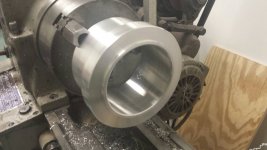
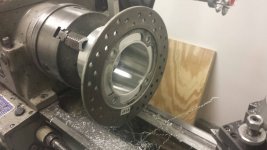
Well guys I ended up straightening the bar and shortening it up. Slowed the machine down to 200 and then 140rpm. The finish got better but not great. I was OK with it though and ended up finishing the part. Here is the finished product... Well lathe wise anyways. Still need to drill some holes in the end to bolt a rotor on and to bolt it to my bike

Enjoy and thanks everyone for your help and insight. uploadfromtaptalk1397087720628.jpguploadfromtaptalk1397087743876.jpguploadfromtaptalk1397087764133.jpguploadfromtaptalk1397087777990.jpguploadfromtaptalk1397087791892.jpg

Sent from my SCH-I545 using Tapatalk
 

bullnerd

Well-known member
Joined
Sep 17, 2012
Messages
5,690
Location
Jersey
If the headstock bearings are shot, try flipping your tool over and cutting on the "backside".

Hard to tell from the pics but the machine looks plenty beefy to do the job.

Woops...too little too late!
 
Last edited:

neufab

Member
Joined
Aug 8, 2011
Messages
13
is the lathe level? any twist in bed ways? with incerts higher speeds and wd40 get me a good finish and short as possible on boring bar
 

Steinmetz

Well-known member
Joined
Oct 11, 2012
Messages
2,274
Location
Washington State
You have a boring bar chatter problem.

Things that will rectify the problem:

Reduce the speed and / or increase the feed rate.
Check that the boring bar is on center or slightly above center.
Use a larger diameter boring bar.
Change insert geometry to a positive finishing insert.
Change to an insert with the smallest nose radius.
Switch to a carbide shank boring bar.

Failing all of the above with the equipment you have on hand, drop carbide completely and switch to a boring bar with a dead sharp HSS tool with about a .020 nose radius.

It won't help the chatter, but a spritz of WD-40 will improve the surface finish at lower speed ranges.

Agree it's tool chatter. More rigidity will definitely reduce it.
 
To avoid these ads, REGISTER NOW!
Top Bottom