To avoid these ads, REGISTER NOW!

Lathe tooling Storage Ideas wanted please.

BRENT in 10-uh-C

Well-known member
Joined
Jan 28, 2006
Messages
212
Location
Tennessee
I have a SB 16x60 lathe that is located in the middle of a shop bay about 8' away from the metal cabinet that I have been storing the tooling in. Does anyone have some ideas on a storage board that I can mount on the 'backside' of the machine where I can place certain items ( dial indicators, Q/C Tool Holders, inserts, insert screw wrench, etc. ) that I use which might help "uncluttered" my chip tray. Any pictures or thoughts that would help me? Thanks!


(If there is a thread or two here on this already, please point me to them because I only found the one from 2011, and apparently there are some pictures missing from that thread??)
 
To avoid these ads, REGISTER NOW!

Troutsqueezer

Well-known member
Joined
Apr 24, 2014
Messages
236
Location
I think it's called California, land of Prii
It is suggested in various machining forums to not place your tooling racks/shelves on the back side of the lathe to eliminate the chance of you ever leaning over the machine while it is running to grab something. Yup, some people have died trying as their clothing/hair/jewelry etc. gets caught in the spinning workpiece/chuck. Still, some folks do it anyway...
 

torched

Well-known member
Joined
Feb 20, 2013
Messages
49
Location
Colorado
It is suggested in various machining forums to not place your tooling racks/shelves on the back side of the lathe to eliminate the chance of you ever leaning over the machine while it is running to grab something. Yup, some people have died trying as their clothing/hair/jewelry etc. gets caught in the spinning workpiece/chuck. Still, some folks do it anyway...

X2 - one of the goriest pictures I ever had the displeasure of seeing was a guy that got caught in a large lathe, lets just say there wasn't much left above the chest.
 

TheBadDog

Well-known member
Joined
Dec 9, 2012
Messages
112
Location
Phoenix
I have a 17x60. I have several main solutions.

First, for "at hand" tooling while working on a project, I built an articulated arm with shelves. I put a 1.75 x 0.125 pole (left over roll bar material) up the back side of the lathe. Bottom sits over an adjuster head, midway up it ties to a convenient bolt. The top has a bronze top-hat thrust bearing. The elbow and wrist are the same, going up from the "wrist" is a spindle. The main tray is fixed on the forearm and about 20" x 10", that's where my bigger stuff goes. "Alan Wrenches", chuck key, lathe *******, extra drill chucks, etc. Above that is an old commercial pizza pan. Hub is lathe made with ball thrust and UHMWPE axial bearings (smooth). My DTI, micrometer(s), machinist square, etc live there. Above that on another hub is a 4 leg 8 place quick change tooling rack to keep the blocks used for the current project at hand and out of the way. With the articulated arm, the shelves are conveniently located where ever I am. Folded up on itself completely, the shelving stack sits right above the headstock. The DRO head is on a smaller similar arm. I have a very similar setup for the mill that incorporates R8 collets and tooling, and where the DRO is on the end of the main shelf where it is always convenient for whatever end of the table I'm working.

My main tooling block storage is a 2x6 mounted at ~15* kicked out from the wall on the bottom. 3/8" dowels slide into the CXA dovetails. Some are spaced wider for large boring bar blocks, multi-tool blocks, etc.

I rarely need the full 60" between centers, so my biggest chucks set at the tail end on cradles made from 2x4 scrap, and holding the chuck aligned for the spindle. All I have to do is bear hug them, and move them end to end. Lining up the spindle pins is automatic.

And finally I have a tooling cart that often gets loaded with whatever else I need to keep it at hand.
 
Last edited:

TheBadDog

Well-known member
Joined
Dec 9, 2012
Messages
112
Location
Phoenix
Not to be argumentative, but I've never understood the popularity of Kennedy boxes. When I worked in "engineering" (glorified draftsmen doing some design engineering) at a tool and die shop, if you didn't have a Kennedy box, you were probably an apprentice sweeping up chips. The only exception was my boss the lead "engineer" who had a knock-off Gerstner that he was inordinately proud of (for his drafting tools, calipers, MH, etc). I was the rebel with an inexpensive off-brand "machinists box", and I took no end of ribbing, but it served my modest needs. Anyway, no I lean hard toward Lista/Lyon/Vidmar. Snapon is nice, but IMO plays second fiddle to the true industrial storage solutions. Anyway, my tooling cart is also my small fixture table built from a scrapped small horizontal milling machine table. It weighs in about 400 lbs and also mounts my sky-hook in one of the t-slots. I've got Lista/Lyon/etc roll arounds, but they are far too heavy to roll conveniently. And again I'm the outcast using a pair of HF boxes for my "point of work" support boxes. These are roller slide and loaded with main go-to mechanic tools all laid out in a single ordered layer for easy access and identification of anything misplaced or missing. But I digress, not the current point of discussion. But of Kennedy boxes, I own not one and am well satisfied.
 

mtnwalton

Well-known member
Joined
Apr 25, 2010
Messages
210
In most machine shops of any size, boxes need to be mobile, bringing the tools to the machine. Kennedy's are the most prevalent because they hold up well in shop environments and their size makes navigating around easier. I used (still have) a 28" base cabinet and one of a couple wooden boxes on top.
 

MushCreek

Well-known member
Joined
Jan 14, 2015
Messages
9,763
Location
Upstate South Carolina
I fell for the Kennedy sales pitch years ago. My Harbor Freight box is much better because of the roller bearing drawers. I'm going to re-fit the Kennedy with roller drawer slides because I got no calls trying to sell it.

I would use a small rolling cabinet. You don't need a big honkin' mechanics tool chest. At 44", my HF box is a little big to be truly mobile. The 29" Kennedy was a handier size.

I've made tool holders for lathes before. I put pins on a board that hold the dovetail quick-change tool holders, and bored holes for collets. The actual cutters I keep in a cabinet unless in use.
 

WILD-BILL

Well-known member
Joined
Dec 10, 2011
Messages
873
Location
Brook Park Oh
Here's the tool holder I made for my lathe.....

toolholder_00009_zps05de2fc0.jpg


Dennis Leigh Henry

Well-known member
Joined
Apr 8, 2013
Messages
6,302
Location
South Central, IN USA
I'll ditto much of what has been said above. Safety is #1, always stop the lathe to reach over it to get anything, and untensioning the belt (with the lever) is a good practice to get into the habit of.

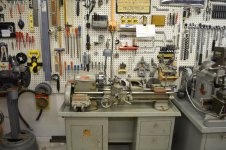
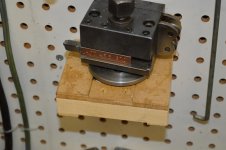
I'm presuming you've got a 16" tool room aka pedestal lathe (as opposed to the bench lathe I'm going to share a picture below). In high school, had mostly those style, a mix of 10" & 13". Most of the common tooling (e.g. the 3 and 4 jaw chucks, tool holders, collets, and so on) were at lathe side. The picture below shows the collet holder. Some of those lathes had a tray top instead of the collet holder w/ holes, so that worked pretty good. Also, the chucks / face plates were located on a post on the rear of the tail stock end leg, a good place to store the ones not in use.. it kept them clean and out of the way. Most of the less commonly used tools (knurling tool, boring tool, drill chucks, etc.) were in a tool crib / cabinet.

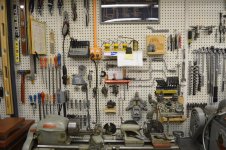
I've solved my situation with most things in the drawers inside the bench. I've see people adapt a simple craftsman tool box under their their chip tray to do something similar. I also have a number of items on the peg board behind mine.

I hope these ideas help you solve your current situation..

Dennis
 

Attachments

  • DSC_0021 small.jpg
    DSC_0021 small.jpg
    156.8 KB · Views: 947
OP
B

BRENT in 10-uh-C

Well-known member
Joined
Jan 28, 2006
Messages
212
Location
Tennessee
Thank you all. In the perfect world, I would just purchase a rolling tool cabinet but my real issue is space. In a 20x20 foot work area, I have this lathe along with a B/P Mill, a Kwik-Way Boring Bar & Stand, a Kwik-Way 090 Honing Machine, a Sunnen LBB hone, a Van Norman 570 Broach, a Kwick-Way Head Shop, a Valve Machine, a Kwik-Way Line Boring machine, a metal storage cabinet, and a 6' long assembly table. Adding to the clutter is half a dozen antique engines awaiting to be rebuilt.

I guess I was thinking I could empty a shelf or two in the cabinet by building a small wall on the backside. Maybe I can explore building an even smaller wall directly behind the headstock away from most of the moving parts?

Again, thanks for the hints & suggestions!
 

zmotorsports

ALLIANCE MEMBER
Joined
Oct 20, 2009
Messages
21,359
Location
Northern Utah
I fabricated a toolholder holder on my backsplash and there is a small shelf just above that where I keep some commonly used items such as cutting fluids, screw jacks, machinist handbook, collets and a few other small odds & ends. I also drilled two small holes into the shelf to put the torx handles for my insert toolholders and my chamfering bits so they within quick and easy reach.
2iihit3.jpg


Just across from my lathe, next to my milling machine I have a small moveable cart with a small toolbox on one side that contains assortments of end mills and other machining tools and the other half is my granite surface plate. It also has a small shelf under that where I keep my tap/die set, pin gauge sets and gauge block sets along with my 8" rotarty table and few other commonly used items so they are within quick and easy reach.

I keep my measuring devices such as calipers, micrometers, bore gauges and others in my actual toolbox which is only a few feet away.

I have many more pictures of my layout in my "shop projects" thread in my signature about page 2 or 3 is where some of the pictures of my machines start.

Mike.
 

Dennis Leigh Henry

Well-known member
Joined
Apr 8, 2013
Messages
6,302
Location
South Central, IN USA
Thank you all. In the perfect world, I would just purchase a rolling tool cabinet but my real issue is space. In a 20x20 foot work area, I have this lathe along with a B/P Mill, a Kwik-Way Boring Bar & Stand, a Kwik-Way 090 Honing Machine, a Sunnen LBB hone, a Van Norman 570 Broach, a Kwick-Way Head Shop, a Valve Machine, a Kwik-Way Line Boring machine, a metal storage cabinet, and a 6' long assembly table. Adding to the clutter is half a dozen antique engines awaiting to be rebuilt.

I guess I was thinking I could empty a shelf or two in the cabinet by building a small wall on the backside. Maybe I can explore building an even smaller wall directly behind the headstock away from most of the moving parts?

Again, thanks for the hints & suggestions!

Sounds like your solution will be in a tool box of sorts (drawer style) bolted to the underside of the chip pan.. might make the most sense.

Good luck and we'd love to see some PICTURES! Sure sounds like a full / busy shop...

Dennis
 

Kevin54

MEMBER EMERITUS
Joined
Jan 12, 2005
Messages
29,341
Location
Urbana, Ohio
I fabricated a toolholder holder on my backsplash and there is a small shelf just above that where I keep some commonly used items such as cutting fluids, screw jacks, machinist handbook, collets and a few other small odds & ends. I also drilled two small holes into the shelf to put the torx handles for my insert toolholders and my chamfering bits so they within quick and easy reach.
2iihit3.jpg


Just across from my lathe, next to my milling machine I have a small moveable cart with a small toolbox on one side that contains assortments of end mills and other machining tools and the other half is my granite surface plate. It also has a small shelf under that where I keep my tap/die set, pin gauge sets and gauge block sets along with my 8" rotarty table and few other commonly used items so they are within quick and easy reach.

I keep my measuring devices such as calipers, micrometers, bore gauges and others in my actual toolbox which is only a few feet away.

I have many more pictures of my layout in my "shop projects" thread in my signature about page 2 or 3 is where some of the pictures of my machines start.

Mike.

Zee......What did you make that rail out of? Do you have a close up pic of it? I made a rail and mounted it to the front of my lathe to set my QC holders on, but I need to change it. Especially after knocking my large boring bar off and chipping the nose of it. :mad:
 

zmotorsports

ALLIANCE MEMBER
Joined
Oct 20, 2009
Messages
21,359
Location
Northern Utah
Zee......What did you make that rail out of? Do you have a close up pic of it? I made a rail and mounted it to the front of my lathe to set my QC holders on, but I need to change it. Especially after knocking my large boring bar off and chipping the nose of it. :mad:

Unitstrut bolted to the backsplash and then some aluminum bent up @ 90-degrees and bolted to the Unistrut using the spring nuts. The aluminum pieces are just the size that the toolholders will slip over them.

Unistrut and spring nuts bolted to the backsplash.
2i2o9d.jpg


Here it is mocked up picture on the bench (sorry a bit blurry).
54sygi.jpg


Close up of completed rack.
s6kco4.jpg


Hope that gives you a better idea of what I did Kevin.

Mike.
 
To avoid these ads, REGISTER NOW!

Kevin54

MEMBER EMERITUS
Joined
Jan 12, 2005
Messages
29,341
Location
Urbana, Ohio
Unitstrut bolted to the backsplash and then some aluminum bent up @ 90-degrees and bolted to the Unistrut using the spring nuts. The aluminum pieces are just the size that the toolholders will slip over them.

Hope that gives you a better idea of what I did Kevin.

Mike.

Yep......that explains it perfectly. That is going to be my next project for my lathe. One thing about this site, there is ALWAYS something to learn, and one is never too old to learn.

Thanks again. I love it!!!!! :thumbup::thumbup:
 

Kevin54

MEMBER EMERITUS
Joined
Jan 12, 2005
Messages
29,341
Location
Urbana, Ohio
I like this setup with the tools on the pegboard, but how do you keep oil and swarf from slinging all over the wall and hanging up on the tools?. Even with a backsplash on my lathe, running a three jaw chuck can at times grab a birds-nest and toss it over the backsplash and behind me. Plus I don't like having anything past arms reach, meaning I don't like to lean over a machine. Don't get me wrong, I'm not OCD about staying clean when working in a shop type atmosphere, but I can run a lathe or mill all day long and not get my clothes dirty. I've worked with ones that by the end of the day it looks like they had a wrestling match with the dirty machine, and the machine won. :lol:

And I have over the years personally witnessed 4 people get wrapped up or hurt pretty badly while leaning over. But everyone has different ways that they like to store their tools. I'm one that doesn't like a machine against a wall though, nor having tools behind a machine. For one, against the wall, makes it harder to clean.

And please don't take it the wrong way......I like your setup, even though not my preferred setup for me, but my main question is the oil and swarf getting all over the tools and wall with no backsplash. But it is a great setup. I think when I get my bumpout built, I am going to put some pegboard on a section of wall to get some of the larger tools out of my toolbox. One drawer of about 7 or 8 pipe wrenches that get used maybe once every two years is a waste of toolbox space, so pegboard would be ideal to hang them on.

attachment.php
 

zmotorsports

ALLIANCE MEMBER
Joined
Oct 20, 2009
Messages
21,359
Location
Northern Utah
Yep......that explains it perfectly. That is going to be my next project for my lathe. One thing about this site, there is ALWAYS something to learn, and one is never too old to learn.

Thanks again. I love it!!!!! :thumbup::thumbup:

No problem Kevin, I wish I could take full credit for it, however, I stole it from another site. Like you said, never too old, or too proud for that matter, to learn.

I like this setup with the tools on the pegboard, but how do you keep oil and swarf from slinging all over the wall and hanging up on the tools?. Even with a backsplash on my lathe, running a three jaw chuck can at times grab a birds-nest and toss it over the backsplash and behind me. Plus I don't like having anything past arms reach, meaning I don't like to lean over a machine. Don't get me wrong, I'm not OCD about staying clean when working in a shop type atmosphere, but I can run a lathe or mill all day long and not get my clothes dirty. I've worked with ones that by the end of the day it looks like they had a wrestling match with the dirty machine, and the machine won. :lol:

And I have over the years personally witnessed 4 people get wrapped up or hurt pretty badly while leaning over. But everyone has different ways that they like to store their tools. I'm one that doesn't like a machine against a wall though, nor having tools behind a machine. For one, against the wall, makes it harder to clean.

And please don't take it the wrong way......I like your setup, even though not my preferred setup for me, but my main question is the oil and swarf getting all over the tools and wall with no backsplash. But it is a great setup. I think when I get my bumpout built, I am going to put some pegboard on a section of wall to get some of the larger tools out of my toolbox. One drawer of about 7 or 8 pipe wrenches that get used maybe once every two years is a waste of toolbox space, so pegboard would be ideal to hang them on.

attachment.php

I like Dennis' set up as well but wondered myself how he keeps it so clean. I have a shelf and a few things over my backsplash but yes swarf gets tossed behind my lathe and I have to sweep it out once a month or so during a "deep cleaning session". I also have a window which would make a pegboard impractical over my lathe, but I sure do like the looks of it.

Mike.
 

Dennis Leigh Henry

Well-known member
Joined
Apr 8, 2013
Messages
6,302
Location
South Central, IN USA
No problem Kevin, I wish I could take full credit for it, however, I stole it from another site. Like you said, never too old, or too proud for that matter, to learn.


I like Dennis' set up as well but wondered myself how he keeps it so clean. I have a shelf and a few things over my backsplash but yes swarf gets tossed behind my lathe and I have to sweep it out once a month or so during a "deep cleaning session". I also have a window which would make a pegboard impractical over my lathe, but I sure do like the looks of it.

Mike.

Kevin / Mike..

Thanks for the comments.. and of course no offense what so ever to questions, comments, rants, raves, etc.. :thumbup:

I make it a point to clean up well after the job is done. I rarely walk away once I'm done machining and at least put the birds nest chips and the majority of the chips, etc. that get caught in the chip pan in the trash can. I do regularly sweep with a shop vac, the lathe itself as well as the parts behind it. This is in the basement of my house, so I don't get overly carried away with tons of machine style work for profit.. mostly tinkering and finer machine / tool maker types of work on a one off or project by project basis.

When it comes to oil and gunk, I wear a shop apron if I get serious.. .. I'll have to take a close up, I'll bet you a coffee in Greenwood IN that there are at least one "chuck oil track" on the peg board... I've had it up and down my clothes, face, etc. over the course of time.. I stay aware of it, but occasionally do it myself. Other than that.. its a habit I've developed and have carried with me from my high school mentor.. outlined below. I'll take the camera and see if I can see any remnants later on today and post them..

When I was in high school, the machine shop teacher (Tom Berry / South Bend John Adams) was very **** about any tooling adjustments of any sort with the lathe on. He actually would chew on you if you didn't have the belt release lever loose; a secondary protection. We had 13" and 10" pedestal lathes back to back, so being aware of your surroundings and those of the others machines around you; as they were a constant reminder to be super safe. Someone left a part loose in a Hardinge lathe we had (we called it a speed lathe, and used it for polishing mostly). It had a lever style locking collet, and someone launched a part out of it and it broke the class room glass. That kid was never welcomed back to the machine shop.. Needless to say, accidents were extremely rare. No horse play at all was tolerated..

He was also a stickler for keeping a machine clean, adjusted, and oiled properly. Each Friday, the senior level vocational class was to take half the period and each one of us had to clean the lathe with a clean rag, top to bottom, and oil the ways, oil the cups, and do PM on the chucks, face plates, dogs, tool holders, etc. etc. That really drove some craftsmanship and machine care into our training.

I've broken a Monarch 10EE while in college, because I was careless with a chuck key in the 3 jaw..plus the spindle control mechanism was sloppy and did not detent properly...and that still has me super cautious around any machine tool. I also saw a kid who had his left arm broken 27 individual bone breaks as his long sleeve shirt got tangled in a LaBlond 10" gear head lathe.. It coasted to a stop and didn't stop or care there was an arm caught in the business end of the chuck... I didn't see the event, but I did see the cast this cat sported for about 4 months..and it sent a tingle up my spine every time I saw him.
 

Kevin54

MEMBER EMERITUS
Joined
Jan 12, 2005
Messages
29,341
Location
Urbana, Ohio
Kevin / Mike..

When I was in high school, the machine shop teacher (Tom Berry / South Bend John Adams) was very **** about any tooling adjustments of any sort with the lathe on. He actually would chew on you if you didn't have the belt release lever loose; a secondary protection. We had 13" and 10" pedestal lathes back to back, so being aware of your surroundings and those of the others machines around you; as they were a constant reminder to be super safe. Someone left a part loose in a Hardinge lathe we had (we called it a speed lathe, and used it for polishing mostly). It had a lever style locking collet, and someone launched a part out of it and it broke the class room glass. That kid was never welcomed back to the machine shop.. Needless to say, accidents were extremely rare. No horse play at all was tolerated..

He was also a stickler for keeping a machine clean, adjusted, and oiled properly. Each Friday, the senior level vocational class was to take half the period and each one of us had to clean the lathe with a clean rag, top to bottom, and oil the ways, oil the cups, and do PM on the chucks, face plates, dogs, tool holders, etc. etc. That really drove some craftsmanship and machine care into our training.

I've broken a Monarch 10EE while in college, because I was careless with a chuck key in the 3 jaw..plus the spindle control mechanism was sloppy and did not detent properly...and that still has me super cautious around any machine tool. I also saw a kid who had his left arm broken 27 individual bone breaks as his long sleeve shirt got tangled in a LaBlond 10" gear head lathe.. It coasted to a stop and didn't stop or care there was an arm caught in the business end of the chuck... I didn't see the event, but I did see the cast this cat sported for about 4 months..and it sent a tingle up my spine every time I saw him.

A very good teacher indeed :thumbup: Just something about a clean machine shows that a person takes care of things, plus they just seem to run better too.

I have a BIL that is married to my sister. He has a paralyzed arm, walks with a limp, and actually can barely walk today (he's in his late '70's) because of a faulty lathe and the tooling for the lathe. This was many years ago when I was little, and the shop was aware of the tooling and the part. If the part happened to come loose, move out of the way. Well the part came loose and hit him in the head. It took a few years of therapy just to learn to walk and talk again, bet he never did gain the use of his arm back. Back then, you didn't get squat out of a company. Today, he would be a millionaire probably. Sadly, the older he gets, he is deteriorating faster than he should be.

And as far as leaving a chuck handle in a chuck. Many have done it, many will continue to do it, and I hope the ones that do are lucky. If a handle happens to be in the chuck of a larger lathe, and you use a R.H. switch, and your arm or hand is in the wrong place......it will not be good. Because the force that it can hit with, if your hand is on the edge of the bed could even possibly sever some digits. I cringe every time I see someone leave the chuck key in. I've witnessed it done too many times. I watched a fellow toolmaker take the spring off of the chuck key on a new lathe we had because it was a pain in the ***. It was only a day later I hear a big crash, and sure enough, he left the key in the chuck and turned it on. He didn't get hurt, but is sure gouged the bed of the lathe, snapped the handle, and ruined a brand new chuck. He learned his lesson. :scared::scared:
 

Dennis Leigh Henry

Well-known member
Joined
Apr 8, 2013
Messages
6,302
Location
South Central, IN USA
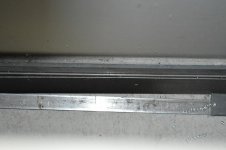
Finally took the time for a closer inspection.. I'm not the angle I alluded to above.. there are oil tracks and chips in places they shouldn't be. A little sweeper action and balance is restored. The last picture is from behind the lathe (flat stock storage too). So.. not a perfectly clean angle.. but close.. :lol_hitti

Dennis
 

Attachments

  • DSC_0006.jpg
    DSC_0006.jpg
    96.9 KB · Views: 65
  • DSC_0007.jpg
    DSC_0007.jpg
    106.3 KB · Views: 54
  • DSC_0008.jpg
    DSC_0008.jpg
    100.2 KB · Views: 48
  • DSC_0010.jpg
    DSC_0010.jpg
    123.6 KB · Views: 52

Rex_A_Lott

Well-known member
Joined
Jul 27, 2011
Messages
167
Location
Upstate South Carolina
Finally took the time for a closer inspection.. I'm not the angle I alluded to above.. there are oil tracks and chips in places they shouldn't be. A little sweeper action and balance is restored. The last picture is from behind the lathe (flat stock storage too). So.. not a perfectly clean angle.. but close.. :lol_hitti

Dennis
I really like the layout and neatness of this setup. Just an idea for you: It might be possible to mount an old-style pull-down window shade ( or projector screen or a big map etc) so that it could be pulled down to protect your tooling while working, and aid in the cleanup. Of course it might be more aggravation than it was worth, raising it up and down every time you changed a tool.
Thanks for the pics!
 

Scar55

Member
Joined
May 1, 2013
Messages
6
I was a machinist in the Navy. When I was in "A" school, they had a big chuck key on a chain that you would have to wear around your neck for the day if you were caught leaving a chuck key in the chuck.

Kelly
 

SM Racing

Well-known member
Joined
May 3, 2006
Messages
856
Location
Huntsville, AL
Here is mine. I reinforced the splash guard in the back and added the wooden shelf. Now I store all the tool holders, common allen wrenches, etc right where I need them.
 

Attachments

  • DSCN6524.jpg
    DSCN6524.jpg
    142.9 KB · Views: 100

E.Marquez

Well-known member
Joined
Jan 11, 2010
Messages
499
Location
Kempner Texas
Many of my indexable lathe tooling is on two sections of DIN rail.. this is for AXA QC sized tool holders.
The tool holder hangs perfectly on the rail.
I have a 2ft section mounted to the top of the machine for "in use" tooling..and two 4ft sections on the wall for other tooling.

Then a small off brand 5 drawl roller cab for mil tooling set up and hold down tooling, equipment, ect. Top of the roll cab is where tailstock, milling vice, 3 (or 4) jaw chuck sits when not in use.

Under the Machine on the left is a small 5 drawl 25" wide Craftsman tool box with the top removed. It is mounted on sides.
So the whole thing slides forward giving me access to the top space, and then the 5 drawls in the box slide out.
On the right under the machine is a large plastic cutting board drilled and milled to hold tooling, commonly used.. drill chucks, arbors, collets, chuck keys, ect ect. The board is mounted to full length sliders and so the whole board slides forward and out to access tooling.

Tooling, set up stuff, hold down fixtures and the like stored in cases are on the bottom shelf under the machine .

Measuring tools that are on MAG bases are "stuck" to the machine or roller cab.
Precision measuring tools commonly used are in two of the drawls in the undermachin box, the rest are in my main roller cab on the other side of the garage.
 

Dennis Leigh Henry

Well-known member
Joined
Apr 8, 2013
Messages
6,302
Location
South Central, IN USA
I really like the layout and neatness of this setup. Just an idea for you: It might be possible to mount an old-style pull-down window shade ( or projector screen or a big map etc) so that it could be pulled down to protect your tooling while working, and aid in the cleanup. Of course it might be more aggravation than it was worth, raising it up and down every time you changed a tool.
Thanks for the pics!

Good idea... I'll put that in my thinking cap...

Thx:rocker:
 
To avoid these ads, REGISTER NOW!
Top Bottom