
You are using an out of date browser. It may not display this or other websites correctly.
You should upgrade or use an alternative browser.
You should upgrade or use an alternative browser.
Lathe vs Mill
- Thread starter blaze_125
- Start date
speed bump
Well-known member
In a lathe the part is rotating, in a mill the part is stationary.
A mill can make asymetrical parts.
A mill can make asymetrical parts.
wbrian63
Well-known member
"In general" - a lathe rotates the part against a stationary cutting tool. A mill rotates the cutting tool against a stationary part.
The orientation of the various components is a variable, not a fixed value. A customer of mine has a lathe where the chuck sits horizontally and the tool post is vertical. (The chuck is 12 feet in diameter!). They also have a HBM (horizontal boring mill) where the tooling rotates horizontally, instead of vertically - you actually ride on the carriage that holds the tooling. It can mill an object 16 feet tall!.
The orientation of the various components is a variable, not a fixed value. A customer of mine has a lathe where the chuck sits horizontally and the tool post is vertical. (The chuck is 12 feet in diameter!). They also have a HBM (horizontal boring mill) where the tooling rotates horizontally, instead of vertically - you actually ride on the carriage that holds the tooling. It can mill an object 16 feet tall!.
"In general" - a lathe rotates the part against a stationary cutting tool. A mill rotates the cutting tool against a stationary part.
At the end of the day, can both machine get the same job done? On a small scale at least... If you could only have one... which one would you pick and why?
ironheadtom
Well-known member
At the end of the day, can both machine get the same job done? On a small scale at least...
No, the two go hand in hand. If you need to drill and tap holes in an odd shaped part, for instance, the mill would do it easily. If you wanted to machine a bushing ( again for instance) you would go to the lathe. If you are really talking a small scale, there are combo machines made by companies like Grizzly or Jet where you could do a little of both, but again on a small scale. Remember, though...you get what you pay for. For a home garage, I think I'd get a mill first because I just think you'd use it more. If you really want to get the most out of these things, maybe it would be wise to take a course on machining basics somewhere.
Last edited:
LoneGunman
Well-known member
If I could only have one it would be a lathe. You can get a milling attachment for a lathe, even though they are far from ideal. You cannot do what a lathe can do on a mill.
rsanter
Well-known member
I use my mill more than my lathe
you could mount a small chuck to the spindle of the mill to act as a small lathe
would be a little limited but you can do it
you can mount a table to the carrage of a lathe to make a small mill
would be a little limited but you can do it
bob
you could mount a small chuck to the spindle of the mill to act as a small lathe
would be a little limited but you can do it
you can mount a table to the carrage of a lathe to make a small mill
would be a little limited but you can do it
bob
ironheadtom
Well-known member
Oh oh. Here we go. Guess you'll have to get both!
Steve from Socal
Well-known member
While a mill may be very handy; in stuff like cars, motorcycles etc, a lathe has more direct application to things shafts and bushings. All precision machines trace their roots to the screw cutting lathe. While some CNC machining centers can do things like thread milling and O.D./I.D. boring a manual mill is less adaptable to turning work.
A mill can be one of several types of machines; vertical, horizontal or combination. The mill most people think of when you mill in garage settings is a Bridgeport. These are very handy machines but have several limitations. In any machine tool weight and mass are attributes that directly correspond to rigidity and performance. A mill like a Bridgeport J-head is a light milling machine, they work well with small cutters, light feeds and moderate cuts. The bigger machines of the same design are 1 1/2-3 times the mass of a Bridgeport.
A lathe is like a mill with small hobby or sizes up to battleship grade machines. A small lathe like a South Bend or Logan will do light work, a bigger heavier lathe will do much of what the little one does and have more power and mass to make heavier cuts on tougher materials.
Purchase prices are all over the place and space is a major consideration when thinking about machine tools. Space is perhaps the biggest issue for many because machinery can take up a lot of real estate. How much space do you have for machinery? This should be where you work backwards from. Then what do you envision doing? Then narrow down what kinds of machines you need and select a few makes and models to research. When buying any machine tooling is a major issue. New machines or used machines with no tooling end up costing far more than the sale price and you could easily spend the price of the machine on tooling.
There are no quick easy answers to should I buy a lathe or mill? Define what you want to do, decide if it is practical with your skill level, space and budget. If you have few skills take some classes at a Vo-tec or Community College before you make any choices to get an idea of this is for you or not. It takes dedication to learn the skills and become proficient let alone be safe. Don't waste you time and money on something that you are not at least safe to operate.
Steve
A mill can be one of several types of machines; vertical, horizontal or combination. The mill most people think of when you mill in garage settings is a Bridgeport. These are very handy machines but have several limitations. In any machine tool weight and mass are attributes that directly correspond to rigidity and performance. A mill like a Bridgeport J-head is a light milling machine, they work well with small cutters, light feeds and moderate cuts. The bigger machines of the same design are 1 1/2-3 times the mass of a Bridgeport.
A lathe is like a mill with small hobby or sizes up to battleship grade machines. A small lathe like a South Bend or Logan will do light work, a bigger heavier lathe will do much of what the little one does and have more power and mass to make heavier cuts on tougher materials.
Purchase prices are all over the place and space is a major consideration when thinking about machine tools. Space is perhaps the biggest issue for many because machinery can take up a lot of real estate. How much space do you have for machinery? This should be where you work backwards from. Then what do you envision doing? Then narrow down what kinds of machines you need and select a few makes and models to research. When buying any machine tooling is a major issue. New machines or used machines with no tooling end up costing far more than the sale price and you could easily spend the price of the machine on tooling.
There are no quick easy answers to should I buy a lathe or mill? Define what you want to do, decide if it is practical with your skill level, space and budget. If you have few skills take some classes at a Vo-tec or Community College before you make any choices to get an idea of this is for you or not. It takes dedication to learn the skills and become proficient let alone be safe. Don't waste you time and money on something that you are not at least safe to operate.
Steve
ironheadtom
Well-known member
Well said..
sawatch
Well-known member
I took evening, 2 nites a wk, machineing classes at the local Jr college for $150 a semester. Had the shop to ourselves, 5-6 old farts, and learned the basics and some cnc stuff. Well worth the time to really find out what each machine will do. I got a Grizzly 10x22 lathe and made/sold some projects & paid for it in just a few hours work. Then I made/sold some more stuff & paid for some really nice upgrades, quick chng tool post, live center, chuck, etc. A good mill that would do compairable work would cost 2-3x as much and you still would be better off getting a bigger/better one. And then add cnc = $$$$$!!
Last edited:
ZRX61
Well-known member
You can use a lathe to make another lathe... but you can't reproduce a mill with a mill 
mkdive
Well-known member
You can use a lathe to make another lathe... but you can't reproduce a mill with a mill
I have saw that quote many a times, for the most part I believe its true ...but some parts (the bed, carriage & compound for example) would be very hard to make on a lathe...at least for this hombre! Im not saying it couldn't be done.....just seems VERY difficult! When I first saw guys making cubes and square objects on a lathe....it blew my mind. Up until that point I assumed lathes produced round and cylindrical objects only.....not true!

Last edited:
jamesemery728
Well-known member
- Joined
- May 2, 2009
- Messages
- 961
I took evening, 2 nites a wk, machineing classes at the local Jr college for $150 a semester. Had the shop to ourselves, 5-6 old farts, and learned the basics and some cnc stuff. Well worth the time to really find out what each machine will do. I got a Grizzly 10x22 lathe and made/sold some projects & paid for it in just a few hours work. Then I made/sold some more stuff & paid for some really nice upgrades, quick chng tool post, live center, chuck, etc. A good mill that would do compairable work would cost 2-3x as much and you still would be better off getting a bigger/better one. And then add cnc = $$$$$!!
Just curious, what parts did you make and sell?
rsanter
Well-known member
You can use a lathe to make another lathe... but you can't reproduce a mill with a mill
why cant a mill make a mill?
bob
ironheadtom
Well-known member
You can use a lathe to make another lathe... but you can't reproduce a mill with a mill
I was wondering what you do for a living?
sawatch
Well-known member
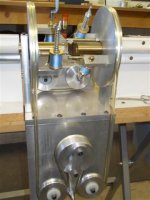
I made what is called a "four string binder" which is used to hold/bind together the splines of a bamboo fly rod section during glue-up. Pics are of the one I made in the class and was able to use aluminum & brass I could get thru the school for free, nuts & bolts from the True-Value. The ones I made to sell were fabracateded of different kinds of plastics, delren, polypropelene, hi mod eurathane, etc. to keep the cost under $400 ea. The aluminum ones woulda gone to the $1k mark. I didn't make much per hour but 5 units sold paid for the lathe. The machine rotates the spools to unwind the 4 threads around the rod shaft as its fed thru the center spindles horizontally wrapping in a spiral, two in one direction and the other 2 in the opposite direction. A unique machine for the craft of rodmaking.
Attachments


Last edited:
ironheadtom
Well-known member
Beautiful work, dude!
I made what is called a "four string binder"...
Great work, sawatch!
How does the feed mechanism work?
bsaint
Well-known member
Ign
Well-known member
My instructor taught me if you can only have one machine, a mill is the hands-down choice. You can turn ID's and OD's with a boring head. You can chuck up short pieces in a collet and clamp a cutting tool in the vise and use the quill feed to turn it down.
You can use a rotary table with tailstock to turn down longer shafts, you'd just have to crank the rotary table by hand and preferably have a power feed on the table.
That said you can also get milling attachments for lathes.
In the end both machines exist for a reason, and just having one makes for only half a machine as some people say. You can push these machines in unconventional ways, but it's a PITA to try to use a mill as a lathe or vise-versa. You wind up with a ton of setup time and possibly inferior results. It might fun if you're retired and bored.
I had a mill first and very much feel that would be the correct choice for anything but a driveshaft shop. However when I worked for a pipeline shop we had 5 lathes and one mill. We mostly made rings.
You can use a rotary table with tailstock to turn down longer shafts, you'd just have to crank the rotary table by hand and preferably have a power feed on the table.
That said you can also get milling attachments for lathes.
In the end both machines exist for a reason, and just having one makes for only half a machine as some people say. You can push these machines in unconventional ways, but it's a PITA to try to use a mill as a lathe or vise-versa. You wind up with a ton of setup time and possibly inferior results. It might fun if you're retired and bored.
I had a mill first and very much feel that would be the correct choice for anything but a driveshaft shop. However when I worked for a pipeline shop we had 5 lathes and one mill. We mostly made rings.
arkangel06
Banned
K.I.S.S If it comes out of a lathe its going to be round, with a mill it can be any shape.
sawatch
Well-known member
Great work, sawatch!
How does the feed mechanism work?
The strings are tied together and pulled thru the right spindle and hooked to a string that goes down the length of a trough & back to a pully/crank. Insert the blank from the left side, lay it on the strings, start cranking/wrapping then as the wraps are made the pulling string/crank is turned pulling/creating the spiral wrap. The trick is in the tension of the strings and consistant eveness of the pull. The tip width of the small end of the rod is .060 or less, made up of 6 sections, hand planed.
Last edited:
speed bump
Well-known member
why cant a mill make a mill?
bob
You can't cut threads on a mill.
Personally for 90% of what I seem to want to build that requires machine tools a lathe is needed and the other 10% a mill. I can get around a mill using other tools about 75% of the time so as it happens I am hunting a lathe. I probably wouldn't turn down a mill if I found one first though.
arkangel06
Banned
You can't cut threads on a mill.
Personally for 90% of what I seem to want to build that requires machine tools a lathe is needed and the other 10% a mill. I can get around a mill using other tools about 75% of the time so as it happens I am hunting a lathe. I probably wouldn't turn down a mill if I found one first though.
Once you buy a mill you will never want to use anything else.
rsanter
Well-known member
You can't cut threads on a mill.
Personally for 90% of what I seem to want to build that requires machine tools a lathe is needed and the other 10% a mill. I can get around a mill using other tools about 75% of the time so as it happens I am hunting a lathe. I probably wouldn't turn down a mill if I found one first though.
you can on a cnc mill
bob
The strings are tied together and pulled thru the right spindle and hooked to a string that goes down the length of a trough & back to a pully/crank. Insert the blank from the left side, lay it on the strings, start cranking/wrapping then as the wraps are made the pulling string/crank is turned pulling/creating the spiral wrap. The trick is in the tension of the strings and consistant eveness of the pull. The tip width of the small end of the rod is .060 or less, made up of 6 sections, hand planed.
Ahh! I see.
Bolster
Well-known member
I'm a long-time garage rat who's been taking courses in machining for a year, and I bought the mill first.
About 66% of the time I think I made the right decision on which to get first. About 33% of the time I am cussing it saying "Why aren't you a lathe?" and trying to figure out how to do lathing operations on my mill.
Item #2 is a metal bandsaw, then item #3 is a lathe. Item #4 is a surface grinder. Then I'm done. (I hope.)
I wish I knew why more makers don't combine a small mill and lathe so that you flop the mill on its side and it's a lathe, or stand the lathe on end and it's a mill. I know there are a couple machines out there that do this, but not many.
Most combo machines just add a mill head to a lathe, which (IMHO) just makes everything more constrained and difficult.
In general, ditto to everything LGN said above.
About 66% of the time I think I made the right decision on which to get first. About 33% of the time I am cussing it saying "Why aren't you a lathe?" and trying to figure out how to do lathing operations on my mill.
Item #2 is a metal bandsaw, then item #3 is a lathe. Item #4 is a surface grinder. Then I'm done. (I hope.)
I wish I knew why more makers don't combine a small mill and lathe so that you flop the mill on its side and it's a lathe, or stand the lathe on end and it's a mill. I know there are a couple machines out there that do this, but not many.
Most combo machines just add a mill head to a lathe, which (IMHO) just makes everything more constrained and difficult.
In general, ditto to everything LGN said above.
Nealcrenshaw
Well-known member
Don't limit yourself get both!!
ZRX61
Well-known member
I was wondering what you do for a living?
Mess about with old stuff
mkdive
Well-known member
Mess about with old stuff
(sorry its OT but)....
Yeah old cool stuff!!....BTW we had a B25 & B17 fly over our house yesterday and today. Can hear them a good 30 seconds before they fly over. Man I miss going to airshows on a semi regular basis.
Combo lathe/mill machines may warrant consideration if you're tight on money and/or space and are doing light work (no hogging cuts on steel)-- or come across a good deal.
Experienced machinists will dismiss them, but there are many satisfied hobbyists who are doing excellent work on them. Like all compromise machines, they shouldn't be expected to be as good as a dedicated lathe and/or mill.
Here are a few names:
Grizzly G4015Z Combo Lathe/Mill (and similar clones including HF)
Shop Fox
ShopMaster
Smithy (Midas or Granite)
Experienced machinists will dismiss them, but there are many satisfied hobbyists who are doing excellent work on them. Like all compromise machines, they shouldn't be expected to be as good as a dedicated lathe and/or mill.
Here are a few names:
Grizzly G4015Z Combo Lathe/Mill (and similar clones including HF)
Shop Fox
ShopMaster
Smithy (Midas or Granite)
ZRX61
Well-known member
(sorry its OT but)....
Yeah old cool stuff!!....BTW we had a B25 & B17 fly over our house yesterday and today. Can hear them a good 30 seconds before they fly over. Man I miss going to airshows on a semi regular basis.
Chino airshow is the weekend after next...
rsanter
Well-known member
I'm a long-time garage rat who's been taking courses in machining for a year, and I bought the mill first.
About 66% of the time I think I made the right decision on which to get first. About 33% of the time I am cussing it saying "Why aren't you a lathe?" and trying to figure out how to do lathing operations on my mill.
Item #2 is a metal bandsaw, then item #3 is a lathe. Item #4 is a surface grinder. Then I'm done. (I hope.)
I wish I knew why more makers don't combine a small mill and lathe so that you flop the mill on its side and it's a lathe, or stand the lathe on end and it's a mill. I know there are a couple machines out there that do this, but not many.
Most combo machines just add a mill head to a lathe, which (IMHO) just makes everything more constrained and difficult.
In general, ditto to everything LGN said above.
well, bolster
I have a lathe for sale
bob
wow, lots of information in here. Thanks alot.
Now my understanding is both machine will perform various operations using what looks like a simple drill bit. Is that it? Does it work because the bit spins faster than in a conventional drill, or does it work because the bit is actually way harder than a regular drill bit? Or maybe a combination of both?
Now my understanding is both machine will perform various operations using what looks like a simple drill bit. Is that it? Does it work because the bit spins faster than in a conventional drill, or does it work because the bit is actually way harder than a regular drill bit? Or maybe a combination of both?
Last edited:
hilld
Well-known member
......
Item #2 is a metal bandsaw, then item #3 is a lathe. Item #4 is a surface grinder. Then I'm done. (I hope.) .....
Famous last words and I have heard that before. You better hope your wife/significant other didn't read that statement.

Steve from Socal
Well-known member
wow, lots of information in here. Thanks alot.
Now my understanding is both machine will perform various operations using what looks like a simple drill bit. Is that it? Does it work because the bit spins faster than in a conventional drill, or does it work because the bit is actually way harder than a regular drill bit? Or maybe a combination of both?
A drill bit is one of many kinds of cutting tools. I would urge you to spend some time reading up on using machine tools and learn the basics of metal cutting. A shop class or two would help you understand the difference and give you a better perspective on what to use and when to use it.
It sounds like you don't have any familiarity with these tools and without any information on what you would like to do it is hard to make meaningful comments. What are your objectives with the machines you asked about?
Steve
It sounds like you don't have any familiarity with these tools and without any information on what you would like to do it is hard to make meaningful comments. What are your objectives with the machines you asked about?
Steve
That would be correct. I've seen them on TV, and in some online videos, but that's pretty much all I know about those tools.
Ultimate objective? I'd say a machine that can cut holes of various size, and also shape a peice that is not always cylindrical*sp?* or circular such as an exhaust flange. I often end up making stuff with a dremel type tool.
I'll also take the advise of looking into courses. I'm pretty sure the city must have something going on.
The choice was easy for me, Mill first, next a South Bend tool room lathe. With that said, I came across a shop that was closing his doors and was selling a nice bridgeport CNC mill with all sort of upgrades. His response to me saying my next purchase is a lathe, he asked why? Then proceeded to show me some of the stuff he made on the mill that usually would be done on a lathe. Since it's CNC, cutting a circle and threads is quite easy.
Bottom line if your gonna get one, get the other, they complement each other.
Bottom line if your gonna get one, get the other, they complement each other.
Attachments

Mickey_D
Well-known member
For the beginner I think that a mill is easier to use and do decent quality work with. The learning curve on a lathe is a little harder and without a mentor or good classes can be frustrating, especially on harder materials. As always steer away from cheap chinese junk and even old American iron if it is totally worn out, and be prepared to spend way more on tooling and accessories than the machines themselves.