To avoid these ads, REGISTER NOW!

lawnmower troubleshooting

rslaback

Well-known member
Joined
Jul 24, 2010
Messages
4,082
Location
Westcentral Wisconsin
I run a small engine side hustle.

2 things to share...

1. Put Stabil in every single can of gas when you buy it. It allows you to not worry about if this week be the last time you use it or not.

2. Cheap aftermarket carbs are a Godsend. Most of the engines I work on need carb cleans. I'll clean it once but if it's rusted or won't run right after a trip through the ultrasonic the engine gets a new cheapest one I can find on eBay or Amazon. I can't justify wasting time on a part that costs 10 bucks to replace. 50 to 75 carburetors in and I haven't been burned yet. Who do all you guys think make the OEM carbs?
 
To avoid these ads, REGISTER NOW!
OP
M

MerlinsBeard

Well-known member
Joined
Mar 27, 2020
Messages
398
Location
MD
So after this weekend, I mowed my lawn without the drive assist enabled and had no sputtering or stalling symptoms. I tried to use the drive assist on concrete and after 10 minutes could not induce the symptoms. It's only the combined drive assist and mowing grass that causes the intermittent stalling issues.

Pretty confident now the likely suspect is the drive assist transmission starting to go bad, possibly combined with belt wear. Feels like the lawnmower still has some life, so I'm going to pursue repair/replacement for the drive assist transmission.

Any one change out one of these transmissions? Is it particularly difficult or should I leave it to a shop? Usually I rely on youtube to demonstrate since I don't have good mechanical intuition, but this seems to be more rare for finding a video.
 

Mick56

Well-known member
Joined
Nov 11, 2015
Messages
558
Location
Janesville Wisconsin
Many mowers have a fine screen in the gas tank where the fuel outlet is. Maybe the screen is partially plugged, causing a lean condition under load. Empty the tank, and sometimes you can see the screen, blow backwards through it to clear.
 

rslaback

Well-known member
Joined
Jul 24, 2010
Messages
4,082
Location
Westcentral Wisconsin
I would not bet the issue is your drive transmission. Keep in mind that your drive assist uses power. If your engine is low on power it might mow without it fine or to work on an easier surface like concrete but not have the get up and go to handle mowing and driving on grass.
 
OP
M

MerlinsBeard

Well-known member
Joined
Mar 27, 2020
Messages
398
Location
MD
I would not bet the issue is your drive transmission. Keep in mind that your drive assist uses power. If your engine is low on power it might mow without it fine or to work on an easier surface like concrete but not have the get up and go to handle mowing and driving on grass.

Possibly, but there is hardly any forward momentum at all when engaging the drive assist on concrete, it doesn't even really "kick" the mower forward on concrete anymore when I engage. Engaging the drive assist still does make it noticeably easier to go up hills.

Beyond a carb cleaning, do you have other suggestions for troubleshooting? I verified constant fuel flow from the fuel line that doesn't taper off until the tank is empty. I haven't tried to check for any seal leaks. I don't have a method to measure "engine power", so how can I ascertain if it's producing "low" power?

The belt is in decent condition (not frayed), but probably worn from use. I could attempt to replace that first and see what that gets me. There's no maintenance information in the owner's manual about when to replace the belt. There is a "technical" manual that I could pay to download.

Is there a resistance to manually feeding the belt around the shaft that could indicate something is wrong? Appreciate any feedback, trying to learn.
 
OP
M

MerlinsBeard

Well-known member
Joined
Mar 27, 2020
Messages
398
Location
MD
Many mowers have a fine screen in the gas tank where the fuel outlet is. Maybe the screen is partially plugged, causing a lean condition under load. Empty the tank, and sometimes you can see the screen, blow backwards through it to clear.
I'll give this a try, thanks for the idea.
 

rslaback

Well-known member
Joined
Jul 24, 2010
Messages
4,082
Location
Westcentral Wisconsin
If it were in my shop, the next thing that I would do would be to buy a new aftermarket carburetor for it and put that on. Carbs can be very finicky to clean especially without the right tools and to me, this sounds like a plugged bypass circuit in the body of the carb.
 
OP
M

MerlinsBeard

Well-known member
Joined
Mar 27, 2020
Messages
398
Location
MD
So I have an update. Decided to try a aftermarket carburetor for the JS36 and I'm having issues. I decided to try for a cheaper version off amazon vs the oem part from john deere based on the reviews and price. The lawnmower seems to run except that it will cut out after some time and then refuse to pull start. There is a difference between the carburetors on the intake side where the aftermarket appears to be fully occluded but the John Deere oem is partially occluded.

The aftermarket carburetor I bought is a Hipa MIA11798 carburetor air filter tune up kit replacement for John Deere JS20 JS25 JS26 JS28 JS30 JS36 JS38 JM26 JM36 Mowmentum Walk-Behind Lawn Mower from amazon.

I have a couple pics of the original carburetor air intake vs the aftermarket carburetor. They look different from the front but identical when viewed from the rear.

When the lawnmower fails to pull-start with the aftermarket carburetor, if I remove the air filter and look at the intake, the intake looks fully occluded. If I open it and pull start, I can start the mower again, but it seems to be a matter of time until the engine stalls out. It doesn't do the sputtering thing like the old carburetor, just seems to spontaneously cut out. I made sure that everything is moving freely on the choke and governor, so I don't believe it to be a linkage install problem.

With the aftermarket kit, I did replace the o-ring and gasket on the back of the air intake. When I put the old carburetor back on, the symptoms still reappear though maybe anecdotally less frequently, so I don't believe it's caused by either of those components (o-ring or gasket).

I did blow back on the fuel line just to be sure there wasn't any fuel flow issue (seems fine to me). Fuel drains from the tank fine.

I could try to order the more expensive OEM carburetor from John Deere, but I don't know if I'll still be in the same predicament afterward.

I guess the main question is whether the air intake difference between the carburetors should matter. It seems like it does, and it makes sense that I don't have any starting issues with the oem carburetor due to more air. Most of the pictures that I see for MIA11798 online have fully occluded looking carburetors like the aftermarket picture. I haven't found any looking like the oem carburetor intake I have, which when closed still allows more air into the engine.

Is it possible to swap the intake valve from the oem to the aftermarket carburetor? I may give that a try if it makes sense to do so, if it's possible.

Any thoughts?
 

Attachments

  • oem carburetor.jpg
    oem carburetor.jpg
    320 KB · Views: 62
  • aftermarket carburetor.jpg
    aftermarket carburetor.jpg
    272.1 KB · Views: 61

nbpt100

Well-known member
Joined
Oct 19, 2016
Messages
2,301
Location
Massachusetts
Looks like you have a Ready Start Briggs engine. It has an automatic choke. The choke plate should be closed when the engine is cold. When the engine is warm it may be partially open and when hot fully open. It should also be fully open when it runs, regardless of its temperature.

In my experience slight differences in the choke plate have not mattered Compare the throat diameters. If they are different that may explain the choke plate differences. Double check that you installed it correctly. The choke plate should move by hand easily when you move the lever above it. Make sure nothing is jambed or dragging. As you pull start the engine, it should slightly open and once it catches it will fully open.

Reading through this thread I have been suspicious of several things

The governor is not set correctly or not operating correctly. The set up is easy to check. Check out YouTube for instruction. Did you confirm the RPM with a tachometer? I do not know about your JD but most 22" mowers are about 2800- 3000 RPM. I always set them on the high side.

Did you remove the fly wheel shroud and clean out any leaves and grass? Mice like to leave their junk inside of there. Any junk in there may mess with the auto choke lever. That will cause erratic running and lower power.

All above is relatively easy to do and do not cost anything. If you do not have a tach you can buy a cheap one on Ebay for about $12. The wire on it wraps around the spark wire.
 
Last edited:
OP
M

MerlinsBeard

Well-known member
Joined
Mar 27, 2020
Messages
398
Location
MD
Ok, been pondering about it and I think I have a possible deduction. I believe that the same symptom is causing the same behavior with both carburetors, but with different effects.

With the oem carburetor, the symptom is that I lose power some time after mowing. This is detected when I engage the drive assist.

With the aftermarket carburetor, the choke plate fully occluded the air intake. After 10 or so minutes after a cold start with the mower while using the drive assist, the lawnmower suddenly dies, no sputtering at all. Repeated attempts to pull start afterward all failed.

Removing the air filter to show the carburetor intake showed a fully closed choke. I had to manually open the choke to start the mower. What’s the difference, a cold start vs a hot start. Cold start allows for a closed choke and everything works fine. When the mower is hot, I believe the choke arm is being forced closed.

Going back to the oem carburetor, the choke profile does not fully occlude the air intake when closed. So even when the mower gets hot, the choke is pushed closed, but there is enough air to keep the mower going but not enough power to both mow and use the drive assist. I’m still able to restart the lawnmower after it stalls because even though the choke is closed, the oem is still letting enough air in.

I suspect that the choke arm is somehow controlled by a bimetallic thermostat that gets heated up from the muffler, and something in that mechanism is messed up where when the engine heats up, it’s forcing the choke closed.

It’s a bit too late for me in the weekend to test my hypothesis, but I think I’m getting close.
 

nbpt100

Well-known member
Joined
Oct 19, 2016
Messages
2,301
Location
Massachusetts
Remove the air filter so you can observe the choke plate. Start cold and let the mower run for a minute. Turn it off and see what the plate does. Start again and run for a few more minutes. At this point the choke should be fully open when you stop. You should get the same results with either carb. If one carb is running much leaner it may heat up the muffler (hence the bimetalic spring will open the choke faster) faster but you should see the same trend with both carbs.

There are videos that explain how to inspect the lever and bimetalic spring on You Tube. It may need to be adjusted or the spring mechanism may need to be replaced. You will have to remove the flywheel cover to do this and while you are at it you should blow out the air fins of any debris.

Did you check if the Governor is set up correctly?
 
OP
M

MerlinsBeard

Well-known member
Joined
Mar 27, 2020
Messages
398
Location
MD
I plan to give it another go this weekend. Been looking at tachometers and there's a lot to choose from. Any particular model you like?

I do usually clean out the flywheel area at the end of the season. I'm sure it's due for one right now.
 

nbpt100

Well-known member
Joined
Oct 19, 2016
Messages
2,301
Location
Massachusetts
I plan to give it another go this weekend. Been looking at tachometers and there's a lot to choose from. Any particular model you like?

I do usually clean out the flywheel area at the end of the season. I'm sure it's due for one right now.
Something like this is fine. There are lots to choose from on eBay. you do not have to make a permanent installation . Unless you want to. For about $10 more you can get a water proof one.

 
To avoid these ads, REGISTER NOW!

TobeyA

Well-known member
Joined
Apr 7, 2021
Messages
252
Location
TX
A handy tip is to get some stranded wire and remove the insulation then use one or several of the copper strands to clean jets and passages.
Copper is nice and soft so it won’t damage any jets.
I use copper wire also. But I mount the jet in my drill and spin it at a medium speed while using the wire.
 

nbpt100

Well-known member
Joined
Oct 19, 2016
Messages
2,301
Location
Massachusetts
I use copper wire also. But I mount the jet in my drill and spin it at a medium speed while using the wire.
This type of tool works well for some jets.

 
OP
M

MerlinsBeard

Well-known member
Joined
Mar 27, 2020
Messages
398
Location
MD
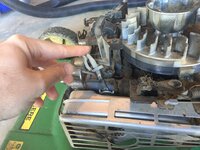
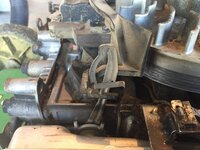
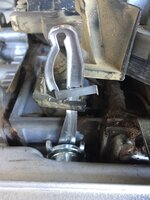
Ok, I got to the linkage and the issue is that the mechanism that’s supposed to open the choke actually doesn’t. The bimetallic arm moves but doesn’t actually push the choke arm open. I tested it by applying a heat gun to the muffler and the thermostat touches the choke arm but there’s not enough force to open it.

If I manually move things, it doesn’t feel like there’s much resistance. I cleaned the screw holding the choke arm in place, no change. Not sure what the next step is, but getting close.

Any ideas what’s causing the bimetallic arm not being able to move the choke arm? I already cleaned the choke arm screw, so I don’t believe that’s the cause.
 

Attachments

  • 3A4A109C-1B2D-4BB9-B8B7-5FB852D9C8E2.jpeg
    3A4A109C-1B2D-4BB9-B8B7-5FB852D9C8E2.jpeg
    791.2 KB · Views: 39
  • C9AD9050-1172-4295-9D1C-5D57B0CE52EB.jpeg
    C9AD9050-1172-4295-9D1C-5D57B0CE52EB.jpeg
    730 KB · Views: 33
  • 698D0616-FD49-470E-AA22-5EB1001CA35A.jpeg
    698D0616-FD49-470E-AA22-5EB1001CA35A.jpeg
    659.2 KB · Views: 34

nbpt100

Well-known member
Joined
Oct 19, 2016
Messages
2,301
Location
Massachusetts
Make sure the arm does not scrap against anything. i.e. the coil. If you have the original coil and arm you should be good. Replacement coils are sometime larger and can interfere. I have had case where there is an interference and I had to file some material off of the plastic arm to resolve it. If the arm is free to move but the bimetalic spring does not have enough force to move the arm I would replace it the spring. From your pictures it appears it is set up correctly. The bi-metalic spring may be damaged.
 
OP
M

MerlinsBeard

Well-known member
Joined
Mar 27, 2020
Messages
398
Location
MD
Right. I did confirm there's no scraping of the arm against anything. Everything seems to be moving normally. Going to try a new choke thermostat and see what happens.
 
OP
M

MerlinsBeard

Well-known member
Joined
Mar 27, 2020
Messages
398
Location
MD
I replaced the choke thermostat and tried out the mower. I think it did the trick. Ran for 2 1/2 hours while I mowed my lawn and my brother-in-law's to test and I had no issues using the drive assist the whole time.

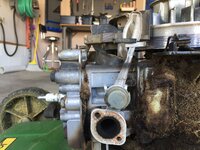
I did notice that the bum choke thermostat had noticeably more tension compared to the new thermostat when I compared moving the arm. You can see the little marks on the choke arm that the thermostat is supposed to sit between. I threaded the muffler bolts with the two gaskets on either side of the thermostat and tightened it back together.

I used the heat gun to confirm that the new choke thermostat actually moved the choke arm before I put it back together. Had to wait about 60 seconds with the heat gun for the thermostat arm to make contact, and another 30 seconds for the choke arm to start moving. I didn't have to make any adjustments to the thermostat as it looked identical to the old. I just needed to tighten the muffler back just right. Replacement part cost a little over $20. The instructions said to tighten the muffler bolts to 90 lb-in of torque. I only tightened the muffler tight enough and then backed it off so that one of the six sides of the hex bolt was in line with the bolt clamp tabs on the muffler.

The only quirk that I noticed after I put it back together is that the releasing the operator presence control bar didn't seem to extend all the way. When I released, it's like it would bounce out and then back halfway between holding it down and where it normally sits when you let go. The operator presence cable still seems to work, but I'm wondering if I missed something putting it back together. All the bolts went back in their respective slots from the flywheel shroud. The lawnmower still stops when I let go of the operator presence control bar, and the linkage looks normal. Maybe there's something that coincidentally just failed in the handle. Something to investigate in the off-season.

Thanks for all the support getting my mower back in service. This one was a challenge.
 

Attachments

  • IMG_1480.JPG
    IMG_1480.JPG
    601.8 KB · Views: 26
  • IMG_1479.JPG
    IMG_1479.JPG
    1.5 MB · Views: 19
  • IMG_1478.JPG
    IMG_1478.JPG
    608.6 KB · Views: 20
  • IMG_1477.JPG
    IMG_1477.JPG
    865.6 KB · Views: 19
OP
M

MerlinsBeard

Well-known member
Joined
Mar 27, 2020
Messages
398
Location
MD
Ok, so I've run into a recent issue where the lawnmower is starting to have issues again. At the beginning of this year I had the original carburetor with a new choke thermostat and everything was running good, but lately the lawnmower is starting to stall under load (with the pull assist engaged). Last year, when troubleshooting I bought a cheapo briggs and stratton carburetor for 15$ and when I installed it, everything ran fine until the 7 minute mark or so when the choke thermostat failed to open the choke plate.

I checked the choke plate and everything appears open. I figured my old carburetor was finally getting clogged down. I installed the new carburetor that worked fine last year, but this time when I installed, the engine would start and then stall and turn off in like 5 seconds. I repeated this several times with the same behavior. I removed the air filter to see the carburetor linkage, maybe I messed something up. This time, when I started the mower, the engine would run and stall in waves until it eventually gave up, maybe 5-6 times in a row. I don't think it's the carburetor or the choke thermostat this time.

The mower is 10+ years so fatigue issues may be starting to set in, e.g. the choke thermostat last year would no longer bend enough when exposed to heat to open the choke plate. I could try to replace springs to see if that helps. Any other suggestions?

I may be at a point where I get a new push mower, but I have a little sentimental attachment to it for some reason. If I do buy new, John Deere doesn't seem to be in the market, so what should I be going for? I don't mind investing in something awesome to use and easy to maintain.
 

The Cobbler

Super Moderator
Staff member
Joined
Oct 24, 2013
Messages
25,965
Location
Niagara Region, Ontario, Canada
sounds fuel related . first thing I would do is remove the choke set up and try running it manually . rig something up to work the choke manually .
is the bowl getting enough fuel, is the filter clogged. do you have water in the fuel, is it fresh fuel

Mine crapped out at the end of last year . wouldn't start for nothing. get looking at it this spring, take the bowl off, all is clean . has spark. didn't see anything obvious. put it back together, primed, pulled and forst or second pull it was running. still running fine. to this day I have no idea what went on with it .
 
OP
M

MerlinsBeard

Well-known member
Joined
Mar 27, 2020
Messages
398
Location
MD
If you stored it without Stabil the carburetor could be your problem again.

Lesson learned. I suppose emptying the bowl and shaking out the fuel isn't sufficient for storing a carburetor for re-use. I have a carb cleaning kit, so I can try that though maybe I'm better off just getting a straight up replacement since the cost is fairly low.

Adding stabil to my fuel storage routine.
 
OP
M

MerlinsBeard

Well-known member
Joined
Mar 27, 2020
Messages
398
Location
MD
I have an update. After getting a 2nd aftermarket carburetor and now using the lawnmower for three weekends without engaging the self-propel, I've had solid operation of the mower. The mower starts after one or two pulls. The aftermarket choke plate fully occludes the air intake, so I know the choke thermostat is doing its job opening the choke plate when the muffler gets hot. However, if I manually extend the choke thermostat arm and release it, the spring does not seem to fully close the choke plate to a fully closed position. Hasn't seemed to affect pull starts though. May consider replacing that spring.

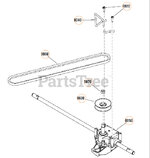
I'm pretty sure that one or more components of the self propel assembly is shot. I replaced the belt to see what would happen and engaging the self-propel puts a high enough load that it makes the engine start to stall after a few seconds. Releasing the self-propel immediately stops the engine stall. In past maintenance, I remember that I was able to rotate the belt through the pulley and it seemed like it worked fine with little resistance. I tried putting on a fresh belt replacement and it's challenging to rotate the belt through the pulley, with significant resistance that I remember in the past wasn't there. Perhaps the old belt had worn where it wasn't snug to the assembly, but with a new belt it's now evident that something in the self propel system is toast.

Trying to track down the components to the self propel system.

John Deere Transmission Drive Belt - GX23549 (just replaced)
John Deere Lawnmower Drive Pulley -
John Deere Transmission Assembly - GX24448
John Deere Wheel Gear - GX22849
John Deere Drive Gear - GX22858

I'm not sure if I should just replace all these parts wholesale. The big ticket item is the transmission assembly, and that's my top suspect right now. Hard to know how to confirm for sure. Take off blade and have the wife video while I tilt mower while engaging the self propel?

Anyone with experience in pushmower repair have thoughts?
 

Attachments

  • js36 transmission.jpg
    js36 transmission.jpg
    75 KB · Views: 5
  • js36 wheel assembly.jpg
    js36 wheel assembly.jpg
    224.3 KB · Views: 5

kbs2244

Well-known member
Joined
Nov 11, 2006
Messages
14,065
RE; the drive belts

You have to get the JD OEM belts
They are a special length and the wear adj. parts will not take up the difference with aftermarket belts
You will not need new springs, pulleys, etc. if you use OEM belts


On your running problems;

Are you sure you do not have any vacuum leaks
Fresh gaskets will take up the heat expansion differences between the carb and block
 
OP
M

MerlinsBeard

Well-known member
Joined
Mar 27, 2020
Messages
398
Location
MD
RE; the drive belts

You have to get the JD OEM belts
They are a special length and the wear adj. parts will not take up the difference with aftermarket belts
You will not need new springs, pulleys, etc. if you use OEM belts


On your running problems;

Are you sure you do not have any vacuum leaks
Fresh gaskets will take up the heat expansion differences between the carb and block

I'm pretty sure I bought OEM belt from the John Deere GX23549 Flat Belt (at least that's the part number advertised from my amazon history). I still have the old one and they appear quite similar side by side, though it's possible to get snookered from amazon.

I'm unsure how to check for vacuum leaks (uneven idling?). When I bought the aftermarket carburetor kit, it did come with an air filter gasket replacement and o-ring that I replaced. Granted it's purchased from a cheap-o amazon look alike and not a JD retailer, but seems like it's working at the moment.

I had issues last year where engaging the self propel would cause the engine to stall, though now with a new belt, the problem is much more pronounced. Could be more deterioration to the self propel causing it, or could be the belt.

With Honda retiring their gas mowers, I'm tempted to buy one for storage until I retire the JS36.
 
To avoid these ads, REGISTER NOW!
Top Bottom