
driftpin
Well-known member
Florida by the coast requires HVHZ (high-velocity, hurricane zone) rated construction. As Florida has 1350 miles (2170 km) of coastline, the most of any of the 48 contiguous states, that means any point on Florida is about 90 miles or less from the salt water. What does that mean? Hurricanes! So, you have very robust building codes.
I needed storage for tools and stuff that I wasn't going to put into off-site storage, too-expensive. So I chose to look at pre-manufactured storage and chose to buy a 10' X 20' X 8' ht steel-frame, 3/4" PT wood-sheathed, Hardi-board clad, standing seam roof building from Lark.
Lark is compliant with the State of Florida HVHZ requirement, and carries a 30 year guarantee. That means when I'm about to hit triple-digits, someone-else will deal with the warranty. Good-enough for me.
I could have gone the route to build something on-site, but that would probably require de-mucking and compacted soil from a depth of probably 9 ft. or some type of pilings. Florida does allow the installation of sheds and garages which are pre-manufactured, to be installed on slabs without pilings. I chose that route. If I was to build on my site, an engineering report said I would need compacted soil in lifts, or pilings, if I was going to construct a CBS garage. Termites are a problem, most homes are CBS because of that.
So my choice was the Lark Lumberjack http://www.larkbuilders.com/models/lumber-jack/
and I had poured a new slab to locate the building on it. I also had demolished an existing asphalt driveway, and replaced it in concrete. I requested a thickened edge (8") and a 6" field, WWM 6" X 6", and two pieces of #5 rebar in the thickened edge. The concrete was spec'ed at 3000 psi and fiber reinforcement.
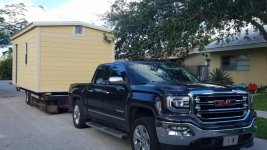
Today they delivered the garage, it's not yet secured to the slab, but it's here, and that's a good thing. The plan calls for 1/2" x 5" wedge-style machine screw anchors about 4 ft o.c., I'm waiting for the crew to finish.
The pre-manufactured unit was placed by a crane, they lifted it over the electrical service to the home, and set it onto the slab. My wife and I had spent awhile this morning before the delivery doing the snap-lines for the 2" X 6" PT footer wood plates that the walls sit-upon, onto the slab. My wife is an engineer, she's retiring this month after a 41+ year career and I'm very proud of her, she's a hard-working woman who made a successful career in a male-dominated field. We did the snap-lines to ensure the proper placement of the building, and the crane operator did a great job of placement.
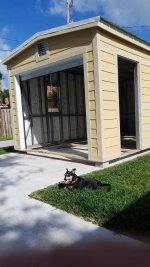
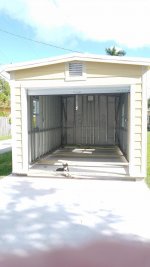
So, the hard work is done, and here are some pics of the process. I spec'ed it without their standard door, and gave them the specs for a standard door 36" X 80" rough-in, I'm installing myself a Masonite Impact-rated (HVHZ) fiberglass door.
The garage has an overhead roll-up door at one gable end, and two single-hung windows. Yesterday I bought at COSTCO the FEIT LED 4 ft. two-bulb luminaires, (four of 'em) which I'll install on the ridge beam area. It's just under 8 ft. 6 in. at the ridge.
I'm going to have installed a branch electrical panel, as this is a stand-alone building, and will be upgrading the house electrical panel and disconnect at the same time. The panel I'm planning to install for the stand-alone garage will probably be a 100 amp or 125 amp panel. I want to have space for a compressor, a mini-split AC, 220 V for my 12" radial arm saw and Powermatic 66 table saw, an outlet for a welder, plenty of duplex outlets and inside/outside lighting.
So the big steps were getting the slab ready, and getting the building on-site. Now it's time to do the other stuff, which will include insulating the walls and ceiling with polyisocyanurate insulation, I have room for 3-1/2", and sheathe the walls with 5/8" PT plywood, so I'll have plenty of versatility for whatever shelving I wish to install. As I accomplish things, I'll add to the thread.
I needed storage for tools and stuff that I wasn't going to put into off-site storage, too-expensive. So I chose to look at pre-manufactured storage and chose to buy a 10' X 20' X 8' ht steel-frame, 3/4" PT wood-sheathed, Hardi-board clad, standing seam roof building from Lark.
Lark is compliant with the State of Florida HVHZ requirement, and carries a 30 year guarantee. That means when I'm about to hit triple-digits, someone-else will deal with the warranty. Good-enough for me.
I could have gone the route to build something on-site, but that would probably require de-mucking and compacted soil from a depth of probably 9 ft. or some type of pilings. Florida does allow the installation of sheds and garages which are pre-manufactured, to be installed on slabs without pilings. I chose that route. If I was to build on my site, an engineering report said I would need compacted soil in lifts, or pilings, if I was going to construct a CBS garage. Termites are a problem, most homes are CBS because of that.
So my choice was the Lark Lumberjack http://www.larkbuilders.com/models/lumber-jack/
and I had poured a new slab to locate the building on it. I also had demolished an existing asphalt driveway, and replaced it in concrete. I requested a thickened edge (8") and a 6" field, WWM 6" X 6", and two pieces of #5 rebar in the thickened edge. The concrete was spec'ed at 3000 psi and fiber reinforcement.
Today they delivered the garage, it's not yet secured to the slab, but it's here, and that's a good thing. The plan calls for 1/2" x 5" wedge-style machine screw anchors about 4 ft o.c., I'm waiting for the crew to finish.
The pre-manufactured unit was placed by a crane, they lifted it over the electrical service to the home, and set it onto the slab. My wife and I had spent awhile this morning before the delivery doing the snap-lines for the 2" X 6" PT footer wood plates that the walls sit-upon, onto the slab. My wife is an engineer, she's retiring this month after a 41+ year career and I'm very proud of her, she's a hard-working woman who made a successful career in a male-dominated field. We did the snap-lines to ensure the proper placement of the building, and the crane operator did a great job of placement.
So, the hard work is done, and here are some pics of the process. I spec'ed it without their standard door, and gave them the specs for a standard door 36" X 80" rough-in, I'm installing myself a Masonite Impact-rated (HVHZ) fiberglass door.
The garage has an overhead roll-up door at one gable end, and two single-hung windows. Yesterday I bought at COSTCO the FEIT LED 4 ft. two-bulb luminaires, (four of 'em) which I'll install on the ridge beam area. It's just under 8 ft. 6 in. at the ridge.
I'm going to have installed a branch electrical panel, as this is a stand-alone building, and will be upgrading the house electrical panel and disconnect at the same time. The panel I'm planning to install for the stand-alone garage will probably be a 100 amp or 125 amp panel. I want to have space for a compressor, a mini-split AC, 220 V for my 12" radial arm saw and Powermatic 66 table saw, an outlet for a welder, plenty of duplex outlets and inside/outside lighting.
So the big steps were getting the slab ready, and getting the building on-site. Now it's time to do the other stuff, which will include insulating the walls and ceiling with polyisocyanurate insulation, I have room for 3-1/2", and sheathe the walls with 5/8" PT plywood, so I'll have plenty of versatility for whatever shelving I wish to install. As I accomplish things, I'll add to the thread.
Attachments
Last edited:

