To avoid these ads, REGISTER NOW!

LB concealed in a wall?

Zoggan

Member
Joined
Nov 20, 2011
Messages
19
Hey everyone, first post woohoo:) I am running 4 - 6 ga. THHN cables between the house and shop. I'm using 1 1/4" pvc. My question, is it OK to install an LB in my 2X6 house wall to make the turn to my main breaker panel in the house? The LB would get covered with sheetrock? There will NOT be a junction/splice in the cables at that point, it would just make it much easier to pull the cable not having to make that 90 degree turn.

Thanks!
 
To avoid these ads, REGISTER NOW!

rvcoaster

Well-known member
Joined
Nov 18, 2011
Messages
202
from what i understand you have to have access to the LB. i could be wrong but this is what my electrician told me.
 

PT Doc

Well-known member
Joined
Nov 12, 2010
Messages
3,197
If there is no splice then does it matter? Will an inspector suddenly appear out of no where and guess that something is covered behind the drywall. Now, if this is going to be inspected per dry walling, then ask the inspector if it could be covered.
 
OP
Z

Zoggan

Member
Joined
Nov 20, 2011
Messages
19
I figure if there's no splice it shouldn't matter, but I've been wrong about things like that before! Yes it will be inspected prior to sheetrocking and I'd rather not have to redo it if Inspector guy says no.
 
OP
Z

Zoggan

Member
Joined
Nov 20, 2011
Messages
19
No concealed LBs in a wall, either use a 90 bend or make access for it
Yeah that's why I asked. I'll just pull the cables without gluing the 90 on,
then slide the rest of the piping over and glue it.

Thanks!
 

Norcal

Well-known member
Joined
Mar 16, 2008
Messages
13,752
A LB buried in the wall is bad whether a inspector sees it or not, & being inspected or not should have no bearing on how the job is done, BTW have pity on the next guy doing work, it's no fun coming back where some doofus buried a box in the wall & there is a problem.:(:(:(
 

rvcoaster

Well-known member
Joined
Nov 18, 2011
Messages
202
i am working on a similar setup, an LB right under a sub panel. i am going to leave an access plate for it but it will be covered by said plate.

i dont see why you couldnt do this stylistically with drywall, just make a nice stylish plate for it and leave it at that.
 

VHF

Well-known member
Joined
Oct 27, 2008
Messages
420
Location
NW Wisconsin
Yeah that's why I asked. I'll just pull the cables without gluing the 90 on,
then slide the rest of the piping over and glue it.

Thanks!

Technically that's also a no-no, although I've seen licensed electricians do it. It is possible that the PVC glue could damage the insulation on the wire.

Any conduit run is supposed to be complete; then you pull the wires through. At least that's the theorey!
 

Charles (in GA)

Well-known member
Joined
Jan 11, 2006
Messages
12,489
Location
50 mi south of Atlanta
While not a junction in this case, it is impossible to pull additional wires or replace existing wires in the conduit, as it would be impossible to access the LB, that is the reasoning, even though there is no wire splices, as already noted, you need a complete conduit system that you can pull thru, and this prevents you from doing that.

If you have room, use a long sweep 90 or as others noted, put an access plate in the wall.

Charles
 

Charles (in GA)

Well-known member
Joined
Jan 11, 2006
Messages
12,489
Location
50 mi south of Atlanta
While not a junction in this case, it is impossible to pull additional wires or replace existing wires in the conduit, as it would be impossible to access the LB, that is the reasoning, even though there is no wire splices, as already noted, you need a complete conduit system that you can pull thru, and this prevents you from doing that.

If you have room, use a long sweep 90 or as others noted, put an access plate in the wall.

Charles
 

caddymanwi

Member
Joined
Dec 11, 2007
Messages
7
Location
SE Minnesota
If you're still not sure, call the inspector and ask. I've done this numerous times and each time they've been friendly and have actually been more helpful during inspections than critical because they recognize that I'm trying to follow the code. Just my two cents worth.
 
OP
Z

Zoggan

Member
Joined
Nov 20, 2011
Messages
19
I actually ended up using a 90 degree sweep and it worked out perfect. Didn't need to glue after the fact either. Thanks to all for the input.
 

The Motts

Well-known member
Joined
May 16, 2009
Messages
67
Stupid question... what's an LB?

LB50.jpg


You use them where you need a pulling point, but don't need a junction box. They don't need to be supported like a junction box does.
 

kngelv

Well-known member
Joined
May 25, 2011
Messages
2,215
Location
Detroit, MI
Look at N.E.C. requirements 314.29 and 314.72 D. You must have access. This is a code violation and foolish. Take a picture of where you propose putting the LB and maybe someone can help you with a better option. If you do this you will regret it later.

James

Journeyman Electrician
 
OP
Z

Zoggan

Member
Joined
Nov 20, 2011
Messages
19
Look at N.E.C. requirements 314.29 and 314.72 D. You must have access. This is a code violation and foolish. Take a picture of where you propose putting the LB and maybe someone can help you with a better option. If you do this you will regret it later.

James

Journeyman Electrician

James, my main reason for posting the question was to find out if it was against code. If is was OK with the NEC I would go ahead and do it. As I found out it was not an approved application, I went forward with my install and found that a 90 degree sweep worked out perfectly and the LB is now a moot point.

Thanks!
 
To avoid these ads, REGISTER NOW!

PRH44

Well-known member
Joined
Dec 25, 2009
Messages
563
Location
Indiana
There ia another options when faced wth a tight turning raduis. Most conditions on the load side of the meter where concealed in the wall will allow a type SE = service entrance cable. This cable which looks like romex will allow for a tight bend as long as you do not exceed the minium bend raduis. Very common installation practice permitted by the NEC. http://www.cable.alcan.com/CablePublic/en-US/Products/STABILOY+Aluminum+Feeder+Cable/Residential+Service+Entrance+Cable/STABILOY+Service+Entrance+Cable+Type+SE+Style+R.htmHowever check local codes and/or local authority having jurisdiction. Some local codes may require conduit.
 

kngelv

Well-known member
Joined
May 25, 2011
Messages
2,215
Location
Detroit, MI
James, my main reason for posting the question was to find out if it was against code. If is was OK with the NEC I would go ahead and do it. As I found out it was not an approved application, I went forward with my install and found that a 90 degree sweep worked out perfectly and the LB is now a moot point.

Thanks!


Good news

James
 
OP
Z

Zoggan

Member
Joined
Nov 20, 2011
Messages
19
you did include a pull string for the future, right?

Haha, no I didn't. That's another one of those shoulda's Ive come across with this project. I've built a 28' X 32' shop from the concrete up with mostly the Internet for guidance. I've had some help from friends, but to say it's been a learning experience would be an understatement of vast proportions!
 

Stuart in MN

Well-known member
Joined
Sep 8, 2005
Messages
22,992
Location
Minneapolis
you did include a pull string for the future, right?

Once wires have been installed a pull string doesn't help much...99% of the time you'll have to temporarily pull out the wires out to add any more. When you pull them out, attach a pull string to those wires.
 

Motofixxer

Well-known member
Joined
Oct 10, 2009
Messages
681
Most Home improvement stores have nice little access panels normally near the plumbing dept. Generally a couple different sizes. They are just a plastic trim ring and a panel that snaps inside of it. Cut your hole in the drywall and put the panel in. The plastic can be painted to match the wall color etc.
 

oleguy

Well-known member
Joined
Nov 22, 2009
Messages
273
Okay, what exactly what word does 'LB' mean? Elbow?

Thanks,

Dave

L=L as in shape, B as in back.look at metal cover.faceing cover,if fitting hole is in back,it is LB.outlet hole left is LL,outlet hole right is LR.
 

Naq

Well-known member
Joined
Apr 2, 2010
Messages
47
Location
SE PA
...
I've built a 28' X 32' shop from the concrete up with mostly the Internet for guidance. I've had some help from friends, but to say it's been a learning experience would be an understatement of vast proportions!

New thread with pics or it didn't happen. :bounce:
 

pattenp

Well-known member
Joined
Jun 4, 2008
Messages
10,175
Location
Virginia - USA
L=L as in shape, B as in back.look at metal cover.faceing cover,if fitting hole is in back,it is LB.outlet hole left is LL,outlet hole right is LR.

Hold the conduit body like a handgun.
LB= cover on back
LR= cover on right
LL= cover on left

Easy way to remember.

Ok.. which is it, hole position or cover position. Right answer wins... wins what I don't know. :)
 

oleguy

Well-known member
Joined
Nov 22, 2009
Messages
273
either way.just go to lowes,hd or any supply house and ask to see one of each.look at post #30 motts post.that is a LB.
 

drps10

Member
Joined
Feb 8, 2013
Messages
10
Old thread, but maybe someone can assist.
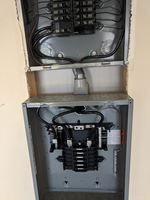
considering doing something similar but with a wire trough. I have a flush mount main in the garage and need to install a wire trough that is running perpendicular to the panel just below it (similar to the picture from another member on here) It will be surface mounted. I need to run 8 THHN to sub panels for critical load panels (surface mount) right next to the main (solar/battery backup). I need to have the feeder wires in conduit at all time (and in the behind drywall). I just need to figure out a solution to come out of main panel into wire trough. I know the LB intent is for access to pull wire through, and with this setup there should be no issue to pull wire through or need access to the back plate to unscrew. I was also going to make an removable access panel between the panel and wire trough just so I can get under main panel if ever need be.
1711982524390.png
 

Attachments

  • 1711982251953.png
    1711982251953.png
    2.4 MB · Views: 9

PCustoms

Well-known member
Joined
Jul 23, 2011
Messages
22,275
Location
VT
Old thread, but maybe someone can assist.
considering doing something similar but with a wire trough. I have a flush mount main in the garage and need to install a wire trough that is running perpendicular to the panel just below it (similar to the picture from another member on here) It will be surface mounted. I need to run 8 THHN to sub panels for critical load panels (surface mount) right next to the main (solar/battery backup). I need to have the feeder wires in conduit at all time (and in the behind drywall). I just need to figure out a solution to come out of main panel into wire trough. I know the LB intent is for access to pull wire through, and with this setup there should be no issue to pull wire through or need access to the back plate to unscrew. I was also going to make an removable access panel between the panel and wire trough just so I can get under main panel if ever need be.
1711982524390.png
Where is the trough?

You can't bury an LB. Period.

Looks like you are adding a sub panel below the panel. Use a ****** (and bushings) to connect the two, mount the lower one flush and repair your drywall. When you put the covers back on it will be a clean install.
 
To avoid these ads, REGISTER NOW!
Top Bottom