To avoid these ads, REGISTER NOW!

Leading body panels

MacMcMacmac

Well-known member
Joined
Oct 21, 2014
Messages
1,584
Location
canada
Does anyone have any experience using lead to fix body panels? I'm working on an old motorycle tank and would like to fill in two indentations where the tank badges were.

There were a few small holes created when the badge mounts were removed. I sucessfully filled them with solder, now I would like to perhaps fill in most of the indentations with solder or lead so as to eliminate the need to fill them in with a thick Bondo layer. This would give a good thick layer of metal to help eliminate any leak issues. I'm thinking it would be far less likely to buckle doing this rather than welding up the side with a MIG.

There is some Babbit at work which will never be used, so I could perhaps snag some.

Any ideas are helpful.
 
To avoid these ads, REGISTER NOW!

K13

Well-known member
Joined
Oct 24, 2007
Messages
2,225
Location
St. Albert, AB Canada
I have. Proper body lead is a 70% 30% mix of lead and tin. You also need a tinning butter to prep the panel so the lead will adhere. It's not super difficult to use but certainly is more involved than body filler.
 

yhprum

Well-known member
Joined
Jul 27, 2006
Messages
1,390
Location
Brisbane Australia
It’s honestly prob not worth going through to effort to source the materials and learn how to do it in a satisfactory manner that you will be happy with. Also note that the acid flux or paste can cause paint blistering problems later down the road.
I prob would get the best filler, prime with epoxy before putting it down and again afterwards.
 

NYBODYMAN

Well-known member
Joined
Sep 10, 2013
Messages
4,847
Location
NY
I never have but I always wanted to learn to lead. If you have the holes welded up solid and the welds dressed, you shouldn't need a thick layer of filler (I hate the word Bondo :rolleyes:). A thin layer blocked down is more than sufficient and shouldn't present any issues.

 
OP
M

MacMcMacmac

Well-known member
Joined
Oct 21, 2014
Messages
1,584
Location
canada
Ok. I figured a 1/4" thick layer of bondo to fill in the indents would be too fragile, hence I thought some lead filler would allow me to build it up to the point where I could get by with a much thinner layer. Probably not worth the effort then.

Ill get the solder out, lay down some Smooth-On MetalSet and bondo over that. Thanks.
 

NYBODYMAN

Well-known member
Joined
Sep 10, 2013
Messages
4,847
Location
NY
Ok. I figured a 1/4" thick layer of bondo to fill in the indents would be too fragile, hence I thought some lead filler would allow me to build it up to the point where I could get by with a much thinner layer. Probably not worth the effort then.

Ill get the solder out, lay down some Smooth-On MetalSet and bondo over that. Thanks.
Body filler should be no thicker than the thickness of a credit card.
 
OP
M

MacMcMacmac

Well-known member
Joined
Oct 21, 2014
Messages
1,584
Location
canada
I should send this to a proper body shop. I had it finished pretty good with GM Ming Blue, then 2 coats of SprayMax 2k. Then I tried applying the badges with 2 sided tape. Looked like ***. Took the badges off, but the 2 sided tore off a chunk of the clear coat. Beyond pissed off. Back down to bead blasted finish now. That SprayMax was laughing at the glass bead. I had to nail it with proper methylene chloride stripper and it still took 40 minutes to blast off the fish scales.
 

MBfreak

MEMBER EMERITUS
Joined
Dec 10, 2010
Messages
2,301
Location
Linkoping , Sweden
This is what I do.
Clean the surface area to be tinned to bright shiny metal .
Apply a coat of electronic graded flux paste, may favorite is NOKORODE. US made.
Use electronic 60/40 solder self fluxed and a 2 kW soldering iron
Tin the entire polished area.
Get a beech wood spatula, properly greased.
Apply body tin with a torch and smooth out with the spatula.
Let cold, no need to wash, the flux will not cause corrosion.
Use a tin/lead file and shape.

Let the paint guru shape to perfection and repaint

Ola
 
Last edited:

TimeWarpF100

Well-known member
Joined
Aug 21, 2010
Messages
6,784
Location
not here
Does anyone have any experience using lead to fix body panels? I'm working on an old motorycle tank and would like to fill in two indentations where the tank badges were.

There were a few small holes created when the badge mounts were removed. I sucessfully filled them with solder, now I would like to perhaps fill in most of the indentations with solder or lead so as to eliminate the need to fill them in with a thick Bondo layer. This would give a good thick layer of metal to help eliminate any leak issues. I'm thinking it would be far less likely to buckle doing this rather than welding up the side with a MIG.

There is some Babbit at work which will never be used, so I could perhaps snag some.

Any ideas are helpful.
I recently did a Motorcycle tank metal finish in lead. My first leadwork was back in 1978 and up until very recent did all my restoration in lead. I know a lot don't like it but of all the jobs I did never had a single failure. Much better plastic fillers today but I still keep lead sticks in cabinet and prefer it for certain jobs. Something I will never do is cover entire panels in bondo like so many do today.

Can you use a dent puller of sorts to get dent out more?

Biggest thing about lead work is as someone already mentioned it gotta be tinned properly but is not difficult to do.
On the 60's or earlier vehicles I will still reshape factory leaded seams using lead.

Pretty sure I have a video using lead on last car I restored. 1970 Boss 302 I did all in lead.
Car on left front.

Boss Quartet 6.JPG
 
To avoid these ads, REGISTER NOW!

36truck

Well-known member
Joined
Jul 13, 2010
Messages
980
Location
UP of Michigan
Can you get to the dents through the filler neck? If so can you pick the dents out some? Then a thin layer of filler over it.
For lead if you haven't done it before you need special tools and some practice before you try out the real thing.
 
  • Like
Reactions: npp

K13

Well-known member
Joined
Oct 24, 2007
Messages
2,225
Location
St. Albert, AB Canada
Go to NAPA and get a quart of of their mini fibre. Make sure the indent area is well sanded with 80 grit. Use the mini fibre to fill the indent and then skim with filler. You will have no issues.
 

lilredex

Well-known member
Joined
Apr 29, 2006
Messages
5,956
Location
Toronto
Cannot see the problem here, cut out a paddle like this and go to town on some scrap. you could try both resin and acid core solder for such a small repair. Wash down with baking soda if worriied about the acid. Did just this 50 years ago.


dffay

Well-known member
Joined
Jul 9, 2015
Messages
434
Lead is a righteous fix as long as it’s the real solution. That is, once leaded, it cannot be welded or even brazed. The lead has gotten into the molecules and it won’t adhere steel or bronze. And. The acid used in flux must be neutralized before primer or paint or that spot’s finish coat will lift right off of the tank.
 

Chris_Hamilton

Well-known member
Joined
Dec 2, 2012
Messages
1,023
Lead is great and works well provided it is applied correctly and filed off. There is a learning curve to it. One mistake many make is using aluminum oxide sandpaper over lead work. Using Al oxide paper and sanding lead causes something called intergranular corrosion. If you look at a car that has lead seams and has been repainted you can often see the outline of the lead or what look like sand scratches in the lead. That is intergranular corrosion. If you have to sand lead (not a good idea really) use silicon carbide sandpaper.

ANd always try to minimize sanding, especially power sanding or grinding of lead. That loads the air with lead particles and you will ingest some and contaminate your work area with lead as well. Always use a body file instead.

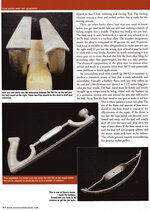
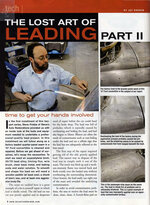
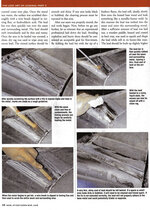
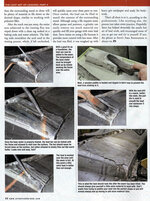
Here is an article from Street Rodder that is a good how to on applying lead. Steve Frisbee demos.

streetrodder_leadarticlepart1_1_750.jpgstreetrodder_leadarticlepart1_2_750.jpgstreetrodder_leadarticlepart1_4_750.jpgstreetrodder_leadarticlepart1_5_750.jpg
 

Chris_Hamilton

Well-known member
Joined
Dec 2, 2012
Messages
1,023
One more thought. If you use body filler, the modern way is to use it over a quality epoxy primer like Southern Polyurethanes Epoxy. (best you can get) PPG DPLF is not a good epoxy. Far far cry from the old DP epoxy that PPG used to make. SPI is as good or better than DP, plus you can use it for build and it sands well.
If you use filler over properly applied epoxy, failure of the filler is a thing of the past. Many don't realize that filler is porous, and will absorb moisture, and actually cause moisture underneath at the metal due to the heat from catalyzation. Especially when applied in sub 70 degree temps. Most filler failure is from rust forming between the surface metal and the filler.
 
To avoid these ads, REGISTER NOW!
Top Bottom