To avoid these ads, REGISTER NOW!

Leaking CO2 valve to cylinder

penright

ALLIANCE MEMBER
Joined
Dec 27, 2016
Messages
618
Location
SW of Mustang, OK
I have never had a valve-to-cylinder leak. When I connect the last mig welder CO2 bottle, there was a leak and it seem to be the bottle's valve. I had no issues with the previous bottle, so I assumed bad valve. I don't use it much, so I just lived with it. Got a new bottle yesterday and doing the same thing, FIgureing the odds of two valves being bad is astronomical, so I did more research. It seemed to be leaking around the threads. I don't see any damage, so not sure why it started. After adding some Teflon tape, it did seal. This does not seem right. I thought I would ping the community to see what you all thought.

1681305626038.png

1681305699214.png
 
To avoid these ads, REGISTER NOW!

rlitman

Well-known member
Joined
Oct 18, 2010
Messages
24,665
Location
Long Island
No tape or sealant should be used on a CGA-580 valve. What you're describing is between the valve and the REGULATOR, not the cylinder. If the threads on the top of the cylinder are leaking, take it back to your supplier, and don't mess with the tank valve. Your regulator should be installed with a wrench. It has a metal-to-metal seal that takes some torque.
 
OP
P

penright

ALLIANCE MEMBER
Joined
Dec 27, 2016
Messages
618
Location
SW of Mustang, OK
threads on the top of the cylinder are leaking, take it back to your supplier, and don't mess with the tank valve.
No worries about that. :) If you have ever seen the Mythbusters episode where they test what happens when a valve is separated from the cylinder, you will NEVER mess with the valve, move it without the cap, or not secure the cylinder somehow when in use.
What you're describing is between the valve and the REGULATOR, not the cylinder. If the threads on the top of the cylinder are leaking
You are correct. I confused things with bad terminology. The leak is between the "cylinder's" valve and Regulator's fitting.

No tape or sealant should be used on a CGA-580 valve.
That is what I was expecting, that is why I was suspecting something is off.

Your regulator should be installed with a wrench. It has a metal-to-metal seal that takes some torque.
Did that. I am not a weight lifter :) , but this is the first regulator I could not get to seal without using Teflon tape. That is why I think the issue is with my regulator.
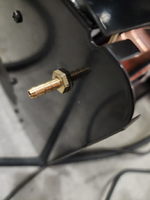
Where are the sealing surfaces exactly? I am pretty sure it would be the ball end of the regulator and a mating surface inside the valve. The bottom of the nut then presses them together. I guess there is no sealing of the threads so to speak. I don't see any damage to the ball part to cause the leak. This is a cheap regulator and I may need to replace it. I don't think my welding skills are good enough to notice the difference between cheap and not-so-cheap regulators. The ball part looks replaceable, is it? Not worth it for the cheap regulator, just curious if I had a more expensive one.
 

rlitman

Well-known member
Joined
Oct 18, 2010
Messages
24,665
Location
Long Island
...Did that. I am not a weight lifter :) , but this is the first regulator I could not get to seal without using Teflon tape. That is why I think the issue is with my regulator.
Where are the sealing surfaces exactly? I am pretty sure it would be the ball end of the regulator and a mating surface inside the valve. The bottom of the nut then presses them together. I guess there is no sealing of the threads so to speak. I don't see any damage to the ball part to cause the leak. This is a cheap regulator and I may need to replace it. I don't think my welding skills are good enough to notice the difference between cheap and not-so-cheap regulators. The ball part looks replaceable, is it? Not worth it for the cheap regulator, just curious if I had a more expensive one.
Well in your regulator (like most), that rounded cone you took a picture of is the sealing surface. It seats on a similar surface in the valve. No threads form the seal. Any burrs on that cone are sure to leak, and that style can take some gorilla wrenching to seal. I use my large Knipex Pliers Wrench to tighten and really lean in on them.

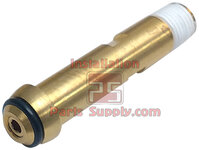
A helium regulator I own which is also CGA-580 has a tool-less stem with an o-ring sealing surface and a plastic hand-wheel. Maybe your LWS can set you up with one of those? It should be easy to put on your regulator, or you could get a regulator with it built in (they're common on helium and nitrogen regulators but I can't say I've seen it on C25 jobs, though the tank valve and regulator internals are the same on all of these).
740-12n.jpg
 

APEowner

Well-known member
Joined
Oct 2, 2009
Messages
4,166
Location
Sunny, New Mexico
As you suspect, it's the ball end of the regulator that does the actual sealing. Inspect it for dings, scratches and contamination. Inspect the seat on the tank side as well. If all looks good try tightening the nut finger tight and then rotating the regulator back and forth in the socket to sort of lap the ball and seat togeather. Just a bit. Don't get carried away. Then tighten with a wrench. If it's still not sealing try looseing the nut and reclocking the regulator slightly and re-tightening.
 
To avoid these ads, REGISTER NOW!
OP
P

penright

ALLIANCE MEMBER
Joined
Dec 27, 2016
Messages
618
Location
SW of Mustang, OK
Learning a lot from this thread, thanks, everyone. I knew that different gas bottles had different fittings, just did not know how to spec them out. For example, I searched for a "****** for a CGA-580" and got what I was looking for. The spec was 1/4" npt, I assume that is the end for the regulator side. I bet that is pretty much standard for plain old regulators. There was a "hand tightening" version, that was like what @rlitman mentioned. @Monza Harry, the reason I would replace would be to upgrade. Did a little research and when most posts talk about flow regulator vs flow meter, it really boiled down to, watching the weld. Plus I have used the barb-type hose fitting. I need to look at my welder at home and see what connector it takes. I wonder if that is standard. I could clamp it like my plasma cutter. A hose with screw-on fittings on both ends is about $20. A lot of regulators come with it now, but not much more than one without. That in of its self makes upgrading tempting. :)
 

rlitman

Well-known member
Joined
Oct 18, 2010
Messages
24,665
Location
Long Island
...I knew that different gas bottles had different fittings, just did not know how to spec them out. For example, I searched for a "****** for a CGA-580" and got what I was looking for. The spec was 1/4" npt, I assume that is the end for the regulator side. I bet that is pretty much standard for plain old regulators...
Yeah, 1/4 NPT is typical on the regulator side for both the ******* and the gauges, though some regulators may use 1/8 NPT, and all bets are off for cheap imports. CGA-580 is standard for inert welding gases: C25, argon, nitrogen, helium, etc. A true CO2 only valve is different and seals with a washer and flat seat, but I don't want to confuse matters more here (these are used by soda machines, beer kegerators, etc.).
 
OP
P

penright

ALLIANCE MEMBER
Joined
Dec 27, 2016
Messages
618
Location
SW of Mustang, OK
A true CO2 only valve is different and seals with a washer and flat seat, but I don't want to confuse matters more here (these are used by soda machines, beer kegerators, etc.).
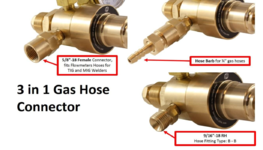
I keep saying CO2, but it is a 75/25 mix, an inert welding gas. I wonder if the fittings used to connect the hose between the regulator and welder are standard? Just to ask a different way for more context, if you currently have barb fittings for the hose between the regulator and welder and want to switch to a hose with screw fittings. Are those connections standard? Here is a hose what I am talking about. I am thinking the barbs are NPT and there is an adapter, but I not sure how to find (text for the search) the adapter if my assumption is true.
1681327544917.png


************************ Edit ********************************************
If I would have went just a little farther looking for the picture for my example.
I am guessing the 5/8"-18 Female, since in the picture the hose side look male.

1681327742297.png
 

rlitman

Well-known member
Joined
Oct 18, 2010
Messages
24,665
Location
Long Island
I keep saying CO2, but it is a 75/25 mix, an inert welding gas. I wonder if the fittings used to connect the hose between the regulator and welder are standard? Just to ask a different way for more context, if you currently have barb fittings for the hose between the regulator and welder and want to switch to a hose with screw fittings. Are those connections standard? Here is a hose what I am talking about. I am thinking the barbs are NPT and there is an adapter, but I not sure how to find (text for the search) the adapter if my assumption is true.
1681327544917.png
Yes, C25.

They're kind of standardized. Most welders I've seen have the same flare type fittings like pictured above for the gas solenoid, and there's a similar threaded standard for water cooler lines. Threaded flowmeter outputs have a few flavors, so you may need an adapter.
 
OP
P

penright

ALLIANCE MEMBER
Joined
Dec 27, 2016
Messages
618
Location
SW of Mustang, OK
I guess the B is a size. I found this chart. But it is mentioning like oxygen and acetylene. That hose looks bigger in the picture, so that "hose fitting type B-B" must not be for the hose.

1681328936939.png
1681328905118.png
 
OP
P

penright

ALLIANCE MEMBER
Joined
Dec 27, 2016
Messages
618
Location
SW of Mustang, OK
If all looks good try tightening the nut finger tight and then rotating the regulator back and forth in the socket to sort of lap the ball and seat togeather.
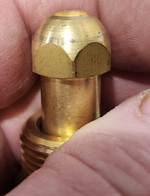
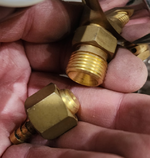
@APEowner you nailed it. I took it apart, clean out all the Teflon, put it back, and tighten it. Still had the leak. Losen it up, finger tight to where could just rotate made a circle a few times, and tighten it back up. No leak. I took it back off to look at it. You can barely see the seat, one thing I notice, it was really close to the flats for the tightening. If you look at the picture you can see what I am talking about and can compare it to the picture in the OP.
1681388396403.png
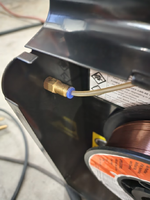
As far as the hose question. Kind of got off topic a bit, I pulled the barb off of the regulator and it has what I believe is the 8B connector. When I look at the welder, it looked like the barb fitting was just part o the welder. The inside of the gas, the hose connects via some sort of push connector. Now that the leak is fixed, I am going to go with what I got for now. I need to finish my welding cart, so I can get everything off the floor. My old cart had room for the cracker box below where the normal drawer would be, then the MIG sit on top. I need to redo it so there would be room for the new plasma cutter. Thanks aging everyone for the info. This forum has never let me down.
1681388479207.png

1681388282711.png1681388294305.png
 

scooterbum46

Well-known member
Joined
Jan 29, 2014
Messages
890
Location
South Central Michigan / ex Gulf Coast Florida
I'm just a home gamer, but with about 60 years dealing with various welding tanks. I agree that if it's seating that far out, there's something amiss. I'd order a replacement.
BTW - do you always "crack" the valve before attaching the regulator? First lesson I was given - make sure there's no **** in the valve first. Actually the first lesson I got was that regulator flow is off when the adjustors are backed all the way out, not in. Hoses make a big bang if you do it wrong :)
 
To avoid these ads, REGISTER NOW!
Top Bottom