To avoid these ads, REGISTER NOW!

lean to roof question

oiler

Well-known member
Joined
Dec 21, 2006
Messages
51
Location
Cold Lake Alberta Canada
I am planning on adding a lean to onto my shop but i'd like to tie the lean to roof into the existing roof and not the wall or ledger board under the trusses.
I'd like to go about 4 ft up the existing roof
I want to maintain some height with my lean so thats the reason.
Any thoughts or ideas on this type of roof?
I'm having trouble seeing it in my mind
Thanks all
Jeff
 
To avoid these ads, REGISTER NOW!

fury9

Well-known member
Joined
Mar 4, 2012
Messages
1,277
Location
Mchenry, IlLaHnoYs
It's called a layover and what's the existing pitsh of your roof? The rafters need to be supported, If you're putting say a 3/12 on a 10/12 thats alotta load on the span of the 12 to not support the 3, you can't just do this stuff your best bet would be to put a gable end on your purposed addition, your rafters will then go to the ridge, it will be much easier to support this increased load on your ridge than if you just die your purposed roof into the side of your existing, even if it's 30 ft too high
 

Zeke

Well-known member
Joined
Aug 13, 2009
Messages
17,176
Location
Long Beach CA, the sewer by the sea.
It's a change of pitch, that's all. Done all the time. Of course you need to consider the snow load and ice dam thing, something of which I am not too familiar with.

You're not telling us about what the roofing material is so answers at this point are going to be vague.
 

readhead

Well-known member
Joined
Dec 8, 2012
Messages
6,181
Location
Durango, Co.
Keep in mind that you will seriously increase the snow load at the pitch break which will influence the design bearing for the new rafters.
 

Kevin54

MEMBER EMERITUS
Joined
Jan 12, 2005
Messages
29,341
Location
Urbana, Ohio
I am planning on adding a lean to onto my shop but i'd like to tie the lean to roof into the existing roof and not the wall or ledger board under the trusses.
I'd like to go about 4 ft up the existing roof
I want to maintain some height with my lean so thats the reason.
Any thoughts or ideas on this type of roof?
I'm having trouble seeing it in my mind
Thanks all
Jeff

You need to supply a little more info before you'll get any approval from us. :lol:

What is the current roof pitch now?

What is the average snowfall you get in the winter?

Going up 4 foot on a steep pitched roof is way different than going up 4 foot on a lower pitched roof. When you say you are going "up" 4', do you mean vertically up, then back, or do you mean just going back 4' on the roof from the edge? If the latter, on a low pitched roof, then your new roof will be mainly flat.

What do you plan on using for your rafters to carry a snowload?

Have you thought about a pitched roof instead? It easier to do than you realize. You can buy stock 24' engineered 4/12 trusses at about any lumber company for around $35 each. You can set them on top of a pole barn type construction, or set them on walls, or if you have enough oles and a string around the top, you can make a carport. The worst part of going this route is that you have to learn to cut a few rafters. No big deal there either. If you don't know how to cut a rafter it's a good learning experience and you'll then have knowledge that a lot of others don't have. The next part that sort of ***** it tieing in the shingles to your other shingles, which it may just be best to reroof the back section.

Pics help, post up a pic or two of where you are wanting to add the addition and roof. There are carpenters, mechanics, doctors and all other walks of life on here more than willing to help you out. And besides that, we just generally like pics whether we know anything or not :lol:

And one thing to remember too is that a decent looking roof addition usually will bring more value to a home than a flat lean-to roof just because of the aesthetic aspect. A lean-to belongs on a farm barn. You want to add an addition that looks like it was originally built that way and not an add-on. But that's just my opinion.

And ZEKE.......You ****!!!!!!!!:lol: We're supposed to get hit with a wet 10" of snow tomorrow.:mad:
 

Tim The Tool Man

Well-known member
Joined
Mar 1, 2012
Messages
1,520
Location
Lehigh Valley, PA
The previous owner of my place put a crappy addition off the back of the shop with a ledger board roof as you described that you do not want to do. It was essentially flat and leaked like and incontinent old man on a bender.

I rebuilt the whole back section and even added to the width last fall as part of my re-roofing project. I changed the roof from a ledger supported structure to it being supported over the exiting wall itself. Originally I was going to seem the new roof 4' up the main shop roof but I eventually decided that the existing trusses probably wouldn't support the weight.

Here is a picture of what I did, I didn't think to take a before shot. I know it looks really bad but I am not done with my project yet. I reused much of the roofing material from the front of the shop where I bought new material putting the old stuff on the back. I am painting the roof green and the sides beige. Winter put a hold on the project for now.

And ZEKE.......You ****!!!!!!!!:lol: We're supposed to get hit with a wet 10" of snow tomorrow.:mad:

BTW I get that slop on Monday! Got to love Spring!


roofproject6_zps4e3f3279.jpg


roofproject8_zps66c00cfc.jpg
 
To avoid these ads, REGISTER NOW!

bczygan

Well-known member
Joined
Nov 4, 2009
Messages
22,002
Location
DETROIT! Arsenal of Scrappers
I am planning on adding a lean to onto my shop but i'd like to tie the lean to roof into the existing roof and not the wall or ledger board under the trusses.
I'd like to go about 4 ft up the existing roof
I want to maintain some height with my lean so thats the reason.
Any thoughts or ideas on this type of roof?
I'm having trouble seeing it in my mind
Thanks all
Jeff

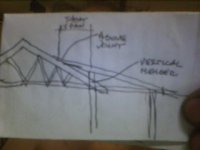
What you are planning will add aa load on your existing trusses somewhere in their span. How much load depends on where your new rafters are supported. If they clear span from one end to the other and are supported only at your new outside wall and also at the point where they meet the existing roof, then they will be adding the maximum possible point load to the existing trusses. This would require that the existing trusses be modified to accept the additional load.

To minimize this load I would support each new rafter at the existing outside wall with a vertical member. You would still be adding a load to the existing trusses, but it would only be half the span from the existing outside wall to the point where it meets the existing roof.

Take care to make sure that the meeting point is at the point where intermediate members of your truss tie into the top chord so you transfer the load better.

Take a look at the very bad drawing and very bad photo. The vertical member cuts the span of the new rafter so the load on your truss is much less because the contributing roof area is reduced significantly.
 

Attachments

  • snapshot.jpg
    snapshot.jpg
    10.4 KB · Views: 464
Last edited:

Garage Dog

Well-known member
Joined
Dec 28, 2012
Messages
633
Location
Minnesota
I second the bczygan thought process. Even a very bad drawing can be extremely helpful as it clearly conveys the basic load principles you need to consider.
 

Tim The Tool Man

Well-known member
Joined
Mar 1, 2012
Messages
1,520
Location
Lehigh Valley, PA
Unfortunately even bczygan's solution would have put too much stress on my trusses. The weight of the short span of rafter and all the roofing product above it lying on that truss (4' o.c.) will deflect that weight down onto the ceiling joist below and deform it. Once you add a snow load to it your done. ...At least that is what my structural engineer (ret.) father said when I ran it by him...
attachment.php
 

Attachments

  • roof.jpg
    roof.jpg
    23.6 KB · Views: 62
Last edited:

Zeke

Well-known member
Joined
Aug 13, 2009
Messages
17,176
Location
Long Beach CA, the sewer by the sea.
Tool Man, technically, that is correct, but your red lines are misgiving. The importance or the vertical member and a purlin running the length of the wall below will catch a lot of that weight. The new rafter is cantilevered over the wall. What does your father say about the wall carrying the load of both roofs?
 

Tim The Tool Man

Well-known member
Joined
Mar 1, 2012
Messages
1,520
Location
Lehigh Valley, PA
Tool Man, technically, that is correct, but your red lines are misgiving. The importance or the vertical member and a purlin running the length of the wall below will catch a lot of that weight. The new rafter is cantilevered over the wall. What does your father say about the wall carrying the load of both roofs?

The stress point in question is where the new roof rafter meets the existing truss. Beyond the sidewall there is no issue assuming the load bearing wall is built to acceptable standards. All the weight, even if it is nominal considering the cantilever effect, between the side wall and truss is a load that was not considered when the truss was designed.

I agree it is probably a minimal impact and would most likely work fine but were it to fail and with me being the licensed and insured contractor that made the change, my homeowners insurance could easily deny the claim.

Whenever I do work for a client where a truss needs to be moved, cut, or adjusted I always consult an engineer and get signed drawings to cover my ****. Even when I can look at something and know the solution, I still make the consult.
 

bczygan

Well-known member
Joined
Nov 4, 2009
Messages
22,002
Location
DETROIT! Arsenal of Scrappers
Make the new rafters a deeper section to make the cantilever portion more able to support it's load and reduce to load at the point it meets the existing roof. Use 2x8's (Which may also be needed for the main span of the addition), and it may not be an issue at all.
 
To avoid these ads, REGISTER NOW!
Top Bottom