To avoid these ads, REGISTER NOW!

LED and Inrush Current

analog

Member
Joined
Nov 27, 2017
Messages
21
Location
Central Oregon
I'm in the final stages of my shop build and putting up my lights. The shop is a 42x24, 18' ceiling at the highest, and I have six 160W high bay LEDs and four 100W high bay LEDs in a lower area. These are split on two 15A circuits (four 160W/two 100W and two 160W/two 100W).

These loads are more than fine for the 15A circuits, but I'd like to add smart switches (zwave) to control them and in specs for smart switches, they massively de-rate their capacity for LED drivers. I've read this is due to the large inrush current that LED drivers have on startup (as much as 100x the steady state current).

Has anyone else put a relatively large LED lights load on a smart switch? How are you contending with the large inrush current which has the potential to melt the relay in the smart switch?
 
To avoid these ads, REGISTER NOW!

Bert_

Well-known member
Joined
Dec 24, 2016
Messages
9,712
Location
NW Iowa
Get a switch rated for your load or use the switch to control a higher power relay.
 

californiaHank

Well-known member
Joined
Nov 20, 2015
Messages
487
The commonly available smart switches designed for 120V/15A circuits (for example, Leviton DZ15S) are typically rated for a full 1800W incandescent load, but only for 600W of LEDs.

If you use the Leviton switches, the circuit you've got with 2x160W + 2x100w is probably OK for one smart switch, but the other circuit with 4x160W + 2x100W would have to be split between two switches so each switch sees a load of less than 600W.
 

MBfreak

MEMBER EMERITUS
Joined
Dec 10, 2010
Messages
2,301
Location
Linkoping , Sweden
The inrush current on LED fixtures vary greatly, as does the harmonics they produce.
A well designed LED fixture ( ie fluorescent fixture replacement "tubes") has no inrush current. It ramps up at start from zero up the the desuígn current of the LED pixels.
The same goes for well designed "replacement bulbs" that you screw in normal lamps. You can actually see their slow start over half a second or so.

That said, many cheap LED fixtures have considerable start current peaks, I have measured a peak of 7,5x steady state on a chicom unit. The peak lasted less than 4 ms, so the thermal load on any switch ( except a semiconductor switch if you use such) is irrelevant.
What was much more disturbing was the harmonics the unit spewed out. Well up int the FM band, so they should really not be allowed to be marketed or sold. What does FCC say?
A peak current if 100 times steady state seems more or less impossible,
but opinions are just that. To measure you need a fast memory scope and a shunt.

Ola
 
To avoid these ads, REGISTER NOW!

cybrdyke

Well-known member
Joined
Sep 9, 2014
Messages
3,442
Location
USA
It can actually be higher than 100x !
This manifests itself often at the contacts in the switch. Switching the load on with large over-current can damage them. They can either get covered in carbon and prevent them from "making", or they can get welded together and prevent them from "breaking". Either way, your lights wont work well. In photocells and in occupancy sensors, it doesn't take much more than 6 months for this to happen.
That's why you see alot of products claiming that they are acceptable for use with LED's.
The better products out there will use zero-crossing technology to eliminate this issue. That's what folks need to look for when selecting control devices for LED's.
CD
 
OP
A

analog

Member
Joined
Nov 27, 2017
Messages
21
Location
Central Oregon

PhysicsDude

Well-known member
Joined
Jan 28, 2013
Messages
805
Location
Dallas, TX
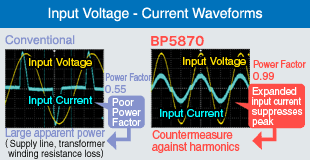
Its not just the inrush current, its also the "Power Factor". The circuitry will draw high amounts of current during short durations during the waveform.

A 300W device that has a power factor of .5 draws as much current as a 600W device, even though its only drawing 300W.

image_gallery
 
To avoid these ads, REGISTER NOW!
Top Bottom