To avoid these ads, REGISTER NOW!

LED lights on 220V vs 110V

rwa2004

Well-known member
Joined
Oct 8, 2016
Messages
54
Location
Western PA
I noticed most all LED lights set up for AC input are rated for either 110V or 220V (usually something like 85-265V). If I am setting up new LED lighting from scratch in a building - is there any benefit to wiring the lights for 220V instead of the conventional 110V? Will the lights last longer or operate at a lower temperature with 110 or 220V? Do you think LED lights in the future will continue to be available with a wide range of input voltage (marketable globally)?
 
To avoid these ads, REGISTER NOW!

u3b3rg33k

Well-known member
Joined
Dec 18, 2017
Messages
4,049
Yes. switching power supplies generally have a slightly better efficiency (low single digits) at higher voltage.

I expect 90-250V, 50-60Hz to be the standard for almost every switching powersupply. reason? you only have to make one product that can be sold to the whole planet.

assuming this is for your home - if you can afford the space in your panel for double wide breakers, go right ahead. make sure the fixtures don't also accept 110V only lighting, or you'll be in for a lot of fun.
 

Norcal

Well-known member
Joined
Mar 16, 2008
Messages
13,769
I don't think the NEC allowed 240v lighting in residential structures

120 volts is maximum in a dwelling for lighting. To the Op, 110, 220 volts are obsolete pre World War II voltages 120 & 240 volts is the standard now.
 

u3b3rg33k

Well-known member
Joined
Dec 18, 2017
Messages
4,049
120 volts is maximum in a dwelling for lighting. To the Op, 110, 220 volts are obsolete pre World War II voltages 120 & 240 volts is the standard now.
they're all nominal ratings anyways. who cares if you call it
110/115/117/120/125? we all know it means single leg and a neutral.
208/220/230/240 means two hots.

NEC 210.6 applies to dwellings. a detached garage is not a dwelling. so where you're doing this matters.

personally i like the idea of not using 220v lighting in residential properties. people don't expect it, and people effectively count on the shell of a light socket to not be a hot conductor. it might be fine for you, but the next owner won't assume your lighting is set up that way. that's probably why it's code. not because a hardwired 220V lighting circuit is bad, but because people will get hurt because they'll simply assume it's a 3 way switch or that things that aren't normally hot, aren't hot.

if you want to have a lot of lights on a single circuit (say, near the limits of 12/15A worth), i would just run one size heavier wire than code requires. I don't think (feel free to verify) there's anything stopping you from having a single 120V lighting circuit with a 30A breaker on it, but at that point i'd probably want them on separate switches anyways. the bigger the breaker is, the less over current protection you have per lamp for small problems. there may be some mitigation provided by AFCI/GFCI breakers, but that's another rabbit hole to go down.
 
Last edited:

Norcal

Well-known member
Joined
Mar 16, 2008
Messages
13,769
they're all nominal ratings anyways. who cares if you call it
110/115/117/120/125? we all know it means single leg and a neutral.
208/220/230/240 means two hots.


Where 110V is still used each leg is 55V, there is no neutral, and 220V is a line to neutral load where it is still used.
 

Stuart in MN

Well-known member
Joined
Sep 8, 2005
Messages
23,179
Location
Minneapolis
NEC 210.6 applies to dwellings. a detached garage is not a dwelling. so where you're doing this matters.

If a detached garage is on a residential property, the rules for a dwelling apply.

edit: to be more precise, it will depend on how the the authority having jurisdiction (AHJ) interprets the code - whether accessory buildings have to meet all the same rules as a dwelling. In my case they do, it may be different in your area.
 
Last edited:

u3b3rg33k

Well-known member
Joined
Dec 18, 2017
Messages
4,049
If a detached garage is on a residential property, the rules for a dwelling apply.

edit: to be more precise, it will depend on how the the authority having jurisdiction (AHJ) interprets the code - whether accessory buildings have to meet all the same rules as a dwelling. In my case they do, it may be different in your area.

if there's a really good reason (i.e. big greenhouse on a residential property), then the AHJ would probably say go for it. regular 600W edison base fixtures, I'd guess not. definitely worth asking if you think you have a good reason for using two hot legs to feed lights.
 

FTG-05

Well-known member
Joined
Oct 11, 2012
Messages
1,543
Location
TN
If a detached garage is on a residential property, the rules for a dwelling apply.

edit: to be more precise, it will depend on how the the authority having jurisdiction (AHJ) interprets the code - whether accessory buildings have to meet all the same rules as a dwelling. In my case they do, it may be different in your area.

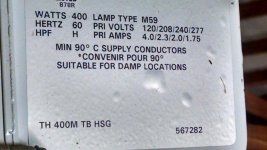
My shop has 220 VAC lights (four 400 watt MH) and was approved by the local inspector when the shop was built (2006). Can I replace them 220 VAC LEDs and be ok?
 
To avoid these ads, REGISTER NOW!

Barnabas

Well-known member
Joined
Nov 24, 2013
Messages
362
Location
Raleigh, NC
My shop has 220 VAC lights (four 400 watt MH) and was approved by the local inspector when the shop was built (2006). Can I replace them 220 VAC LEDs and be ok?

I replaced my MH lamps, bypassed the ballast, with the corn-cob style, mogul base LED lamps. Mine go from the 240v breaker to a special relay that has a photo cell attached, then feed to the three lights. These are my on-all-night outside lights.
 
OP
R

rwa2004

Well-known member
Joined
Oct 8, 2016
Messages
54
Location
Western PA
Thanks guys, I was all excited about wiring it all up as 220, but I think the reasons for not doing that were really well proven :)

I often am bothered that the codes that have the sole purpose of safety are different in different places. The laws of physics do not care of political boundaries. It just goes to show, once again, that the people aspect is always more complicated than the technical aspect.

Sent from my SAMSUNG-SM-G920A using Tapatalk
 

alfredeneuman

Well-known member
Joined
Mar 3, 2011
Messages
4,594
Location
Fullerton, CA
Math is important for electrical. There has to be a standard way of figuring. Accuracy is important as well.

It's the basis of all Electrical Engineering and Codes. There's no "close enough" in math.
The tables are based on these standards.

If you are 10% off in your calculations and figure it is OK, what's the next person in line to do? Take your 10% figure and treat it the same way as you do and add to that 10% mistake by 10% ...... and on down the line like a game where you whisper something to a person and it changes until the message is nowhere close to the original?
It is surprising (or not) that you think that way.
 

u3b3rg33k

Well-known member
Joined
Dec 18, 2017
Messages
4,049
you're twisting my words again to suit your argument. and in the real world, there's lots of "close enough" in math.

I suppose this motor isn't suitable for operation at 240V?
ao-smith-motors-wiring-diagram-blower-motor-roc-grp-org-18-0.jpg


if you spec parts rated for 240V, they fail when powered up on 240V AC, because 240V AC isn't actually 240V AC. i expect a "220V" or "230V" or "240V" rated motor to work properly on any of those three voltages, and they do.
 

FTG-05

Well-known member
Joined
Oct 11, 2012
Messages
1,543
Location
TN
I replaced my MH lamps, bypassed the ballast, with the corn-cob style, mogul base LED lamps. Mine go from the 240v breaker to a special relay that has a photo cell attached, then feed to the three lights. These are my on-all-night outside lights.

That's not a bad idea!

What bulbs did you buy?

Instructions on bypassing the ballast? I've done it with regular 4' flor lights.

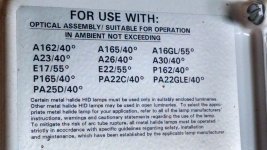
Here are the MH light fixtures I have in my shop:
 

Attachments

  • IMG_20180606_133925290_HDR (Large).jpg
    IMG_20180606_133925290_HDR (Large).jpg
    146.1 KB · Views: 16
  • IMG_20180606_133932602_HDR (Large).jpg
    IMG_20180606_133932602_HDR (Large).jpg
    119.6 KB · Views: 12
  • IMG_20180606_133942261_HDR (Large).jpg
    IMG_20180606_133942261_HDR (Large).jpg
    149.7 KB · Views: 12

cybrdyke

Well-known member
Joined
Sep 9, 2014
Messages
3,449
Location
USA
That's not a bad idea!

What bulbs did you buy?

Instructions on bypassing the ballast? I've done it with regular 4' flor lights.

Here are the MH light fixtures I have in my shop:

Easy. Just bring black and white wires to the socket.
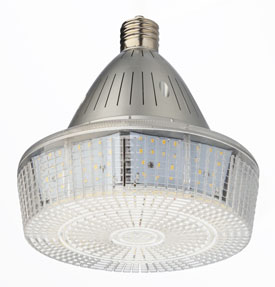
Corn lamps are not good lamps to use if you have a metal dome reflector on the fixture. Too much light wasted inside the dome and not enough gets to the target. There are LED lamps designed specifically for these fixtures that push ALL the light down in the correct beam angle without any wasted light.

f8ccaedd5e29939a55c89ca13a19.jpg

If you have clear, acrylic domed reflectors, there is a version with side lighting to get some side-light thru the reflector.
Good luck,
CD
 
To avoid these ads, REGISTER NOW!
Top Bottom