To avoid these ads, REGISTER NOW!

LED replacements for T8s

Oggy

Well-known member
Joined
Jan 2, 2011
Messages
1,295
Location
Central New York
Was in Lowe’s over the weekend and saw they had the universal T8 replacement LED bulbs. I have some lights in the shop that have ballasts that went bad, so I picked up a box (10 bulbs).

I’ve only gotten one fixture done, but wiring them was easy, I just need 3 more boxes to finish…

2 questions:

1. At $50/case does anyone have recommendations on where I could save some money?

2. If I use them with a ballast, will I regret not changing them over right now? Like I said it was easy, but changing a bulb is quicker…
 
To avoid these ads, REGISTER NOW!

cybrdyke

Well-known member
Joined
Sep 9, 2014
Messages
3,449
Location
USA
5 bucks a tube is a pretty good price. yes, you can find them cheaper, but not much.
Using the tube on a ballast (if they're dual rated for that) will not harm the tube if you decide to bypass the ballast later. What you are asking about is done all the time.
Carry on....
CD
 

Dodge

Well-known member
Joined
Feb 8, 2008
Messages
557
Location
Illinois
if you're changing over to LED , scrap the ballast now, why procrastinate ... it's literally 5 minutes of work and then all you have as a fail point is the led tube
Can you explain the wiring process to removing the ballast, please? I tried, but was not successful.
 

Steve_P

Well-known member
Joined
Sep 15, 2010
Messages
5,185
I also recommend getting rid of the ballast because it's significantly more energy efficient than keeping the ballast. And maybe it's just the drop in Philips LED bulbs I bought years ago, but I was changing out the drop in LED bulbs all the time, and I don't recall changing out a direct wire LED in the 5+years since I switched.

The wiring process to remove the ballast should be on the box that the bulbs come in. It's very simple. You'll want to buy some 18 ga solid core wire, and the Wago connectors are also a good idea. I couldn't find the wire locally and bought it on Amazon
 

The Cobbler

Super Moderator
Staff member
Joined
Oct 24, 2013
Messages
25,928
Location
Niagara Region, Ontario, Canada
Can you explain the wiring process to removing the ballast, please? I tried, but was not successful.
There are different configurations on wiring, no standard . the ones I have done are described on the bulb itself. I am not sure what to say to help, can you show a picture of your bulbs with the schematic for wiring?
 
OP
O

Oggy

Well-known member
Joined
Jan 2, 2011
Messages
1,295
Location
Central New York
Thanks for the energy saving info about removing the ballasts, and confirming the price…

The only benefit of waiting is that I have a herniated disc in my neck, so looking up to change the other 8 lights to operate without the ballast kind of aggravates it and the nerve that runs down my right arm…

Wago connectors will make things easier though, I’ll pick some up… the wires are JUST long enough to where I can use what’s in there without having to splice anything. It’s tough to get everything wire nutted together though because of holding them (and the pain/numbness in my right arm doesn’t help.

I’ll pick up more bulbs at Lowe’s and the wagos (probably on Amazon) and git r done.
 
OP
O

Oggy

Well-known member
Joined
Jan 2, 2011
Messages
1,295
Location
Central New York
Can you explain the wiring process to removing the ballast, please? I tried, but was not successful.
It’s pretty easy, ***verify what you buy, as it may be different from what I bought***, I just cut out the ballasts, matched the wires from the left side of the bulb, wire nutted all 4 tombstones to the black (hot) and all 4 from the right side of the bulbs to the white (neutral). Never had to touch the ground.

My lights were 4bulbs on a single ballast, so 8 tombstones, the only thing to watch was that I made sure the middle 4 tombstones were wired as I intended.
 

Fav Onefour

Well-known member
Joined
Jul 14, 2022
Messages
709
Location
MN cold and hot
Remove the ballasts. I can't even think of a good reason to keep those old heat producing energy hogs.

Once you figure out the fixtures, it's a piece of cake. I've got it down to a process and do fixtures when the old bulbs die. Sure, I could go and do them all right off the bat. I'm too cheap. I have a hard time replacing working light bulbs.

I watch for the bulbs to go on sale and pick up a pile. It's a bit ironic. I probably have enough bulbs to do all the fixtures already.

One tip I recommend. Find the matching light color and jump up on lumen output with the new bulbs. That makes the process of slow replacement less noticeable. People would notice color difference. Output of the same color, not so much. In the end you'll have more light when they get replaced. ;)
 

CJ7VFR

Well-known member
Joined
Jan 13, 2015
Messages
2,939
Location
Central New Jersey
Can you explain the wiring process to removing the ballast, please? I tried, but was not successful.
Besides what others have suggested already, you need to know what type of LED tubes you have/want to buy. Make sure you get ballast bypass LED tubes. These are the ones that will only work once you cut out the old fluorescent ballast.

There are some LED tubes that are called replacement/retrofit tubes that work with the old fluorescent ballasts but these are not as good. They require the old ballast in order to work, they use more electricity (due to the ballast still being used) and if the old ballast stops working the LED tubes will no longer work and you're back to square one. So get the ballast bypass tubes.

Ballast bypass LED tubes come in several configurations. Some are doubled ended tubes and some are singled ended tubes.

The double ended tubes will have the pins on one end of the tube that get hooked up to the line side (hot) wires and the pins on the other end of the tube that get hooked up to the neutral wires. These are very easy to hook up as all the line side (hot) wires, which are normally black, get hooked up the tombstones on one end of the light fixture and all the neutral side wires, which are normally white, get hooked up to the tombstones on the other end of the fixture. The double ended LED ballast bypass tubes will have markings on them to designate which end of the tube gets attached to the hot side and which end gets attached to the neutral side of the light fixture. This is the type that I have and if you put them in backwards the lights won't light up indicating you have to turn them around.

The single ended tubes will have both the line (hot) and the neutral pins of the tubes on the same end. One pin is hot the other pin is neutral and the tube will be marked as to which is which. The pins on the other end of these tubes are just dummy pins (not connected to anything). These types of tubes require a bit more thinking and care when prepping the light fixture than the double ended type. The tombstones on one end of the light fixture (in a two tube fixture for example) will each have one hot and one neutral wire hooked to them and the tombstones on the other end of the fixture will require the removal of all the wires to them. The end with no wires hooked up to the tombstones is where the dummy pins on the tubes will go. If you put the tubes in wrong they will not light up which means either you need to flip them around or you wired the tombstones wrong and you have to reverse the hot and neutral wires to them. This is why you need to think about which side of each tombstone will get the hot wire and which will get the neutral wire so it matches the pin configuration of the LED tube.

Either type of ballast bypass LED tubes will be a great improvement over the old fluorescent tubes and ballasts. You will get more light, use less electricity and you will get instant on lighting even if your fixtures are in unheated structures that have temperatures that get to below freezing.

Jim
 
Last edited:

Dodge

Well-known member
Joined
Feb 8, 2008
Messages
557
Location
Illinois
There are different configurations on wiring, no standard . the ones I have done are described on the bulb itself. I am not sure what to say to help, can you show a picture of your bulbs with the schematic for wiring?
I can't take a picture now, i replaced the bulbs a few years ago and left the ballasts in, could not figure it out then. Thanks anyway for the reply
 

CJ7VFR

Well-known member
Joined
Jan 13, 2015
Messages
2,939
Location
Central New Jersey
I can't take a picture now, i replaced the bulbs a few years ago and left the ballasts in, could not figure it out then. Thanks anyway for the reply
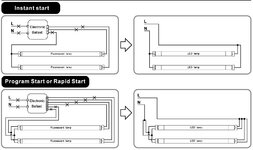
Here is a picture of the wiring diagrams for a two tube fixture using double ended ballast bypass LED tubes. The two wiring diagrams shown are pretty much the same. It shows that you cut out the ballast and wire all the line (hot) wires to the tombstones on one side of the fixture and all the neutral wires to the tombstones on the other side.

I bought Halco brand LED ballast bypass tubes and they are marked with an "L" on the end that goes to the line (hot) side of the fixture and an "N" on the end that goes to the neutral side of the fixture after it is rewired. Most other brands should be marked in a similar way.

All double ended ballast bypass LED tubes are wired this way. You can also find wiring diagrams for the single ended ballast bypass LED tubes as well. A quick Google search should get you there.

Jim
 

Attachments

  • ledbbp-inst.JPG
    ledbbp-inst.JPG
    133.8 KB · Views: 33

dscheidt

Well-known member
Joined
Apr 26, 2017
Messages
2,904
I recently installed some sylvania branded led replacement tubes that will work with or without a ballast, and either single or double ended connection. I suspect others are selling the equivalent thing Pretty hard to screw them up...
 

cybrdyke

Well-known member
Joined
Sep 9, 2014
Messages
3,449
Location
USA
I recently installed some sylvania branded led replacement tubes that will work with or without a ballast, and either single or double ended connection. I suspect others are selling the equivalent thing Pretty hard to screw them up...
Nearly all tubes are this way now. Makes things pretty simple.
CD
 

CJ7VFR

Well-known member
Joined
Jan 13, 2015
Messages
2,939
Location
Central New Jersey
I recently installed some sylvania branded led replacement tubes that will work with or without a ballast, and either single or double ended connection. I suspect others are selling the equivalent thing Pretty hard to screw them up...
Do you have the model number for these tubes? I would like to check out how they do the internal wiring inside the tubes for the pins on both ends of the tubes.

Jim
 

dscheidt

Well-known member
Joined
Apr 26, 2017
Messages
2,904
Do you have the model number for these tubes? I would like to check out how they do the internal wiring inside the tubes for the pins on both ends of the tubes.

Jim
These, I think.
 

CJ7VFR

Well-known member
Joined
Jan 13, 2015
Messages
2,939
Location
Central New Jersey
These, I think.
Thanks for the info. It is interesting to see that these can fit into a bunch of different configurations.

But damn those things are expensive at $25 for just one LED tube. That is 3 to 4 times the price of a regular double ended ballast bypass LED tube.

I had 10 two tube 4 foot long fluorescent light fixtures that I converted over to ballast bypass LED tubes a few years ago. I bought two 10 packs of the LED double ended ballast bypass tubes for $76 dollars for each 10 pack, which ended up costing $152 for 20 tubes.

Buying the ones like you have shown would have cost over $500 to buy 20 LED tubes.

That is a big chunk of change I don't have for stuff like this. But for those who may not be very handy, or that don't know what kind of old fluorescent tube fixtures they have, and they don't like messing with wiring, these would make it easy for them to convert over to LED tubes.

Jim
 

CJ7VFR

Well-known member
Joined
Jan 13, 2015
Messages
2,939
Location
Central New Jersey
Nearly all tubes are this way now. Makes things pretty simple.
CD
Thank God the regular double ended and single ended ballast bypass LED tubes are still around and being sold in a lot of places.

Those fancy one type fits all LED tubes cost 3 to 4 times what the regular ballast bypass LED tubes cost!

Jim
 

dscheidt

Well-known member
Joined
Apr 26, 2017
Messages
2,904
Thank God the regular double ended and single ended ballast bypass LED tubes are still around and being sold in a lot of places.

Those fancy one type fits all LED tubes cost 3 to 4 times what the regular ballast bypass LED tubes cost!

Jim
No, they're more expensive because they don't ****. much better quality of light out of them than most replacement led tubes.
the **** color rendering version is only a couple bucks more expensive than either the regular type A or type B.
 
To avoid these ads, REGISTER NOW!

CJ7VFR

Well-known member
Joined
Jan 13, 2015
Messages
2,939
Location
Central New Jersey
No, they're more expensive because they don't ****. much better quality of light out of them than most replacement led tubes.
the **** color rendering version is only a couple bucks more expensive than either the regular type A or type B.
I can see those tubes have good specs and don't ****. For people who want to spend that kind of money for just one tube I say more power to them.

But for the average person who is converting a bunch of old fluorescent fixtures with burned out ballasts that they have hanging in their garage, shed or basement there are far less expensive regular double ended or single ended ballast bypass LED tubes out there that are not "****".

cyberdyke recommended Halco brand double ended ballast bypass LED tubes a few years ago as being a good quality brand at a decent price. Those are the ones I bought and I am happy with them as are many others here who bought them. They are still available and cost less than 8 bucks a tube.

The ones you bought have features that most people don't really need for the added price. The ability to accommodate multiple wiring configurations of different fixtures and to tune the white color to different color temperatures in the tubes is something the average person is not looking for.

Good color rendering and better quality of light can be had with regular ballast bypass LED tubes without spending a fortune on the tubes.

Most of us are just looking to get our tube light fixtures to not blink or hum, we want them to come on and work when it's cold, have more light than before and not have it cost and arm and a leg.

Jim
 

cybrdyke

Well-known member
Joined
Sep 9, 2014
Messages
3,449
Location
USA
Thank God the regular double ended and single ended ballast bypass LED tubes are still around and being sold in a lot of places.

Those fancy one type fits all LED tubes cost 3 to 4 times what the regular ballast bypass LED tubes cost!

Jim
They dont. I dont know where he got those prices from, but they only cost a tiny bit more than double-end tubes.
"Triple tubes" as they're known (because they can be wired 3 different ways) are the latest generation, and most manufacturers are moving in that direction. It allows the manufacturer to make fewer different models, the wholesaler or big box to buy and stock fewer models, the service trucks to carry only one model, and the installer to use one item on a project. All of this saves money.
Double-end only tubes will still be available because on large projects, the installer knows which wiring method he's going to use and which CCT he needs, so he doesn't need to have any flexibility or the extra cost of the convenience.
As of now, single-end tubes are practically gone, triple tubes are in stock everywhere and growing rapidly and double-end are still #1, but declining.
CD
 

CJ7VFR

Well-known member
Joined
Jan 13, 2015
Messages
2,939
Location
Central New Jersey
They dont. I dont know where he got those prices from, but they only cost a tiny bit more than double-end tubes.
"Triple tubes" as they're known (because they can be wired 3 different ways) are the latest generation, and most manufacturers are moving in that direction. It allows the manufacturer to make fewer different models, the wholesaler or big box to buy and stock fewer models, the service trucks to carry only one model, and the installer to use one item on a project. All of this saves money.
Double-end only tubes will still be available because on large projects, the installer knows which wiring method he's going to use and which CCT he needs, so he doesn't need to have any flexibility or the extra cost of the convenience.
As of now, single-end tubes are practically gone, triple tubes are in stock everywhere and growing rapidly and double-end are still #1, but declining.
CD
He got the link and the price for the tubes from Menards. If that is not where he got them then he did not post where they were purchased or how much they actually cost. So my replies are only going by what was posted and shown. Perhaps the exorbitant cost is because the LED tubes shown have the ability to change the white color temperature of the light? Most people are not looking for features like that when they are just replacing old fluorescent tubes and removing ballasts from fixtures in the garage, basement or shed.

Do you have any links to good quality new triple tubes that don't cost $25 each? It was your recommendation a few years ago about the Halco brand double tubes being a good quality LED ballast bypass tube that let myself and others here know they were a good choice for our basements, sheds and garages. And you were right.

If there are actually good quality triple tubes that cost, as you say, just a tiny bit more than good quality double ended tubes like the Halco's cost at just $7.60 a tube, then that would be great.

Jim
 
Last edited:

CJ7VFR

Well-known member
Joined
Jan 13, 2015
Messages
2,939
Location
Central New Jersey
Here's one from Green Creative that's not only a triple tube, but it's also got a CCT selector switch on it.
$8.25 on 1000bulbs.com

GC Triple tube
Now you're talking! That is a lot easier to swallow than $25 bucks a tube.

There are no reviews for these tubes. Do you have any more info about them? Are they considered low end, middle of the road or higher end tubes?

Jim
 
Last edited:

NUTTSGT

Super Moderator
Staff member
Joined
Sep 14, 2009
Messages
51,020
Location
Northern Central Ohio
Without me hacking the wiring apart in my fixtures, can anyone say for sure if I can bypass the ballast using these bulbs ? I have no issue with rewiring and deleting the ballast.

Please keep 2 things in mind. I swapped these over back in 2016... things were a bit different when I did this.

Secondly, I'm not going to go out and just buy new bulbs to bypass the ballast...if I do one, I'm doing all of them.... that's 90 bulbs.

Here's two of the brands I have.

KIMG2494.JPG


KIMG2495.JPG


Edit: after some direct wire bench testing, it appears that I can not bypass the ballast with these bulbs.
 
Last edited:

cybrdyke

Well-known member
Joined
Sep 9, 2014
Messages
3,449
Location
USA
Now you're talking! That is a lot easier to swallow than $25 bucks a tube.

There are no reviews for these tubes. Do you have any more info about them? Are they considered low end, middle of the road or higher end tubes?

Jim
Green Creative is well respected in the industry for good quality and for innovation. For folks that use zillions of tubes, these would be higher end.
 

cybrdyke

Well-known member
Joined
Sep 9, 2014
Messages
3,449
Location
USA
Without me hacking the wiring apart in my fixtures, can anyone say for sure if I can bypass the ballast using these bulbs ? I have no issue with rewiring and deleting the ballast.

Please keep 2 things in mind. I swapped these over back in 2016... things were a bit different when I did this.

Secondly, I'm not going to go out and just buy new bulbs to bypass the ballast...if I do one, I'm doing all of them.... that's 90 bulbs.

Here's two of the brands I have.


Edit: after some direct wire bench testing, it appears that I can not bypass the ballast with these bulbs.
You are correct. Those require ballasts.
CD
 

imma_stocker

Active member
Joined
Sep 22, 2024
Messages
43
Location
Waller Texas
I just put these in the horse barn. 3 dual bulb fixtures. 1st fixture had a bad ballast and somehow caused the other fixtures to go dark. I don't understand how that happened since I didn't wire it.

Cost $60 from Amazon so 10/bulb
1000004042.jpg

Reason I got these are the adjustable color range and lumen output. Also nice they are type A + B for installation options. Adjustability helps us manipulate our broodmares breeding cycles with light therapy.
 

Innovate1

Well-known member
Joined
Jul 28, 2014
Messages
4,289
Location
Illinois near St. Louis, Missouri
Price means very little without good reliability information. If the manufacturer uses cheaper materials that run the LED and electronic elements hotter the life or there are other issues it could easily be much shorter. You could be replacing that cheaper bulb several times over the life of the other bulb. But on (supposedly) long life products there may be no consumer data until years later. So that information may be hard to find. Initial reviews shortly after purchase have no relation to long term reliability. Different bulb shape but I recently replaced an LED flood light bulb with a standard screw base that I wrote the installation date on - Aug 2024. It's on dusk to dawn. Just for estimation assume on for 10 hours/day. It lasted 6 months or 180 days. That's 1800 hours. A lot different than the 15000 hour claim. They were cheap enough (think it was a local utility deal that reduced the price) that I'm not too upset- I got a bunch and will just replace as needed. Not sure but guessing the average life is better. Still a nearly 10x reduction from claimed life is huge. I have had much better luck with tubes but similar life issues could happen.
 

NUTTSGT

Super Moderator
Staff member
Joined
Sep 14, 2009
Messages
51,020
Location
Northern Central Ohio
Price means very little without good reliability information. If the manufacturer uses cheaper materials that run the LED and electronic elements hotter the life or there are other issues it could easily be much shorter. You could be replacing that cheaper bulb several times over the life of the other bulb. But on (supposedly) long life products there may be no consumer data until years later. So that information may be hard to find. Initial reviews shortly after purchase have no relation to long term reliability. Different bulb shape but I recently replaced an LED flood light bulb with a standard screw base that I wrote the installation date on - Aug 2024. It's on dusk to dawn. Just for estimation assume on for 10 hours/day. It lasted 6 months or 180 days. That's 1800 hours. A lot different than the 15000 hour claim. They were cheap enough (think it was a local utility deal that reduced the price) that I'm not too upset- I got a bunch and will just replace as needed. Not sure but guessing the average life is better. Still a nearly 10x reduction from claimed life is huge. I have had much better luck with tubes but similar life issues could happen.
This is part of the reason I'm not switching. I've only replaced one or two bulbs since I switched to LEDs. I did swap out a bad ballast but that $24 ballast was cheaper than buying new 4 LED bulbs at $8-10/ea.
 

lund

Well-known member
Joined
Nov 2, 2019
Messages
806
Location
Michigan
Was in Lowe’s over the weekend and saw they had the universal T8 replacement LED bulbs. I have some lights in the shop that have ballasts that went bad, so I picked up a box (10 bulbs).

I’ve only gotten one fixture done, but wiring them was easy, I just need 3 more boxes to finish…

2 questions:

1. At $50/case does anyone have recommendations on where I could save some money?

2. If I use them with a ballast, will I regret not changing them over right now? Like I said it was easy, but changing a bulb is quicker?
On 2: I strongly recommend removing the ballast. LEDs are low voltage. So the LED bulbs designed for high voltage have to include conversion back down to low voltage. So the ballast (transformer) stepping up 120V AC line voltage to high voltage has be be brought back down ... which is logically not sound (more to dissipate and go wrong). Plus fluorescent lights had start capacitors too. Both the ballast and start cap can go bad. The ballasts can age with laminates becoming loose which causes a hum (annoying) and it also dissipates some (small amount) of energy so it reduces efficiency. It is also safer to have a fully low voltage system in the general Murphy's law of life (say should fixture get damp etc).

So it makes good sense to get rid of them: simpler and less to go wrong, more efficient, safer, etc.

Also, nobody should be replacing fluorescent bulbs with florescent today. Florescent bulbs relative to LED do not last as long, are less efficient, they are filled with toxic stuff (including mercury) making disposal a pain, AND the light they put out has a worse spectrum (can tune LEDs to your taste and application). Please also dispose of old florescent bulbs properly and do not put them in the trash.

In principle on 1), you should be able to buy bulbs that are not designed to work with a ballast and they should be a little cheaper and have less failure points (high voltage circuits are less reliable). But when enough of something is made/sold price drops so I am not sure if this aspect is a big impact.
 
Last edited:
OP
O

Oggy

Well-known member
Joined
Jan 2, 2011
Messages
1,295
Location
Central New York
On 2: I strongly recommend removing the ballast. LEDs are low voltage. So the LED bulbs designed for high voltage have to include conversion back down to low voltage. So the ballast (transformer) stepping up 120V AC line voltage to high voltage has be be brought back down ... which is logically not sound (more to dissipate and go wrong). Plus fluorescent lights had start capacitors too. Both the ballast and start cap can go bad. The ballasts can age with laminates becoming loose which causes a hum (annoying) and it also dissipates some (small amount) of energy so it reduces efficiency. It is also safer to have a fully low voltage system in the general Murphy's law of life (say should fixture get damp etc).

So it makes good sense to get rid of them: simpler and less to go wrong, more efficient, safer, etc.

Also, nobody should be replacing fluorescent bulbs with florescent today. Florescent bulbs relative to LED do not last as long, are less efficient, they are filled with toxic stuff (including mercury) making disposal a pain, AND the light they put out has a worse spectrum (can tune LEDs to your taste and application). Please also dispose of old florescent bulbs properly and do not put them in the trash.

In principle on 1), you should be able to buy bulbs that are not designed to work with a ballast and they should be a little cheaper and have less failure points (high voltage circuits are less reliable). But when enough of something is made/sold price drops so I am not sure if this aspect is a big impact.
Without going to an electrical supply store, or shopping online, these were actually the most economical they had in the store. I initially purchased them because they were universal, but have since started removing the ballast as I install them. Takes me 5 minutes since picking up some push in wire connectors… say what you want, but it allows me to connect them quickly and securely without adding additional wire (and necessary connections) as they’re already quite close in length.
 

BrandonV

Well-known member
Joined
Jun 9, 2023
Messages
4,030
Location
Arizona
Yeah, thanks. It would cost me $400+ to switch and bypass the ballasts out. I think it would take along time to see a ROI.

Exactly, and that's why ballast-compatible LED tubes exist!

I always encourage people to rewire fixtures when it's something in their home, but when you're dealing with thousands of fixtures in an office, I simply don't have the time to rewire each one and remove the ballast.

In fact, it's often more cost-effective and efficient for us to wait until a ballast fails, rather than spending time removing it for a small gain in energy efficiency.
 

BruceMc

Well-known member
Joined
Jan 17, 2015
Messages
2,166
Location
Fairbanks, AK
In fact, it's often more cost-effective and efficient for us to wait until a ballast fails, rather than spending time removing it for a small gain in energy efficiency.
That's something I haven't been able to find good info on - what is the efficiency comparison between ballast and ballast-bypass? Does anyone have hard numbers?
 

cybrdyke

Well-known member
Joined
Sep 9, 2014
Messages
3,449
Location
USA
That's something I haven't been able to find good info on - what is the efficiency comparison between ballast and ballast-bypass? Does anyone have hard numbers?
It varies wildly by brand, lamp wattage and type of existing ballast. The short answer to your question is that it's an insignificant difference. The existing ballast only uses a couple of watts when running the LED tubes, so it would take hundreds of them to make any difference on your power bill.
Efficiency (technically efficacy), which is what your question is, is measured in lumens per watt, which can be compared to miles per gallon.
The longer answer can be found in the spec sheets below. In lighting lingo, Type A runs on the existing ballast, Type B is ballast bypass, and Type A+B is capable of being used either way. There is a column for efficacy.
Type A
Type B
Type A+B
You'll notice that in this brand the Type A tubes are the most efficacious, reaching as high as 194 lumens per watt. The Type B tubes get as high as 173 and the Type A+B tubes are in the 150 range. This might surprise some folks here, but having a big power source (the ballast) really helps provide lumen output without adding much wattage. As most people here have noted, the downside to having ballasts are pretty well known, so there's not many people that advocate for using Type A tubes even though they do what they do very well.
Data from other brands will vary from this brand, but this shows you the general drift.
Hope that helps.
CD
 

BruceMc

Well-known member
Joined
Jan 17, 2015
Messages
2,166
Location
Fairbanks, AK
Hope that helps.
CD
It does. Thanks. If I was doing an initial install, pulling the ballasts on a workbench would be no big deal. But converting 2 dozen fixtures working upside down on a 12' ceiling isn't very appealing.

eta: Somewhere I read that the low draw of Type As can actually extend the life of ballasts. Any idea if that's true?
 
Last edited:

dscheidt

Well-known member
Joined
Apr 26, 2017
Messages
2,904
It does. Thanks. If I was doing an initial install, pulling the ballasts on a workbench would be no big deal. But converting 2 dozen fixtures working upside down on a 12' ceiling isn't very appealing.

eta: Somewhere I read that the low draw of Type As can actually extend the life of ballasts. Any idea if that's true?


if they're drawing less current, they're generating less heat. I'd expect the power consumed by the ballast to be a constant, plus some amount linearly variable with the power supplied to the load, so it should be less. heat can accelerate failure of electronic bits, and cheap stuff is often down with poor thermal management, so it's entirely plausible.

Most of the conversions I've done I've left the ballasts in place, and just cut the wires to and from it, and then splice the incoming power to the lampholders, using the existing ballast wires. most of the time, getting the cover (and lens, if so equipped) on and off is the longest part. Takes longer than doing a tube swap, but not a huge amount. I totally get why places with lots of tubes don't want to bother, though.
 

cybrdyke

Well-known member
Joined
Sep 9, 2014
Messages
3,449
Location
USA
It does. Thanks. If I was doing an initial install, pulling the ballasts on a workbench would be no big deal. But converting 2 dozen fixtures working upside down on a 12' ceiling isn't very appealing.

eta: Somewhere I read that the low draw of Type As can actually extend the life of ballasts. Any idea if that's true?
It's not true. There aren't any good studies of this that I know of. I can only tell you my experience and that of my colleagues. Back in the day, fluorescent lamp manufacturers started to develop "energy saving" T8 lamps, which had the wattage reduced from 32 to 28 and then even 25 watts. Soon after these started getting installed on existing electronic ballasts, the ballasts started dying left and right. It's probably contradictory to what you would normally think, but it happened. It had something to do with the slight differences between the standard lamp's specs and the energy saving lamp's specs.
My experience with Type A LED tubes is that they're easier on the ballasts than those energy saving fluorescents were because we dont see the same level of ballast failures after a change out. But I wouldn't go so far as to say that they extend the life of the ballast either.
Side note: What a Type A tube WILL do is expose an existing ballast that is near death. In this case, if the capacitor inside the ballast isn't capable of sustaining a good current to the sockets, the LED tube will only come on very dim or not at all, whereas the flourescent will come on full and you'd never know the ballast is about to die.
CD
 
To avoid these ads, REGISTER NOW!
Top Bottom