To avoid these ads, REGISTER NOW!

LED vs. Flourescent heat generation

Kelby

Member
Joined
Jun 21, 2016
Messages
8
Longtime lurker here. I'm interested in trying to cool down my shop by reducing the heat from my lighting. I have some questions.

Background: I live in Southern California, and I have converted my three-car garage into a woodshop. The shop stays too warm all year. I have insulated the walls and ceiling, and I have installed a mini-split AC. The AC does a good job, but (a) it's pretty expensive to run, and (b) when it gets over 90 degrees outside in the summer, the AC struggles to keep things as cool as I would like. Part of the problem is my garage door (I've installed one of those foam insulation kits, which helped a lot, but I really need a better garage door.) However, part of the problem is that my shop has a lot of things in it generating heat.

One of the key culprits, I think is my fluorescent shop lights. I have 8 75W T12 bulbs and 8 32W T8 bulbs. By my math, that's 856 Watts, which the online conversion calculators tell me is equal to 2921 Btus per hour! Wow! I love the great lighting in my shop, but that's a lot of heat! With my mini-split battling my lights, it's no wonder my electric meter shifts into high gear when I'm spending time in the shop.

So here's my question: How much heat reduction will I get if I install some of the latest, greatest LED T8 fixtures? It looks like it would take somewhere in the ballpark of 24 T8 bulbs to keep the lighting similar to what I have now. Looking at the James tubes referenced in the sticky, they use 15W each, which would be 240 Watts of total power. That's a reduction of 600 Watts to produce roughly the same amount of light, which translates into 2047 Btus. That seems like a lot, and worth the upgrade. Am I doing the math right?

Thanks.
 
To avoid these ads, REGISTER NOW!

zendriver

Well-known member
Joined
Dec 10, 2014
Messages
29,839
Location
Indiana
Looks good, but you will save even more, because you can probably remove your ballasts, whichl consume considerable wattage and creating heat, themselves.
 
Last edited:

Milton Shaw

Well-known member
Joined
Feb 11, 2011
Messages
4,836
You probably get more heat from the ballast than from the bulbs. Also try splitting the circuits so that you only have the lights on where you are working, for instance only on bench if stuck there for hours rebuilding something. If you have windows also install mirror tint on them to reduce heat buildup from the sun inside the shop.
 

cybrdyke

Well-known member
Joined
Sep 9, 2014
Messages
3,444
Location
USA
Longtime lurker here. I'm interested in trying to cool down my shop by reducing the heat from my lighting. I have some questions.

Background: I live in Southern California, and I have converted my three-car garage into a woodshop. The shop stays too warm all year. I have insulated the walls and ceiling, and I have installed a mini-split AC. The AC does a good job, but (a) it's pretty expensive to run, and (b) when it gets over 90 degrees outside in the summer, the AC struggles to keep things as cool as I would like. Part of the problem is my garage door (I've installed one of those foam insulation kits, which helped a lot, but I really need a better garage door.) However, part of the problem is that my shop has a lot of things in it generating heat.

One of the key culprits, I think is my fluorescent shop lights. I have 8 75W T12 bulbs and 8 32W T8 bulbs. By my math, that's 856 Watts, which the online conversion calculators tell me is equal to 2921 Btus per hour! Wow! I love the great lighting in my shop, but that's a lot of heat! With my mini-split battling my lights, it's no wonder my electric meter shifts into high gear when I'm spending time in the shop.

So here's my question: How much heat reduction will I get if I install some of the latest, greatest LED T8 fixtures? It looks like it would take somewhere in the ballpark of 24 T8 bulbs to keep the lighting similar to what I have now. Looking at the James tubes referenced in the sticky, they use 15W each, which would be 240 Watts of total power. That's a reduction of 600 Watts to produce roughly the same amount of light, which translates into 2047 Btus. That seems like a lot, and worth the upgrade. Am I doing the math right?

Thanks.

The T8's use 59 watts total for 2 lamps and the ballast.
The T12's use 156 watts total for 2 lamps and the ballast.
Fluorescent is generally considered to be 40% efficient, meaning that 40% of the energy consumed is turned into light and the 60% remaining is wasted as heat. There are, of course, numerous variants on lamps and ballasts that can change these figures.
LED isnt all that much better, BUT....and this is big...LED doesn't produce any Infrared light, which is where a ton of the heat from incandescent or fluorescent light comes from. Also, LED light is created from wattages that are much smaller, so wasted energy translated to heat is also smaller.
A 20 watt LED tube would then create 2/3 as much heat as a fluorescent system.
Again, there are many variables....but you get the gist.
Good luck
CD
 
Last edited:

ForceFed70

Well-known member
Joined
Apr 27, 2010
Messages
3,441
Location
BC, Canada
LED and T8 fluorescent are actually pretty close in efficiency. As such, they also put out about the same amount of heat per lumen of light.
 

MrBalll

Well-known member
Joined
Mar 8, 2016
Messages
318
Location
West Texas
Upfront, yes. Over time, no.
20 years from now when you, or someone else, has to replace it it'll be worth it to switch over now to LED. Plus, you can get rid of any startup/humming you may have with fluorescent.
 
OP
K

Kelby

Member
Joined
Jun 21, 2016
Messages
8
LED and T8 fluorescent are actually pretty close in efficiency. As such, they also put out about the same amount of heat per lumen of light.

Respectfully, you're going to have to explain that, because it doesn't seem consistent with the math or with my practical experience.

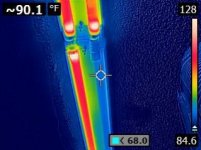
What experience is that? Well, I have a four-lamp T8 fluorescent fixture in which one of my fluorescent bulbs burnt out this weekend. I just replaced it with one of those LED bulbs that fits the fluorescent fixtures. I happen to have a FLIR thermal imaging camera, which gives me a very clear picture of how much heat things are generating. My image of the 4-bulb fixture clearly shows the 3 fluorescent bulbs, which show as red (120 degrees) and, at the ends, white (130 degrees). In the image, it's almost impossible to make out the LED bulb, because it is the same temp as my ceiling. The LED bulb is barely generating any heat, while the fluorescent bulbs are generating lots of heat.

As for the math, my fluorescent bulbs are 32W and 2400 lumens (75 lumens per Watt). My LED bulb is 12W and 1600 lumens (133 lumens per Watt). The LED is nearly twice as efficient as the fluorescent bulb. Admittedly, the LED is producing 33% less light, but that would not explain the fact that the fluorescent bulbs are 120-130 degrees while the LED bulb is operating at just above room temperature.

So neither the math nor the thermal image seem to support your suggestion that fluorescent and LED T8 bulbs are equally efficient and put out the same amount of heat for a given amount of lumens. I am open-minded and willing to consider a reasoned argument to the contrary, which is why I posted my original question. But someone is going to have to do better than a conclusory assertion to overcome the math and the photo that seem to support my original conclusion.
 

Attachments

  • FLIR0036.jpg
    FLIR0036.jpg
    14.8 KB · Views: 43

jreineri

New member
Joined
Mar 11, 2016
Messages
4
Here is a very interesting chart showing various light source effeciencies:

https://www.mge.com/saving-energy/home/lighting/lumens-comparison.htm

The most interesting take-away is the very wide range of efficiency within each single technology.

High pressure sodium is very efficient, but expensive and have a relatively short life. Also, terrible color for shop.

Here is another chart showing relative lumen output for various technologies. http://www.thelightbulb.co.uk/resources/lumens_watts

An interesting chart at http://lumennow.org/lumens-vs-watts/ shows that for incandecent bulbs the large wattage bulbs give higher lumen per watt. Suggesting that fewer large wattage bulbs are more efficient that more smaller wattage bulbs. For example, 600 watts of 100 watt bulbs gives 9600 lumens, but 600 watts worth of 60 watt bulbs gives 800 lumens.

Also, there is this: http://www.cree.com/News-and-Events/Cree-News/Press-Releases/2014/March/300LPW-LED-barrier. This is manufacturer marketing noise, but still indicates that the other chart showing a best case of 100 lumens per watt has been significantly improved on. I think it is reasonable to expect to find to be able to get LEDs that are twice as efficient as fluorescent.

I would do the LED conversion. Because you get much more the better efficiency with LED. You get a better quality of light with LED (be careful to choose color temperature wisely, Home Depot has an in store display that shows this quite well). Much longer 'bulb' life. An LED might 'burn out', but I have never seen it happen. However, I have occasionally seen the power supply (that converts the 120v AC to the DC needed by the LED) fail on a couple of occasions.

One note about your wattage/heat calculations. They seem to assume that all of the electricity is converted to heat, this is not the case. A previous responder said that a fluorescent is about 40% efficient. In that case a 10 watt fluorescent would produce 6 watts of heat rather than 10.

Jim
 
Last edited:
OP
K

Kelby

Member
Joined
Jun 21, 2016
Messages
8
Jim,

Great stuff! Thanks!

On your last point, that's a good point. Of course, all light ultimately ends up turning into heat. (Eg., the light hits the black case on my cordless drill and warms the case rather than being reflected to some other portion of the shop.) So it's all heat in the end. But the amount of light that ultimately turns into heat is similar whether we're talking about fluorescent or LED, so the inefficiency is really where the unnecessary heat generation exists. But ultimately, the photo aI ttached above shows the result I was hoping to achieve, so the LED conversion will go forward!

Thanks.
 

hnsy

Well-known member
Joined
May 3, 2015
Messages
111
Looks good, but you will save even more, because you can probably remove your ballasts, whichl consume considerable wattage and creating heat, themselves.

I agree here, Costco sells Feit fixtures reasonably cheap, I bought 8 of them when renovating my garage. Low heat, super bright. I couldn't be happier with them.
 

jtpfarm

Active member
Joined
Mar 6, 2015
Messages
28
LEDs definitely run cooler. Grab a fluorescent bulb after an hour of runtime and compare it to an LED. The LED is cooler.

Efficiency and comparisons are many times inaccurate. This is due to the fact that LEDs project all of there light downward where fluorescent throw their light 360 degrees. That means half the light needs to be reflected back to the ground. In theory it take less rated lumens from an LED vs a fluorescent to get the same amount of light to the ground.

Switching to LEDs will definitely take BTUs out of your shop.
 

cybrdyke

Well-known member
Joined
Sep 9, 2014
Messages
3,444
Location
USA
LED and T8 fluorescent are actually pretty close in efficiency. As such, they also put out about the same amount of heat per lumen of light.
I suppose if you compared a 32w fluorescent system to a 32w LED system, this could be true. But, seeing as how you can get the same delivered lumens by using 50% of the energy, you would have 50% of the heat.

Is it more cost effective to replace the T12's with T8's at this point than to replace all the fluorescents with LEDs?
Using the lamps in the OP's hypothetical, if your kwHr rate was 10 cents and you ran your lights for 1000 hours per year, you would pay:
5.90 per year for 2 lamps F32T8 and get approx 3400 delivered lumens
2.90 per year for 2 lamp 12T8 LED and get approx 3200 delivered lumens
Obviously, the longer your burn hours are, the quicker your payback is.
Your mileage may vary.


Looks good, but you will save even more, because you can probably remove your ballasts, whichl consume considerable wattage and creating heat, themselves.
A T8 electronic ballast running 2 lamps consumes approximately 4 watts.
It will run at somewhere between 40c - 60c, depending on environmental cirmcumstances.

You probably get more heat from the ballast than from the bulbs.
Definitely true.

LEDs definitely run cooler. Grab a fluorescent bulb after an hour of runtime and compare it to an LED. The LED is cooler.

Efficiency and comparisons are many times inaccurate. This is due to the fact that LEDs project all of there light downward where fluorescent throw their light 360 degrees. That means half the light needs to be reflected back to the ground. In theory it take less rated lumens from an LED vs a fluorescent to get the same amount of light to the ground.

Switching to LEDs will definitely take BTUs out of your shop.
Well said. This is why the OP's 1600 lumen LED lamps are as bright as his 2800 lumen T8's, while using 50% less energy and running significantly cooler. Even the ballast is running cooler since it's not loaded as much.
CD
 

ForceFed70

Well-known member
Joined
Apr 27, 2010
Messages
3,441
Location
BC, Canada
Guys. All you need to look at is efficiency. AKA "Lumens per watt". Don't overcomplicate this.

Every bit of wasted efficiency in a lighting system turns into heat. Therefore the lighting system with the most efficiency produces the least amount of waste heat for the same amount of usable light.

When you compare lumens per watt of LED vs T8 fluorescent you'll find some interesting data. Which basically boils down to this:
- Average T8 is MORE efficient than LED retrofit (socket style)
- Average T8 and cheap LED fixture are usually on par with each other with regard to efficiency. There are cheap LED fixtures out there that are LESS efficient than standard T8.
- Average T8 is less efficient than well designed and much more expensive LED fixture. But even then - we're talking about 10% improvement.

By all means, bust out google and start doing some research - you'll find similar. HID is actually MORE efficient than LED, but isn't typically used for a few reasons.
 
Last edited:

ForceFed70

Well-known member
Joined
Apr 27, 2010
Messages
3,441
Location
BC, Canada
I suppose if you compared a 32w fluorescent system to a 32w LED system, this could be true. But, seeing as how you can get the same delivered lumens by using 50% of the energy, you would have 50% of the heat.

You'll have to show me the datasheet. Most I've seen is approx 10% improvement over T8.
 

ForceFed70

Well-known member
Joined
Apr 27, 2010
Messages
3,441
Location
BC, Canada
Is it more cost effective to replace the T12's with T8's at this point than to replace all the fluorescents with LEDs?

This is hard to answer. You'd need to do the ROI calcs. The LED fixtures with significant efficiency improvements over T8 counterparts aren't cheap.

It really depends on how much you pay for electricity, how many hours a day the lights are on, cost of cooling/climate, etc.
 
To avoid these ads, REGISTER NOW!

My Old Tools

Well-known member
Joined
Jun 4, 2014
Messages
5,435
Location
Hamrick Lake, TX
Guys. All you need to look at is efficiency. AKA "Lumens per watt". Don't overcomplicate this.

Every bit of wasted efficiency in a lighting system turns into heat. Therefore the lighting system with the most efficiency produces the least amount of waste heat for the same amount of usable light.

When you compare lumens per watt of LED vs T8 fluorescent you'll find some interesting data. Which basically boils down to this:
- Average T8 is MORE efficient than LED retrofit (socket style)
- Average T8 and cheap LED fixture are usually on par with each other with regard to efficiency. There are cheap LED fixtures out there that are LESS efficient than standard T8.
- Average T8 is less efficient than well designed and much more expensive LED fixture. But even then - we're talking about 10% improvement.

By all means, bust out google and start doing some research - you'll find similar. HID is actually MORE efficient than LED, but isn't typically used for a few reasons.

Only true if you can find a T8 tube that puts all of its light down. Since half of it goes up it's already half as efficient as the LED bulb. The studies you cite consider all the light generated, not the useful light directed downward.
 

ForceFed70

Well-known member
Joined
Apr 27, 2010
Messages
3,441
Location
BC, Canada
As for the math, my fluorescent bulbs are 32W and 2400 lumens (75 lumens per Watt). My LED bulb is 12W and 1600 lumens (133 lumens per Watt). The LED is nearly twice as efficient as the fluorescent bulb. Admittedly, the LED is producing 33% less light, but that would not explain the fact that the fluorescent bulbs are 120-130 degrees while the LED bulb is operating at just above room temperature.

Your math is using some extremes here.

Cheap T8 is 2800 lumens for 32w lamp. For a $3 or $4 more, you can buy lamps approaching 3000lumens for 32W lamp.

133 lumens/watt is VERY good for an LED fixture. That's higher than any datasheet I've read, and a can't help but question the number. There have been a few instances where it's been found that the manufacturer's claims in this regard are not accurate. Is this a reputable manufacturer? Do you have the datasheet? 110lumens/watt is typically the most you'll see from a LED fixture, tho I'll admit that it's been nearly a year since I went searching through datasheets and it's possible there have been some major advancements.
 

ForceFed70

Well-known member
Joined
Apr 27, 2010
Messages
3,441
Location
BC, Canada
Only true if you can find a T8 tube that puts all of its light down. Since half of it goes up it's already half as efficient as the LED bulb. The studies you cite consider all the light generated, not the useful light directed downward.

I reccomend more research and study here.

1st - yes, output pattern and reflector design does come into play. But to say 50% of light is lost is completely wrong.

2nd - This is also a consideration with LED. LED light as you've mentioned is directional. The problem is that it's TOO directional. Manufacturers must find ways to deal with the spotlight pattern a LED produces. They do this by adding materials to help diffuse the light and they also commonly rely on reflectors to change the patterns and promote additional "overlap" of the light pattern. Both of those processes result in lost light. So long story short - to assume there is no similar loss of output from LED is not correct. Tho I will certainly admit that losses are higher with T8.
 
Last edited:

rlitman

Well-known member
Joined
Oct 18, 2010
Messages
24,596
Location
Long Island
Respectfully, you're going to have to explain that, because it doesn't seem consistent with the math or with my practical experience....
So neither the math nor the thermal image seem to support your suggestion that fluorescent and LED T8 bulbs are equally efficient and put out the same amount of heat for a given amount of lumens...

I would take that thermal image comparison with a grain of salt. Without knowing the relative emissivities of the bulbs, it can be very misleading.

Still, I'm with you that LED beats T8 for efficiency. However, there is a bigger step up in efficiency going from T12 to T8 (and a correspondingly lower associated cost), than there is from T8 fluorescent to LED. The question is where is the tradeoff makes the most sense.

Look at it this way, driving the same miles, you will save much more in gasoline by changing from a vehicle that does 6MPG to a vehicle that does 12MPG, than from going from 12MPG to 18MPG, even though both steps have the same improvement of 6MPG.

All that being said, I just purchased a new T8 fixture for a walk-in closet, and fitted it with a pair of 17W 2100 lumen LED bulbs (they're $10 a piece at the local HD). I find it to be just a touch brighter than when using normal T8 bulbs, and the difference was important to me.

Still, I'm not swapping out my existing T8 bulbs to LED any time soon (though I'd consider it if I used them a lot), but if I had any remaining T12 fixtures, I'd get them swapped out ASAP.
 

cybrdyke

Well-known member
Joined
Sep 9, 2014
Messages
3,444
Location
USA
You'll have to show me the datasheet. Most I've seen is approx 10% improvement over T8.

This was a response to your comment. It is hypothetical. There is no 32w LED tube (that I know of). What I meant by my comment is...if there WAS a 32w LED system to compare to a 32w fluorescent system, you could be right. But there isn't, so we'll never know.
CD
 

cybrdyke

Well-known member
Joined
Sep 9, 2014
Messages
3,444
Location
USA
Guys. All you need to look at is efficiency. AKA "Lumens per watt". Don't overcomplicate this.

Sorry, but I actually think that the OP is trying to figure out actual BTU's and your comments are more relative to percentages.

I'll try to explain using a 2 lamp set up.

The T8 system uses 59 watts and is 40% efficient. (+/-)
The equivalent LED system uses 29 watts and is 40% efficient. (+/-)

The T8 lamps put out 4928 lumens without factoring in fixture losses.
The LED lamps put out 3200 lumens. There are no fixture losses.

The T8 system is 83.52 lpw
The LED system is 110.34 lpw

As for "heat per lumen", this is a statistic not found in nature. If you care to figure out that formula, I'd be interested. But seeing has how the LED can deliver more lumens to target at 50% energy, it's a clear winner.
CD
 
OP
K

Kelby

Member
Joined
Jun 21, 2016
Messages
8
Your math is using some extremes here.

Cheap T8 is 2800 lumens for 32w lamp. For a $3 or $4 more, you can buy lamps approaching 3000lumens for 32W lamp.

133 lumens/watt is VERY good for an LED fixture. That's higher than any datasheet I've read, and a can't help but question the number. There have been a few instances where it's been found that the manufacturer's claims in this regard are not accurate. Is this a reputable manufacturer? Do you have the datasheet? 110lumens/watt is typically the most you'll see from a LED fixture, tho I'll admit that it's been nearly a year since I went searching through datasheets and it's possible there have been some major advancements.

Thanks. I'm using a Sylvania OSRAM 12W bulb, 4.1k temp. I don't know how reputable Sylvania is, but here's the data sheet. https://assets.sylvania.com/assets/Documents/LED465.d4a378b6-879b-4ff9-b2a0-0a89b472b554.pdf
 

ForceFed70

Well-known member
Joined
Apr 27, 2010
Messages
3,441
Location
BC, Canada
Thanks. I'm using a Sylvania OSRAM 12W bulb, 4.1k temp. I don't know how reputable Sylvania is, but here's the data sheet. https://assets.sylvania.com/assets/Documents/LED465.d4a378b6-879b-4ff9-b2a0-0a89b472b554.pdf

Thanks.

Sylvania is pretty reputable actually. The last page tells us what we need to know. Your 12W lamps produce an impressive 112lumens/watt.

What's even more impressive is the 15.5W version that produce 125+ lumens/watt.

Looking at the datasheet tho, this appears to be a retrofit lamp that requires the use of the existing T8 ballast. That ballast will eat up a few watts itself and will drive down the efficiency as a result.

Looks like near 130lumens/watt would be achievable using this technology if applied to a dedicated (non-retrofit) fixture.


Let's do some calculations based on your fixture's datasheet, some educated guesses, and a fairly typical T8 fixture.

T8 = 90 lumens/watt - 20% reflector loss = usable 72lumen/watt
12W LED retrofit = 112 lumens/watt - 15% ballast loss - 5% reflector loss = usable 90 lumen/watt.

Your lighting is roughly 25% more efficient than a standard T8 equivalent.

Also - check out this neat article from a magazine dedicated to LED lighting. It analyzed data published by DOE (department of energy) Long story short - DOE analyzed light output from 31 different T8 retrofit kits of a variety of types and brands. Lots of great data there, most telling was that despite their manufacturer ratings only 8 of the 31 exceeded 100lumens/watt of output. Many performed worse than T8 reference lamps. Their end conclusion was "LEDs now ready to compete with T8 in efficiency, but still lag behind in regard to light quality". Important to note tho, the data is 3 years old and your lights aren't one of the ones tested. I suspect newer versions would perform better.
http://www.ledsmagazine.com/article...proved-performance-but-lumen-output-lags.html

A lot can happen in 3 years, but according to DOE, 3 years ago LED and T8 were pretty much on par with each other.
 
Last edited:
OP
K

Kelby

Member
Joined
Jun 21, 2016
Messages
8
Thanks, ForceFed70.

I'm curious: Why did you include a 15% ballast loss for the LED, but not for the T8? Doesn't the ballast chew up an equal amount of power regardless of whether it's hooked up to an LED or T8?
 

ForceFed70

Well-known member
Joined
Apr 27, 2010
Messages
3,441
Location
BC, Canada
Thanks, ForceFed70.

I'm curious: Why did you include a 15% ballast loss for the LED, but not for the T8? Doesn't the ballast chew up an equal amount of power regardless of whether it's hooked up to an LED or T8?

Very good question.

With T8, the wattage show on the lamp is total wattage including the ballast. Not wattage of just the lamp. That's actually true for any ballast/lamp combo. Wattage through the lamp only is closer to 28W.

It's an unfortunate old system from back when there was only 1 ballast design and efficiency didn't change.
 

cybrdyke

Well-known member
Joined
Sep 9, 2014
Messages
3,444
Location
USA
Kelby said:
Why did you include a 15% ballast loss for the LED, but not for the T8? Doesn't the ballast chew up an equal amount of power regardless of whether it's hooked up to an LED or T8?
It's not 15%. The literature states that it 2.5 watts per tube.

T8 = 90 lumens/watt - 20% reflector loss = usable 72lumen/watt
12W LED retrofit = 112 lumens/watt - 15% ballast loss - 5% reflector loss = usable 90 lumen/watt.

Your lighting is roughly 25% more efficient than a standard T8 equivalent.
Using actual figures...

Standard 2 lamp T8 "usable lumens" is 2 x 2800 lumens x .88 ballast factor x 75% fixture losses / 59 watts = 62.64 lumens/watt.

2 lamp 12w Sylvania LED "usable lumens" is 2 x 1600 (no ballast factor or fixture losses) / 29 watts = 110.3 lumens/watt

The Sylvania lamp with a 150 beam angle is not too tight to be directional, nor is there any fixture losses.

Your lighting system is roughly 40% more efficient than a standard T8, but you will be using 50% less energy.

Although if this comparison was done when both systems are brand new, you would have approximately 400 fewer lumens with the LED lamps, this would even out over time.
 
Last edited:

CMillet86

Member
Joined
Mar 29, 2014
Messages
6
Lots of technical reading in here, that I haven't read at the moment. But real world experience from me. We have started switching our 6000 FT shop to LEDs, we have dual bulb 8 foot fixtures, using 8 FT LEDs from Hyperikon. So far we've switched 30 or so out 76 or so fixtures. The difference in heat on the ceiling panels is 10 Degress where the LEDs are vs the Flourescents. Climb a ladder and go up to the 16 ft ceiling and the air up there is noticeably cooler around the LEDs also. Our A/C also works much better now.
 
OP
K

Kelby

Member
Joined
Jun 21, 2016
Messages
8
CMillet86, thanks for sharing your experience. That seems consistent with my math and my thermal image. I'm hoping to get the same kind of results in terms of the A/C not having to work as hard. Right now, it's struggling to keep up on hot days with all the heat coming from outside and from the lights and motors inside.

I'll keep everyone posted with results as the project progresses.
 

CMillet86

Member
Joined
Mar 29, 2014
Messages
6
We are in the same situation, we are admittedly undersized on our Tonnage, but we have very little money in the systems as is. And doing the other stuff to help will only help us in the long run when we upgrade systems.
 
To avoid these ads, REGISTER NOW!
Top Bottom