I'll try to summarize my process including the good and bad and helpful info.
Background:
New house finished 8/2014. Completely custom design. Two separate garages, one double side-entry mainly for wife and kids stuff and one single with extra space for me to use. I decided to do the 2-car garage first as it gets the most use and I use my space for lots of projects and it gets abused.
Process:
I rented diamabrush on floor buffer from local HD. It worked well to "scuff" the floor but I didn't feel that it really prepped the floor as well as it should. The directions from home depot specifically said not to add weight to the machine. The weight of the machine wasn't enough to get the rough side of the diamabrush against the floor and the very edge of the abrasive blades were a little worn. If I put lots of pressure against the machine it worked very well. I've seen a variety of machines used here and some look way heavier than others. I would definitely recommend using a heavy machine that really removes a layer of floor. I think the easiest way to determine this is by how much dust you are making!
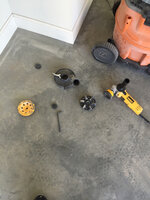
I used a handheld grinder (in picture) with a wire brush, diamabrush ($60 at HD) and concrete grinding disc to work the edges and level where I filled the control joints. This worked really well.
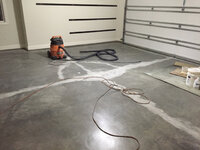
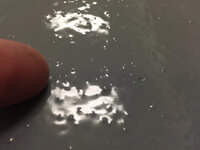
I used the Legacy Xtreme set 100 crack and joint filler. Man does that stuff set up fast! Again one of my main reasons for choosing this system was speed. I'd recommend only mixing small batches and using a generic ketchup dispenser as suggested by Legacy. Having help for this part would be very helpful. Basically you fill the joints and cracks with very fine "play sand" that I got at HD. I found that using a large squeege to level the sand in the joint worked well. You might even want to add extra sand above the joint. I ended up doing about 4 "rounds" before i was satisfied. Completely set up and ready to grind in 30 minutes. Other than the fast set-up time this stuff is awesome.
http://www.legacyindustrial.net/pro...atings/xtreme-set-100-crack-joint-filler.html
Nohr-S Polyurea:
I chose Nohr-S because I am very busy with work and 3 small kids. Projects that should take a week take me a month and I'm sure many of you know what I mean. I was willing to pay a little more to make this a faster process than traditional epoxy. I also frequently have interruptions and an unlimited pot-life was very attractive. Advantages of Nohr-S: (from legacy)
No A&B to mix
Unlimited Pot-Life
Gloss finish - similar to epoxy
Available clear or pigmented
Excellent chem and wear resistance
Fast recoats (1-2 Hours)
Aliphatic Chemistry (superior to aromatic)
I used 18" wide 1/4" nap epoxy rollers that I got from Amazon. I did the base/primer coat with just the gray pigment pack in 2 gallons per directions. You can see the gray color in the photos above. Total garage sq-ft is 556 and I was able to do it with 2 gallons. I cut in the edges with a 4" brush and had taped off the baseboard vertically. Man this stuff is thick! The only problem that I had was that as I was laying down with the roller, the product got a little thick/tacky and the roller would pull up and leave a texture that was very similar to what it might look like with the soft skid fine media. Legacy recommends using a 3/8" nap roller so this might be my fault. I was initially worried that my prep wasn't adequate or that there was "outgassing" or moisture in the floor that was going to be catastrauphic but in retrospect I think that after gently mixing in the pigment in my 2-gallon "batch" there was enough air introduced that the product began to set-up and got too thick/sticky and the roller was just pulling it up as I went. I didn't mind too much because I was going to add soft-skid to the final coat anyway and avoiding having a very slick surface was a safetly priority anyway. If you want a glass smooth surface you might need to make some adjustments and hopefully Scotty from Legacy will chime in here.
Final coat went on in a very similar fashion without a hitch. Outside temp was around 40 degrees and it did take about 3 hours for the surface to be tack free and ready to recoat. I decided to go bold for the final coat and mixed half gray and half black color for the remaining 2.5-3 gallons. I also added the fine texture soft-skid to the final coat.
Summary:
We didn't park or drive on the surface for 8 days. So far it has held up perfectly. I love it and more importantly the WAF is sky high. I love the dark color even though it shows a lot of dirt because when clean it is awesome looking. Even with the fine soft skid it is very easy to mop clean. Now I can just blow out the dirt and mop clean in about 10 minutes.
I'm planning on painting over the builder flat paint and doing the celing, adding overhead storage, cabinets etc. I'll update as I progress!
I welcome questions and will try to add helpful info for the garage journal community as I have benefited greatly from your collective wisdom. I'm sure I left out a lot of details. I'll try to take some more detailed pictures and add them as I have time!
Thanks also to Scotty from Legacy Industrial who was awesome to work with!