To avoid these ads, REGISTER NOW!

Lengthen solid wire that's too short (Camper)

mrjaw14

Well-known member
Joined
May 22, 2012
Messages
1,958
Location
Nashville, TN
My FIL just bought a new camper. Has about a 4" square access panel where the power cord connects to the RV. Just inside is a junction box. Whoever last repaired the power cable did an abysmal job, and the wiring has gotten so hot the wire nuts have melted and I see black char on the inside walls of the box! I've never seen the charred remains of a wire nut before, that was interesting. The wire exiting the box going into the RV is solid conductor UF type wire and it's stretched tight with no slack. All the wire in the junction box is no good, and I may have to go a few inches to get good wire. Then the wire is outside the junction box. I can barely get one hand in to work on this.

I do a lot of electrical work on campers and such, but it's always on stranded wire. I'd normally use a heat shrink lined **** splice on stranded wire. I know I can't use that on solid. I generally say wire nuts in vehicles or RV's are a no-no. Other than a regular wire nut, what can I use on solid #10 wire that will likely see 25+ Amps? It'll get hot, all RV's do that have a 30A plug. it's not uncommon for people's male 30A plugs to melt, but I've not seen the interior junction this bad before.
 
To avoid these ads, REGISTER NOW!

matt_i

Well-known member
Joined
Mar 14, 2008
Messages
10,741
Location
SE Michigan
Can you use the old wire to pull in (fish) some new THHN or UF wires? Not totally sure how far it goes to the destination or how many hold-downs there would be inside (guessing pretty few). You could potentially upgrade to #8 to get a wire that's not going to go over-temp. That would be the one-stop-no-more-messing-with-it-solution in my mind.

Other than that my opinion is you'd have to solder. Seeing as it already gets hot, would need a long joint to disperse the heat, and hopefully you can get a big iron in there to solder the #10 or larger conductors.
 

LXCam

ALLIANCE MEMBER
Joined
Apr 23, 2013
Messages
19,182
Location
AZ
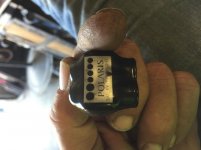
Can you get away with using this style **** splice It sounds like you might need to remove the junction box to get to some clean wire though.


IMG_2076.jpg

IMG_2075.jpg
 
OP
M

mrjaw14

Well-known member
Joined
May 22, 2012
Messages
1,958
Location
Nashville, TN
The wire is stapled to the wall studs, and I can't access it, otherwise I'd pull some THHN in a heartbeat. that's what I usually do is situations like this. But the wire is not accessible without disassembling the wall unfortunately.

I like the set screw lug type splice. I'll try to source something like that got 10 ga wire
 

wyliesdiesels

Well-known member
Joined
Aug 14, 2012
Messages
20,067
Location
Modesto, CA
My FIL just bought a new camper. Has about a 4" square access panel where the power cord connects to the RV. Just inside is a junction box. Whoever last repaired the power cable did an abysmal job, and the wiring has gotten so hot the wire nuts have melted and I see black char on the inside walls of the box! I've never seen the charred remains of a wire nut before, that was interesting. The wire exiting the box going into the RV is solid conductor UF type wire and it's stretched tight with no slack. All the wire in the junction box is no good, and I may have to go a few inches to get good wire. Then the wire is outside the junction box. I can barely get one hand in to work on this.

I do a lot of electrical work on campers and such, but it's always on stranded wire. I'd normally use a heat shrink lined **** splice on stranded wire. I know I can't use that on solid. I generally say wire nuts in vehicles or RV's are a no-no. Other than a regular wire nut, what can I use on solid #10 wire that will likely see 25+ Amps? It'll get hot, all RV's do that have a 30A plug. it's not uncommon for people's male 30A plugs to melt, but I've not seen the interior junction this bad before.

Which wire are we talking about? The power cord that goes from the pedestal to the breaker panel?

And #10 building wire is rated for 30a minimum(NM-b is limited to 60* c ampacity; THWN is 35a), so it shouldnt be getting hot nor melting. If the 30a plugs are getting so hot theyre melting, it means there is more than 30a flowing through them. Wouldnt surprise me if the breaker is the wrong size.
 
OP
M

mrjaw14

Well-known member
Joined
May 22, 2012
Messages
1,958
Location
Nashville, TN
RV's either have 30a service or 50a. This RV is 30a. It's not uncommon for a large 30A RV to pull damn near 30A almost constantly, especially if it has more than one AC unit. I have a really nice power box on mine that I keep a watch on my load, and I don't let it get over 80%. This RV's previous owners weren't so caring. It's shore power cable terminates to a normal metal junction box onto solid wire via wire nuts. I have a standing rule not to use wire nuts on anything that moves due to vibration, and they aren't sealed. They either allow moisture in and the termination ends up corroding, or if it's indoors the junction fails due to vibration and starts arcing. I think the latter is what happened here. The inside of the box is the worst I've ever seen as far a charred wires. There was a blob of melted black plastic with what used to be the metal part of a wire nut in it LOL

The 30A male connectors melting happens all the time because the pedestal outlets don't make good contact after they're well used, and the camp grounds don't change them out until they just don't work anymore. Also people are known to not clean the corrosion off the male ends. I've seen them almost black with surface corrosion. 5 minuets with emery cloth does the trick, but most people don't do that. In either case, doesn't make good contact and it heats up to the point of failure. I've seen male ends melt, continue to get used, moisture gets in and green and black corrosion migrates literally feet into the wire. By the time I get it, I have to cut 3-5 feet into the wire, 6 inches at a time, to get back to good shiny copper again.

I've given it some thought and I'm not going to repair with wire nuts. the only other options were wagos or screw lug types. the wagos don't work on fine stranded wire, so the only other option is the screw lug type. that's the most expensive, but the best of the options to join solid and fine stranded #10 wire so hopefully this doesn't happen again. Going to require some doing to work practically one handed given the access requirements, which is why I really wanted wagos to work. but alas the shore cables are fine stranded so no go.
 
Last edited:

tyme2par4

Well-known member
Joined
May 16, 2016
Messages
571
Location
NH
Wait, who says you can't use solid wire in a **** splice?!
All splices I know of, are good for solid or stranded.
 

BuffettFan

Well-known member
Joined
Jul 11, 2017
Messages
10,910
Location
Central Illinois
I've not had any experience wiring AC power in an RV, but do have a bit of experience wiring AC in marine applications.
Solid wire on a boat is not acceptable due to the vibration of the boat when under way causing fatigue and eventual failure of the wire, usually at a connection point.
I would expect the same would go for an RV application, wouldn't it?
Might be a lot more work, but if it were me, I'd bite the bullet and open up the wall.
Sounds like there may be some more suspect wiring hiding.
 
To avoid these ads, REGISTER NOW!

American Locomotive

Well-known member
Joined
Jan 8, 2017
Messages
11,010
Location
Rhode Island
I've not had any experience wiring AC power in an RV, but do have a bit of experience wiring AC in marine applications.
Solid wire on a boat is not acceptable due to the vibration of the boat when under way causing fatigue and eventual failure of the wire, usually at a connection point.
I would expect the same would go for an RV application, wouldn't it?
Might be a lot more work, but if it were me, I'd bite the bullet and open up the wall.
Sounds like there may be some more suspect wiring hiding.
I've seen more than one RV and Camper use standard solid-core NM-B cable for all the outlets. Honestly surprised not more of them burn to the ground.
 
OP
M

mrjaw14

Well-known member
Joined
May 22, 2012
Messages
1,958
Location
Nashville, TN
I've not had any experience wiring AC power in an RV, but do have a bit of experience wiring AC in marine applications.
Solid wire on a boat is not acceptable due to the vibration of the boat when under way causing fatigue and eventual failure of the wire, usually at a connection point.
I would expect the same would go for an RV application, wouldn't it?
Might be a lot more work, but if it were me, I'd bite the bullet and open up the wall.
Sounds like there may be some more suspect wiring hiding.


I agree 100%. I prefer to use stranded wire in anything that moves, and use proper termination practices. That's why I'm having such an issue with this. The owner isn't going to tear the walls out for a re-wire, so unfortunately all I have to work with is about 6" of solid wire. :headscrat

I'm thinking about using Alumiconns. they are intended for AL to Cu retrofits, but they're listed for 10ga solid and stranded Cu. they're small enough to go in junction boxes. Only downside is they're expensive. My only concern is the lug screws loosening over time, but they can be periodically tightenend.

darn I wish the lever wagos went to 10ga!
 
Last edited:

arkieguide

Well-known member
Joined
Aug 10, 2017
Messages
50
i think slid wire in a camper/RV is a dumb idea - but its done, now to fix it.i have no problem with scotch lok, are wire nuts, on solid wire if right size is used & done right. Fill wire nuts etc, with good caulking before putting on wires to stop are lessen corrosion.It may pay you to increase size of the box to gain a little slack to work with. You could also use screw connectors on the solid wire but they take up more room.Another way use stak on copper splice caps and the wire end to end but side by side and use tool to crimp the connector's.Then you can use heat shrink insulation. Good luck on this one.
 
OP
M

mrjaw14

Well-known member
Joined
May 22, 2012
Messages
1,958
Location
Nashville, TN
I do have a nice ratcheting double-crimp tool. I've considered using an AMP or Molex brand double-crimp **** splice; something that states it's ok for solid wire. I just normally have a fundamental issue crimping solid wire
 
Last edited:

reader2580

Well-known member
Joined
Dec 31, 2014
Messages
14,570
Location
Minneapolis, MN
As already mentioned it is common to use solid NM-B in RVs. I would use the Polaris connectors someone pointed out.

I have a converted bus I wired myself. I used marine grade cable that is finely stranded. Marine wire is UL listed, but the listing is for marine use, not RV use. Lots of arguments about using it in RVs due to the UL listing.
 

Dragfluid

ALLIANCE MEMBER
Joined
Sep 15, 2013
Messages
17,649
Location
Pillager, MN
i think slid wire in a camper/RV is a dumb idea - but its done, now to fix it.i have no problem with scotch lok, are wire nuts, on solid wire if right size is used & done right. Fill wire nuts etc, with good caulking before putting on wires to stop are lessen corrosion.It may pay you to increase size of the box to gain a little slack to work with. You could also use screw connectors on the solid wire but they take up more room.Another way use stak on copper splice caps and the wire end to end but side by side and use tool to crimp the connector's.Then you can use heat shrink insulation. Good luck on this one.

Ummmm,,,,,,,,,,, WHAT?!

No, not a good idea. I have a problem with people using them on low voltage as it is.
 

wyliesdiesels

Well-known member
Joined
Aug 14, 2012
Messages
20,067
Location
Modesto, CA
i think slid wire in a camper/RV is a dumb idea - but its done, now to fix it.i have no problem with scotch lok, are wire nuts, on solid wire if right size is used & done right. Fill wire nuts etc, with good caulking before putting on wires to stop are lessen corrosion.It may pay you to increase size of the box to gain a little slack to work with. You could also use screw connectors on the solid wire but they take up more room.Another way use stak on copper splice caps and the wire end to end but side by side and use tool to crimp the connector's.Then you can use heat shrink insulation. Good luck on this one.

Scotch-lok as in IDC connectors?

Those are for low voltage.

Ummmm,,,,,,,,,,, WHAT?!

No, not a good idea. I have a problem with people using them on low voltage as it is.

Whats wrong with them? I use them on all the phone wiring i do and never have any issues with them.
 
OP
M

mrjaw14

Well-known member
Joined
May 22, 2012
Messages
1,958
Location
Nashville, TN
Thank you everyone for the replies. I've decided to use a screw terminal style connector. The reason is for serviceability. if I use a crimp, then to take it loose if the shore power cable had to be replaced in the future, I'd have to cut into the rest of the wire that I already don't have enough of. With a screw terminal I can leave that portion of the wiring alone to service the shore power cable. The Polaris ones seem like they are for large feeder cable. Alumiconn connectors seem like they will be the ticket
 

Dragfluid

ALLIANCE MEMBER
Joined
Sep 15, 2013
Messages
17,649
Location
Pillager, MN
Scotch-lok as in IDC connectors?

Those are for low voltage.


Whats wrong with them? I use them on all the phone wiring i do and never have any issues with them.

Wylie, the first thing I think about when someone mentions SL's are the morons that use them in automotive. Never gave what you just mentioned a thought.
 
To avoid these ads, REGISTER NOW!
Top Bottom