

You are using an out of date browser. It may not display this or other websites correctly.
You should upgrade or use an alternative browser.
You should upgrade or use an alternative browser.
Lets see those wood burning stoves!!
- Thread starter bski224
- Start date
rickycobra
Well-known member
- Joined
- Sep 9, 2010
- Messages
- 292
Thinking about putting wood burning stove in new garage. Any inputs or pics!!
How much wood doe s a wood burning stove go through?
sixt8 berd
Well-known member
My parents have a wood burning stove and a wood burning furnace in their house. That is all they heat the house with all winter.
Its a lot of work but it helps them save money since they get the wood for free. It would be pretty expensive if they had to buy the wood.
Its a lot of work but it helps them save money since they get the wood for free. It would be pretty expensive if they had to buy the wood.
Drdaves49
Well-known member
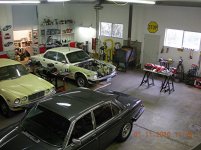
After 3 yrs I'm still tryin to figure out how the hell mine works. It's my understanding that the PO burned wood and or metal shavings with waste oil dripped on them.....well good luck...lol.....any ideas?
Attachments


electrodude
Well-known member
The cost depends on where you are. I live out in the country, I can have a cord of split wood delivered for about $100, all fir or better (no pine). I also collect up pallets during the year, breaking them down and cutting them to length with my chopsaw. They make excellent kindling and I've burned the oak ones at night for better coals.
If you're a normal person (unlike my mom who would kill woodstoves by stoking them up to seam melting temperatures) you should get by on somwhere between 2-4 cords per winter. There's too many factors to judge how much you'll burn, but a suggestion is to find an older, good condition, quality stove (pre-EPA regulated). The reason being is that the newer stoves are harder to damp down as effectively as the old ones. Getting a good coal bed going and damping the stove down well, I can keep a fire in an older Earth Stove "Princess" (smallest model they had) for at least 6 hours.
My first job at seven years old was stacking firewood in long ricks to sell. I got $2
If you're a normal person (unlike my mom who would kill woodstoves by stoking them up to seam melting temperatures) you should get by on somwhere between 2-4 cords per winter. There's too many factors to judge how much you'll burn, but a suggestion is to find an older, good condition, quality stove (pre-EPA regulated). The reason being is that the newer stoves are harder to damp down as effectively as the old ones. Getting a good coal bed going and damping the stove down well, I can keep a fire in an older Earth Stove "Princess" (smallest model they had) for at least 6 hours.
My first job at seven years old was stacking firewood in long ricks to sell. I got $2
electrodude
Well-known member
After 3 yrs I'm still tryin to figure out how the hell mine works. It's my understanding that the PO burned wood and or metal shavings with waste oil dripped on them.....well good luck...lol.....any ideas?
That's a heck of a shop stove! If they were burning metal chips, they were probably soaking them in used oil and dumping them in the stove. I don't see any oil tank there that you would use with a drip line to feed a fire. We had a setup like that in my grandfathers logging shop, it had a large reservoir tank to the side that would gravity feed into the firebox, once the fire got going good enough, turn on the blower and be prepared to open all the doors! Of course, our stove would fit whole pallets in it too...
5lima30
Well-known member
I had a woodburning stove (airtight) in my previous house. My new house has a gas log fireplace and a gas log stove heater. I never had any problems with my wood burner. BTW you need a good chimney of proper diameter. and length in order for it to "draw" properly.
Drdaves49
Well-known member
That's a heck of a shop stove! If they were burning metal chips, they were probably soaking them in used oil and dumping them in the stove. I don't see any oil tank there that you would use with a drip line to feed a fire. We had a setup like that in my grandfathers logging shop, it had a large reservoir tank to the side that would gravity feed into the firebox, once the fire got going good enough, turn on the blower and be prepared to open all the doors! Of course, our stove would fit whole pallets in it too...
If ya look at the top of the stove there is a line the runs over and thru the wall to a barrel outside. If you look close you can see the handle, up close to the wall.
It had no damper ,air gaps everywhere and the chimney come out of the roof at about 18". There is was no kind of air regulator. From what I gather he put the chips or shavings in and dripped the oil on them. He used to get it so hot in the shop that he always had the doors open in the middle of winter.Specs.
2'wide
little over 2'high and about 4 feet long
the chimney is 7" coming out of the stove closing down to 6" coming out of the roof.
I'm beginning to think it's a joke stove.......gets my blood boiling and I don't need it.....

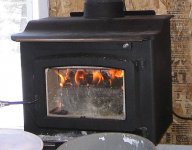
Just got done testing this guy out. From a 32 degree start it was able to attain a 10 degree per hour rise and maintain 70 degrees while outside temperature went as low as 10 degrees. Heated about 700 square feet. Burned a mixture of Oak, Pine and **** softwood. All Oak would have been window opening time.
How efficient is this woodstove? After using the trick where you use a 6" section of double wall pipe to allow the incoming fresh air to be preheated by the stove pipe, you could go outside and place your bare hand on the single wall stovepipe 12" after it exits the building.
How efficient is this woodstove? After using the trick where you use a 6" section of double wall pipe to allow the incoming fresh air to be preheated by the stove pipe, you could go outside and place your bare hand on the single wall stovepipe 12" after it exits the building.
Attachments


rwhite692
Well-known member
Wood stoves are incredible. It's all we heat our house with in the winter, and we burn through a good 4-5 cords each year. It doesn't just keep the house a bearable temperature either, it can get HOT. Every wood stove should come with a kettle of water to boil on top, this keeps the inside of your house from drying out.
I've always noticed that with the wood stove vs. the gas heat, the wood stove has a much nicer humid feeling to it whereas the regular heat is always dry and unbearable.
Our gas heat will come on and heat the house up, then shut off, and it gets cold again. It's never comfortable when we use it. The wood stove is always cooking, and it keeps everything nice and warm all the time.
I've always noticed that with the wood stove vs. the gas heat, the wood stove has a much nicer humid feeling to it whereas the regular heat is always dry and unbearable.
Our gas heat will come on and heat the house up, then shut off, and it gets cold again. It's never comfortable when we use it. The wood stove is always cooking, and it keeps everything nice and warm all the time.
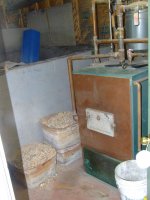
What is that?
First thing, check with your insurance company. They may say "No way, Jose" on the stove in the garage.
Then, put one of these outside.
Ign
Well-known member
Thinking about putting wood burning stove in new garage. Any inputs or pics!!
Yep, I bet you'll find loads of info in the Heating and A/C forum on this board:
http://www.garagejournal.com/forum/forumdisplay.php?f=26
RAYJAY
Well-known member


What is that?
What is what? The picture is an outdoor wood boiler. All the smoke/mess is outside. No danger of fire inside the building. Water is circulated into the building(s) to be heated. Mine is a Central Boiler brand. Note the snow on the roof - they are very well insulated. Heats my house and all domestic hot water. Could easily add another building to the system.
Or were you referring to an insurance company?!?
Drdaves49
Well-known member
I've decided to scrap this stove I have......maybe hang a reznor, I think it would probably be cheaper to run nat. gas than burn wood or oil, at least with what I have, that thing scares me. Plus it'd open up more room.
cre73
Well-known member
I burn wood exclusively for heat in the house and the shop and love it. It is a little extra work but its worth every penny it saves. Plus the stove in the shop creates a gathering place after the work is done. Stoke the fire and have a cold one. Can't beat it.
jerseywild
Well-known member
First thing, check with your insurance company. They may say "No way, Jose" on the stove in the garage.
Then, put one of these outside.
Better check with the local code office, they may say no way! They may require EPA certification.
RAYJAY
Well-known member
I've decided to scrap this stove I have......maybe hang a reznor, I think it would probably be cheaper to run nat. gas than burn wood or oil, at least with what I have, that thing scares me. Plus it'd open up more room.
I went from burning NG reznor in my garage to the coal burner my cost saving is close to 150 to 200 per month installing the coal burner
Here's mine, as seen a few times in my thread.


No, the picture, of course.
I'm going to look into them based on your post, but I would be very surprised if my town or state allows them.
I'm going to look into them based on your post, but I would be very surprised if my town or state allows them.
What is what? The picture is an outdoor wood boiler. All the smoke/mess is outside. No danger of fire inside the building. Water is circulated into the building(s) to be heated. Mine is a Central Boiler brand. Note the snow on the roof - they are very well insulated. Heats my house and all domestic hot water. Could easily add another building to the system.
Or were you referring to an insurance company?!?
Kevin54
MEMBER EMERITUS
How does everyone dispose of their ashes? To the dump, garden, or where?
How does everyone dispose of their ashes? To the dump, garden, or where?
Right on top of the piles of dog ****, which are piled along the creek.
Found info for my state. Need to check town next. I am copying the info below. Other folks from Mass might find it useful, but it's long, so skip it if you don't care.
Taken from: http://www.mass.gov/dep/air/community/burnwood.htm#owfb
Given the high costs of oil and natural gas, a growing number of people in Massachusetts and elsewhere across the country are looking at outdoor hydronic heaters (wood-fired boilers) as potential money-saving solutions for heating their homes. These units are typically located outside the buildings they heat in small, insulated sheds with short smokestacks (usually no more than six to ten feet tall). They burn wood to heat water that is piped underground to provide heat and hot water to occupied buildings.
Outdoor wood-fired boilers can be substantially dirtier and less efficient than other home heating technologies. An investigation by the New York State Attorney General's Environmental Protection Bureau found that even when used properly, one of these units can emit as much fine particle pollution as:
* 2 heavy-duty diesel trucks
* 12 EPA-certified indoor wood stoves
* 45 passenger cars
* 1,000 homes with oil heat
* 1,800 homes with natural gas heat
NESCAUM, the Clean Air Association of the Northeast States, has also completed an Assessment of Outdoor Wood-Fired Boilers.
With their large, smoldering fires and short smokestacks, outdoor wood boilers create heavy smoke and release it close to the ground, where it lingers and exposes everyone in the area to nuisance conditions and health risks. Although these units are designed to burn dry, seasoned wood, some people use them to burn green wood, which generates much more smoke, and even household trash or construction debris, which not only can release a harmful array of chemicals but is also against state law.
The U.S. Environmental Protection Agency (EPA) has established a voluntary program that encourages manufacturers of outdoor wood-fired boilers to develop and distribute cleaner-burning and more efficient units. EPA issues a consumer label for any model that is submitted for testing and pollutes 70 percent less (Phase 1 "orange tag") or 90 percent less (Phase 2 "white tag") than less efficient units.
Under MassDEP regulations issued in December 2008:
* Only those outdoor hydronic heaters that are EPA Phase 2 "white tag" qualified and whose manufacturers have filed compliance certifications with MassDEP may be sold for installation in Massachusetts. See a list of currently certified units.
* New units must be located minimum distances away from property lines and neighbors' dwellings (determined by their heat output ratings and specific uses), meet minimum smokestack height requirements, burn only clean seasoned wood, and cause no nuisances or conditions of air pollution.
* Existing units (those in operation before December 26, 2008) are not required to be EPA Phase 2 "white tag" qualified, but like new units are subject to minimum smokestack height requirements, must burn only clean seasoned wood, and may not cause nuisances or conditions of air pollution.
Along with MassDEP, towns and cities - through their building, health, police and fire departments - are authorized to enforce specific provisions of the outdoor hydronic heater regulation. Some municipalities have enacted by-laws or ordinances that prohibit or limit the use of outdoor wood-fired boilers.
Even when units are operated according to manufacturers' instructions, they can sometimes create nuisance conditions that are prohibited by state air quality regulations. MassDEP and local boards of health have taken enforcement actions against people who own and operate units that have caused excessive odor or smoke. Regardless of how much a unit might have cost to install, sometimes the only way to resolve the nuisance conditions an outdoor wood boiler creates is to stop using it permanently.
If you are thinking about buying an outdoor wood-fired boiler, first check to be sure it is legal to install and operate one in your community, and if so, whether there are any specific restrictions you need to know about. Second, consider the impacts an outdoor wood-fired boiler could have on your neighbors and their property. Finally, if you do purchase a unit, never use it to burn anything other than dry firewood, and to the extent you can, operate it only during the cold weather months.
Taken from: http://www.mass.gov/dep/air/community/burnwood.htm#owfb
Given the high costs of oil and natural gas, a growing number of people in Massachusetts and elsewhere across the country are looking at outdoor hydronic heaters (wood-fired boilers) as potential money-saving solutions for heating their homes. These units are typically located outside the buildings they heat in small, insulated sheds with short smokestacks (usually no more than six to ten feet tall). They burn wood to heat water that is piped underground to provide heat and hot water to occupied buildings.
Outdoor wood-fired boilers can be substantially dirtier and less efficient than other home heating technologies. An investigation by the New York State Attorney General's Environmental Protection Bureau found that even when used properly, one of these units can emit as much fine particle pollution as:
* 2 heavy-duty diesel trucks
* 12 EPA-certified indoor wood stoves
* 45 passenger cars
* 1,000 homes with oil heat
* 1,800 homes with natural gas heat
NESCAUM, the Clean Air Association of the Northeast States, has also completed an Assessment of Outdoor Wood-Fired Boilers.
With their large, smoldering fires and short smokestacks, outdoor wood boilers create heavy smoke and release it close to the ground, where it lingers and exposes everyone in the area to nuisance conditions and health risks. Although these units are designed to burn dry, seasoned wood, some people use them to burn green wood, which generates much more smoke, and even household trash or construction debris, which not only can release a harmful array of chemicals but is also against state law.
The U.S. Environmental Protection Agency (EPA) has established a voluntary program that encourages manufacturers of outdoor wood-fired boilers to develop and distribute cleaner-burning and more efficient units. EPA issues a consumer label for any model that is submitted for testing and pollutes 70 percent less (Phase 1 "orange tag") or 90 percent less (Phase 2 "white tag") than less efficient units.
Under MassDEP regulations issued in December 2008:
* Only those outdoor hydronic heaters that are EPA Phase 2 "white tag" qualified and whose manufacturers have filed compliance certifications with MassDEP may be sold for installation in Massachusetts. See a list of currently certified units.
* New units must be located minimum distances away from property lines and neighbors' dwellings (determined by their heat output ratings and specific uses), meet minimum smokestack height requirements, burn only clean seasoned wood, and cause no nuisances or conditions of air pollution.
* Existing units (those in operation before December 26, 2008) are not required to be EPA Phase 2 "white tag" qualified, but like new units are subject to minimum smokestack height requirements, must burn only clean seasoned wood, and may not cause nuisances or conditions of air pollution.
Along with MassDEP, towns and cities - through their building, health, police and fire departments - are authorized to enforce specific provisions of the outdoor hydronic heater regulation. Some municipalities have enacted by-laws or ordinances that prohibit or limit the use of outdoor wood-fired boilers.
Even when units are operated according to manufacturers' instructions, they can sometimes create nuisance conditions that are prohibited by state air quality regulations. MassDEP and local boards of health have taken enforcement actions against people who own and operate units that have caused excessive odor or smoke. Regardless of how much a unit might have cost to install, sometimes the only way to resolve the nuisance conditions an outdoor wood boiler creates is to stop using it permanently.
If you are thinking about buying an outdoor wood-fired boiler, first check to be sure it is legal to install and operate one in your community, and if so, whether there are any specific restrictions you need to know about. Second, consider the impacts an outdoor wood-fired boiler could have on your neighbors and their property. Finally, if you do purchase a unit, never use it to burn anything other than dry firewood, and to the extent you can, operate it only during the cold weather months.
strokerace
Member
- Joined
- Feb 27, 2010
- Messages
- 22
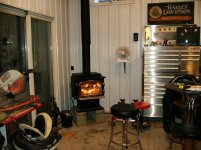
I only heat a couple days a week. Take the chill off with a couple electric heaters while the fire gets going. I have not bought wood in at least ten years.Took a big oak down when I built the shop and the county took one down in front of my place a couple years ago.
Attachments
dlenkewich
Well-known member
Looking at one now for the shop.
Not cheap to buy off the batt, at about $3k(There's never any used ones around, people keep them for life!) for the chimney and stove rated at 1500SF, but I like the idea of wood heat vs gas/elec, and the idea of sitting by it for beer time like someone else mentioned.
Not cheap to buy off the batt, at about $3k(There's never any used ones around, people keep them for life!) for the chimney and stove rated at 1500SF, but I like the idea of wood heat vs gas/elec, and the idea of sitting by it for beer time like someone else mentioned.
EuroVt
Well-known member
I would echo what Bull said. We have a ton of those outdoor boilers around here. This is probably an unpopular opinion, but I think they need to be heavily regulated.
I would echo what Bull said. We have a ton of those outdoor boilers around here. This is probably an unpopular opinion, but I think they need to be heavily regulated.
Do you find them to be stinky?
My research indicates that after the EPA devised new regulations for the efficiency of these unit s a few years ago, my town voted to remove the moratorium on them. That news was from a few years ago, though. I have not found anything written about my town's current policy.
Crazy Car Guy
Well-known member
i am using 2 indoor add on wood/coal furnaces but the kicker is they are both set up out side. 1 is out of the 70s' and off the back of the garage it has a 15 x 18" duct 5 ft long witch gives me around 4 ft of clearance and i can paint spill gas ect while heating with coal. it will run you out fast i have a scored from the county dump box fan propped up about 12" from the back to create a positive pressure and some boiler insoulation on it to hold the heat in the stove. keep in mind its in a 15x24 temp building.
the 2nd one is from tsc 1557m if i rember right it has 2x8" ducts all insulated blowing the air in the house and it heats well over 2000 sq ft too good most days. i cannot handle the dust / mess inside but love the price of coal heat and not having a fire hazard inside. i keep it under roof with 2 open sides. and have zero regrets in putting it out side even though there supposed to go in a basement or the likes.
we have no building codes no nothing here. 3 am air hammer going full tilt in the drive way with the stereo up as loud as it can possibly go to drown out the air hammer is perfectly acceptable here no neighbors no codes no complaints!
the 2nd one is from tsc 1557m if i rember right it has 2x8" ducts all insulated blowing the air in the house and it heats well over 2000 sq ft too good most days. i cannot handle the dust / mess inside but love the price of coal heat and not having a fire hazard inside. i keep it under roof with 2 open sides. and have zero regrets in putting it out side even though there supposed to go in a basement or the likes.
we have no building codes no nothing here. 3 am air hammer going full tilt in the drive way with the stereo up as loud as it can possibly go to drown out the air hammer is perfectly acceptable here no neighbors no codes no complaints!
Drdaves49
Well-known member
I went from burning NG reznor in my garage to the coal burner my cost saving is close to 150 to 200 per month installing the coal burner
Problem being ,Oregon doesn't have coal....at least no one I know has ever heard of it. It's wood here.....
MScott
Well-known member
Do you find them to be stinky?QUOTE]
Whether they are stinky or not depends on what is burned in them. Because they can burn **** wood and garbage, some inconsiderate people do just that and the result stinks. Well seasoned dry wood (at least to me,) is pleasant smelling and smells like "country."
When there is a cold air inversion hanging around with no wind, I have seen outdoor boilers create so much smoke that went straight down to the ground. There have been several instances of that smoke obscuring the high way so badly, accidents have occurred.
MScott
Well-known member
That too, is a function of what is being burned. Wet, unseasoned wood will produce a lot of smoke and this will happen whether the stove is indoors or outside.
Rockerbox1
Well-known member
the house I just sold a couple of months ago, I had a huge Newmac wood furnace in the basement. I would burn roughly a rick of wood per week, and it kept my house on average 78 to 88 degrees. I mean, 3 degrees outside, and inside I sit around in a pair of shorts, no socks, no shirt, and sometimes had a window or two cracked open.
the first year I owned that house, we installed a 90+ efficiency lp furnace and it still cost us about $700 month in lp to keep the house at 62 degrees.
house was 1.5 story over a basement 1900 sqft. built in 1939 when coal was cheaper than insulation.
at $40 rick seasoned and split wood, $150 to $160 per month in the winter for heat is a hell of a lot cheaper than lp gas
the first year I owned that house, we installed a 90+ efficiency lp furnace and it still cost us about $700 month in lp to keep the house at 62 degrees.
house was 1.5 story over a basement 1900 sqft. built in 1939 when coal was cheaper than insulation.
at $40 rick seasoned and split wood, $150 to $160 per month in the winter for heat is a hell of a lot cheaper than lp gas
Lippyp
Well-known member
This is the woodstove we have in our house in France is pretty much the main source of heat, its a UK brand called a clearview, thats a fairly small one and puts out some serious heat, will stay in all night but we do only burn seasoned hardwood, mostly oak. I'd buy another in a heartbeat, its so easy to light, completely controllable, turning the air damper down is like turning down a gas burner and the real beauty is the glass never ever gets dirty. They also do two different back boilers, one that just does a hot water supply and a full on one that will run radiators around the house.
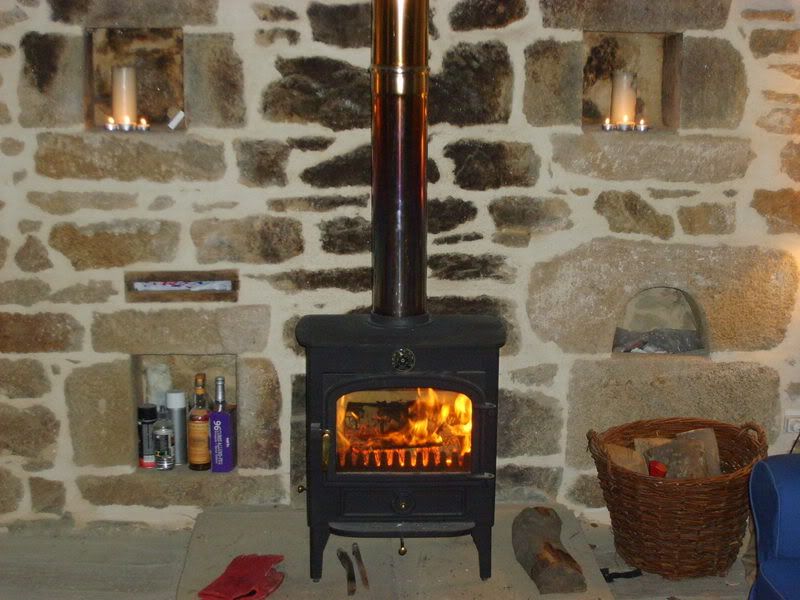
I want a woodburner when I finally get a decent sized garage, it may not end up as fancy as a clearview though as they are pretty pricey. Most likely may end up with one home built from a 47kg Propane bottle.
I want a woodburner when I finally get a decent sized garage, it may not end up as fancy as a clearview though as they are pretty pricey. Most likely may end up with one home built from a 47kg Propane bottle.