To avoid these ads, REGISTER NOW!

let's see your craftsman block grinders

exmaxima1

Well-known member
Joined
Jun 25, 2011
Messages
6,339
Location
Midwest
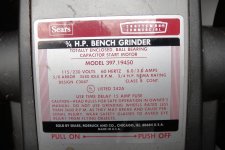
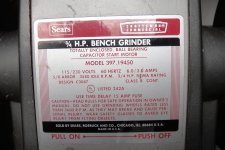
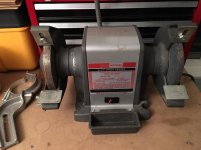
I had promised myself that I would not go out today and fight the malls and traffic, yet hours later I made a 70 mile trip to pick up yet another grinder I don't really need. But I have to admit, it looks barely used and in great shape.
 

Attachments

  • DSC02525.jpg
    DSC02525.jpg
    36.4 KB · Views: 78
  • DSC02526.JPG
    DSC02526.JPG
    143.7 KB · Views: 71
  • DSC02532.jpg
    DSC02532.jpg
    146 KB · Views: 30
Last edited:
To avoid these ads, REGISTER NOW!

drivesitfar

Well-known member
Joined
Oct 23, 2013
Messages
36,006
Location
Pacific Northwest
Doc: thanks for the links. i'm still wondering if we can re purpose old grinding stones. maybe not putting them on a grinder spinning at 1750 or 3600 RPM, but maybe some use instead of just dumping them?

EX: well i truly see why you picked up that one. i like the older design a bit better but that 3/4 HP has the bigger tool rests and water tray and the original stand. i don't care what you paid for it, but i bet it was also a great buy.

congrats
 

McBrownie

Well-known member
Joined
Mar 27, 2014
Messages
1,827
Location
Cleveland, OH
I had promised myself that I would not go out today and fight the malls and traffic, yet hours later I made a 70 mile trip to pick up yet another grinder I don't really need. But I have to admit, it looks barely used and in great shape.

A 3/4hp is hard to pass up, especially in that condition. Nice job finding one of the big boys. :rocker:
 

exmaxima1

Well-known member
Joined
Jun 25, 2011
Messages
6,339
Location
Midwest
EX: well i truly see why you picked up that one. i like the older design a bit better but that 3/4 HP has the bigger tool rests and water tray and the original stand. i don't care what you paid for it, but i bet it was also a great buy.

congrats

I agree with you on the older style, and I still have a 3/4 block like that with the deluxe base. The newer style should be more powerful since they draw more amps, but the old style (especially the 1/2hp cap start) hits the "sweet spot" for most users. I suspect the tolerances were closer for the older blocks, so they made more power with less amperage, or maybe because they were wound for a lower voltage of that era, but whatever the reason they run great.
 

exmaxima1

Well-known member
Joined
Jun 25, 2011
Messages
6,339
Location
Midwest
Set four up recently on my two Rockwell 7" and they run very nicely. Also two for my Rockwell 6"

I have a Rockwell 7" as well as the Rockwell 6" (made by Baldor). Be honest, Doc, those machines are in a different realm from the blocks, wouldn't you agree?
 

cbacres

Well-known member
Joined
May 28, 2010
Messages
5,998
Location
SW Florida
Hey CBAcres-
This looks like a crack forming to me. You might want to do a ring test on that wheel.

Rings right up, I could only see what looked like a crack when held at a certain angle in the sun.

Thanks for the notice at any rate, you never know.

The wheel is probably a original, I'll post. A picture later.
Craig
 

JZiggy

Well-known member
Joined
Dec 1, 2014
Messages
990
Location
Atlanta
Question -- would it be feasible to convert a block grinder that it not capacitor-start into a cap-start one? Is it just a matter of including a capacitor in the start coil circuit or is there more to it than that, or some other construction differences?
 

torqueman2002

Well-known member
Joined
Jun 3, 2009
Messages
6,139
Location
SE Michigan
Cap start setups usually have a switch which kicks out of circuit when it's upto speed.
Yup, at about 2/3 - 3/4 running speed the start-up circuit is de-energized.

The Packard Electric grinders (115) have the centrifugal starting switch on the rotor, like their regular motors.
The centrifugal switch is a pair of weights connected by springs, that slide an actuating sleeve.
The actuating sleeve engages or disengages a contact ring mounted on the end bell for the start windings, based on rpm.

The Delco grinders (397) and subsequent 257s have a starting relay instead.

I believe all of the 6" grinders were split-phase.
Some of the 7"x¾" grinders were split-phase.
Almost everything else was capacitor start.

I hope this helps.
 

McBrownie

Well-known member
Joined
Mar 27, 2014
Messages
1,827
Location
Cleveland, OH
Yup, at about 2/3 - 3/4 running speed the start-up circuit is de-energized.

The Packard Electric grinders (115) have the centrifugal starting switch on the rotor, like their regular motors.
The centrifugal switch is a pair of weights connected by springs, that slide an actuating sleeve.
The actuating sleeve engages or disengages a contact ring mounted on the end bell for the start windings, based on rpm.

The Delco grinders (397) and subsequent 257s have a starting relay instead.

I believe all of the 6" grinders were split-phase.
Some of the 7"x¾" grinders were split-phase.
Almost everything else was capacitor start.

I hope this helps.

Dr. TM,
Thanks for the quick response. The original question is was if a split-phase could be converted to a cap-start. What do you think?
 

torqueman2002

Well-known member
Joined
Jun 3, 2009
Messages
6,139
Location
SE Michigan
Question -- would it be feasible to convert a block grinder that it not capacitor-start into a cap-start one? Is it just a matter of including a capacitor in the start coil circuit or is there more to it than that, or some other construction differences?
I'm not an EE, but my understanding from this document is the motor is designed to use the specified capacitor to help over-come the at-rest inertia.

The start-up coil has thinner (and more) wire-windings than the main/run windings. The start-up switch/relay is used to open the start-up circuit at a pre-set speed to keep full current from going through the start-up coil.

A faulty (stuck closed start-up switch/relay) will damage the start-up winding - probably letting out the magic smoke.

Here's a link to a pdf document:
<table border="0" cellpadding="0" cellspacing="0" width="710"><colgroup><col style="mso-width-source:userset;mso-width-alt:22720;width:533pt" width="710"> </colgroup><tbody><tr style="height:14.25pt" height="19"> <td style="height:14.25pt;width:533pt" align="left" height="19" width="710">AC Induction Motor Fundamentals</td> </tr> <tr style="height:14.25pt" height="19"> <td style="height:14.25pt" align="left" height="19">Microchip AN887</td> </tr> <tr style="height:14.25pt" height="19"> <td style="height:14.25pt" align="left" height="19">Author: Rakesh Parekh</td> </tr> </tbody></table>
www.t-es-t.hu/download/microchip/an887a.pdf
 

torqueman2002

Well-known member
Joined
Jun 3, 2009
Messages
6,139
Location
SE Michigan
Dr. TM,
Thanks for the quick response. The original question is was if a split-phase could be converted to a cap-start. What do you think?
Sorry, for the delay in answering the original question.

It took me a bit to find the document I was looking for, see my post above.

I don't have the skills or knowledge to really answer the question, but from my read of the document I'd say the grinder and it's circuits/components need to be designed to work with a capacitor.

Cap%20Start%20AC%20Induction%20Motor.jpg
 
Last edited:

exmaxima1

Well-known member
Joined
Jun 25, 2011
Messages
6,339
Location
Midwest

I think that was off the Leeson site. Most interesting was the higher startup current of the Split Phase motor, which I never considered before. On a 1/2hp split phase block grinder, the inrush current can be (according to the article) upwards of 25 amps or more for a brief moment. That certainly explains why the switches get burned up even when rated for 15 amps. For now on I will use DPST switches for replacements with the contacts in parallel to provide higher current capacity and longer life.
 

exmaxima1

Well-known member
Joined
Jun 25, 2011
Messages
6,339
Location
Midwest
Dr. TM,
Thanks for the quick response. The original question is was if a split-phase could be converted to a cap-start. What do you think?

You could install a capacitor but you wouldn't get much, if any, benefit from it. The start windings in a split phase motor are purposely very thin to limit current, and the capacitor would add even more reactance (ac resistance). The cap would add some phase shift, which would help with the starting torque, but being in series with the high resistance coil its effectivemess would be minimal.

I guess the question is: why bother? The major advantages of the cap-start vs the split phase are higher starting torque and lower startup current. But once the wheels are spinning there are zero differences. Unless you are running massively heavy wheels---or a belt adapter---there really is little need for a cap-start machine. If you run wire wheels, like I do on one of my blocks, start up is so fast with either machine that it is completely moot.
 
To avoid these ads, REGISTER NOW!

alpinewhite

Well-known member
Joined
Aug 4, 2012
Messages
1,315
Location
Orange County, California, USA
You could install a capacitor but you wouldn't get much, if any, benefit from it. The start windings in a split phase motor are purposely very thin to limit current, and the capacitor would add even more reactance (ac resistance). The cap would add some phase shift, which would help with the starting torque, but being in series with the high resistance coil its effectivemess would be minimal.

I guess the question is: why bother? The major advantages of the cap-start vs the split phase are higher starting torque and lower startup current. But once the wheels are spinning there are zero differences. Unless you are running massively heavy wheels---or a belt adapter---there really is little need for a cap-start machine. If you run wire wheels, like I do on one of my blocks, start up is so fast with either machine that it is completely moot.
I agree with this. The motor was designed not to have a cap to correct the power factor. Adding one is not analogous to souping up a car engine. Leaving it as-is is what's best for it.
 

JZiggy

Well-known member
Joined
Dec 1, 2014
Messages
990
Location
Atlanta
I agree with this. The motor was designed not to have a cap to correct the power factor. Adding one is not analogous to souping up a car engine. Leaving it as-is is what's best for it.

Makes sense to me. The fact that the cap and non-cap grinders are designed differently is enough evidence in my opinion that simply adding a capacitor is not a good idea.

Other question: I have seen grinders with the standard 6" wheels and ones with different shields to accommodate larger wheels. Are the shield castings for 7" and 8" grinders the same, or are they different between those two sizes?
 

exmaxima1

Well-known member
Joined
Jun 25, 2011
Messages
6,339
Location
Midwest
Makes sense to me. The fact that the cap and non-cap grinders are designed differently is enough evidence in my opinion that simply adding a capacitor is not a good idea.

Other question: I have seen grinders with the standard 6" wheels and ones with different shields to accommodate larger wheels. Are the shield castings for 7" and 8" grinders the same, or are they different between those two sizes?

1/2 HP blocks come in 6 and 7 inch versions (split phase vs cap start commercial). They are different castings. The 7-inch has dust chutes at the rear. 3/4HP models are 7 or 8 inch, again split phase vs cap start. The 8 inch is yet another casting.
 

exmaxima1

Well-known member
Joined
Jun 25, 2011
Messages
6,339
Location
Midwest
I agree with this. The motor was designed not to have a cap to correct the power factor. Adding one is not analogous to souping up a car engine. Leaving it as-is is what's best for it.

I'm curious why you always say the capacitor is to "correct the power factor". Power factor correction is normally taken to mean that circuitry is used to eliminate the phase error between voltage and current in a factory's distributed power. Sometimes the correction requires capacitors, while other times it may require inductors.

In my experience, the role of the cap in a capacitor start motor is to intentionally force a current lag in the start winding---NOT to correct the lag (or power factor). Once the motor gets up to speed that circuit is switched out. Any "power factor correction" might be done upstream of the motor in the power line.
 

alpinewhite

Well-known member
Joined
Aug 4, 2012
Messages
1,315
Location
Orange County, California, USA
I'm curious why you always say the capacitor is to "correct the power factor". Power factor correction is normally taken to mean that circuitry is used to eliminate the phase error between voltage and current in a factory's distributed power. Sometimes the correction requires capacitors, while other times it may require inductors.

In my experience, the role of the cap in a capacitor start motor is to intentionally force a current lag in the start winding---NOT to correct the lag (or power factor). Once the motor gets up to speed that circuit is switched out. Any "power factor correction" might be done upstream of the motor in the power line.

I'm not a motor expert but from what I remember in school, inductive loads such as motors don't have a power factor of 1. A capacitor changes the power factor in the opposite direction that an inductor does, thus, equalizing them back to an ideal power factor of 1. Again, pardon my ignorance since I'm not a motor expert.
 

exmaxima1

Well-known member
Joined
Jun 25, 2011
Messages
6,339
Location
Midwest
I'm not a motor expert but from what I remember in school, inductive loads such as motors don't have a power factor of 1. A capacitor changes the power factor in the opposite direction that an inductor does, thus, equalizing them back to an ideal power factor of 1. Again, pardon my ignorance since I'm not a motor expert.

You are correct about using a capacitor for power factor correction, but that is not the only use of capacitors in industry. In single phase motors, capacitors are used to cause a phase shift in the magnetic field and induce rotation. Inside of motors, caps have nothing to do with power factor correction. One more note, PF is rarely a concern until you become a big energy user and find it more economical to correct it for electrical cost savings (mainly when power companies charge a penalty for it). With so many new lighting technologies, and electronic motor controls, it is not as prevalent as it was years ago.
 

mroneeyedboh

Well-known member
Joined
Dec 30, 2011
Messages
459
Hey guys
I have several of these available to me and I was wondering what is the difference between them quality wise? Are they pretty much all the same? Ive seen some with a metal toggle as the switch, some with a plastic toggle too. Whats a good price roughly as well? I know you cant be exact, but maybe a ball park?

Thanks guys!
 

nh_yota

Well-known member
Joined
Mar 10, 2015
Messages
4,076
Location
Seacoast New Hampshire
Just picked up this guy today - not bad for $25 I think. It's a 1/2 HP model which is almost exactly the same as the 1/3 HP model I picked up earlier this year. One of the previous owners had rigged up something on the left wheel which looks like a tool rest, but I'm not sure what it is (it's sitting off to the left of the grinder). Only parts missing are the eye shields - anyone know where I can get a spare set? I think I'll give this one to my dad for Christmas.

IMG_0353.jpg
 

torqueman2002

Well-known member
Joined
Jun 3, 2009
Messages
6,139
Location
SE Michigan
yota - See my comments in Blue.
Just picked up this guy today - not bad for $25 I think. I agree, nice price, and nice condition. :thumbup: ....

One of the previous owners had rigged up something on the left wheel which looks like a tool rest, but I'm not sure what it is (it's sitting off to the left of the grinder). That looks like a part of a CM tool sharpening attachment. See page #1 in the following link. http://www.garagejournal.com/forum/showthread.php?p=4000528#post4000528

Only parts missing are the eye shields - anyone know where I can get a spare set?
See page #3 in the link above.

I wouldn't trust those grinding stones. Replacements are good insurance, and available from:
ENCO - http://www.use-enco.com/CGI/INSRAR?PMSECT=0000000163
McMaster - http://www.mcmaster.com/#abrasive-grinding-wheels/=xk1v58
MCM - https://www.mscdirect.com/browse/tn...nch+&+Pedestal+Grinding+Wheels&navid=12100087

I think I'll give this one to my dad for Christmas.
That's a great present!
 

torqueman2002

Well-known member
Joined
Jun 3, 2009
Messages
6,139
Location
SE Michigan
Hey guys
I have several of these available to me and I was wondering what is the difference between them quality wise? Are they pretty much all the same? Ive seen some with a metal toggle as the switch, some with a plastic toggle too. Whats a good price roughly as well? I know you cant be exact, but maybe a ball park?

Thanks guys!
Capture%20Sep18.jpg

Pictures, prices, location, and travel ---- will help you get the information for which you are asking.
:)
 
Last edited:

exmaxima1

Well-known member
Joined
Jun 25, 2011
Messages
6,339
Location
Midwest
Just picked up this guy today - not bad for $25 I think. It's a 1/2 HP model which is almost exactly the same as the 1/3 HP model I picked up earlier this year. One of the previous owners had rigged up something on the left wheel which looks like a tool rest, but I'm not sure what it is (it's sitting off to the left of the grinder). Only parts missing are the eye shields - anyone know where I can get a spare set? I think I'll give this one to my dad for Christmas.

That bracket to the left is to mount a blade sharpener jig. Its useful for plane irons and chisels, if you can find the jig. Otherwise, sell it to me---I have the jig, but missing the bracket :)
 

Attachments

  • jig1.JPG
    jig1.JPG
    140.5 KB · Views: 30
Last edited:

sector9

Well-known member
Joined
Jun 17, 2012
Messages
62
Location
PA
Are you guys using anything special to paint or seal over the paint on the water quench tray?
 

torqueman2002

Well-known member
Joined
Jun 3, 2009
Messages
6,139
Location
SE Michigan
Are you guys using anything special to paint or seal over the paint on the water quench tray?
The ones I've done are 1st primed with Rustoleum and then color coated according to their directions.

To be honest though, I don't use the quench trays much, so they've stayed nice.
 
Last edited:

McBrownie

Well-known member
Joined
Mar 27, 2014
Messages
1,827
Location
Cleveland, OH
Are you guys using anything special to paint or seal over the paint on the water quench tray?

What seemed to help with my cast iron one was to fill it with Jasco Metal Prep and let that sit for a while to get rid of the rust. Then I degreased, sprayed on Rustoleum color, then clear. Like TM, I have never used it for a cooling tray. It's easier to use separate container in my option. It does make for a handy parts holder when grinding a bunch of bolts, etc...
 
Last edited:

sector9

Well-known member
Joined
Jun 17, 2012
Messages
62
Location
PA
Thanks for the input above guys.

Has anyone found a source for the little feet that go on the bottom of the heavy duty base? Supposed to be part 5219033 "Foot and screw assembly". They're quite different from the little rubber grommets that go on the grinder itself.

I looked in the hardware drawers at Lowe's and Home Depot and didn't find anything that fit
 

torqueman2002

Well-known member
Joined
Jun 3, 2009
Messages
6,139
Location
SE Michigan
To avoid these ads, REGISTER NOW!
Top Bottom