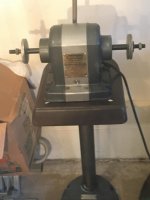
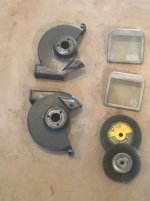
Thanks.
This bit of research has piqued my interest, too.
For instance, there are two
1955 CM tool catalogs on OWWM/VM websites. A
Power Tools Catalog and a
Mechanics' Tools Catalog.
From the
Power Tools Catalog.
1/4-HP 'Underwriters' Laboratory approved.' RT CI pre-Block, 44# $32.50.
1/3-HP 'Underwriters' Laboratory approved (Industrial Standards).', 'Heavy-duty production-type. Ideal for factories, machine shops, garages, mills, any place where a top quality, tough grinder is needed.', rear exhaust ports, RT CI pre-Block, 59#, $48.95.
1/2-HP 'Underwriters' Laboratory approved (Industrial Standards).' 'Built for industrial use...ideal for heavy work in machine shops and factories.' RT CI pre-Block, HD base. 85#, $66.95.
From the
Mechanics' Tools Catalog.
1/4-HP, UL Seal, CI RT pre-Block, $35.95.
1/3-HP, UL Seal, 'Larger, heavier, with more power and greater adjustment' than 1/3-HP, 59# vs. 44#, UL (Industrial Standards), rear exhaust ports, 7x3/4" grinding wheels, CI RT pre-Block. $49.95.
1/2-HP not included in catalog. ?!?
I thought maybe the
Mechanics' Tools Catalog came out prior to the
1955 Power Tools Catalog, but the prices are higher than they are in the
Power Tools Catalog and the 1/2-HP pre-Block was available in the 1954 catalog
.

Further surfing of some available CM tool catalogs on the OWWM/VM website did not reveal any technical changes from the
1954 introduction of the round top, pre-Block grinders.
The following shows the pricing of the pre-Block grinders.
1956
1/4-HP, $33.95
1/3-HP, $48.95
1/2-HP, $66.95
1957
1/4-HP, $37.95
1/3-HP, $53.95
1/2-HP not included in catalog
1958
no catalog available
1959@
1/4-HP, $35.95
1/3-HP, $51.95
1/2-HP, $72.95
1960 61 Power Tools
1/4-HP, $37.95
1/3-HP, $53.95
1/2-HP, $74.95
1960 Hand Tools: Mechanics, Carpenters, Plumbers, Electricians
1/4-HP, $38.95
1/3-HP, $54.95
1/2-HP, $75.95
1962 no catalog available
1963 Power Tools
1/4-HP, $38.95
1/3-HP, $55.95
1/2-HP, $76.95
@ Note: "The Recession of 1958, also known as the Eisenhower Recession, was a sharp worldwide economic downturn in 1958." "The effect on prices and costs was an apparent paradox, as prices continued to rise while production and employment were declining."
https://en.wikipedia.org/wiki/Recession_of_1958
OK, then why are the 1959 pre-Block prices less than the 1957 prices?
Remember - 'You can tune a piano, but you cannot tune a fish!'