Tinkerer2
Well-known member
Just upgrade your pressure washer to a 4 gpm unit and it'll be fine. 


There's no "setting"-- the correct way to adjust pressure washer operating pressure is to change orifice size on the tips.Really want to be careful washing vehicles with a pw. You can lift the paint.
Use lowest pressure setting if you must.
I’m in the market for a gas pressure washer. It’ll be used primarily for pressuring washing the house, driveway, sidewalks and washing cars.
I keep coming back to this 3400 psi Westinghouse available at Home Depot. It has the attachments I want.
Before I pull the trigger, are there any other pressure washers to consider? Anything specific I need for my applications? Budget is around $400.
Thanks,
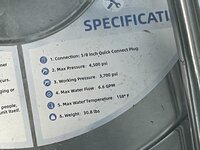
Mine has a pressure regulator integral to the pump. I can dial in 500 - 3500psi.There's no "setting"-- the correct way to adjust pressure washer operating pressure is to change orifice size on the tips.
That's probably an unloader and not a regulator. It's there to protect the pump, not to set your pressure.Mine has a pressure regulator integral to the pump. I can dial in 500 - 3500psi.
Yeah, it is the unloader have but used to also lower delivered pressure at the nozzle.That's probably an unloader and not a regulator. It's there to protect the pump, not to set your pressure.
If you set it too low, your pump is constantly recirculating water internally and will get hot. This is why you should never let a PW run for any period of time over a minute or so without using the lance. This is also why professionals use "snubber tanks" plumbing on the bypass so they can recirculate the water *externally* and not burn up the pump when or of they need to let the engine run awhile without using the lance.
Well ****, now you tell me. I could not find one thing on the Amazon listing showing any lower limit for gpm. Nor any chart showing surface cleaner size vs recommended gpm.
It's already on the UPS truck. Guess we're gonna find out.
ETA: Just read the Owner's Manual again: Nothing about max size for a surface washer: https://manuals.harborfreight.com/manuals/71000-71999/71100-193175528889.pdf
That's a common RoT that I've seen as well.Yep. They don't mention other tips and orifice sizes either. I think they don't want to imply the PW isn't really complete or discuss different psi for different items (cars, decks, fences, vinyl siding, wood siding, etc). They would probably be liable if they did.
The 4" to 5" per 1 gpm is something I found when I was researching surface cleaners.
It worked fine.That's not going to work well with a 2.8gpm washer... Too large


I'm really glad you got rhe result you wanted.It worked fine.
- Did I have to go slow? Yep
- Did I have to sometimes go over some spots? Yep, mostly when going backwards; it was easier going slow forward rather backing up.
- Was it effortless? Yep, we're talking just a fingertip to move forwards or backwards.
- Did I constantly have to fight it going airborne? Nope, not one bit.
- Is it perfect? Nope, but at my age, I'll take not killing myself (I'm looking at you HF surface cleaner) over "perfection" any day of the week.
I got pics showing the difference, I'll post them tomorrow. I got about twice as much done vs the HF version in about the same time with far less effort. I can tell no difference in cleaning effect.
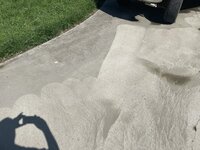
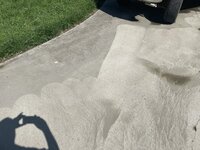
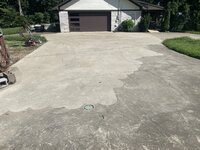
Here are some pics of what I need to surface clean:
Between my water hoses and 50' of high pressure hose, I hope to make it to the concrete spur leading to my pole barn (shown right of pic). You can just barely see the concrete spur just before the power pole, center of pic:
The concrete spur is more visible in the far right of this pic.
Thanks for the help!
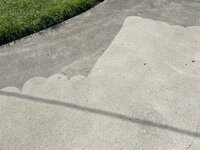
HF 14" on the left, Effortless 20" on the right:Where are the after photos?
...Find a good quality commercial spec pump. CAT, General, etc...
...Honda is the gold standard of small engines. Stick with them...
No doubt. For the vast majority of what I need doing (simple concrete cleaning) it works just fine, if a little slow. Where the cleaning efficiency falls flat on its face is a small area of the driveway up front and the front walkway - areas under my Black Walnut trees. I would say about 80% clean; which means I'll have to follow up with the wand at close range. It's a small area so no biggie.I'm really glad you got rhe result you wanted.
To be fair, I didn't say that it would not function, and most people would say that having to go slow and redo spots would be not working well. A smaller one would work better
So, could I fix part of the "too big SC" problem by changing out the nozzles to a different size orifice?Mike93lx is correct about it being too large for your pressure washer. Once should figure 4-5" in diameter per 1 gpm. So a 2.8 gpm machine should power a surface cleaner with a diameter of 11 - 14 inches.
20" surface cleaners usually have two 25020 nozzles. The 25 is the degree angle and the 20 (actually 2.0) is the orifice size.
I agree with 5ubtle that you might get 800 psi from your PW. However, you won't ever be able to get 6.6 gpm from your hose spigot as it probably only produces around 4 gallons per minute. For machines that have a higher gpm than your spigot supplies, you'd need a supply tank that is constantly being filled. Pulling 8 with a supply of 4 to try to keep from running out. But as some point the tank will get empty.
As far as a wheeled surface cleaner, I'd get one with 4 casters so you could use it straight, angled or side to side easily. Also note that a 14" wheeled version is measured from outside wheel to outside wheel. A 17" wheeled model would get you close to an actual 12 inch surface cleaner.
I missed the $400 part....List even one new PW with those for the $400 budget the OP posted. What you're recommending doesn't exist.
Outstanding answer! Thank you very much.Your nozzle spares are probably identical orifices as nozzles do wear out. Take a magnifying glass and look at the end or along the side and it may have size stamped on them.
[snip]
Hope this helps. Feel free to ask more questions.
Again I have pics of the nozzles, so I'll post them later.


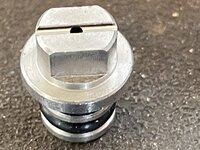


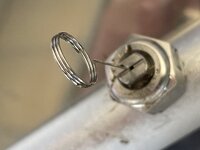





My PW and SC are at my daughter's house at the moment (please pray they don't destroy the PW!!!). But here are some pics of my SC:Looks a lot better. I'd pre-treat that dirty area with 50/50 bleach and water and let sit 15 - 20 minutes before using the surface cleaner. Get liquid pool bleach is you have a pool supply close by. Don't get pool bleach at walmart, etc as it sits on their shelf for long periods of time and will self degrade. The spots may never come out with your wand or SC but I bet a turbo nozzle will do it. May make it cleaner than the surrounding area.
Oh, a turbo nozzle will sound like a jet taking off. My neighbors come out and look around when I'm using mine.
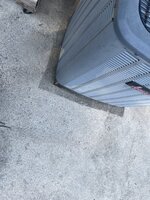
And be careful around the AC unit. You don't want to accidentally hit that with wand or turbo nozzle spray.
BTW, this is my surface cleaner Works great with my 3750psi 4gpm machine. And don't forget the vegetable oil. Does it have a hole where a zerk can be screwed into the hub at the base of the SC?
And scratch the 16" SC comment. I keep thinking that you were the OP with the 2.8 gpm machine.


Dunno; I've noticed one. You think that is AL or SS? If AL, I could easily drill and tap a hole for a zerk.Is there a hole anywhere on these vertical sides that might take a zerk?
Tagging @fatfillup in case he misses thisAre we still up for talking about pressure washers in 2025? Before it turns 2026?
@Hohn
@Tinkerer2
If so, then can we please talk about why my belt driven General Pump T 47 Series TS1021 4.8 GPM @ 3K PSI with a Suttner ST-261 Unloader does not appear to be moving any water period?
It is pre-fed by a float tank... I changed the water filter (new filter head, bigger screen, clear bowl, can see supply water flowing), I disassembled and cleaned the float valve, and I reverse flushed the supply line between the pump and the float tank... and was able to reverse fill the float tank via that supply line... so I KNOW that water is available to the pump, which is rated at 9 feet of suction head, and there is only 1 foot of rise between the bottom of the float tank and the entry to the pump.
Yet no water emerges at the port where the pressure hose would otherwise attach.
I removed the belt cover, and the belt is in tact, turns the pump sheave without slippage when driven by the 16 HP B&S Vanguard, which has only been run at idle for less than a minute at a time, since no water is emerging.
I'm not talking about pressurized water... I'm talking about ANY water flow period.
What I used to be able to do is run low pressure water through the pressure washer plumbing and boiler coil to clear out any little bits of mineral accumulation prior to connecting the pressure hose. It has been about 10 years since I last used this machine.
I disconnected the output line from the pump, that goes to a cross fitting that holds the unloader, and there was water in it... but I don't know if it was old water or new water.
I'm about to remove all 6 valve caps on this triplex pump to see if there is anything obviously evident. I am reticent to remove the head without a full set of new seals, and the special tools to remove and reseat them on hand.
I have a feeling that the issue is with the unloader, but I'm not sure how to isolate what the problem is. I don't want to disassemble things due to my ignorance of the simple things that could be the cause.
So let's talk. Tawk some sense to me. Tell me how to methodically tackle this problem, now that you know that I have already tackled the water supply.
Thanks!