To avoid these ads, REGISTER NOW!

Leveling a ceiling

morpheusmac

Active member
Joined
May 18, 2014
Messages
27
Location
Seattle, WA
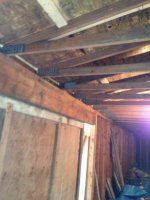
The bottom chord of my shop's trusses are pretty uneven (up to 5" in one location). The trusses are set 24" on center and I'd like to put up 5/8" drywall on the ceiling at some point when I am done wiring.

Would sistering steel studs to the bottom chord be an acceptable way to get it flat enough to throw up a lid?
 

Attachments

  • IMG_1374.jpg
    IMG_1374.jpg
    73.1 KB · Views: 119
To avoid these ads, REGISTER NOW!

Marctrees

Well-known member
Joined
Mar 5, 2015
Messages
6,265
Location
TX/LA border - Toledo Bend
Why steel rather than wood sister ?

But otherwise, if your bottom chords vary up to 5" something is very severely wrong.

I can't even imagine how that could be unless the building is basically needing total demo.

Marc
 

ddawg16

Well-known member
Joined
Jul 11, 2008
Messages
21,005
Location
S. California
The bottom chord of my shop's trusses are pretty uneven (up to 5" in one location). The trusses are set 24" on center and I'd like to put up 5/8" drywall on the ceiling at some point when I am done wiring.

Would sistering steel studs to the bottom chord be an acceptable way to get it flat enough to throw up a lid?

Why steel rather than wood sister ?

But otherwise, if your bottom chords vary up to 5" something is very severely wrong.

I can't even imagine how that could be unless the building is basically needing total demo.

Marc

My thoughts as well.

I'd run a string from end to end (top side of chord). The offending chords will be obvious....from there, start looking for the cause. Trusses are not supposed to have that much variation.

Also....consider running additional ceiling joists across. 24" Is right at the ragged edge for drywall....even 5/8".

If it was me, once the problem causer has been fixed, I'd run 2x6 or 2x8's sistered to the bottom chord and another between each truss with proper blocking. I would then be putting up 1/2" plywood on top of that new ceiling joists for light storage and it will also help to keep things lined up.
 

rieferman

Well-known member
Joined
May 18, 2009
Messages
2,586
Location
Collegeville PA (30 min west of Philly)
Keep in mind that not all trusses are designed to carry the weight of sheetrock etc. The old timers at the post-frame builder that I once worked for told me stories of undersized bottom cords snapping under the weight of ceiling enclosure and insulation - never witnessed it myself, just passing along something to consider.

Also my old boss would always remind me to keep in mind that trusses are typically designed to deflect/flex etc. Stiffening the bottom cord may work against the design of the truss.

All that said... if it were me, I'd figure out why some are so far out of wack, fix that issue, eyeball/gut check the strength of the trusses, add perpendicular 2x, install ceiling (consider steel ceiling... noisy, but fast and light, and no mudding or painting).
 

MoonRise

Well-known member
Joined
Nov 5, 2010
Messages
4,028
Location
NJ
Note: Not all trusses are 'rated' to even hold up a drywall ceiling. Check first.

Next, even if the trusses are 'rated' (designed) to hold up a drywall ceiling, if the trusses are bending/deflected 5" over the distance then drywall -might- not even be able to be physically installed.

And with trusses, you can NOT just willy-nilly go just attaching additional lumber or steel and drywall to those trusses.

Check first with the truss company and/or engineer(s).

Proceed from there.

If (big IF there) the trusses are designed to handle additional ceiling dead loads, then you MIGHT be able to frame up and attach to the trusses a ceiling sub-frame arrangement that is flat and level and have the drywall attached to THAT.
 

signcrafter

Well-known member
Joined
May 9, 2012
Messages
12,318
I could see maybe an inch depending on a lot of variables, but 5" is crazy unless the house has sunk or something. OP, have you checked how level the floor is? Are the walls all the same height from floor to trusses? How far of a span are your trusses covering from wall to wall and is there a load bearing wall in the middle?

If you decide that you can level your ceiling one product I have used is hat track.

https://www.google.com/search?q=hat...qOLjAhULRqwKHewoDF0Q_AUIESgB&biw=1517&bih=694.

If you scroll down you will see pictures and examples of how to use it. If you do use it make sure that you have a proper vapor barrier and insulation so you don't get thermal transfer in the metal.
 
OP
M

morpheusmac

Active member
Joined
May 18, 2014
Messages
27
Location
Seattle, WA
The building I believe was a pre-fab in the 70's, 2x4 exterior walls and t1-11 siding. Some foundation sinking has occurred over time as evidenced by a couple of cracks in the foundation. The trusses in the middle of the shop are pretty far off the string line I ran from end to end. The largest gap on the string line is 5" off the chord near the middle of the building.

I was thinking the steel would weigh less than sistering wood in order to make the lid relatively level.
 
To avoid these ads, REGISTER NOW!

Kaizen

Well-known member
Joined
Jan 9, 2015
Messages
6,944
Location
New England
Does the roof have a noticeable dip in it? Does it fan out from the center like 5-4.5-4-etc. or is it all over the place? If it was built wrong then sistering wood is fine. If it sunk or rotted fix that first


Sent from my iPhone using The Garage Journal mobile app
 

Marctrees

Well-known member
Joined
Mar 5, 2015
Messages
6,265
Location
TX/LA border - Toledo Bend
Morpheus - What are the building dimensions ?

Ridge length and Truss length ?

Are the top plates relatively stringline straight in both dimensions ?

You said "Cracks" in foundation... how big open wide/ elevation step are these cracks?

Is the ridgeline also sagging corresponding 5" or so ?

What I am asking is WHERE is the origin/ cause of these deviations ??

Are some truss plates hanging loose/ falling off ??

How can bottom chords be 5" off w/o the roof structure seriously coming apart ?

More info and photos needed.


Marc
 
Last edited:

Marctrees

Well-known member
Joined
Mar 5, 2015
Messages
6,265
Location
TX/LA border - Toledo Bend
Morpheus - I realize your OP was simply "steel sisters OK ?"...

But I think I can speak for many of us here saying there is way more to this than that possible band aid.

Marc
 

Fatboy148

Well-known member
Joined
Feb 15, 2017
Messages
999
Without consideration of future or continued settling of the building. Your easiest and least expensive way to get a flat ceiling in there would be to suspend a steel grid system and install your gypsum board to that.

Google:

"suspended gypsum board ceiling"
 
OP
M

morpheusmac

Active member
Joined
May 18, 2014
Messages
27
Location
Seattle, WA
This isn't a long term building. I am estimating 15-20 years before it is demoed for housing, hence the bandaid fix for leveling the ceiling. I understand that there is a more substantial problem with the building/foundation and that it will affect the lid over time.

The roof has a couple of minor dips in it but nothing horrendous. I re-roofed the shop a couple years back and replaced all the outer sheathing on the roof. The couple of foundation cracks have about 1/2" of gap about equal on each side. Probably a combination of foundation settling after poor foundation prep and a VERY cheap building.

The building is 48' x 28'
 

paredown

Well-known member
Joined
Jan 12, 2012
Messages
544
Location
Pomona, NY
I leveled the master bedroom ceiling in our house the way you are talking about--sistered light steel studs onto the sides of the joists. Clearly, nowhere near the area you are talking, and I was also working with standard 2x10 roof joists (flat roof), 16" OC.

The procedure was set the level line using a laser, and then checking for maximum (somewhere around 3"--in my case actual sag plus a section where water damage had caused some problems--and much to hard to correct because of the way this house was built.)

Not too difficult technically--I used screws to attach studs and used a tighter than standard spacing on sheetrock screws on 5/8" board in the field as well. I now have a pretty much dead flat ceiling and no one will know that it is a bit of a fake job, since the roof will (eventually) be redone using roof board built up. Settling does not (IME) mean that the building is going to fall down, if you have some idea of the root cause.

It is also pretty cheap to do that way as compared to a full suspended grid, since you can pick up steel stud pretty much anywhere (in commercial lengths if you can handle them--I used 8' since I work by myself).

The question though in your case will be the weight load on the bottom chords--it may be worth it to spend a few bucks and get an engineer to look at it.

Also as has been said, the 24" span (partially addressed by using 5/8" I would think) and (likely) 2x4 bottom chords may require at the least strongbacks, and possibly addition bracing.

Our local guy does small jobs like this, and charges less that you would think (we just had him design a steel and paralam set-up to open up a kitchen we were working on--I think it was only a few hundred dollars.)
 
Last edited:
To avoid these ads, REGISTER NOW!
Top Bottom