To avoid these ads, REGISTER NOW!

Leviton 20amp outlet receptacles

TTA89

Well-known member
Joined
Feb 23, 2014
Messages
230
Location
New Hampshire
These seem cheap enough at $2.69 if I buy 10+ from HD. Any reason I should be looking at something else? I'm going to install 20-30 of these in various single and double gang boxes around the garage. I plan to run a couple circuits with 12/2 and using GFI 20amp breakers alternating between the oulet boxes.

The prices are basically the same as 15amp receptacles and I can't think of any reason I would ever need 20amp plugs... But for the same cost, why not?

http://www.homedepot.com/p/Leviton-...ex-Power-Outlet-White-R62-CBR20-00W/202066702
 
To avoid these ads, REGISTER NOW!

cybrdyke

Well-known member
Joined
Sep 9, 2014
Messages
3,449
Location
USA
Will there be an electrical inspector stopping by? You might try to find out if your local codes require these to be tamper resistant (TR) or weather resistant (WR) or both, in your garage.
Good luck
CD
 

nsula_country

Well-known member
Joined
May 23, 2013
Messages
1,534
Location
Northwestern Louisiana
Will there be an electrical inspector stopping by? You might try to find out if your local codes require these to be tamper resistant (TR) or weather resistant (WR) or both, in your garage.
Good luck
CD

Heavens forbid if he has to use TR receptacles. Those are the biggest PITA in my house! I believe in natural selection. Stick a butter knife in a receptacle, get introduced to AC electricity!

Seriously, it is a fair price for 20a receptacles. Do they have screws terminals or compression plates? I like the ones with screw down plates.

CT
 

Charles (in GA)

Well-known member
Joined
Jan 11, 2006
Messages
12,489
Location
50 mi south of Atlanta
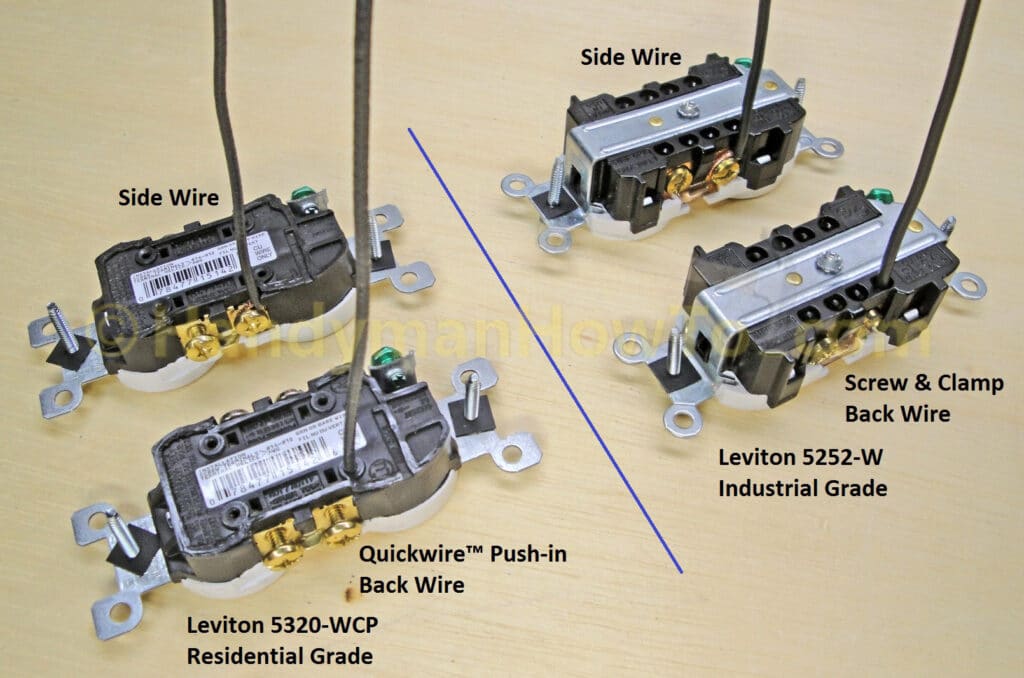
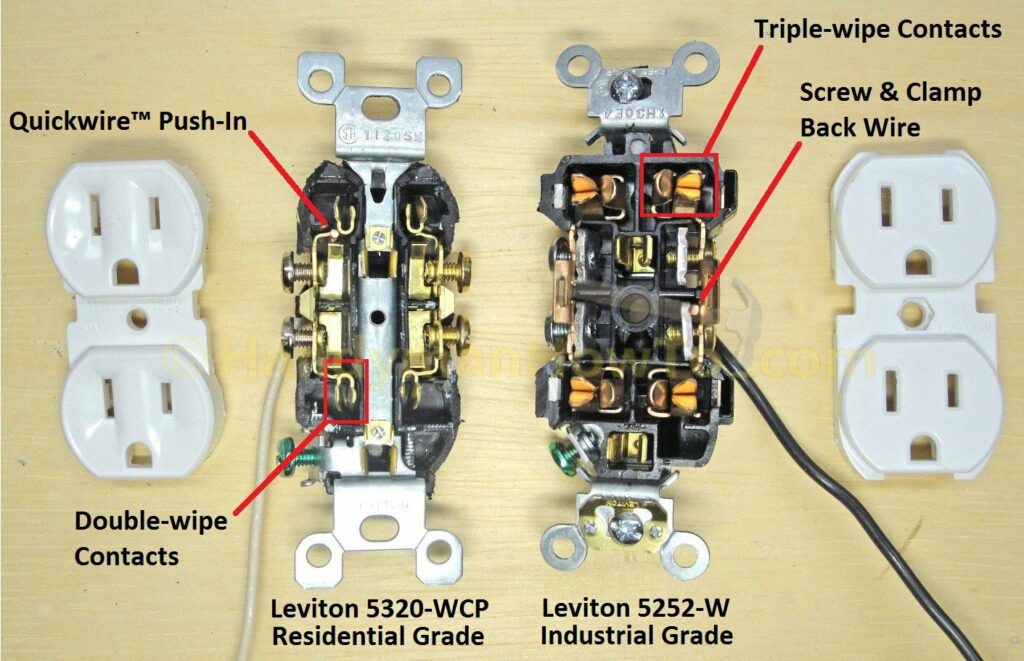
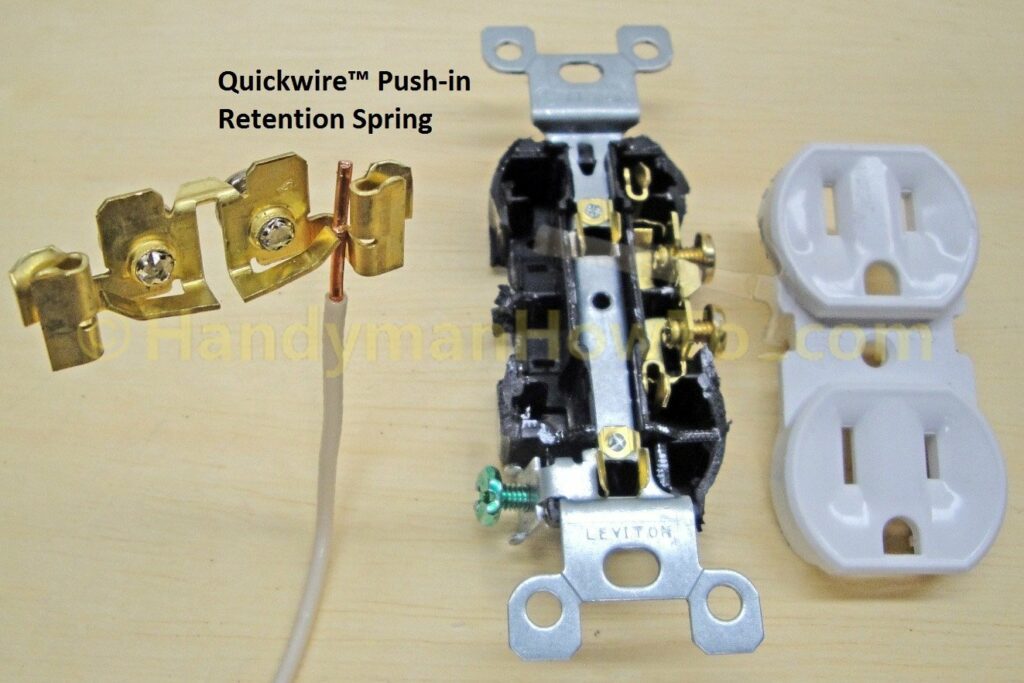
You have no earthly need for 20 amp receptacles. Code allows 15 amp receptacles on a 20 amp circuit, and it is extremely rare to find a piece of equipment with a NEMA 5-20 plug on the cord. Secondly, those receptacles are not a back wire variety. Get ones that allow the screw to be loosened and a wire inserted in the back and the screw tightened down. They are much easier to install and make a much better connection that putzing around with wrapping wires around every screw on the sides. If you examine good quality 15 amp receptacles (commercial, industrial, spec) you will find that the insides of a 20 amp receptacle are in there, covered with a 15 amp face plate.

Charles
 
OP
T

TTA89

Well-known member
Joined
Feb 23, 2014
Messages
230
Location
New Hampshire
I agree I don't need 20amp receptacles... What would a good brand/model be to look at with the screw down terminals?
 

Stuart in MN

Well-known member
Joined
Sep 8, 2005
Messages
23,164
Location
Minneapolis
A quick online search indicates tamper resistant receptacles are required for residential use in New Hampshire, but you can check with your local inspector to make sure.
 

Charles (in GA)

Well-known member
Joined
Jan 11, 2006
Messages
12,489
Location
50 mi south of Atlanta
Big question is if you need tamper resistant variety. If attached to a residence, most certainly, if detached but on a residential lot, code most likely does (too lazy to look it up) but an inspector may let it slide. If not on residential property, you won't need them.

This is a tamper resistant back wire, commercial grade in white. Letters at the end of the Leviton number denote colors.

http://www.homedepot.com/p/Leviton-...rade-Receptacle-White-R52-TCBR1-00W/205844894

Cooper, and Hubbell also make similar receptacles. Hubbell is good, just a little pricey as the big box stores don't have them, and you end up at a supply house or Grainger. Cooper is the old Eagle, decent but not so great. P&S is about on par with Cooper. Leviton is good middle to upper middle of the road model.

Get good receptacles and you will never buy a replacement. Flat face plates on Leviton are Nylon, the grounding hole won't break out when you trip and pull a cord out sideways, I like that.

Charles
 

Dick in Wisconsin

Well-known member
Joined
Mar 3, 2012
Messages
3,048
Location
Shawano, Wisconsin
Seriously, it is a fair price for 20a receptacles. Do they have screws terminals or compression plates? I like the ones with screw down plates. CT

I think this poster mean "back wired receptacles". DO NOT, I repeat, DO NOT use "back stabbed receptacles".

You have no earthly need for 20 amp receptacles. Code allows 15 amp receptacles on a 20 amp circuit, and it is extremely rare to find a piece of equipment with a NEMA 5-20 plug on the cord. Secondly, those receptacles are not a back wire variety. Get ones that allow the screw to be loosened and a wire inserted in the back and the screw tightened down. They are much easier to install and make a much better connection that putzing around with wrapping wires around every screw on the sides. If you examine good quality 15 amp receptacles (commercial, industrial, spec) you will find that the insides of a 20 amp receptacle are in there, covered with a 15 amp face plate. Charles

I agree with Charles. But having the 20amp receptacles just looks cooler, at least to me, that is what I did in my shop.

I've read on the GJF that (1) only first outlet on a 20amp circuit must be a 20amp outlet and (2) for a garage or basement the first outlet in any circuit must be a GFCI outlet or the circuit must have a GFCI/GFI circuit breaker in the panel.

I agree I don't need 20amp receptacles... What would a good brand/model be to look at with the screw down terminals?

Look for the Professional or Premium Grade or Industrial receptacles. HD usually had at least two or three grades of 15amp and 20amp receptacles. I

If you have enough room in the panel, given that many outlets, I would recommend having three or four 20 amp circuits. In my 1000sf race shop I have lots and lots of 20amp outlets and six circuits for the convenience outlets on the three working walls, one for the toilet room (15amp), one for the attic light (15amp), one for garage door openers (3) and outlets between the doors (20amp), two 20amp circuits for the lights, so far three dedicated 240 volt circuits (two A/C units and a lathe), a 20amp circuit for the outside lights, and a 100amp circuit for the RV pedestal.

I've read on the GJF that the better, slightly more expensive "Premium" grade receptacles have better guts that have better springs to hold plugs better over many, many pluggings and unpluggings. That is one of the reasons why I went with the better receptacles. Stay away from the contractor grade stuff I was I read on the GJF.

2x What Charles is posting.
 
OP
T

TTA89

Well-known member
Joined
Feb 23, 2014
Messages
230
Location
New Hampshire
Hey guys, I'm in the "Middle of Nowhere" with no inspections. It's a detached garage and I'm willing to forgo the code on this one. Those tamper outlets ****...
 

md21722

Well-known member
Joined
Nov 30, 2015
Messages
1,840
Location
Mt Juliet, TN
There are residential, commercial, and industrial grade receptacles. The cheaper ones are easier to push a cord in and out. The Hubbell industrial are a bit harder because they grip harder. I was raised on Hubbell industrial and continue to use them. Personal preference versus code may be more of a deciding factor especially on something that you're likely to plug in and plug out more often.
 

Norcal

Well-known member
Joined
Mar 16, 2008
Messages
13,769
In doing receptacle tension tests, they fail if less then 4 ounces of tension, the Leviton hospital grade receptacles have been outperforming Hubbell, all of them do well with tension on the hot, and neutral, but the weak point is tension on the ground, thought that was interesting as I prefer Hubbell over Leviton, which I always considered a brand to be used in tract homes, trailers, and multi-family dwellings, all three are lowball, build em as cheap as possible projects.

When my shop was built, had a bunch of 20A duplex receptacles so used them, in 23 years since never needed a 20A receptacle and if had a machine that did, would require a dedicated circuit, paying extra for 20A is foolish but if it were by some fluke the same price as 15A, go for it.
 

augustus

Well-known member
Joined
Jul 12, 2013
Messages
164
Location
Columbus, OH
I agree with Charles and the screw down type, but I don't mind the wrap around type too much, but I hate the back stabbed ones and I don't sleep at night thinking about them. I like the Cooper outlets, that's what I replaced all mine with. Also, I hate mushy outlets and had to put a screw or two in each box to sturdy it up a bit. Good luck!
 

sberry

Banned
Joined
Jun 18, 2005
Messages
35,747
Location
Brethren, Michigan
I have been using the cheap 4$ a box recepts and never have a problem, some of them on my bench have survived 1000's of cycles, I cant even remember replacing one from failure. Only a few recepts are continuously used in a common garage and wall warts and such don't know the difference,,,, but,,,, just because it has worked for me for 25 years in a full shop doesn't mean a cheap recept will last a day for most people,,, haha
 

Stuart in MN

Well-known member
Joined
Sep 8, 2005
Messages
23,164
Location
Minneapolis
I have been using the cheap 4$ a box recepts and never have a problem, some of them on my bench have survived 1000's of cycles, I cant even remember replacing one from failure.

I have some of the cheap receptacles in my house. The problem isn't so much the electrical parts of the receptacle, it's the plastic parts that can chip or crack when people plug or unplug power cords. The more expensive receptacles use nylon or other materials that is more durable.
 

sberry

Banned
Joined
Jun 18, 2005
Messages
35,747
Location
Brethren, Michigan
This I will agree with. I only bring it up because it is based on a lot of real world use and not on cliché types of assumptions. I am sure I have had a problem, just cant remember it. Most of the circuits I own have no load or very small or occasional. Some never get used. Many have connected equipment never gets moved, switched for lights.
Some seemed like a good idea at the time and havnt been used since, doesn't matter how good it is. Since been replaced or moved, now obsolete. I have 50 outlets and the vaccume isn't always used on the same one, they will never wear out from duty.
 
Last edited:

sberry

Banned
Joined
Jun 18, 2005
Messages
35,747
Location
Brethren, Michigan
The most moved tool anymore is a 4 1/2 grinder, battery charger, occasional portable light. Our welding benches are the survival test. Similar to some of the wrenches I talk about, they are used rather continuous by more than 1 man. We drill and saw cordless and I have a grinder for that but on the bench use common 4 1/2 and there are not many days that all the recepts on it havnt been used at least as time or 2.
 

Attachments

  • bench shot.jpg
    bench shot.jpg
    145.3 KB · Views: 44

sberry

Banned
Joined
Jun 18, 2005
Messages
35,747
Location
Brethren, Michigan
I used to think it all made a lot of difference but it doesn't. When I started I worried about the quality but today I don't. Human error is many times higher than actual parts failure. Most problems are due to the fact it was something I did to it or neglected to do.
Much has got so much better, qc was a buzz word and in the toilet 10 yrs ago but today even most reman car parts are very good. I cant recall the last thing I got out of a box that wasn't right
Back wired are super nice and worth the convenience for remodel, old work, crowded boxes for feed thru. I got more stuff than most people, don't own a single piece with a 20A plug. It isn't that this equipment that comes with that plug always needs it, its often so it cant be used on other general circuits in institutions. It keeps the cleaning crew from using the generals in the science lab, puts it on a dedicated circuit. In some cases wire size may be increased for voltage drop.
Cheap can be good, so cheap it isn't painful to have a couple boxes on the shelf along with a box of new switches.
 
Last edited:

Norcal

Well-known member
Joined
Mar 16, 2008
Messages
13,769
There are residential, commercial, and industrial grade receptacles. The cheaper ones are easier to push a cord in and out. The Hubbell industrial are a bit harder because they grip harder. I was raised on Hubbell industrial and continue to use them. Personal preference versus code may be more of a deciding factor especially on something that you're likely to plug in and plug out more often.

There is really only 2 types of receptacles, residential, and hospital grade, all the others are manufacturers marketing, like spec grade.
 

joe_padavano

Well-known member
Joined
Feb 26, 2011
Messages
1,788
Location
Northern VA
This is almost funny
http://www.nfpa.org/safety-informat...rical/tamper-resistant-electrical-receptacles

What happens when a child learns to take two knives and try to insert them lol. A solution without a problem.

Amen. I'm a big fan of both personal responsibility and evolution. Interesting that they include the question I would have asked:

Shouldn’t people accept responsibility for their children and teach their children not to stick items in receptacles?

Yeah, comes to mind! My gawd, how did we all survive to this age without government nannys?
 
To avoid these ads, REGISTER NOW!

pima67

Well-known member
Joined
Dec 5, 2009
Messages
309
Location
Tucson, AZ
AS my young son figured out years ago, two knives are not needed -- tweezers work very nicely. The sparks scared the living s*** out of him.
 

wyliesdiesels

Well-known member
Joined
Aug 14, 2012
Messages
20,073
Location
Modesto, CA
This is almost funny
http://www.nfpa.org/safety-informat...rical/tamper-resistant-electrical-receptacles

What happens when a child learns to take two knives and try to insert them lol. A solution without a problem.

Another example of the electrical manufacturering industry making a product for a problem that is practically non existent and pushing it to be code so they can make tons of money.

The premise is to prevent child injuries but The code only applies to new houses so what about the millions of existing houses? The perceived danger will still exist for decades to come so how many injuries and deaths will be prevented in new homes? Doubt there will be that many.

The real problem here is not the non TR outlets but instead a move towards lazy and non existent parenting. Whatever happened to teaching your children about the dangers of things such as a hot stove, fire place, and shower water, pills, knives, playing in the street and cars, alcohol, etc etc...
 

Jason280

Well-known member
Joined
Mar 4, 2012
Messages
3,174
The prices are basically the same as 15amp receptacles and I can't think of any reason I would ever need 20amp plugs... But for the same cost, why not?

I'm not sure they are really worth the money. That being said, I installed close to 30 or 40 of them in my latest shop. I was more than a little OCD on this build, and put no more than 4-5 receptacles on a single breaker. Sure it was overkill, but it definitely makes me feel better. Interesting thing is, when I built my first shop, I used cheap 15a plugs and ran as many as 6 or more off a single breaker...and have never had an issue. Never once I have I flipped a breaker, chipped anything, or had a plug fail in 5+ years of use. Nevertheless, I still went with the commercial grade 20a plugs in my latest shop.

I literally have plugs everywhere you can imagine in this shop...35+ 120v plugs, 4x 20a 240v plugs, 2x 40a 240v plugs, and 2x 50a 240v plugs.
 

MikeF2316

Well-known member
Joined
Dec 29, 2012
Messages
9,605
Location
Thornhill, ON
AS my young son figured out years ago, two knives are not needed -- tweezers work very nicely. The sparks scared the living s*** out of him.

Or the way I did it when I was a youngster - I had a pair of scissors that would have worked great in a 240 V receptacle but wouldn't do anything in a 120. So I plugged in an extension cord, pulled it out 1/8", slid the scissors into the gap, then opened them up. The scissors went into hiding after that. :lol_hitti
 

Stevie-Ray

Well-known member
Joined
Jul 23, 2013
Messages
2,894
Location
Michigan's Sunrise Side
Or the way I did it when I was a youngster - I had a pair of scissors that would have worked great in a 240 V receptacle but wouldn't do anything in a 120. So I plugged in an extension cord, pulled it out 1/8", slid the scissors into the gap, then opened them up. The scissors went into hiding after that. :lol_hitti
I recently read a post where a girl I knew's little boy had taken up the very dangerous practice of licking receptacles. Unfortunately, her attitude was more of That little fart. I did the best I could do of hurriedly impressing upon her the dangers, including death that could occur if conditions were right. I've seen no more on the subject, but sheesh, I was horrified when I saw that.
 

Redwolf947

Well-known member
Joined
Feb 13, 2015
Messages
613
Location
South East WI
I used black 20amp outlets on 20amp breakers with 12awg wire and white 15amp outlets on 15amp breakers with 14awg wire all the outlets were screws with plates with NO TR or WR cant stand those all my outlets are 4+foot up. I wanted to make it easy for me and the next guy to know whats what easily. My wall outlets are all 20amp. One ceiling outlet is 20amp and the rest are 15amp.
 
Last edited:

600SL

Well-known member
Joined
Apr 26, 2012
Messages
1,794
Location
Connecticut
My inspector made me change to TR for my detached building.

I have never had any problems with cheep receptacles but switches are another story. I only buy good quality for those.
 

gtae07

Well-known member
Joined
Mar 6, 2015
Messages
2,985
Location
Fayetteville, GA
Or the way I did it when I was a youngster - I had a pair of scissors that would have worked great in a 240 V receptacle but wouldn't do anything in a 120. So I plugged in an extension cord, pulled it out 1/8", slid the scissors into the gap, then opened them up. The scissors went into hiding after that. :lol_hitti

Hell, my best friend throughout childhood stuck paperclips in the outlets along the tabletops in his high school chemistry class.

I used to sometimes pull out plugs and touch both prongs with my fingers to feel the funny tingle :shocking:

The real problem here is not the non TR outlets but instead a move towards lazy and non existent parenting. Whatever happened to teaching your children about the dangers of things such as a hot stove, fire place, and shower water, pills, knives, playing in the street and cars, alcohol, etc etc...
In large part I agree, but some of these things are things that you can't really teach kids if they're too young. I could admonish my son all day long about the dangers of eating pills, but all he's going to do is look at me and gurgle and smile and stick whatever he can get his hands on into his mouth.

One-year-olds don't understand electricity or the function of appliances, and can be incredibly fast and devious. My mom once opened the oven and turned around to grab the item she was baking to put it in, and in that time I ran over and decided to touch the pretty red glowing heat element.

Of course, the next day I stuck the same finger in a mouse trap...
 

MushCreek

Well-known member
Joined
Jan 14, 2015
Messages
9,826
Location
Upstate South Carolina
I'm required to put TR outlets in my barn, but only on the 120V outlets. There will be several LARGE 240V outlets for the kiddos to play with.

My favorite outlet story is about a maintenance man one place I worked. He was shining up the stainless steel outlet covers, using steel wool. Apparently, there were long enough wires on the steel wool to make contact, and the thing went off in his hand like a flash bulb. The look on his face was priceless.
 

Speedy Petey

Well-known member
Joined
Apr 22, 2012
Messages
1,430
Location
NY State
I'm required to put TR outlets in my barn, but only on the 120V outlets. There will be several LARGE 240V outlets for the kiddos to play with.
THIS is one of the many problems I have with the code.
We are required to use TRs for standard 120V, but if you have tools and equipment that require 30 or 50A 240V receptacles, like a welder (and we know how rare those are, right?) then you can have as many of those as you want, which are non-TR and have nice large slots to stick things into.

It's just dumb as F-.
 

cybrdyke

Well-known member
Joined
Sep 9, 2014
Messages
3,449
Location
USA
THIS is one of the many problems I have with the code.
We are required to use TRs for standard 120V, but if you have tools and equipment that require 30 or 50A 240V receptacles, like a welder (and we know how rare those are, right?) then you can have as many of those as you want, which are non-TR and have nice large slots to stick things into.

It's just dumb as F-.

Shhhh.
They'll hear you and then they'll require everything be TR.
CD
 

Stuart in MN

Well-known member
Joined
Sep 8, 2005
Messages
23,164
Location
Minneapolis
I'm required to put TR outlets in my barn, but only on the 120V outlets. There will be several LARGE 240V outlets for the kiddos to play with.

The reason is, the vast majority of residences in the US don't have any open 240vac receptacles where children can get to them. If they do have one at all, it's for the kitchen stove and that one is hidden behind the stove.
 

MushCreek

Well-known member
Joined
Jan 14, 2015
Messages
9,826
Location
Upstate South Carolina
Agreed- So why require any TR outlets in an outbuilding? I'm hoping they haven't gotten around to requiring AFIC; I have several tools that routinely trip them in the house.
 

nsula_country

Well-known member
Joined
May 23, 2013
Messages
1,534
Location
Northwestern Louisiana
Agreed- So why require any TR outlets in an outbuilding? I'm hoping they haven't gotten around to requiring AFIC; I have several tools that routinely trip them in the house.

Another reason our shop is not on the same parcel as the house, zoned ag, and has its own address and electrical service. 100% commercial at this point and not more than 200 yards away.

CT
 

nsula_country

Well-known member
Joined
May 23, 2013
Messages
1,534
Location
Northwestern Louisiana
I'm zoned ag; I wonder if they'll cut me some slack? I already bought the TR outlets anyway, though.

Unless your inspector is just plain difficult, I don't see why not. I'd return them and get conventional receptacles. They are about as picky as to what you plug into them as an AFCI.

The way I read the code, it is only for new (or remodeled) residential and attached garages.

CT
 

Sonorous

Well-known member
Joined
Aug 10, 2013
Messages
102
Location
Ottawa/Outaouais/MTL Canada
There is really only 2 types of receptacles, residential, and hospital grade, all the others are manufacturers marketing, like spec grade.

In my experience it's basically residential or non-residential (whether "pro" grade, commercial, industrial, hospital etc.). I bet a cold beverage that the receptacles the OP bought for $2 each have the same guts as the ones that are several times the price, which I think it what you are getting at.

Of course they're missing a green dot if he ever wants to convert his shop into a hospital :shocking:, but I think they're a nice step up over the $5 ten-pack residential receptacles. I usually spring for the flexible nylon wall plates as well, which are about 50 cents each. All told you're talking about $2.50 per receptacle for the good stuff (versus 75 cents).

That's money well spent. Apart from more secure contacts and the faster back wire clamps, up here in the winter the more flexible nylon receptacle cover and wall plates do a much better job at resisting cracking in the cold.

If he doesn't make it back by saving time on the install, I think the OP will get his money's worth from every plug feeling 100% solid and secure.

DSC03645-797x1024.jpg


DSC03743-1024x678.jpg


DSC03649-1024x661.jpg


DSC03652-1024x927.jpg


DSC03713-1024x683.jpg


DSC03733-1024x747.jpg
 
To avoid these ads, REGISTER NOW!
Top Bottom