To avoid these ads, REGISTER NOW!

Lifepo4 battery/charger question

Razorhunter

Well-known member
Joined
Apr 25, 2013
Messages
393
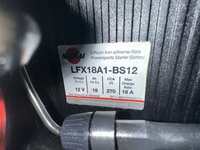
So I’ve got a Garmin fishfinder that runs off a 20ah Lifepo4 battery. This Garmin unit has a 9-18vdc input and it draws 1.7amps under normal operation. It has a 3a inline fast blow fuse for protection on the factory Garmin power cord.

I spoke to Garmin and they say there is no need for an isolation switch or breaker between fishfinder and battery for charging purposes. You can literally direct wire it and charge your battery at will. They do this all the time.

So my question is obviously about charging and the unit being direct wired….If I have a Lifepo4 charger hooked up, (with the Garmin not isolated during charging), is it possible to blow this 3a inline fuse when charging the battery? I mean, can I use a 3ah charger? How about a 10ah charger? (We’re charging at something like 14v btw)

Bottom line is I don’t really understand how much current is going through the wire when charging especially given the unit isn’t even turned on and drawing power. Help me understand this simple issue of how much current that fuse will see during charging because I know it’s quite simple. Just never really known.
I suppose this is not much different from charging your cars battery with it still hooked up in the vehicle and none of those fuses blow but I still had to wrap my head around this.
 
To avoid these ads, REGISTER NOW!

BillK

Well-known member
Joined
Aug 24, 2006
Messages
9,317
Location
Beautiful Southern Maryland
Bottom line is I don’t really understand how much current is going through the wire when charging especially given the unit isn’t even turned on and drawing power. Help me understand this simple issue of how much current that fuse will see during charging because I know it’s quite simple.
There is probably no way of knowing that because it will be different for different chargers etc. Different batteries also have different charge rates.

I don't know if you would really want to use an actual charger. It almost sounds like the unit has a charging circuit built in to it. If that is the case all you will need is a 12 volt power supply, not a charger.

Without seeing a schematic its hard to say.
 

walta

Well-known member
Joined
Jan 13, 2017
Messages
2,310
Location
Dutzow Missouri
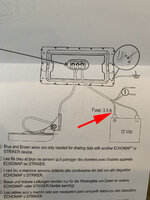
Assuming your fish finder is something like this wiring diagram. Then the fuses only job is to blow before the wire running to the unit can get hot enough to start a fire should the wire get damaged and shorted to a ground. You want the fuse as close to the battery as possible. You can safely assume the unit has all the built-in protection necessary.

Walta
 

Attachments

  • D387F619-DDDE-41A9-AD17-D1D.jpg
    D387F619-DDDE-41A9-AD17-D1D.jpg
    229.9 KB · Views: 24
OP
R

Razorhunter

Well-known member
Joined
Apr 25, 2013
Messages
393
Ok. Guys, it’s really simple. Yes like the pic above. No schematic needed.

Take a 12v battery and run your hot and ground to fishfinder. Put a 3a fuse on the hot leg in between fishfinder and battery.

Thats it. Nothing else lol
Now you go to hook your alligator clips to your battery to charge it after a long day fishing.
Can current flow “out of my battery” so to speak, and up towards my fishfinder (while charging) and blow the fuse that’s 3” away inline on the 18awg power cord of fishfinder?

I don’t think it’s possible but is there any way for current to flow toward the fishfinder at all when charging (and fishfinder is off)???

Take a look at the guys pic above. Imagine your alligator charger clips are on that battery charging away via a 10ah Lifepo4 charger.
(To the one guy above, YES, I have to charge the battery with a charger. After the end of every day fishing. Fishfinders don’t have charging circuits or whatever you mentioned )
 
OP
R

Razorhunter

Well-known member
Joined
Apr 25, 2013
Messages
393
Assuming your fish finder is something like this wiring diagram. Then the fuses only job is to blow before the wire running to the unit can get hot enough to start a fire should the wire get damaged and shorted to a ground. You want the fuse as close to the battery as possible. You can safely assume the unit has all the built-in protection necessary.

Walta
Yes indeed. Fuse inline protects the wiring. As close to battery as possible. Totally agree.
My questions pertained to what amperage the wires would see during charging but I’m glad we agree on these points too. Thank you kind Sir.
 

BillK

Well-known member
Joined
Aug 24, 2006
Messages
9,317
Location
Beautiful Southern Maryland
Ok, I guess I am confused. I thought the battery was actually built into the finder. If it is a separate battery then no you do not have to worry about the current getting back into the fishfinder. It does not matter what amp charger you use. You could most likely even leave the finder on while charging.
 
To avoid these ads, REGISTER NOW!

TRWham

Well-known member
Joined
Aug 11, 2017
Messages
1,959
Location
East Cobb County, Georgia
I have a LiFePO4 battery in my ‘75 Norton Commando and use an Optimate 4S6A LFP charger. It is wired straight to the battery and never sees the bike’s wiring. The Norton has an electrical system designed in the early Victorian era with a single 20 A fuse in the negative battery lead (positive earth even in 1975) for the entire bike. Having owned and worked on British vehicles since high school, I’m only a bit surprised the Brits didn’t deploy wooden sailing ships against the Germans in WW2.
 

bronc076

Well-known member
Joined
Jul 17, 2023
Messages
190
Location
Ozarks
i Love the rats nest of wires inside the headlight on vintage motorcycle, so much fun to work on. The British had the knowledge and skills to build computers and crack German communications during WWII, clearly none of those blokes went to work for Lucas.
 

duneslider

Well-known member
Joined
Jan 20, 2013
Messages
2,252
Location
Riverton, Utah
You can charge the battery however you want with whatever charger you want (assuming it is appropriate for the battery). The battery you are using is capable of supplying more than 3amps but that doesn't happen because the fish finder is never gonna ask for more than 3amps. Charge with 10amps if you want but at the end of the day it is still better for the battery to be charged slower. Charging at 10amps isn't going to hurt the fish finder though and its not going to blow the fuse. Connect the charger directly to the battery.
 
To avoid these ads, REGISTER NOW!
Top Bottom