To avoid these ads, REGISTER NOW!

Lifting trusses in sections

backintheday

Well-known member
Joined
Feb 7, 2012
Messages
104
Location
Western Wyoming
Hi all,
I asked a question on the tractor by net page and got a response that got me thinking. I am wondering if this is a good idea. Assemble 8' sections of trusses on the ground to include the gable ends and nail down as much sheeting as possible (depending on the Wyoming winds that day) leaving areas open so the crane can still attach where it needs to for the lift. This way majority of the work is done on the ground then after the sections are in place secure them to the building and install the remaining sheeting. Seems to me that it's possible as long as the crane can handle the load. The building will be a 40x60x16 with SIPs for the walls and 2' overhangs.

Let me know what you all think. Cheers.
 
To avoid these ads, REGISTER NOW!

dirttracker18

Well-known member
Joined
Aug 10, 2009
Messages
3,191
Location
Slate River, ON
A little hard to toe nail to the top plate with sheets in the way.

You could leave the bottom row of sheets off as well.

It could work.
 

larry4406

Well-known member
Joined
Jan 27, 2006
Messages
19,061
Location
Northern Virginia
I build production homes in VA/MD. Our carpenters fully sheath the end gables, apply Tyvek, and build the cornice while on the ground. This is all that is done on the ground for the roof.

Once the trusses are all swung into position, the roof is sheathed. We have 12" gable overhangs and the roof sheathing runs long over this.
 

Rookie2

Well-known member
Joined
Feb 27, 2013
Messages
1,925
Location
Western Pa.
anything is possible but you would have to get with the truss builder to safely pick how many lift points and where.
 

DekeT

Well-known member
Joined
Aug 12, 2011
Messages
2,234
Location
USA
Hi all,
I asked a question on the tractor by net page and got a response that got me thinking. I am wondering if this is a good idea. Assemble 8' sections of trusses on the ground to include the gable ends and nail down as much sheeting as possible (depending on the Wyoming winds that day) leaving areas open so the crane can still attach where it needs to for the lift. This way majority of the work is done on the ground then after the sections are in place secure them to the building and install the remaining sheeting. Seems to me that it's possible as long as the crane can handle the load. The building will be a 40x60x16 with SIPs for the walls and 2' overhangs.

Let me know what you all think. Cheers.

Sounds like a certain recipe for disaster.

btw, Nugent was a draft dodging hypocrite that did not wash for weeks, crapped in his pants, and other filthy things in order to fail his draft physical. I guess the squirmy chicken hawk didn't aspire to be anything more than a philandering misogynist instead of his today's self-serving take on America.
 

hemiredneck

Well-known member
Joined
Feb 12, 2011
Messages
64
I did that only for the first section to accommodate the stairway...First two trusses together, stretch 4 feet with 2x6 bridging, next two together...placed it up as one unit. All the rest one at a time...went pretty quick. The lull would grab 3 or 4 trusses at a time, hoist them up and the guys up top would slide them off one at a time for every 16" as needed
 

Attachments

  • 1044635_1387263151491022_870560512_n.jpg
    1044635_1387263151491022_870560512_n.jpg
    100.2 KB · Views: 50
Last edited:

carcajou

Well-known member
Joined
Dec 7, 2012
Messages
879
Location
SW Alberta
Hi all,
I asked a question on the tractor by net page and got a response that got me thinking. I am wondering if this is a good idea. Assemble 8' sections of trusses on the ground to include the gable ends and nail down as much sheeting as possible (depending on the Wyoming winds that day) leaving areas open so the crane can still attach where it needs to for the lift. This way majority of the work is done on the ground then after the sections are in place secure them to the building and install the remaining sheeting. Seems to me that it's possible as long as the crane can handle the load. The building will be a 40x60x16 with SIPs for the walls and 2' overhangs.

Let me know what you all think. Cheers.
I build all my farm buildings that way, putting up 12' sections with purlins attached. It is safer, faster and hell of a lot easier to do. On my last building, 114 ft long, 3 of us put up the roof structure in a day.
 

jlckmj

Well-known member
Joined
Dec 7, 2009
Messages
732
Location
SE Wiscosin
I posted this earlier but it disapered.
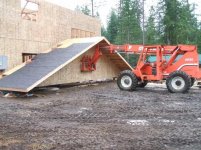
My son is a contractor, and I have seen him do that before. On the attached pic you can see the entire roof section going up on a second story addition. Most of the plywood and even the roof jacks were put on while on the ground, it made things much easier for him.

Jim

5.png
 
To avoid these ads, REGISTER NOW!

rslaback

Well-known member
Joined
Jul 24, 2010
Messages
4,062
Location
Westcentral Wisconsin
Where do you find a big enough flat enough area to do this? Or do you just measure from the top of each truss to determine sheathing location and then hope for the best?
 

Playwme

Well-known member
Joined
Sep 13, 2012
Messages
2,032
Location
The Lucky Country Down Under
You'd need to get your measurements spot on while on the ground. It's much easier to tweak a single truss to fit rather than a 40x8 foot block.

Do you also then limit your purlin lengths to 8'? I'd prefer the longest purlins possible but I know you guys build differently over there.
 

Majordisorder

Well-known member
Joined
Jan 5, 2014
Messages
234
Location
North Idaho
I like to put the gable ends together on the ground and place them as a unit. This one was assembled right up against the building where it was going. Level up some 6x6's, then stand up the trusses just like they were on the roof, bracing against the building as needed. Gable sheeting was installed an inch below the bottom cord so it ends up getting nailed to the top plate. Once set on the top plate and nailed off, it gives a nice solid anchor point to brace the remaining trusses that were delivered to the top plate. Some truss companies will not assist you in placing individual trusses, and if they do it can be costly. Not that having a crane assist in the build is a bad thing, but I own my forklift.

Pole builders around here use the cable winches on top of the posts to lift sections that were assembled on the ground.
 

Attachments

  • sgable.jpg
    sgable.jpg
    140.6 KB · Views: 24
OP
B

backintheday

Well-known member
Joined
Feb 7, 2012
Messages
104
Location
Western Wyoming
You'd need to get your measurements spot on while on the ground. It's much easier to tweak a single truss to fit rather than a 40x8 foot block.

Do you also then limit your purlin lengths to 8'? I'd prefer the longest purlins possible but I know you guys build differently over there.

I don't plan to use purlins. I'm doing trusses 2' on center. Since I'm using SIPs I don't think I'll have to deal with gables, (not 100% on that) just building the 2' lookouts. The reason for the 8' limit is the sheeting.
 
OP
B

backintheday

Well-known member
Joined
Feb 7, 2012
Messages
104
Location
Western Wyoming
I like to put the gable ends together on the ground and place them as a unit. This one was assembled right up against the building where it was going. Level up some 6x6's, then stand up the trusses just like they were on the roof, bracing against the building as needed. Gable sheeting was installed an inch below the bottom cord so it ends up getting nailed to the top plate. Once set on the top plate and nailed off, it gives a nice solid anchor point to brace the remaining trusses that were delivered to the top plate. Some truss companies will not assist you in placing individual trusses, and if they do it can be costly. Not that having a crane assist in the build is a bad thing, but I own my forklift.

Pole builders around here use the cable winches on top of the posts to lift sections that were assembled on the ground.

This is what I'd like to do. How did you secure the trusses to the top plate? When I built my house I toe nailed the trusses, the blocking between each truss then hurricane ties on each truss. I would assume the sheeting gets in the way of toe nailing.

I have access to the gradall that flew in the trusses on my house, I wonder if that could handle it.... Great machines.
 

Majordisorder

Well-known member
Joined
Jan 5, 2014
Messages
234
Location
North Idaho
Those trusses had a full 16" of depth at the exterior wall so lots of room to install hurricane ties and toe nailing. Nailing the bottom lip of gable sheathing to the wall ties things together very well and gives you something to go by when you lift it in place. Of course the wall sheathing needed to be held down accordingly at the time walls were framed. As was mentioned, all your ducks must be in a row to pull it off. The plywood can be used to square things up, but trusses are usually not perfect so works for someone that likes working precisely.
 

Majordisorder

Well-known member
Joined
Jan 5, 2014
Messages
234
Location
North Idaho
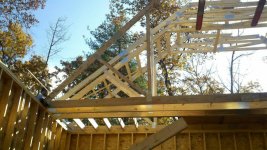
Another view showing the rear gable up and the depth of trusses at the plate. I think there is 6 foot of roof up on the rear(2' overhang) and the front gable makes for 10 or 12 feet of roof with 4- overhang. Definitely nicer to work from the ground than from around 30' to the peak.
 

Attachments

  • settrus.jpg
    settrus.jpg
    68.6 KB · Views: 16
To avoid these ads, REGISTER NOW!
Top Bottom