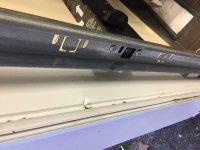
I don't know if this has been reported and I know the 8500 is a popular garage door opener. Unfortunately I got broken into last night, the ease of how they bypassed the door lock left me stunned. Hopefully you will see and learn from my pictures and take steps to protect your own property. Basically, someone inserted a screwdriver or something through the door seal and was able to push the lock pin back, once this is done you can actually lift the door and overcome the friction/force of the motor.


You are using an out of date browser. It may not display this or other websites correctly.
You should upgrade or use an alternative browser.
You should upgrade or use an alternative browser.
Liftmaster 8500 major security flaw
- Thread starter Norm01
- Start date
driftpin
Well-known member
Wow, now that's going to be all over the internet, how-to defeat the system, not good! Sorry they got you.
xyster101
Well-known member
Wonder if screwing a piece of wood or angle iron against the door jam between the track and jam would stop that from happening.
What was stolen?
What was stolen?
Wonder if screwing a piece of wood or angle iron against the door jam between the track and jam would stop that from happening.
What was stolen?
Luckily my alarm scarred them! Haven't done full inventory but a good look over seems like nothing is gone.
Holt
Well-known member
How did they k ow you had the 8500. Sounds like a inside job or someone who has been in your house
n20junkie
Well-known member
Windows? They may just have looked inside.
My shop has no first floor windows for such reasons.
My shop has no first floor windows for such reasons.
PhantomEB
Well-known member
I just looked at mine and there is room to trim down a piece of 2” wide angle to screw to a 2x4 and massage in there to clear the cable, track wheels and lock itself.
PhantomEB
Well-known member
I am also thinking of relocating it to a spot that’s not ergonomically comfortable to fk with a lock.
PhantomEB
Well-known member
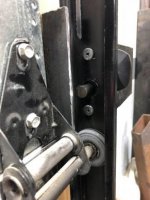
Couple pieces kicking around to support a piece of angle iron clearanced too much whipped this up in 30 min tops.
Second version will be more inpentretable(sp?) and tighter fit around the shafts.
Only other way I can see more secure would be to wrap around the track with just a slot for the wheel tracks to slip thru right where the door track is.
Second version will be more inpentretable(sp?) and tighter fit around the shafts.
Only other way I can see more secure would be to wrap around the track with just a slot for the wheel tracks to slip thru right where the door track is.
Attachments
Ole Slewfoot
Well-known member
Shove it in at the bottom and slide up till you hit something.Can't find the lock pin with only luck. So how did they manage to find it with just a screwdriver?
The door panels are usually weak enough it really doesn't matter much what you do with the lock though.
SALIV8
Well-known member
It looks to me, based on the pic, that the thieves just forced the door up. The track bowed enough from the force and allowed movement.
If thieves want in, they will get in.
If thieves want in, they will get in.
matt_i
Well-known member
I think this method of entry requires going behind the door gasket trim...which is usually held in place with chintzy trim nails. Mine were pulling off the existing garage with no intervention required. On the new garage I sourced some color matched torx drive trim screws. Which doesn't make it like fort knox but it does hold the trim on a lot better now and would make more noise than overcoming those sad trim nails.
xyster101
Well-known member
A simpler solution might be to put the dead bolt behind the upper most wheel. Then it would be 8ft up and a good foot from the top of the door opening. Of course this means you will need a bucket to stand on if you want to manually open the door.
finn
Well-known member
Move to a better neighborhood?
cajunfirehawk
Well-known member
Repeat after me; Locks only keep honest people out...sorry to say.
and not another liftmaster 8500 issue thread....
and not another liftmaster 8500 issue thread....
LifeLongWNYer
Well-known member
Whomever said that if the bad guys want in, they will get in, was right, that is very true. I suggest taking normal steps to harden the locking hardware on all ( not just overhead ) doors, but, again, a motivated bad actor WILL get in.
Operating on that premise I would suggest a quality security alarm system, with well placed ( quality ) motion sensors. Every square inch of the building does not need to be covered, but place the sensors so that, at the least, all points likely to be used as entry/exit portals are covered.
Install a backup battery on the alarm panel, and replace it every 3-4 years, IF NOT used. If you do have a power failure, and the back up battery runs down to flat dead, replace it ASAP. Once that type of battery is run dead, its' life is severely diminished and it is no longer dependable. They are not expensive. A couple of hours of no power, provided the battery isn't run dead, is okay.
Connect the alarm panel to a UL listed central station via a "POTS", which is a "plain old telephone system" phone line. That is the most dependable commo method. In serious large scale emergencies, a cellular panel communicator may not be able to call the central station, if the cell system is overloaded, or if your cell tower is out of service, or without power. Using a "phone" connection via a cable company is less desirable because all those amplifiers that you see on utility poles need to have power, and if even one of them is without power, in the cable path between you and the cable company head end, the communicator will be dialing like crazy, but the call won't go through. This is of lesser significance in built up areas, where the signal may take alternative paths, but is a problem in rural locations, where there is only "one way out" for the commo.
Ensure that the telephone wire, between your alarm panel, and the point where it connects to the telco system is underground so it can't be cut by a bad actor.
High end alarm panels are capable of communicating with the central station via two different means, and they monitor the phone line for dial tone voltage. They cost more, so depending on your risk and location, ( neighborhood loss experience ) may be worth the extra money. For the standard garage, with a "homeowner" assortment/quanity of tools and a normal car, or two, it isn't necessary, BUT if you have hundred of thousands of tools and several high value/collector vehicles, it may be justifiable.
Install a "tamper switch" on the door to your alarm panel enclosure, connected to a separate zone on the panel. Lock, and keep, the door locked, remove the key, and do not "hide" the key on top of the alarm panel enclosure. This prevents anyone with access to your building, from tampering with your alarm to facilitate a later break in.
Lastly, TEST your alarm. At least once a year, but two times, if possible, call your central station, tell them that you will be testing your system, and would they keep a record of your "trips". Then arm your system, and, keeping track of the sequence, trip every sensor in the system. After tripping one, wait a minute, or two to give your panel time to send the signal to the central station and restore itself. When done, unarm the system, call the central station again, tell them you are finished with your test, any further alarms will be real. Ask them to send you a print out of the "trips" that they received, and when you get it, compare their list to the sequence in which you activated your sensors. Make sure that each sensor that you tripped, appears on the list.
Finally, this only addresses burglary threats, if you do all of this, you aren't far away from adding a fire notification system. Think of that, during your planning and design.
.
Operating on that premise I would suggest a quality security alarm system, with well placed ( quality ) motion sensors. Every square inch of the building does not need to be covered, but place the sensors so that, at the least, all points likely to be used as entry/exit portals are covered.
Install a backup battery on the alarm panel, and replace it every 3-4 years, IF NOT used. If you do have a power failure, and the back up battery runs down to flat dead, replace it ASAP. Once that type of battery is run dead, its' life is severely diminished and it is no longer dependable. They are not expensive. A couple of hours of no power, provided the battery isn't run dead, is okay.
Connect the alarm panel to a UL listed central station via a "POTS", which is a "plain old telephone system" phone line. That is the most dependable commo method. In serious large scale emergencies, a cellular panel communicator may not be able to call the central station, if the cell system is overloaded, or if your cell tower is out of service, or without power. Using a "phone" connection via a cable company is less desirable because all those amplifiers that you see on utility poles need to have power, and if even one of them is without power, in the cable path between you and the cable company head end, the communicator will be dialing like crazy, but the call won't go through. This is of lesser significance in built up areas, where the signal may take alternative paths, but is a problem in rural locations, where there is only "one way out" for the commo.
Ensure that the telephone wire, between your alarm panel, and the point where it connects to the telco system is underground so it can't be cut by a bad actor.
High end alarm panels are capable of communicating with the central station via two different means, and they monitor the phone line for dial tone voltage. They cost more, so depending on your risk and location, ( neighborhood loss experience ) may be worth the extra money. For the standard garage, with a "homeowner" assortment/quanity of tools and a normal car, or two, it isn't necessary, BUT if you have hundred of thousands of tools and several high value/collector vehicles, it may be justifiable.
Install a "tamper switch" on the door to your alarm panel enclosure, connected to a separate zone on the panel. Lock, and keep, the door locked, remove the key, and do not "hide" the key on top of the alarm panel enclosure. This prevents anyone with access to your building, from tampering with your alarm to facilitate a later break in.
Lastly, TEST your alarm. At least once a year, but two times, if possible, call your central station, tell them that you will be testing your system, and would they keep a record of your "trips". Then arm your system, and, keeping track of the sequence, trip every sensor in the system. After tripping one, wait a minute, or two to give your panel time to send the signal to the central station and restore itself. When done, unarm the system, call the central station again, tell them you are finished with your test, any further alarms will be real. Ask them to send you a print out of the "trips" that they received, and when you get it, compare their list to the sequence in which you activated your sensors. Make sure that each sensor that you tripped, appears on the list.
Finally, this only addresses burglary threats, if you do all of this, you aren't far away from adding a fire notification system. Think of that, during your planning and design.
.
Last edited:
tapered-pin
Well-known member
Couple pieces kicking around to support a piece of angle iron clearanced too much whipped this up in 30 min tops.
Second version will be more inpentretable(sp?) and tighter fit around the shafts.
Only other way I can see more secure would be to wrap around the track with just a slot for the wheel tracks to slip thru right where the door track is.
THIS is exactly what I did to mine when I installed my 8500.
Sorry you didn't see that as an issue OP..
tapered-pin
Well-known member
How in the hell were they able to find the exact location of that lock pin and push it back with a screwdriver. I don't believe it honestly.
same way you can get into a locked door with a knife, put pressure on the door and use the blade to back the bolt out of the strike plate.
same way you can get into a locked door with a knife, put pressure on the door and use the blade to back the bolt out of the strike plate.
Yeah, but you have a really good idea where the dead bolt is on 99.9% of entry doors. You can mount that lock anywhere on the garage door. But they are able to single it out vs rollers, pry the door back, then blindly locate the lock pin with a screwdriver and push it back?

86turbodsl
Well-known member
You guys aren't thinking this through. the garage door rollers always line up with the section edges, or pretty close. the one obstacle that doesn't is the lock pin.
Hot Rod Grampa
Well-known member
Most people install the lock in a convenient location. Second panel up. That is where the instructions tell you to put it. No brainer a crook would guess where to look for the lock. The trolley openers are more secure unless the red handle gets pulled. Alarm system sounds like the way to go. Sad we as a society have come to this.
Can't find the lock pin with only luck. So how did they manage to find it with just a screwdriver?
They are all in the exact same spot I'm sure. Once you know where one is, you just measure up that distance. ****, there it is.
xyster101
Well-known member
They are all in the exact same spot I'm sure.
FAKE NEWS. I'm 6' 4" and my lock pin is above my head.
Holt
Well-known member
You guys aren't thinking this through. the garage door rollers always line up with the section edges, or pretty close. the one obstacle that doesn't is the lock pin.
Still doesnt explain how the person knew he had a 8500. So many variables at play here.
ole442
Well-known member
Was the opener owner installed or installed by dealer personnel. They'd know it was there and what goodies were inside the garage.....just a thought!
JRC3
Well-known member
Sad we as a society have come to this.
Thievery always has been and always will be, people just have more today worth stealing. I was about 8 around 1978 when I learned my lesson, I didn't put my bike away one evening and looked outside to see it riding away. http://simhq.com/forum/files/usergals/2015/05/full-912-103106-huffy.jpg That thing was pretty sweet too.
Was off line for a few days and I’ll answer a few questions. My garage has a flaw of a side door with window and a window beside that so no brainer in retrospect, someone could easily see the lock. System with new door was professionally installed and as someone pointed out most installers use the standard lock knock outs for ease of installation and these are at standard heights. Just realized tonight that the lever to open the lock is on both sides for left or right install. With the lever on the backside and knowing what I know now, I swear I can break in through the gasket in 10 seconds. My temporary solution was to drill a hole just above a roller and install a padlock. I will relocate the lock in the highest position as someone pointed out, at that spot in the corner of the track it is braced and you cannot get through the plate. At the end of the day my alarm did the job but this was a wake up call to address certain deficiencies.
They are all in the exact same spot I'm sure. Once you know where one is, you just measure up that distance. ****, there it is.
Absolutely right, you can even slide a coat hanger in and slide up until you hit it. I’m convinced now I can open on of these without any damage or trace.
You are more than welcome to come over and inspect it. Did a police report and the policeman said he’d never seen anything like this. My goal was simple in posting this, I learnt a lot from something and wanted to share for others to protect themselves. Anyone who has a 8500 can simply look at it and understand the flaw, with a little thought they can also overcome 99% of the issues, problem was realizing it’s an issue in the first place.How in the hell were they able to find the exact location of that lock pin and push it back with a screwdriver. I don't believe it honestly.