To avoid these ads, REGISTER NOW!

Lighting a 30'x40' garage

armorerr

Member
Joined
May 7, 2012
Messages
22
Location
Pittsburgh, PA
I have searched the forum and read about 300 different lighting threads, but still feel a bit unsure about how to best position the lights in my garage. The garage will eventually have finished walls and ceiling (about 10' height), all painted white, and a light-color epoxy floor. The main use will be automotive work and light fabrication.

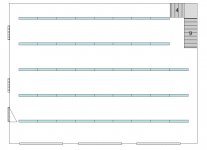
I think I am going with the general consensus of getting the basic T8 HO fixtures from Home Depot. Attached is a quick plan for using all 8' fixtures (two 4' sections with 2 bulbs per section) in a grid type pattern. If you read my other thread, I already went total overkill on electrical service and want the same with my lighting solution. I do plan to zone the lights into two or three switches.

According to some of the threads, this is not enough light for the space. Others indicate I could do this with about half the fixtures and just run strips across either front-to-back or left-to-right. I know it will be better than the current space where I work on my cars but much like the electrical service, I want to do this once and have no "wish I had added a few more" regrets!

Any thoughts are appreciated!
 

Attachments

  • Garage-lights.jpg
    Garage-lights.jpg
    55.6 KB · Views: 112
To avoid these ads, REGISTER NOW!

2ManyProjects

Well-known member
Joined
Jul 18, 2013
Messages
757
I have searched the forum and read about 300 different lighting threads, but still feel a bit unsure about how to best position the lights in my garage. The garage will eventually have finished walls and ceiling (about 10' height), all painted white, and a light-color epoxy floor. The main use will be automotive work and light fabrication.

So far, so good.

Yours is a fairly typical request; and you're doing most of the "ancillary" things right: passable (if still not great) ceiling height, smooth white walls, light-ish floor, etc..

I think I am going with the general consensus of getting the basic T8 HO fixtures from Home Depot.

I'm not sure where/how you came up with that so-called "consensus"; but I certainly would not characterize it as such. While "High Output" T8 tubes do exist, by far the more common solution is to use standard F32T8 tubes -- and for good reason (see below).

Attached is a quick plan for using all 8' fixtures (two 4' sections with 2 bulbs per section) in a grid type pattern.

As is often the case with such simplistic "rank & file" layouts, this seems pretty far from ideal. For one thing, at least the first two "crossways" rows will be completely useless if you work with the doors open. And unless this garage/shop is completely climate controlled, odds are you WILL be working with the doors open much of the time.

If you read my other thread, I already went total overkill on electrical service and want the same with my lighting solution. I do plan to zone the lights into two or three switches.

"Zoning" is one thing. And at 30'x40' your garage is ALMOST big enough to benefit from that. But in most cases (including this one, I think), the more important consideration is being able to vary the brightness (within each "zone" if also doing zoning) as needed at any given moment.

According to some of the threads, this is not enough light for the space. Others indicate I could do this with about half the fixtures

Well then... Let's do the math: You have 1,200 ft.^2 to cover. You're currently showing 23 fixtures, presumably with four F48T8HO tubes in each. Using these:

http://www.1000bulbs.com/product/4726/FHO-048CWT8.html

as a benchmark, that's 368,000 initial source lumens, or approximately 306 lumens/ft.^2 -- IOW, gross overkill! Even after the tubes age, their "Mean Lumens" spec is still 3,600 each; so that would still be approximately 276 lumens/ft.^2 -- again, gross overkill!

So clearly, "half the light" would still be MORE than enough (even one-third would be quite adequate by most standards; but you said you'd rather err on the high side, so let's say half).

However, that does not mean, and I would seriously question, the "half the fixtures" assumption (again, see below).

and just run strips across either front-to-back or left-to-right.

Again, simplistic layouts usually lead to sub-optimal results.

I know it will be better than the current space where I work on my cars but much like the electrical service, I want to do this once and have no "wish I had added a few more" regrets!

Any thoughts are appreciated!

First, forget the HO tubes. Like virtually everyone else with low-ceilinged residential garages, your problem is NOT how to get "enough" light; it's how to DISTRIBUTE that light in the most effective manner. So standard issue F32T8 tubes will be MORE than sufficient (and a LOT cheaper).

Second, drop the 8-foot tandem fixtures in favor of four-foot twin-tube fixtures. This will give you MUCH more flexibility in terms of both layout AND switching.

Third, put the light where you really need it, even if that doesn't make for a "pretty" symmetrical pattern on paper.

And finally, set up the switching to provide as much granular control over illumination levels as possible. This another reason to use the 4-foot fixtures, so that alternate fixtures in any given run can be on different switch banks, yet still provide semi-even light distribution.

 
OP
A

armorerr

Member
Joined
May 7, 2012
Messages
22
Location
Pittsburgh, PA
I'm not sure where/how you came up with that so-called "consensus"; but I certainly would not characterize it as such. While "High Output" T8 tubes do exist, by far the more common solution is to use standard F32T8 tubes -- and for good reason (see below).

Most of the threads had the same recommendation for the Home Depot Lithonia fixtures. I thought I needed the HO version for firing them up below 0*? That's really only an issue while the build-out is happening as the building will be insulated and heated when it is done, so maybe I don't need the HO fixtures?

As is often the case with such simplistic "rank & file" layouts, this seems pretty far from ideal. For one thing, at least the first two "crossways" rows will be completely useless if you work with the doors open. And unless this garage/shop is completely climate controlled, odds are you WILL be working with the doors open much of the time.

The shop will be climate controlled, but the layout also comes from experience with the last shop I built. I neglected lights up front because I thought exactly what you said - the door will block them! And it would have, right up until winter came to Chicagoland and the door didn't get opened for almost 5 months. I've moved but I'm still in an area with cold winters, so there is half the year where the doors will be closed all the time. They will be switched together so during the summer, when the doors are open, they don't need to be used.

Well then... Let's do the math: You have 1,200 ft.^2 to cover. You're currently showing 23 fixtures, presumably with four F48T8HO tubes in each. Using these:

http://www.1000bulbs.com/product/4726/FHO-048CWT8.html

as a benchmark, that's 368,000 initial source lumens, or approximately 306 lumens/ft.^2 -- IOW, gross overkill! Even after the tubes age, their "Mean Lumens" spec is still 3,600 each; so that would still be approximately 276 lumens/ft.^2 -- again, gross overkill!

So clearly, "half the light" would still be MORE than enough (even one-third would be quite adequate by most standards; but you said you'd rather err on the high side, so let's say half).

However, that does not mean, and I would seriously question, the "half the fixtures" assumption (again, see below).

Again, simplistic layouts usually lead to sub-optimal results.

First, forget the HO tubes. Like virtually everyone else with low-ceilinged residential garages, your problem is NOT how to get "enough" light; it's how to DISTRIBUTE that light in the most effective manner. So standard issue F32T8 tubes will be MORE than sufficient (and a LOT cheaper).

Second, drop the 8-foot tandem fixtures in favor of four-foot twin-tube fixtures. This will give you MUCH more flexibility in terms of both layout AND switching.

Third, put the light where you really need it, even if that doesn't make for a "pretty" symmetrical pattern on paper.

And finally, set up the switching to provide as much granular control over illumination levels as possible. This another reason to use the 4-foot fixtures, so that alternate fixtures in any given run can be on different switch banks, yet still provide semi-even light distribution.

Wow, those bulbs are not the ones I used in my calcs! I had come up with ~120,000 lumens in my calculations, so ~100 lumens / sq ft, which sounds like is about what you are suggesting I aim for? Surfing the site you linked to, it appears I was using numbers from F32T8 tubes, which is also what you recommend. It appears I have more reading to do on the fixtures and bulbs.

However, this still doesn't address my layout question. I am trying to avoid dark spots and get a good amount (ok, TONS) of light. Sure, there will be workbenches and those areas are easy, but the shop bays will see various size cars, trucks, ATV, UTV, and tractor projects. I have an innate skill at knocking over any portable task lighting, so I want to make it as generally bright using the main lighting as possible. Is the grid the best option, or rows?
 

Ray916MN

Well-known member
Joined
Apr 15, 2012
Messages
1,066
Location
Orono, MN
Rows are a better option than grids for evenly distributing light. In a grid wherever 4 fixtures come together, there is a greater concentration of light than where they don't. So for the same number of fixtures, the more widely spaced (less concentrated) the fixtures the more evenly the light is distributed. As light and dark are relative terms, aside from having enough light output, even distribution is the way you avoid relatively dark sports.

If your intent is to light the floor, you want to be careful how closely you position fixtures to the walls. The closer to the wall the more the fixture lights the wall as opposed to the floor. If you intend to put shelving or shelves up along the walls, you also want the lighting to be a bit away from the wall so the light loss to the shelving is minimized and the lighting is more effective at providing some lighting into the shelves.

Follow the link in my sig if you want to see what rows of lights in a building with roughly the same square footage (24x48) as you're building, but a taller ceiling (13.5) and close to as many bulbs (88 4' tubes vs 92 4' tubes in your plan).
 

2ManyProjects

Well-known member
Joined
Jul 18, 2013
Messages
757
Most of the threads had the same recommendation for the Home Depot Lithonia fixtures. I thought I needed the HO version for firing them up below 0*? That's really only an issue while the build-out is happening as the building will be insulated and heated when it is done, so maybe I don't need the HO fixtures?

You are apparently confusing two very different things.

The ability to start in cold weather is primarily a function of the ballast, not the tube. And while special "Cold Service" tubes are made for such applications as walk-in freezers and such, even run-of-the-mill F32T8s are generally rated down to at least 0-degrees F. How often do you expect your shop to get THAT cold?!?

The shop will be climate controlled, but the layout also comes from experience with the last shop I built. I neglected lights up front because I thought exactly what you said - the door will block them! And it would have, right up until winter came to Chicagoland and the door didn't get opened for almost 5 months. I've moved but I'm still in an area with cold winters, so there is half the year where the doors will be closed all the time. They will be switched together so during the summer, when the doors are open, they don't need to be used.

Fair enough. But you still don't need a "grid" pattern to accomplish this; and odds are, you'll do better with a more "row oriented" layout. If the space will be primarily used for automotive projects, I generally tend to favor a "Big 'U'" or "Big 'W'" layout, with more-or-less continuous runs of lights running along the SIDES of the vehicles, and additionally across the back of the space (i.e., furthest from the door). This puts most of the light where you most need it -- i.e., where you'll actually be working. After all, it does precious little good to brightly illuminate the roofs of cars (unless you're painting them; but paint booths are a whole 'nother topic). If you also want to add a little light near the door end of each bay, fine; but as you noted, you'll need to switch those separately, or they'll be a complete waste of electricity whenever the doors are open.

Wow, those bulbs are not the ones I used in my calcs! I had come up with ~120,000 lumens in my calculations, so ~100 lumens / sq ft, which sounds like is about what you are suggesting I aim for?

That's the generally accepted target for a "serious" garage. Some folks get by with less; some folks want more. But in any event, ~300 lumens/ft.^2 is completely over the top.

Surfing the site you linked to, it appears I was using numbers from F32T8 tubes, which is also what you recommend. It appears I have more reading to do on the fixtures and bulbs.

I'm willing to wager that, when all is said and done, you'll wind up using (at least mostly) twin-tube fixtures with F32T8 tubes in them.

However, this still doesn't address my layout question. I am trying to avoid dark spots and get a good amount (ok, TONS) of light. Sure, there will be workbenches and those areas are easy, but the shop bays will see various size cars, trucks, ATV, UTV, and tractor projects. I have an innate skill at knocking over any portable task lighting, so I want to make it as generally bright using the main lighting as possible. Is the grid the best option, or rows?

See above. Notwitstanding "special cases" such as very small ATVs (which would benefit from somewhat more "closely coupled" lighting), the very middle of each "bay" is the LAST place you need to concentrate light. This is not to say you should ignore it entirely or make it cave-like dark in those areas; after all, fundamentally you still want fairly even illumination across the entire space. But to the extent that "Nirvana" can never be achieved in real life, make the variations work for you, not against you; and prioritize those areas where you will be spending most of your time.


Rows are a better option than grids for evenly distributing light. In a grid wherever 4 fixtures come together, there is a greater concentration of light than where they don't.

True in theory; but if that "grid" is tight enough (say, 4'x4', with the fixtures mounted as tight to each other as reasonably practical), and the ceiling is high enough (10-12 feet would probably do it, in this example), this won't be a practical problem. What WILL be a problem is, he'll have so damn many lights on in such a small space that he'll need SPF50 sunscreen to work in there!

So for the same number of fixtures, the more widely spaced (less concentrated) the fixtures the more evenly the light is distributed.

I think you've got this backwards. Or maybe you're trying to say something else, such as, "The more CONSISTENTLY the fixtures are spaced..."

In the end, what it really comes down to is the distribution pattern of a linear fluorescent tube -- which, unlike a conventional light bulb or other point sources, is NOT even remotely close to spherical. They emit the VAST majority of their output radially, directly perpendicular to their axis, and virtually none out the ends (or even at small angles to the axis). This is why continuous runs of "strip" lights, with each fixture butted tight to the next one, work so well. The correct (or at least "ideal") lateral spacing between each of those runs is basically a function of mounting height, as influenced by the photometrics of the particular fixtures. Open-tube "strip" lights and those with simple "wrap" diffusers can be spaced more widely (or tolerate a lower installed height, or some combination of the two), than fixtures with efficient reflectors and/or focusing vanes/lenses (such as typically found in "High Bay" fixtures, for example).

As light and dark are relative terms, aside from having enough light output, even distribution is the way you avoid relatively dark sports.

Agreed.

If your intent is to light the floor, you want to be careful how closely you position fixtures to the walls. The closer to the wall the more the fixture lights the wall as opposed to the floor.

Well... Sort of. Barring major blockage by a shelf or similar, it still lights up the floor just fine, and for the same (or maybe just slightly MORE, due to reflection from the wall) lateral distance from the fixture. But with the fixture mounted closer to the wall, that fixed lateral distance does not extend as far into the room.

If you intend to put shelving or shelves up along the walls, you also want the lighting to be a bit away from the wall so the light loss to the shelving is minimized and the lighting is more effective at providing some lighting into the shelves.

Also agreed. Typically, with "normal" sized (12"-15" deep) shelving or wall cabinets, 2-3 feet off the wall is near-ideal.

Follow the link in my sig if you want to see what rows of lights in a building with roughly the same square footage (24x48) as you're building, but a taller ceiling (13.5) and close to as many bulbs (88 4' tubes vs 92 4' tubes in your plan).

And you still have one of the nicest-lit shops I've seen. ;)

 
OP
A

armorerr

Member
Joined
May 7, 2012
Messages
22
Location
Pittsburgh, PA
Rows are a better option than grids for evenly distributing light. In a grid wherever 4 fixtures come together, there is a greater concentration of light than where they don't. So for the same number of fixtures, the more widely spaced (less concentrated) the fixtures the more evenly the light is distributed. As light and dark are relative terms, aside from having enough light output, even distribution is the way you avoid relatively dark sports.

If your intent is to light the floor, you want to be careful how closely you position fixtures to the walls. The closer to the wall the more the fixture lights the wall as opposed to the floor. If you intend to put shelving or shelves up along the walls, you also want the lighting to be a bit away from the wall so the light loss to the shelving is minimized and the lighting is more effective at providing some lighting into the shelves.

Follow the link in my sig if you want to see what rows of lights in a building with roughly the same square footage (24x48) as you're building, but a taller ceiling (13.5) and close to as many bulbs (88 4' tubes vs 92 4' tubes in your plan).

Thanks for the advice. I love your garage and wish mine had higher walls but the structure was already in place when I bought the property. But, it's completely unfinished so I get to do that however I wish.

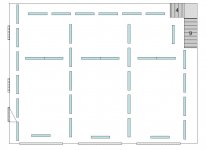
Based on how nice yours turned out, I have modified my plan as attached, attempting to mimic your approximate spacing of the rows of lights. I started 4' off the back wall as there will be benches back there and I can add specific lighting over them if needed, then went about every 5' although the first longer row is a bit further due to the stairs on the right side and the bathroom that will be built under there. That spacing also puts the front row a little less than 4' from the front wall, but this is a rough sketch to figure out the plan, I can always work in fractions when I get to the actual install to make it even, if need be.

This picture shows 4' fixtures, but I suppose it doesn't really matter if I use 4' fixtures or 8' fixtures, the bulbs will all be 4'. Thoughts?
 

Attachments

  • Garage-lights2.jpg
    Garage-lights2.jpg
    53.3 KB · Views: 56
OP
A

armorerr

Member
Joined
May 7, 2012
Messages
22
Location
Pittsburgh, PA
You are apparently confusing two very different things.

Yes, I was.

The ability to start in cold weather is primarily a function of the ballast, not the tube. And while special "Cold Service" tubes are made for such applications as walk-in freezers and such, even run-of-the-mill F32T8s are generally rated down to at least 0-degrees F. How often do you expect your shop to get THAT cold?!?

Once it's done, never, or something has gone horribly wrong! But, I'm trying to get the lights in now, the cold has already hit, and insulation won't go in until next year, if I'm lucky. I am hoping to use the lights this winter to work out there and I will be running some heaters during those times, but it's just a plywood box with siding for the time being. But now that you put it that way, if it's below 0*, I'm not going to be working out there anyway! So, I believe I am on-track with standard F32T8 bulbs and fixtures now.

Fair enough. But you still don't need a "grid" pattern to accomplish this; and odds are, you'll do better with a more "row oriented" layout. If the space will be primarily used for automotive projects, I generally tend to favor a "Big 'U'" or "Big 'W'" layout, with more-or-less continuous runs of lights running along the SIDES of the vehicles, and additionally across the back of the space (i.e., furthest from the door). This puts most of the light where you most need it -- i.e., where you'll actually be working. After all, it does precious little good to brightly illuminate the roofs of cars (unless you're painting them; but paint booths are a whole 'nother topic). If you also want to add a little light near the door end of each bay, fine; but as you noted, you'll need to switch those separately, or they'll be a complete waste of electricity whenever the doors are open.

See the attached; I dumped the grid but it's a bit of an edit from my reply above to Ray916MN. I spaced 3' off the back wall and then 5', which leaves a little less than 5' off the front wall.

That's the generally accepted target for a "serious" garage. Some folks get by with less; some folks want more. But in any event, ~300 lumens/ft.^2 is completely over the top.

Agreed. My target was right, but my implementation was off.

I'm willing to wager that, when all is said and done, you'll wind up using (at least mostly) twin-tube fixtures with F32T8 tubes in them.

As I said above, I believe that is exactly where I am at now, thanks to the advice here.

In the end, what it really comes down to is the distribution pattern of a linear fluorescent tube -- which, unlike a conventional light bulb or other point sources, is NOT even remotely close to spherical. They emit the VAST majority of their output radially, directly perpendicular to their axis, and virtually none out the ends (or even at small angles to the axis). This is why continuous runs of "strip" lights, with each fixture butted tight to the next one, work so well. The correct (or at least "ideal") lateral spacing between each of those runs is basically a function of mounting height, as influenced by the photometrics of the particular fixtures. Open-tube "strip" lights and those with simple "wrap" diffusers can be spaced more widely (or tolerate a lower installed height, or some combination of the two), than fixtures with efficient reflectors and/or focusing vanes/lenses (such as typically found in "High Bay" fixtures, for example).

Ok, so this is where I'm headed, what do you think of the spacing? With my lower ceilings compared to Ray916MN's building, I think I should be good.
 

Attachments

  • Garage-lights2.jpg
    Garage-lights2.jpg
    52.5 KB · Views: 27

2ManyProjects

Well-known member
Joined
Jul 18, 2013
Messages
757
Based on how nice yours turned out, I have modified my plan as attached, attempting to mimic your approximate spacing of the rows of lights. I started 4' off the back wall as there will be benches back there and I can add specific lighting over them if needed, then went about every 5' although the first longer row is a bit further due to the stairs on the right side and the bathroom that will be built under there. That spacing also puts the front row a little less than 4' from the front wall, but this is a rough sketch to figure out the plan, I can always work in fractions when I get to the actual install to make it even, if need be.

In either this version, or the one you attached to your reply to me, you're still showing a Metric Buttload [tm] of light -- 200-205 lumens/ft.^2, depending on which version of the sketch we consider. While I would be the last person to claim that you MUST stick to that previously discussed nominal 100 lumens/ft.^2 "Rule of Thumb", this strikes me as just TOO far off-base.

This picture shows 4' fixtures, but I suppose it doesn't really matter if I use 4' fixtures or 8' fixtures, the bulbs will all be 4'. Thoughts?

It mostly comes into play in two ways:

1. - With individual 4-foot fixtures, you can usefully fudge the end-to-end spacing of each fixture in the run WITHOUT creating huge gaps in the coverage pattern. For example, you're currently showing nine four foot fixtures in your longer runs; hence, eight inter-fixture joints/gaps. If you space each of those fixtures 6 inches apart (end-to-end), you'll add four feet to the total run length without actually adding any more fixtures -- and more importantly, without creating noticeable "dark spots" in the coverage pattern. But to stretch out a run of eight-foot fixtures similarly, the inter-fixture gaps would each have to be much bigger, because there would be fewer of them. Hence, those "dark spots" are more likely to become noticeable.

2. - Using individual four-foot fixtures makes it far more feasible to wire them up into multiple separately switched "banks", on an (approximately) "every-other-fixture" basis. Doing this with eight-foot fixtures would create MUCH larger gaps in the coverage pattern when you're only running some of the lights.


See the attached; I dumped the grid but it's a bit of an edit from my reply above to Ray916MN. I spaced 3' off the back wall and then 5', which leaves a little less than 5' off the front wall.
Ok, so this is where I'm headed, what do you think of the spacing? With my lower ceilings compared to Ray916MN's building, I think I should be good.

As noted above, I think you're still using WAY too many lights. I also don't think the simple "rank & file" layout is your best bet. Just as a rough starting point, try this:

Starting near the front wall (where the overhead doors are), put four "runs" of lights, each extending back about 2/3rds of the way to the rear. Place these runs to avoid the overhead doors themselves (i.e., about 2-4 feet off the side walls for the outer runs, and directly BETWEEN the overhead doors for the inner runs). I'm guessing four (4-foot) fixtures would suffice for each run; but you could probably cram in five if you wanted to.

Now put a single "crossways" run just past where these runs terminate (which will likely be just before that stairwell in the upper-right corner). Probably 6-8 fixtures, total, in this run.

Optionally (but likely), put a second "crossways" run at about half the distance from the first one and the back wall, maybe fudging it a bit more toward the wall than "dead centered" would imply. Again, 6-8 fixtures here.

This would all add up to 28-36 fixtures (56-72 tubes) to cover the entire space. That works out to about 130-168 lumens/ft.^2 (at the source(s), with fresh tubes). That's PLENTY. And by placing the fixtures approximately as I have described, you're putting (most of) the light where you're actually going to need it, as opposed to wasting a ton of it by brightly illuminating the roofs of cars or letting it get blocked by the overhead doors.


PetesPonies

Well-known member
Joined
Jan 1, 2010
Messages
120
My opinion . . too many lights. You just don' need that many. I have had a 24 x 36 shop a 40 x 52 shop and now a 56 x 64 shop.
 

Ray916MN

Well-known member
Joined
Apr 15, 2012
Messages
1,066
Location
Orono, MN
...
And you still have one of the nicest-lit shops I've seen. ;)

Thanks for the compliment. I was lucky it worked out well. Most of the electricians who bid the job thought there were too many lights.

Thanks for the advice. I love your garage and wish mine had higher walls but the structure was already in place when I bought the property. But, it's completely unfinished so I get to do that however I wish.

Based on how nice yours turned out, I have modified my plan as attached, attempting to mimic your approximate spacing of the rows of lights. I started 4' off the back wall as there will be benches back there and I can add specific lighting over them if needed, then went about every 5' although the first longer row is a bit further due to the stairs on the right side and the bathroom that will be built under there. That spacing also puts the front row a little less than 4' from the front wall, but this is a rough sketch to figure out the plan, I can always work in fractions when I get to the actual install to make it even, if need be.

This picture shows 4' fixtures, but I suppose it doesn't really matter if I use 4' fixtures or 8' fixtures, the bulbs will all be 4'. Thoughts?

The difference between 8' and 4' fixtures is subtle. More layout flexibility with 4's and less install cost with 8's. I went with 4's simply because their popularity made them ultra inexpensive. I ended paying under $8 per fixture tax included from my local Menards. Considerably less expensive than I could get from any wholesaler or electrical supply house I could find.

With respect to layout, given you have 3 garage doors, I would consider laying your lights out parallel to the side walls as opposed to perpendicular so it is easier to minimize the number of lights obscured by the garage doors when opened. One of the things I really like about having good lighting with the doors open is working with the doors open on cool summer evenings and having it feel like I'm outdoors through out the garage with the doors open (daylight spectrum tubes) during the daytime.

I think 2ManyProjects has a point with the amount of lighting being potentially excessive. Your ceiling height is a better fit for regular fixtures with reflectors than mine is. Regular fixtures designed for ceiling mounting are generally designed to work with ceiling heights below 12-14' (probably optimized for 8" height). At these ceiling heights, high bay fixtures start to become more efficient for floor lighting. I used regular fixtures because they were much less expensive than high bay fixtures and I wanted to light into my tall shelving. My racking also absorbs a considerable amount of light. With floor to ceiling 18"-36" deep racking on two walls and an 8' wide island bisecting my space there is allot of above floor light absorption. Enough so that there are 24 4' tubes mounted to the underside of some of the racked space to compensate. I would imagine that you could reduce the number of lights in your plan by 25% and achieve the same of higher level of lighting I have and if you drop mounted your lighting to an 8' level you could reduce the amount of lighting in your plan by maybe as much as 50% to achieve the same level of lighting.
 

2ManyProjects

Well-known member
Joined
Jul 18, 2013
Messages
757
Thanks for the compliment. I was lucky it worked out well. Most of the electricians who bid the job thought there were too many lights.

Well, you're definitely on the high side. But, probably for most of the reasons you later cite, it's not so far into "overkill" territory than it becomes a problem. And after all, it is the end result which counts.

The difference between 8' and 4' fixtures is subtle. More layout flexibility with 4's and less install cost with 8's.

AND more switching flexibility with the four-footers. Different folks value this to different degrees; but personally, I consider keeping your day-to-day operational options open to be WELL worth the slight added complexity -- ESPECIALLY if you also go slightly overboard on the total number of fixtures used, so that you CAN have "operating room"-like lighting when you want/need it.

With respect to layout, given you have 3 garage doors, I would consider laying your lights out parallel to the side walls as opposed to perpendicular so it is easier to minimize the number of lights obscured by the garage doors when opened.

As you will note from my previous post to this thread, at least for the "front" 1/2 to 2/3 of the space, I agree. The thing is, there is no rule which states that all the lights need to run parallel to each other, as the OP appears to be assuming (perhaps in part because most online "lighting calculators" also make that same simple-minded assumption?). So when we get back toward the rear of the space, it makes somewhat more sense to revert to a "crossways" orientation, so as to better illuminate the benches, shelving, and other "stuff" likely to be placed along that back wall.

I think 2ManyProjects has a point with the amount of lighting being potentially excessive. Your ceiling height is a better fit for regular fixtures with reflectors than mine is.

ITYM "withOUT reflectors", or "with DIFFUSERS" (i.e., most simple "wrap" type fixtures). Reflectors (built into fixtures) nearly always work to more tightly focus the light output in a straight-downward direction, as opposed to letting it spread out to the sides. That's just the ticket in so-called "High Bay" applications; but it is exactly the opposite of what is needed with relatively low ceilings.

Regular fixtures designed for ceiling mounting are generally designed to work with ceiling heights below 12-14' (probably optimized for 8" height). At these ceiling heights, high bay fixtures start to become more efficient for floor lighting.

Just to be clear, by "these ceiling heights", you are referring to your own 13.5-foot ceilings (and higher). "High Bay" fixtures do NOT work well at lower heights.

I used regular fixtures because they were much less expensive than high bay fixtures and I wanted to light into my tall shelving. My racking also absorbs a considerable amount of light. With floor to ceiling 18"-36" deep racking on two walls and an 8' wide island bisecting my space there is allot of above floor light absorption. Enough so that there are 24 4' tubes mounted to the underside of some of the racked space to compensate.

The "take home" here is that, while certain basic principles tend to apply across the board, every situation is at least somewhat unique; and so, for the best results, you have to do what works in THAT particular space.

I would imagine that you could reduce the number of lights in your plan by 25% and achieve the same of higher level of lighting I have and if you drop mounted your lighting to an 8' level you could reduce the amount of lighting in your plan by maybe as much as 50% to achieve the same level of lighting.

Well... Hold on here a moment.

While lowering the installed height of the fixtures will indeed tend to brighten things up at floor/working height, it will also make getting even coverage of that space even more problematic. At lower mounting heights, the output of each fixture/tube has less opportunity to disperse over a wide-ish area before it gets down to "working height"; so you wind up needing MORE lights in order to evenly cover the space, even though (in theory, at least) you already have "too much" light in terms of the overall average.

 
To avoid these ads, REGISTER NOW!
OP
A

armorerr

Member
Joined
May 7, 2012
Messages
22
Location
Pittsburgh, PA
First, thanks again to everyone for the continued assistance!

Attached is the re-worked plan; 32 4' 2-tube fixtures. It is mostly what 2ManyProjects suggested, except I put three lights at the front, above the garage doors, to provide light when the doors are closed (again, this is based on my experience failing to take that into consideration at the last shop!). I keep waffling that I could stick a few more fixtures in the "middle" row running side-to-side, but I just don't think they will be needed from what you all have said.

I am planning to use these fixtures: http://www.homedepot.com/p/Lithonia-Lighting-2-Light-Utility-Light-3348-2L32W-WRAP/100654395 Any issues with them?

I will also need to then decide on the actual tubes; 4100K, 5000K or 6500K? I know I want the mean lumens as close to 2700 as possible, but there are plenty of options.
 

Attachments

  • Garage-lights4.jpg
    Garage-lights4.jpg
    49.8 KB · Views: 28

2ManyProjects

Well-known member
Joined
Jul 18, 2013
Messages
757
First, thanks again to everyone for the continued assistance!

No problem. ;)

Attached is the re-worked plan; 32 4' 2-tube fixtures. It is mostly what 2ManyProjects suggested, except I put three lights at the front, above the garage doors, to provide light when the doors are closed (again, this is based on my experience failing to take that into consideration at the last shop!).

You're homing in on it. I'd still "tweak" this layout a bit; but it's definitely the best plan you've come up with so far. The three extra fixtures near the doors are no big deal; if they help put your mind at ease, go for it.

I keep waffling that I could stick a few more fixtures in the "middle" row running side-to-side, but I just don't think they will be needed from what you all have said.

Well... Actually, I probably WOULD put more fixtures into that run. However, I would ALSO shorten the main front-to-back runs by one fixture (and maybe bring them closer to each other -- i.e., reduce or eliminate the end-to-end gaps). The idea here is: Four ~4-foot fixtures, butted tight end-to-end, would run just over 16 feet, total. If those runs start two feet off the front wall, and you space the mid-room "crossways" run similarly, that would put that crossways run ~20 feet in from the door -- just about exactly where you'd want it to provide maximum illumination into the open engine compartments of any vehicles parked in there. And since that is a relatively important function of the lighting system, "more is better" tends to apply here. This is not to imply that you would not ALSO want one or two pull-down trouble lights on retractable cord reels; but it should help make you somewhat less dependent on them.

The row across the back wall is fine as-is, presuming it's approximately 2-3 feet off the wall. After you've got all that laid out, IF the "gap" between the two "crossways" runs still seems too large, you can fill it in as desired with a FEW (no more than three or four) additional "stand-alone" fixtures, probably oriented perpendicular to the crossways runs. But given the "stronger" mid-room crossways run as discussed above, you probably won't actually NEED these (except maybe on the far left, to illuminate any wall-hung storage there).


Some folks have noted that those are indeed VERY cheap fixtures, with all that implies. That said, I still think they represent a decent value; and as of the moment, they're still at the top of my "short list" for my own garage project (which, for unrelated reasons, is still at least several months off). Still, I wouldn't object to finding a higher-quality version of essentially the same design; but at least most of the alternatives I've seen thus far are both physically larger and have a somewhat less desirable diffuser/lens design. Also, having a "matching" two-foot version available is handy, at least in my case.

I will also need to then decide on the actual tubes; 4100K, 5000K or 6500K? I know I want the mean lumens as close to 2700 as possible, but there are plenty of options.

Typical F32T8 tubes are rated at about 2,800 initial lumens. And pretty much all linear fluorescent tubes degrade similarly, losing 5-10% of their output over their useful lifetimes. So don't let the "Mean Lumens" spec be the tail that wags the dog here. The simple fact is, there just isn't that much difference from one "general-purpose" tube to the next in this respect. Now, if you start getting into special-application tubes, such as those intended for Cold Service or high-CRI applications, all bets are off; some of those will indeed vary markedly in terms of both initial output and degradation over the expected lifespan.

As for color temperature, I'd look first to either 4100K or 5000K types. These will be the closest to what most folks think of as "natural daylight" (even tho', in reality, they're still VERY far off that mark). The 3000K types will appear VERY yellow; while the 6500K types will probably seem noticeably bluish. But again, since NO fluorescent tube does a decent job of mimicking real daylight over the FULL visible spectrum, these are all crude approximations anyway.


Tim H. 1969

New member
Joined
Nov 27, 2013
Messages
1
I have ten 8 foot, four light T8 fixtures in my 30x40 shop bought from Home Depot. I couldn't ask for more. The light quality did diminish when I put in the wafferboard due to the darker color of the ceiling but that should get better when I paint the ceiling gloss while to reflect the light. I have considered a pair of 8 ft. T50 lights that will go over the work bench for extra lighting. If anyone has any ideas, please let me know.
 

jvitez

Well-known member
Joined
Nov 30, 2009
Messages
2,429
Location
Big Sky Country, Canada
2ManyProjects gives excellent detailed explanations of each specific point so I can't add anything to that, but I will give my personal experience about colour temperature and T8's.

I added a fluorescent fixture to our walk in closet, and the Mrs. doesn't like bluish fluorescent illumination, so I thought I'd give "warm white" a try. I bought 3 four ft T8 tubes in 2700K. I happily installed them and turned on the fixture: GAAAAK! I've never seen such sickly bilious looking colour. The colour of every bit of clothing was completely off even though the CRI was supposedly 85. The white ceiling looked severely jaundiced. Yuuuuuuuk!

I immediately searched for an alternative, and am very happy with Standard brand made in Germany 3500K lamps. What a difference! But for a garage I prefer a crisper more clinical look, so at a minimum I'd use 4100K, though 5000K would be my preference. I have 5000K CFL's in several closets and I really like the crisp white appearance. It looks brighter than lower colour temperature CFL's even if the lumen output is the same.

Main point: fluorescent lamps whether tubular or CFL's do NOT appear the same as incandescents even if rated for the same colour temperature.
 
OP
A

armorerr

Member
Joined
May 7, 2012
Messages
22
Location
Pittsburgh, PA
Well... Actually, I probably WOULD put more fixtures into that run. However, I would ALSO shorten the main front-to-back runs by one fixture (and maybe bring them closer to each other -- i.e., reduce or eliminate the end-to-end gaps). The idea here is: Four ~4-foot fixtures, butted tight end-to-end, would run just over 16 feet, total. If those runs start two feet off the front wall, and you space the mid-room "crossways" run similarly, that would put that crossways run ~20 feet in from the door -- just about exactly where you'd want it to provide maximum illumination into the open engine compartments of any vehicles parked in there. And since that is a relatively important function of the lighting system, "more is better" tends to apply here. This is not to imply that you would not ALSO want one or two pull-down trouble lights on retractable cord reels; but it should help make you somewhat less dependent on them.

The row across the back wall is fine as-is, presuming it's approximately 2-3 feet off the wall. After you've got all that laid out, IF the "gap" between the two "crossways" runs still seems too large, you can fill it in as desired with a FEW (no more than three or four) additional "stand-alone" fixtures, probably oriented perpendicular to the crossways runs. But given the "stronger" mid-room crossways run as discussed above, you probably won't actually NEED these (except maybe on the far left, to illuminate any wall-hung storage there).

The drawing is actually to scale (in it's original format, anyway) so that cross-run is 20' back from the doors and the back row is 2' off the rear wall. I like the idea of running the lights butted end-to-end, but then I end up seeing bigger gaps, usually at the ends. 16' is only 1/2 the depth, so if I add space in the run where the cross-run is, then I'm almost back to my original grid. As they are pictured, the gaps are 1' between fixtures. While coming up with the version below, I attempted to shorten the gap, particularly on the left-most run, and I didn't like it at all. I think this will give me good light and as you say, I could add fixtures in the right-to-left orientation if needed anywhere for additional light.

Some folks have noted that those are indeed VERY cheap fixtures, with all that implies. That said, I still think they represent a decent value; and as of the moment, they're still at the top of my "short list" for my own garage project (which, for unrelated reasons, is still at least several months off). Still, I wouldn't object to finding a higher-quality version of essentially the same design; but at least most of the alternatives I've seen thus far are both physically larger and have a somewhat less desirable diffuser/lens design. Also, having a "matching" two-foot version available is handy, at least in my case.

Given my somewhat low ceiling height, I feel better with a diffuser/cover on the fixtures vs. exposed tubes. The (hopefully) better light distribution is just a bonus. I will check around and see if I can find another option but they are the leader for me as well right now.

Typical F32T8 tubes are rated at about 2,800 initial lumens. And pretty much all linear fluorescent tubes degrade similarly, losing 5-10% of their output over their useful lifetimes. So don't let the "Mean Lumens" spec be the tail that wags the dog here. The simple fact is, there just isn't that much difference from one "general-purpose" tube to the next in this respect. Now, if you start getting into special-application tubes, such as those intended for Cold Service or high-CRI applications, all bets are off; some of those will indeed vary markedly in terms of both initial output and degradation over the expected lifespan.

As for color temperature, I'd look first to either 4100K or 5000K types. These will be the closest to what most folks think of as "natural daylight" (even tho', in reality, they're still VERY far off that mark). The 3000K types will appear VERY yellow; while the 6500K types will probably seem noticeably bluish. But again, since NO fluorescent tube does a decent job of mimicking real daylight over the FULL visible spectrum, these are all crude approximations anyway.

5000K is where I was leaning as I saw enough threads saying 6500K was too blue.

Final (?) version attached. Thanks again for the advice!
 

Attachments

  • Garage-lights4.jpg
    Garage-lights4.jpg
    51.4 KB · Views: 26

2ManyProjects

Well-known member
Joined
Jul 18, 2013
Messages
757
The drawing is actually to scale (in it's original format, anyway) so that cross-run is 20' back from the doors and the back row is 2' off the rear wall. I like the idea of running the lights butted end-to-end, but then I end up seeing bigger gaps, usually at the ends. 16' is only 1/2 the depth, so if I add space in the run where the cross-run is, then I'm almost back to my original grid.

Not really. Or at least, not as I envisioned it; but maybe I've not done a great job of explaining that vision.

As they are pictured, the gaps are 1' between fixtures. While coming up with the version below, I attempted to shorten the gap, particularly on the left-most run, and I didn't like it at all. I think this will give me good light and as you say, I could add fixtures in the right-to-left orientation if needed anywhere for additional light.

OK, before anything else, what you are (currently) showing probably WILL work pretty well for you. But hey... I'm playing Devil's Advocate here anyway; so just for grins, try this:

1. - Eliminate the end-end gaps between the first (i.e., "front-most") four fixtures in each of the four front/back runs.

2. - Adjust the fore/aft placement of these runs so that the gap between the front wall and the start of these runs is about the same as the gap between the end of the (far right-hand) run and the start of the staircase. (If I'm eyeballing this correctly, those gaps should be no more than about three feet each. If you think that's still too much "gaposis", stick one of the matching two-foot fixtures in the middle of each of those runs.)

3. - EITHER leave the "fifth" fixture in each of those runs more-or-less where they are now, or (more likely, especially considering the points below) eliminate all but the far-left & far-right ones (which would remain mostly to provide wall illumination).

4. - Adjust the fore/aft placement of the mid-room crossways run so that it lies about a foot (maybe two, but no more than that) beyond the ends of the main font/back runs.

5. - Optionally (but recommended), add two or three additional fixtures to the mid-room crossways run, to make it more-or-less continuous. (Note that with three more fixtures and no gaps, this would put the endpoints of that run within two feet of both sidewalls. If that seems too "tight", you could substitute three two-foot fixtures for two of the four-footers, placing them more-or-less in the middle of each parking bay.)

[SIDE NOTE: In either this case, or the one in point #2 above, some or all of these two-foot fixtures would also be PERFECTLY suited to do double-duty as your "walk-through" lighting.]

6. - Also optionally, fudge the rear-most crossways run just SLIGHTLY further from the wall -- say, to three feet, max. This, in combination with the previous two points, will all but eliminate the need for those "fifth" fixtures in the main fore/aft runs.

Given my somewhat low ceiling height, I feel better with a diffuser/cover on the fixtures vs. exposed tubes. The (hopefully) better light distribution is just a bonus.

I agree on both counts.

I will check around and see if I can find another option but they are the leader for me as well right now.

Keep us posted.

5000K is where I was leaning as I saw enough threads saying 6500K was too blue.

I think you'll be happy with that.

Final (?) version attached. Thanks again for the advice!

Never say never. ;)


Another alternative: I went with 5 85watt CFL 6,500K bulbs in my 3 car garage with standard ceramic screw-in fixtures. I think I'm all in for under $200 and it produces a TON of light. 8 of these in your space and you should be more than good.

The problem with high-power CFLs, including the ones you propose, is that they concentrate all the light into a very few point-sources. That in turn leads to relatively "spotty" and uneven illumination (unless your ceilings are VERY high; but that brings other issues into play).

Further, it would take WAY more than eight of them to cover "armorerr"'s 30'x40' space. Assuming these:

http://www.alzodigital.com/online_store/full_spectrum_light_bulbs_85w.htm

are typical, they each produce 4,250 initial lumens. To hit our target 100-125 (source) lumens/ft.^2, would require at least 28-35 of them.

Similarly, if your "three-car garage" is of typical proportions (perhaps 20'x30' or so), I am at something of a loss as to how you could describe just five of these as producing "a TON of light" in that space. That would be only about 35 lumens/ft.^2 at the source(s); even less at working height.

As a side note, CFLs tend to be significantly less (electrically) efficient than linear fluorescent tubes; and these are no exception. Using 85 watts to produce 4,250 lumens equates to 50 lumens/watt. A standard F32T8 tube produces a nominal 2,800 lumens on just 32 watts, or 87.5 lumens/watt.


Ummm... Those are 105 watts each, not 85 watts. But the same fundamental principles (and the same inherent problems) apply. They also don't specify the output lumens on that Amazon page; but 1000bulbs.com does, for what appears to be a very similar product:

http://www.1000bulbs.com/product/8257/FC105-S50MOGOD.html

7,150 (initial) lumens out of 105 watts = 68 lumens/watt. That's better than the 85-watters cited above, but still not as good as a $3.00 F32T8.


Using these would just make the "spottiness" problem worse, at least as compared to a flat white ceiling. If you are forced to use CFLs in an open-truss-ceiling situation, they could be useful.

Bottom Line: CFLs are essentially "Band-Aids" -- i.e., quick & dirty substitutes for conventional incandescent bulbs, when you are forced to use the same existing fixtures. As such, they have their place (at least for awhile; I expect their popularity to fade markedly over the next several years). But they will never be competitive with linear fluorescents in those situations where you're not stuck with an Edison base.


ripper70

Well-known member
Joined
Nov 30, 2011
Messages
70
Location
Oregon Coast
I have searched the forum and read about 300 different lighting threads, but still feel a bit unsure about how to best position the lights in my garage. The garage will eventually have finished walls and ceiling (about 10' height), all painted white, and a light-color epoxy floor. The main use will be automotive work and light fabrication.

I think I am going with the general consensus of getting the basic T8 HO fixtures from Home Depot. Attached is a quick plan for using all 8' fixtures (two 4' sections with 2 bulbs per section) in a grid type pattern. If you read my other thread, I already went total overkill on electrical service and want the same with my lighting solution. I do plan to zone the lights into two or three switches.

According to some of the threads, this is not enough light for the space. Others indicate I could do this with about half the fixtures and just run strips across either front-to-back or left-to-right. I know it will be better than the current space where I work on my cars but much like the electrical service, I want to do this once and have no "wish I had added a few more" regrets!

Any thoughts are appreciated!


I just finished my lights in my 30x40 with vault and i ran 4 rows 32 ft. long with t8 8 ft fixtures with 4 bulbs. First row is 5 ft of wall on each side then next row is 7 ft. Its is PLENTY of light imo. Any brighter id need sunglasses.:beer:
 
OP
A

armorerr

Member
Joined
May 7, 2012
Messages
22
Location
Pittsburgh, PA
OK, before anything else, what you are (currently) showing probably WILL work pretty well for you. But hey... I'm playing Devil's Advocate here anyway; so just for grins, try this:

1. - Eliminate the end-end gaps between the first (i.e., "front-most") four fixtures in each of the four front/back runs.

2. - Adjust the fore/aft placement of these runs so that the gap between the front wall and the start of these runs is about the same as the gap between the end of the (far right-hand) run and the start of the staircase. (If I'm eyeballing this correctly, those gaps should be no more than about three feet each. If you think that's still too much "gaposis", stick one of the matching two-foot fixtures in the middle of each of those runs.)

3. - EITHER leave the "fifth" fixture in each of those runs more-or-less where they are now, or (more likely, especially considering the points below) eliminate all but the far-left & far-right ones (which would remain mostly to provide wall illumination).

4. - Adjust the fore/aft placement of the mid-room crossways run so that it lies about a foot (maybe two, but no more than that) beyond the ends of the main font/back runs.

5. - Optionally (but recommended), add two or three additional fixtures to the mid-room crossways run, to make it more-or-less continuous. (Note that with three more fixtures and no gaps, this would put the endpoints of that run within two feet of both sidewalls. If that seems too "tight", you could substitute three two-foot fixtures for two of the four-footers, placing them more-or-less in the middle of each parking bay.)

[SIDE NOTE: In either this case, or the one in point #2 above, some or all of these two-foot fixtures would also be PERFECTLY suited to do double-duty as your "walk-through" lighting.]

6. - Also optionally, fudge the rear-most crossways run just SLIGHTLY further from the wall -- say, to three feet, max. This, in combination with the previous two points, will all but eliminate the need for those "fifth" fixtures in the main fore/aft runs.

I gave it a shot and it started to have gaps the same as my original grid layout, which means I felt I would need more fixtures! I am pretty happy with what has evolved, as it allows for the relatively easy addition of fixtures if I decide that is needed in the future.

Armorerr said:
5000K is where I was leaning as I saw enough threads saying 6500K was too blue.
I think you'll be happy with that.

I just got a Griot's catalog in the mail and they are pushing 5000K as "daylight", so it must be the best, right? ;)

Now to find the fixtures so I can get started on the install!
 

AZ Glen

Well-known member
Joined
Apr 3, 2006
Messages
118
Location
Scottsdale, AZ
I would be careful about running those fixtures along the perimeter wall, the ceiling is only 10 feet tall? if you put cabinets and/or shelves along the wall you might create shadows and waste the lighting on the top of the cabinet. space them out off the wall a little. (I didn't see a measurement?)

I have 12 foot ceilings 30x40 and ran 10 8ft. long fixtures with 40 T5 bulbs and it is stupid bright.
 
Last edited:

mcimc558

New member
Joined
Aug 22, 2013
Messages
1
HAPPY T K to all i am new to forum . building a 22x32 garage this has been a wealth of knowledge i hope to be able to contribute as time goes on
 
To avoid these ads, REGISTER NOW!
Top Bottom