To avoid these ads, REGISTER NOW!

Lighting fence columns

miketyler

Well-known member
Joined
Sep 10, 2009
Messages
635
Location
Cedar Hill, TX
I hope this isnt too far off topic. I see lots of general contruction info here and hope someone can help me. We are installing wrought iron fence on our acre lot. At the corners of the fence and at mid points we will have decorative stone columns.

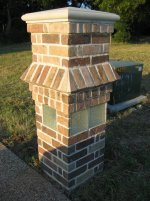
One of the properties in our area has pony walls flanking the driveway with these type columns and they have illuminated them. They have 8" glass block (2 on each side) and what looks like dimmable incandescent lighting to each.

I was thinking on running low voltage lighting to these but wasnt sure about how voltage drop would affect brightness since the total run will be around 450 ft. The columns will be placed in a large U shape and I would like to feed the power from one source location but if necessary, could split it off and feed power from both front corners and actually run two circuits.

Any ideas on this? I have seen the solar LED applications and they just dont seem bright enough to give me the affect I am looking for.

Here's an example of what I have seen in our neighborhood. I plan on using only one glass block per side. Would appreciate any advice regarding lighting, earth contact wiring, specific code compliance, etc.

 

Attachments

  • IMG_5453.jpg
    IMG_5453.jpg
    152.8 KB · Views: 79
  • IMG_5467.jpg
    IMG_5467.jpg
    148.1 KB · Views: 72
To avoid these ads, REGISTER NOW!

critter

Well-known member
Joined
Mar 20, 2012
Messages
47
Location
Outside your window
Solar is ****.
Looking to do similar with a similar sized run.
From what I have gleened so far from talking to electrical nerds is that the 12v transformer needs to be a bigun to deliver the correct wattage and larger gauge wire will prevent voltage drop. That's as far as I have gotten with it so far.
Bought 2 solar spots to see how effective the are.....not very.
 

PRH44

Well-known member
Joined
Dec 25, 2009
Messages
563
Location
Indiana
The voltage drop on low voltage such as 24 volt AC at 450 feet will eat you alive, if you intend on using more than 50 watts of lighting total. To run 50 watts at 24 volt AC and keep the voltage drop to 5 % you would need a #8 or #6 AWG copper. 12 volt or DC would be worse.
It would be best to install a 120 volt Ac circuit to a location at the wall and place the low voltage transformer close to the loads, if it is not integrated in the fixture you purchase.
You can play around with this voltage drop calculator and get an idea what you are up against.
http://www.southwire.com/support/voltage-drop-calculator.htm

Hope that helps

Paul
 

fastbroshi

Well-known member
Joined
Jul 23, 2010
Messages
111
Location
Dallas, TX
Have you asked that property owner what exactly they or their contractor did? Might be some good insight there.
 

Speedy Petey

Well-known member
Joined
Apr 22, 2012
Messages
1,430
Location
NY State
At those distances line voltage is your ONLY choice. Having local transformers will work, but installing/hiding them might be an issue.
 
OP
M

miketyler

Well-known member
Joined
Sep 10, 2009
Messages
635
Location
Cedar Hill, TX
Thanks for the responses. I have run 3/4" PVC tube going in and out of the column footing. I may be in trouble as it has 90* in the middle and I may not be able to get the direct burial wire pulled thru as stiff and as large a diameter as it may be. I will have to check this.

I will have to ck specs on the 24VAC stuff as well. I had some 12VAC stuff saved back for this but maybe isnt going to cut it. If the above is the case, maybe two separate runs of 24VAC one @ 190ft length and one at 225ft?
 

Speedy Petey

Well-known member
Joined
Apr 22, 2012
Messages
1,430
Location
NY State
Thanks for the responses. I have run 3/4" PVC tube going in and out of the column footing. I may be in trouble as it has 90* in the middle and I may not be able to get the direct burial wire pulled thru as stiff and as large a diameter as it may be. I will have to check this.
DO NOT pull UF cable into that conduit. It's not illegal, but pulling any UF cable into a 3/4" conduit will most likely not be complaint (fill wise), and will be next to impossible.

You use THHN/THWN pulled into conduit.
 
OP
M

miketyler

Well-known member
Joined
Sep 10, 2009
Messages
635
Location
Cedar Hill, TX
Because of the tight bend or vacant space left inside the PVC once pulled? Not sure I understand.

14-2 is rated for up to 15amps. Set on its own breaker would that be ok for eight 40 watt bulbs?
 

Norcal

Well-known member
Joined
Mar 16, 2008
Messages
13,752
IMHO, use twin tube fluorescent lamps supplied from a 120V feed, a 13 watt twin tube is compact, as is the ballast, + cheap.

I would not use UF cable under any circumstances, PVC SCH 40 conduit is cheap & good insurance.
 
Last edited:

Stuart in MN

Well-known member
Joined
Sep 8, 2005
Messages
23,039
Location
Minneapolis
Because of the tight bend or vacant space left inside the PVC once pulled? Not sure I understand.

14-2 is rated for up to 15amps. Set on its own breaker would that be ok for eight 40 watt bulbs?

Because of the overall diameter of UF cable - the NEC has guidelines for how much you can stuff inside a given size of conduit. I'd have to do the calculations but it's likely the cable is bigger than is allowed. In any event it's really stiff stuff, so pulling it through the bends of the conduit will be very hard to do. Since it will be inside conduit, there's no need to use UF cable anyway - you're just paying extra for the outer sheath.

Running eight 40 watt bulbs should be fine: 8 x 40 = 320 watts; 320 watts divided by 120 volts is only 2.7 amps. Edit: I didn't take into account the distance...for 450 feet, the voltage drop on #14 wire will be a little higher than desired, I'd go with #12.
 
Last edited:
OP
M

miketyler

Well-known member
Joined
Sep 10, 2009
Messages
635
Location
Cedar Hill, TX
That might be a possiblity actually but I would like to understand more about the wire size as it relates to the acceptable load. I plan to put in a dedicated breaker for the column lighting. I'd like to use the 14-2 UF THHN as it looks like it will pull pretty easy (although I havent tried yet)

I really appreciate the advice and ideas here. I am not an electrician and want to do this as safely as possible.

IMG_0037.JPG
 

Stuart in MN

Well-known member
Joined
Sep 8, 2005
Messages
23,039
Location
Minneapolis
Something else to consider: if it's 450 feet from point A to B, you either need to use wire that's 450 feet long - if you buy wire in shorter lengths you need to include some junction boxes / hand holes along the way to make the junctions.
 
OP
M

miketyler

Well-known member
Joined
Sep 10, 2009
Messages
635
Location
Cedar Hill, TX
I am putting in junction boxes inside each column. Was planning on joining each new segment within this junction box.
 
OP
M

miketyler

Well-known member
Joined
Sep 10, 2009
Messages
635
Location
Cedar Hill, TX
Because of the overall diameter of UF cable - the NEC has guidelines for how much you can stuff inside a given size of conduit. I'd have to do the calculations but it's likely the cable is bigger than is allowed. In any event it's really stiff stuff, so pulling it through the bends of the conduit will be very hard to do. Since it will be inside conduit, there's no need to use UF cable anyway - you're just paying extra for the outer sheath.

Running eight 40 watt bulbs should be fine: 8 x 40 = 320 watts; 320 watts divided by 120 volts is only 2.7 amps. Edit: I didn't take into account the distance...for 450 feet, the voltage drop on #14 wire will be a little higher than desired, I'd go with #12.

Thanks for the follw up. The PVC is actually 9/10" ID. The 14-2 is only 3/8" x 5/32". I havent pulled it yet but my fishtape went thru it easily. The 14-2 is ver flexibel and I would bet it will go thru it just as easy. But maybe I should consider the larger 12-2 if the voltage drop is substantial.

Aside from all that, are you saying that if I were to run closed PVC conduit sections between each that I could run conventional Romex?
 

Norcal

Well-known member
Joined
Mar 16, 2008
Messages
13,752
Thanks for the follw up. The PVC is actually 9/10" ID. The 14-2 is only 3/8" x 5/32". I havent pulled it yet but my fishtape went thru it easily. The 14-2 is ver flexibel and I would bet it will go thru it just as easy. But maybe I should consider the larger 12-2 if the voltage drop is substantial.

Aside from all that, are you saying that if I were to run closed PVC conduit sections between each that I could run conventional Romex?[/QUOTE]


NM cable, "Romex" is allowed in dry locations only, a conduit underground, or outdoors is defined as a wet location by the NEC.
 

Speedy Petey

Well-known member
Joined
Apr 22, 2012
Messages
1,430
Location
NY State
No, it is simply that it is unprofessional, and unconventional, to run a cable assembly in a closed conduit system. It is not illegal in a code sense, but it is certainly hacky as far as workmanship goes.
Like has been explained, there are rules as far as conduit fill goes, and by pulling in a cable assembly you are unnecessarily overfilling the conduit. Individual conductors will pull MUCH easier.

There is simply NO reason to pull a multi-conductor UF cable in a closed conduit system. NONE.
 
Last edited:
To avoid these ads, REGISTER NOW!

Speedy Petey

Well-known member
Joined
Apr 22, 2012
Messages
1,430
Location
NY State
Also, IMO you'd be nuts to pull #14 for that long of a run. Not unless you want to keep the loads on everything really low. The voltage drop on #14 @ 120v for distances like yours will be significant.
 
OP
M

miketyler

Well-known member
Joined
Sep 10, 2009
Messages
635
Location
Cedar Hill, TX
Ok, I think I understand now. I hadn't planned on a closed conduit path between each column but if there was an added safety element, it could easily be done at this point in the project.

The only PVC conduit is about 32" long and provides an entry point into the footing (below grade) makes a 90" and extends up above the footing about 18".
 
OP
M

miketyler

Well-known member
Joined
Sep 10, 2009
Messages
635
Location
Cedar Hill, TX
Also, IMO you'd be nuts to pull #14 for that long of a run. Not unless you want to keep the loads on everything really low. The voltage drop on #14 @ 120v for distances like yours will be significant.

Understood. They also have 12-2 available and I dont think its that much larger than the 14-2. It is however nearly twice as much but if it keeps loads within the median range theres no question that its money that should be spent.
 

Stuart in MN

Well-known member
Joined
Sep 8, 2005
Messages
23,039
Location
Minneapolis
Ok, I think I understand now. I hadn't planned on a closed conduit path between each column but if there was an added safety element, it could easily be done at this point in the project.

The only PVC conduit is about 32" long and provides an entry point into the footing (below grade) makes a 90" and extends up above the footing about 18".

In that case, it's not a big deal - I thought you were talking about using conduit all the way back to the house. Having said that, using conduit all the way with individual THWN wires is probably a more durable and reliable way to go. UF cable is acceptable but it is more prone to damage, either from someone digging a hole to plant a flower or something, or from critters chewing on it.
 

Speedy Petey

Well-known member
Joined
Apr 22, 2012
Messages
1,430
Location
NY State
Understood. They also have 12-2 available and I dont think its that much larger than the 14-2. It is however nearly twice as much but if it keeps loads within the median range theres no question that its money that should be spent.
You're missing the point. You should be pulling in #12 (or even #10) THWN conductors.
 

Falcon67

Well-known member
Joined
Jun 11, 2009
Messages
18,371
Location
Merkel, TX
You're missing the point. You should be pulling in #12 (or even #10) THWN conductors.

I think the OP is. What the voltage drop thing is, is that basically you will lose a lot of voltage between here and way out there. Probably enough to make your lights not work right. That's why you need #12 at least to run 450'. And you'll need wet location rated wire, so I think you'll be pulling three #12 (black, white, green) off 500' wire spools to get from here to there. If you start out at 120V, by the time it gets out there on #12 you'll be at 114~115V or so.
 
Last edited:
OP
M

miketyler

Well-known member
Joined
Sep 10, 2009
Messages
635
Location
Cedar Hill, TX
Yes, admittedly I was preoccupied yesterday running in and out of the office overseeing the columns construction and missed one of the critical points made about the type cabling. I will have to check the size on the #10 leads. My first choice was 40 watt incandescents but thats negotiable. Regardless I should have done more research prior to the column builds to avoid such uncertainty in middle of the project.
 

Kevin54

MEMBER EMERITUS
Joined
Jan 12, 2005
Messages
29,341
Location
Urbana, Ohio
If you have to put a junction box halfway to the columns, sink a 4" x 4" in the ground, leave a foot or so sticking up, and add an outlet if possible. Not knowing how you are landscaped, but if there is a flowerbed or something similar, an outside outlet comes in real handy.
 
OP
M

miketyler

Well-known member
Joined
Sep 10, 2009
Messages
635
Location
Cedar Hill, TX
I may do just that but admittedly have little need for power out to the back half of the lot. Looking over the THHN/THWN #10 diameter spec, the wire can be 1/8" dia to 5/32" dia. Hopefully I wont have problems getting the three lines fed into the column.

I see some of the manufacturers products rated as THHN/THWN. While neither are rated for direct burial would it be code compliant running these type wires thru a PVC tube underground?
 

Speedy Petey

Well-known member
Joined
Apr 22, 2012
Messages
1,430
Location
NY State
I see some of the manufacturers products rated as THHN/THWN. While neither are rated for direct burial would it be code compliant running these type wires thru a PVC tube underground?
Yes. That is exactly what you would use. :thumbup:
As long as it is a complete closed conduit system. You can't run THWN/THHN in free air or without a conduit/raceway.
 

I void warranties

Well-known member
Joined
Mar 1, 2011
Messages
605
my guess is this is accent lighting your installing? should look great. you can run low voltage, in a loop with no voltage drop. you will need a high end transformer like a kichler 900 or better. i have seen longer runs with low voltage for accent purposes and it looks great.
 

ishiboo

Well-known member
Joined
Oct 27, 2010
Messages
9,481
Location
Oshkosh, WI
my guess is this is accent lighting your installing? should look great. you can run low voltage, in a loop with no voltage drop. you will need a high end transformer like a kichler 900 or better. i have seen longer runs with low voltage for accent purposes and it looks great.

The voltage drop on a 12v or 24v system would be pretty bad, you can't get away from that.

I would run 14-2 UF line-voltage with fluorescent or LED bulbs. Right up into the conduit.
 

gabedad

Well-known member
Joined
Mar 10, 2009
Messages
357
Location
Massachusetts
I just did both low voltage in front and solar in the back. I have to say the hampton bay solar ones that I bought look really good. They are a whiter light vs the 12v. The 12v are warmer looking and do look better overall. But considering the wiring run and ll the other stuff I would say try a good solar one (not a cheapie) and you may be surprised
 

madstat

Well-known member
Joined
Mar 22, 2011
Messages
98
Location
Southeast Michigan
Seems to me there are on occasion times when its not "hackish" to run UF inside of conduit. I have even seen this done in examples for protecting short sections of UF such as it coming up out of the ground to an exterior receptacle and the like. IMHO the OP is using the conduit in similar fashion and if it is acceptable by code then I don't see any harm. I imagine the OP wants to possibly save some time and money by running UF instead of THHN/THWN in conduit for the entire run, we are talking 450' here.
 
OP
M

miketyler

Well-known member
Joined
Sep 10, 2009
Messages
635
Location
Cedar Hill, TX
That is exactly what I am proposing. I didnt think a low voltage solution would be feasible for the voltage drop and the solar possibility I dismissed early on because they just arent bright enough for the affect we are after.
 
OP
M

miketyler

Well-known member
Joined
Sep 10, 2009
Messages
635
Location
Cedar Hill, TX
So how best to get this system on a timer? My breaker panel is full so I plan to swap out one of my single 15a breakers for a dual. I then plan to run only dedicated breaker to a wall socket that columns will be plugged into .

How best to put these on a timer and switch? I know I can run the new breaker to a wall socket and then put in a plug-in timer and plug in the line from the columns but that seems so....ghetto. Whats a better way to do this? Maybe a 110v water heater timer?
 
Last edited:
To avoid these ads, REGISTER NOW!
Top Bottom