So this is what I see from what you have shown me...
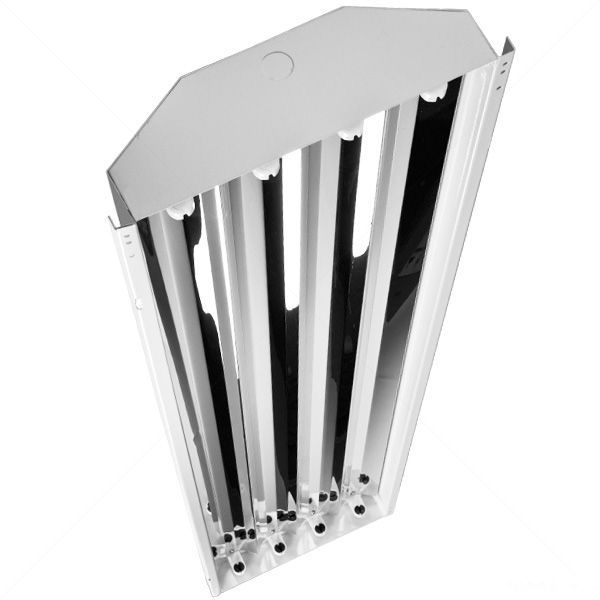
Those LED fixtures cost about $100 more than the T5 fixture after you figure in the cost of the bulbs with the fixtures, but they consume about 31% less energy than the T5 4-lamp fixture (149 W LED vs. 216 W - 54 W x 4).
True, as far as it goes. But you're forgetting the fact that you need two of those LED fixtures to provide (approximately) the same amount of light as one of the fluorescent fixtures. So really, you're looking at ~$440 vs. ~$95 (with tubes, and assuming you'll need at least two dozen of them, which is probably a reasonable bet).
More to the point, that same "2:1" issue also rears its ugly head on the energy-consumption front. Two of the LED fixtures will consume (approximately) 300 watts, vs. four F54T5 tubes at a nominal 216 watts. In short, the LED fixtures would use about 38% MORE electricity to make (approximately) the same amount of light.
With the lumen output compared (11,200 lm for LED vs. 19,000 lm for CFL) I would estimate a little more than $6/yr. to operate the LED fixtures over the CFL fixtures given the amount of time that I will actually operate them (I'm estimating 2 hr/day average).
Uhhhh...
WHAT "CFL fixtures?!? We haven't discussed CFLs at all (nor do I suggest that we do; they ALWAYS lose out to linear fluorescents).
The lifetimes should be a moot-point as I should never have to replace any bulbs given the usage and the average lifetime of each. Heavy on the theory because I know that those lifetimes are just an average and other factors contribute to bulb life.
And more importantly, virtually NONE of them ever **** out at or near the "average" lifespan. That "average" is just that -- a STATISTICAL average. In practice, most electronic things (definitely including most LEDs) either fail VERY early, or last halfway to forever. It only takes a few of those early failures to bring that "statistical average lifespan" down to well below what MOST of them live to.
Unless I was operating these lamps much, much more, it would never pay-off to invest in LED with the current specs.
Despite some side-tracks along the way, you did indeed get to more-or-less the correct final conclusion.

These would actually save me about $12-13 a year in electrical costs, but I don't know how much the initial cost is.
http://www.ledtronics.com/Products/ProductsDetails.aspx?WP=2259
Maybe -- and that is a very
BIG "maybe", at that.
I have no idea who "LED Tronics" is, or how credible they are. They certainly are not the well-established major manufacturer that Lithonia is, for example. And in this particular case, credibility is a major concern.
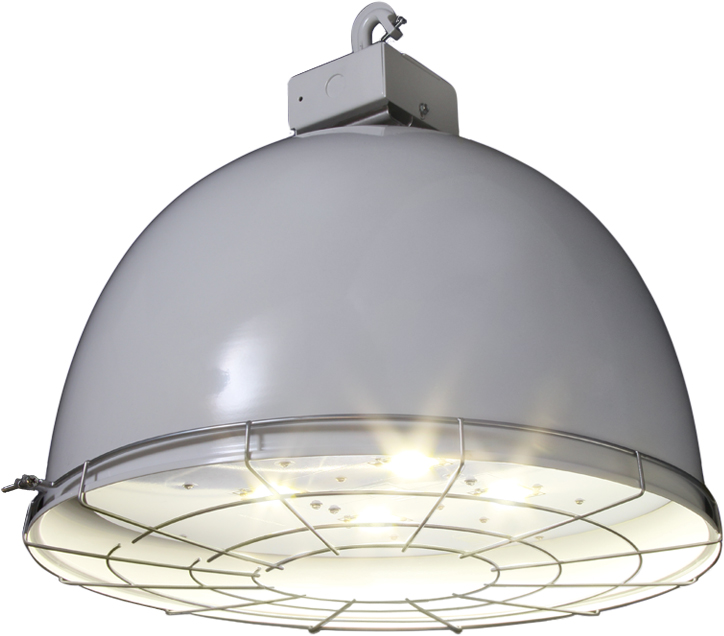
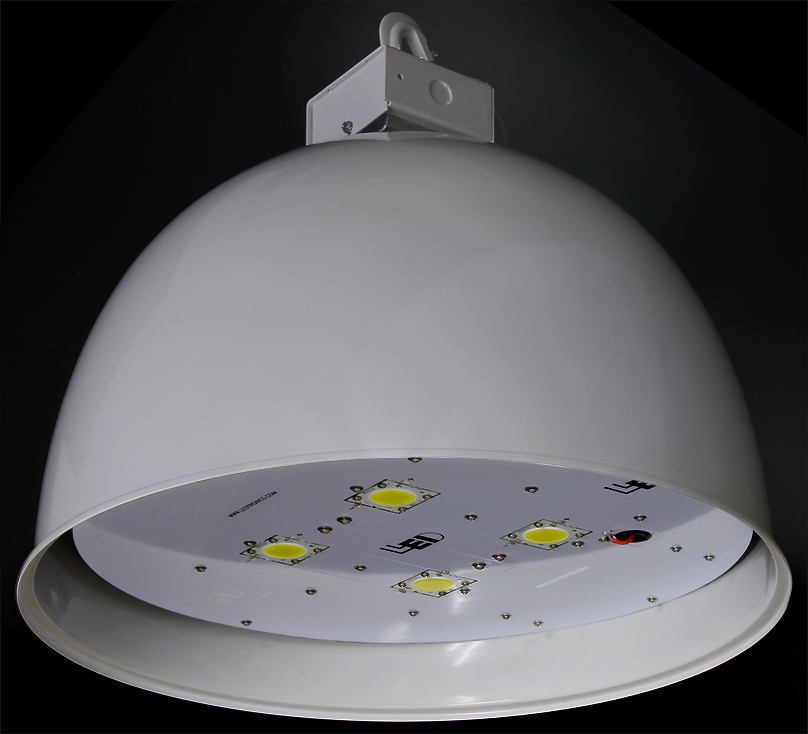
They're claiming over 10,600 lumens out of just four LEDs,
AND doing it at 108 lumens/watt in the process. That seems quite a bit more than "optimistic", to me, considering that (AFAIK, anyway) the highest-output raw LEDs available are the Cree LMH2 series; and even Cree only claims about 82 lumens/watt (cf.
http://www.cree.com/news-and-events.../2012/april/120403-brightest-lmh2-led-modules).
We'd also need to see some verifiable photometric data (of which, they provide NONE) to determine the effective lighting pattern (and from that, how many of these fixtures would REALLY be needed).
Then there's the "all your eggs in one basket" problem... With a typical LED-based fixture (including that Lithonia one I cited earlier), you have several dozen individual LEDs contributing to the output. So if one of them fails, it's no big deal. But with only four LEDs in each fixture, a single failure costs you 25% of your light output.
And finally, to even use these particular fixtures, you'd need to run your lights off
AT LEAST 240V; and I strongly suspect that little "(Tested @ 480VAC)" notation is a HUGELY critical data point in terms of actually approaching the level of performance implied in that specs table. Do you have three-phase power coming into your shop? Have you gotten a price quote from your PoCo to supply it?