To avoid these ads, REGISTER NOW!

Lighting Plan - 21X32 - modifiable zones

87jeepwrangler

Well-known member
Joined
May 23, 2013
Messages
195
i spent the summer working on an addition to my house, which included a new attached 21 wide x 32 deep attached. i'm working on the lighting plan right now so i can start wiring.

since money is tight, i'll probably just be using inexpensive T-8 4' 2-bulb fluorescent fixtures. with 8' ceilings, i want to save every possible inch of headroom, so im going to french the lights up into the joist bays, essentially making a little cove for each fixture (it will be a lot of corner bead and spackling, but i think it will be worth the extra headroom). because of this, location and direction of the fixtures is limited.

i want 2 lighting zones. since i never like being too "locked in", i wanted to mount a duplex receptacle in the ceiling in each lighting cove, and break the tab off of the hot side so i can control each side of the outlet. i can then run SO cord off of each fixture and have the option of plugging each fixture into either zone A or zone B. i have access to free outlets, so it's just a matter of running 14/3 instead of 14/2, and spending a little extra time wiring. does that seem like overkill?

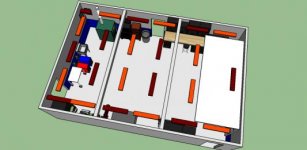
the fixtures along the long walls are centered at 1'8" out from the walls, just enough to clear my cabinets that are 14" deep (i have these cabinets already). here is my proposed layout...

1.jpg

2.jpg
 
To avoid these ads, REGISTER NOW!

2ManyProjects

Well-known member
Joined
Jul 18, 2013
Messages
757
i spent the summer working on an addition to my house, which included a new attached 21 wide x 32 deep attached. i'm working on the lighting plan right now so i can start wiring.

since money is tight, i'll probably just be using inexpensive T-8 4' 2-bulb fluorescent fixtures.

First, congratulations on the new garage.

Second, money is NOT the only good reason to use twin-tube F32T8 fixtures. In most cases (near-certainly including this one) they are simply the most appropriate form of lighting for the application, regardless of cost.

with 8' ceilings, i want to save every possible inch of headroom, so im going to french the lights up into the joist bays, essentially making a little cove for each fixture (it will be a lot of corner bead and spackling, but i think it will be worth the extra headroom). because of this, location and direction of the fixtures is limited.

I'm not at all sure this is a good idea. In fact, I'm pretty sure it's not.

First, as you mention, it adds a LOT of work to the project. But more importantly, it will very probably have a detrimental effect on the actual performance of the lights.

Second, if you simply recess the lights into the ceiling, the fixtures you choose would have to be IC-rated for direct insulation contact; and at least most "inexpensive" strip or wrap-type fixtures are NOT so-rated. If you actually go to the trouble of fashioning a little "cave" in the ceiling out of framing & drywall for each individual fixture, you MIGHT skirt around the letter of the IC-rating requirement; but fundamentally, you'd be facing the same problem those ratings are intended to address: HEAT (which you would be "trapping" in that little box, causing the tubes & ballasts to operate a higher effective ambient temperatures than they are designed for -- not good). Either way, this will surely drive up your costs considerably.

Further, with the lights mounted flush in the ceiling, they can no longer distribute their light out to the sides as well as they were originally designed to do (a situation made still worse by your already low ceiling height). This in turn means more lights will be required to evenly cover a given area. So again, more costs.

And finally, this approach would further limit you in terms of where you could place the fixtures. For example, how would you go about installing one to lie ACROSS multiple rafter bays?

All in all, this seems like a very poor trade-off vis-a-vis the (literally) two inches or so of headroom you would "save".

i want 2 lighting zones. since i never like being too "locked in", i wanted to mount a duplex receptacle in the ceiling in each lighting cove, and break the tab off of the hot side so i can control each side of the outlet. i can then run SO cord off of each fixture and have the option of plugging each fixture into either zone A or zone B. i have access to free outlets, so it's just a matter of running 14/3 instead of 14/2, and spending a little extra time wiring. does that seem like overkill?

Maybe not "overkill", per se; but that doesn't make it a good idea.

You're basically talking about making your own plug-in "shop lights". And odds are, you'll spend more to fashion your one-offs than it would cost to simply go out and buy a bunch of cheap ready-made plug-in "shop lights". Buying ready-made "shop lights" is additionally problematic, because at least most of them are not only NOT IC-rated, they aren't even approved for direct surface mounting on the ceiling. Instead, they are intended to be hung a foot or two BELOW the ceiling, via short lengths of chain. And the reason for this is, again, HEAT.

Quite beyond the additional costs (boxes, outlets, cords, plugs) this implies, this approach has yet another problem: Per the current NEC, any and ALL electrical outlets installed in a garage (including those mounted 8-10 feet up in the air on a ceiling) MUST be GFCI-protected. Yes, I think that's silly; but it is what it is. The problem here is, fluorescent lights often do not work well off a GFCI, particularly if there are more than perhaps 2-4 tubes running off each GFCI (which there near-certainly would be, unless you drive your costs up still further by installing individual GFCI outlets for EACH fixture). How often do you want to have to climb a ladder and push that little "Reset" button?

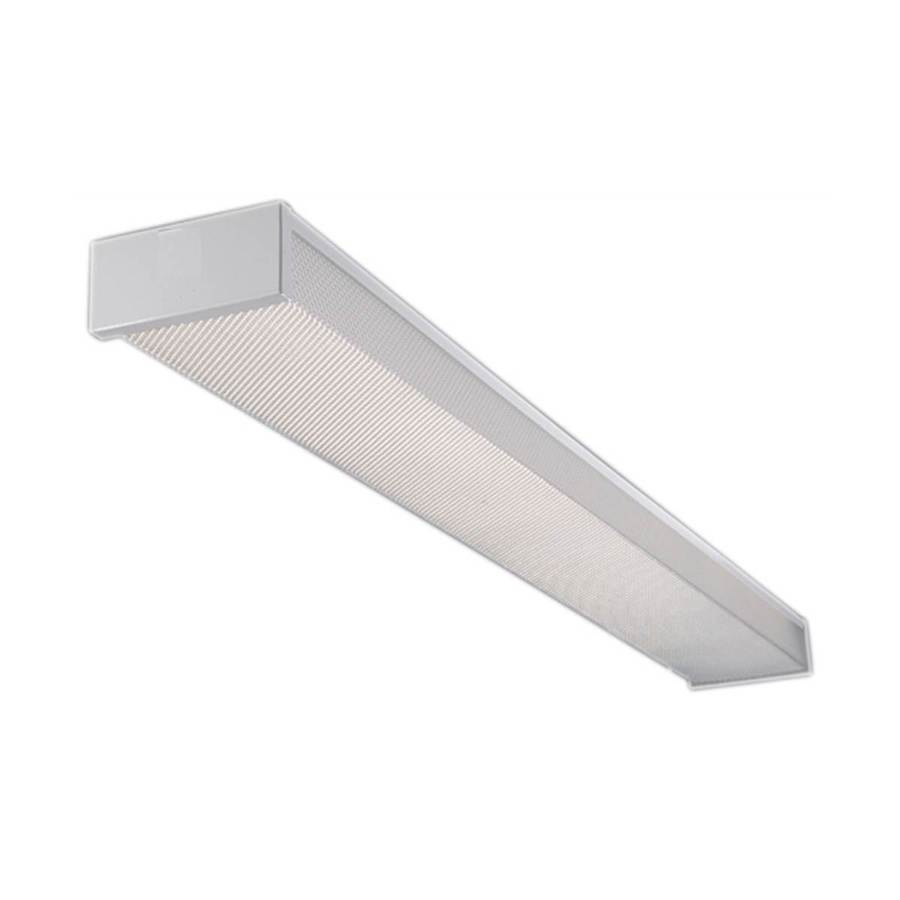
Seriously... You're over-thinking yourself into making this job MUCH harder than it needs to be. What you really ought to do is use as many of these:

http://www.homedepot.com/p/Lithonia-Lighting-2-Light-Utility-Light-3348-2L32W-WRAP/100654395
92eeea00-35d4-4de6-9cd6-11e57dd051fc_300.jpg


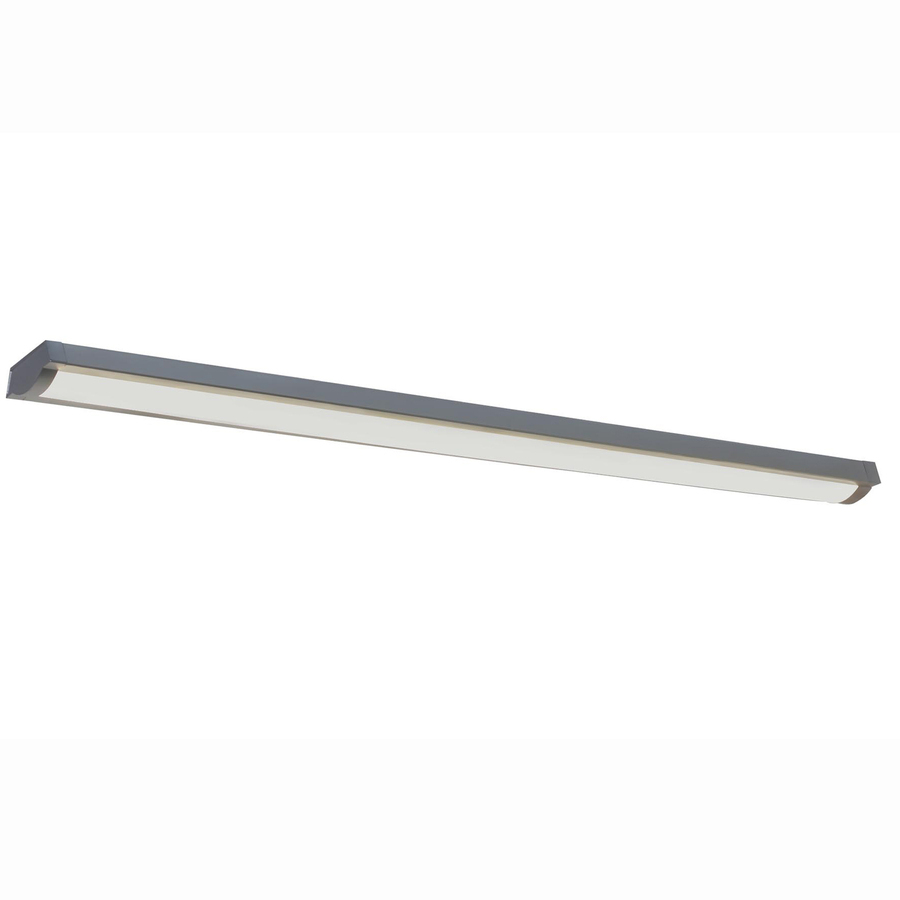
or these:

http://www.lowes.com/pd_163697-337-WP232RLU_0__?productId=3181895
080083518647.jpg


or these:

http://www.lowes.com/pd_336745-13537-336745_0__?productId=3686312
037949005377.jpg


as you need to properly cover the space. When mounted directly to the ceiling, they will "cost" you only about 2-1/2 inches of clearance. Wire them up into at least THREE switch banks: Some minimal amount (probably 1-3 fixtures, in your case) of "walk-through" lighting on one switch ; about 30-40% of the "main" lighting on a second switch; and the remaining 60-70% of the main lighting on a third switch. The fixtures assigned to each of these switch banks should be distributed more-or-less as evenly as possible throughout the controlled area. Typically, that means something approximating an "every other fixture" approach; but it is often useful to "fudge" that somewhat depending on the exact way the space will really be utilized (and also, such influences as open garage doors, skylights & windows, etc. -- in other words, put the light where it will be most needed).

I would also suggest that each of those two "Main" switch banks be fed from a different circuit breaker. The reason for this is not because the load will be all that high (it surely won't be); but so that if/when one breaker trips (or must be thrown in order to do maintenance work), you won't be left totally in the dark. The "walk through" lighting and whatever task lighting you will presumably also have can then be piggy-backed onto either of these two circuits, as convenient.

[And while we're talking about circuit breakers... Use at least two more (20A) breakers to feed your various 120V convenience outlets around the shop. I typically recommend putting a double-gang box every 6-8 feet around the perimeter of the space, with one duplex in each box fed from "Circuit A", and the other from "Circuit B". Use at least AWG 12/2 wiring throughout.]

the fixtures along the long walls are centered at 1'8" out from the walls, just enough to clear my cabinets that are 14" deep (i have these cabinets already).

I'd move them out a bit further than that, as long as that does NOT mean they'd be blocked by the overhead door when said door is open. Part of the point is to throw some light INTO those upper cabinets & shelves, which they cannot do very well from (nearly) directly overhead.


ez-duzit

Well-known member
Joined
Jun 24, 2013
Messages
5,099
Location
Marina del Rey
It seems like you are going to a lot of trouble with your lighting due to building the ceiling too low. Is there a 2nd story living space?

The hip roof is open in my shop--there is no ceiling--only the open framing. So fluorescent fixtures can hang high. Each lighting fixture has its own cord. Working groups of lights are plugged into power strips whose switch allows complete control over which area of the shop I choose to light.
 
OP
8

87jeepwrangler

Well-known member
Joined
May 23, 2013
Messages
195
First, congratulations on the new garage.

thanks, i am pumped. the house had a small single car, so i'm looking forward to the additional space. i would have gone bigger, but i am on a small lot to begin with. i had no choice on the ceiling height, as there is living space above for the new master, and the floors had to match.


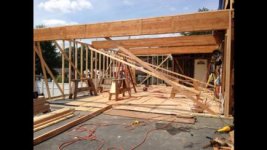
here it is just getting started...
2.jpg

the garage...
3.jpg

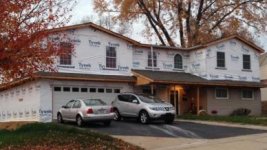
how it looks now...
4.jpg


as you mention, it adds a LOT of work to the project.
although it would be a lot of extra work to french the lights in, IF it was decided it would be a benefit, i'd be willing to do it. so for me, the extra work involved is not really a deterrent or a reason not to do it. that being said, i see what you are saying about that not necessarily being the best idea.


if you simply recess the lights into the ceiling, the fixtures you choose would have to be IC-rated for direct insulation contact.... you'd be facing the same problem those ratings are intended to address: HEAT (which you would be "trapping" in that little box
i had planned on fully boxing the joist bay with drywall, including the sides and top, but leaving a few inches above the drywall but below the floor for foam insulation. if my drywall recess was 3" deep by full joist width, do you really think the lights would still build up heat? there would easily be a few inches on each side of the light.


Further, with the lights mounted flush in the ceiling, they can no longer distribute their light out to the sides as well as they were originally designed to do
again, the box wouldn't be tight to the fixture, so it would allow some light going out the sides to be distributed. would it still inhibit enough light to be an issue?

this approach would further limit you in terms of where you could place the fixtures. For example, how would you go about installing one to lie ACROSS multiple rafter bays?
yes. this is 100% true. this would simply be one of the trade-offs.


Quite beyond the additional costs (boxes, outlets, cords, plugs) this implies, this approach has yet another problem: Per the current NEC, any and ALL electrical outlets installed in a garage (including those mounted 8-10 feet up in the air on a ceiling) MUST be GFCI-protected.
hadn't thought about that. the outlets at each light might not be such a good idea.


for what it's worth, i've seen this shop in person, and is actually where i got the idea of frenching the lights in. it works quite well, although i would have lowered the lights another 1 or 2 inches if it was mine.
1.jpg
 
Last edited:

2ManyProjects

Well-known member
Joined
Jul 18, 2013
Messages
757
First, congratulations on the new garage.

thanks, i am pumped. the house had a small single car, so i'm looking forward to the additional space. i would have gone bigger, but i am on a small lot to begin with. i had no choice on the ceiling height, as there is living space above for the new master, and the floors had to match.

Well, it's obviously too late now; but there ARE other ways that could have been handled, had it been addressed at the time of the original architectural planning.

i had planned on fully boxing the joist bay with drywall, including the sides and top, but leaving a few inches above the drywall but below the floor for foam insulation. if my drywall recess was 3" deep by full joist width, do you really think the lights would still build up heat? there would easily be a few inches on each side of the light.

While that would probably help SOME, it's still fundamentally an unvented box with a heat source inside. The open bottom of that box doesn't really change this because, as you surely know, heat rises. Factor in the insulation above/around that box, and you make a bad situation even worse. Bottom Line: I cannot in good conscience recommend this.

again, the box wouldn't be tight to the fixture, so it would allow some light going out the sides to be distributed. would it still inhibit enough light to be an issue?

Yes.

Unless the light source (tube) actually sits BELOW the plane of the ceiling, its output WILL be blocked by the sides of that box. It really doesn't matter whether the "shutter" (so to speak) is an inch away or a foot away.

for what it's worth, i've seen this shop in person, and is actually where i got the idea of frenching the lights in. it works quite well, although i would have lowered the lights another 1 or 2 inches if it was mine.

That picture actually makes my point.

While you cannot see anything in the shop itself, what you CAN see is that, while the interior of the "box" is well-illuminated, virtually NONE of that light is escaping to the area immediately surrounding it (which appears pitch black). While I'm more than willing to presume that this effect is not quite so starkly severe "in real life" as depicted in the picture (in part because our eyes/brains are FAR more adaptable than any camera yet invented), the fundamental point remains. You would in effect be turning a standard open-tube fixture into a (very inefficient) "High Bay" type, AND mounting it so low as to make it near-impossible to obtain even illumination at working height.

 
OP
8

87jeepwrangler

Well-known member
Joined
May 23, 2013
Messages
195
Well, it's obviously too late now; but there ARE other ways that could have been handled, had it been addressed at the time of the original architectural planning.
2many, you are right. i COULD have designed things differently and had higher ceilings. i could have also spent 10's of thousands more and made the garage even bigger by building extreme retaining walls (the edge of the garage is on a very steep hill). in fact, i could have moved and bought a house with a finished 100x100 garage. but at some point, what i COULD have done has to meet reality. financially, just to make this addition happen, not only did i do all the engineering and design work, but i am also doing all of the work, including framing, electric, plumbing, exterior, rock, etc. just like every thing else, my 8' ceilings are in fact, a compromise. but never the less, that is what i chose, so i am now designing around those limitations. it is what it is. while it's not the garage i could dream up, it's what i can afford to make happen right now.


While that would probably help SOME, it's still fundamentally an unvented box with a heat source inside. The open bottom of that box doesn't really change this because, as you surely know, heat rises. Factor in the insulation above/around that box, and you make a bad situation even worse. Bottom Line: I cannot in good conscience recommend this.
Fair enough. You bring up very valid points, and have definitely made me re-think my options. however, i'm still not 100% sold on mounting the lighting under the finished ceiling (although i'm very torn).

Unless the light source (tube) actually sits BELOW the plane of the ceiling, its output WILL be blocked by the sides of that box. It really doesn't matter whether the "shutter" (so to speak) is an inch away or a foot away.
i'm certainly no lighting guru. that's exactly why im here. however, are you saying that all drop ceiling lighting and fixtures that are recessed are a bad idea, simply because you can get better diffused light by lowering the light source (tube)? if not, than you are in fact agreeing that there is a compromise between tube location(height), appearance, and light effectiveness.

again, i'm not sold on my original ideas, and i can be talked out of it. but i'm not sure that i've seen enough solid reason not to recess the lights and gain back what little ceiling clearance i have for just a few hours of extra work and a slightly less optimal lighting layout. if i can design a recess enclosure that doesn't over heat the fixture and ballast, and i only loose a small amount of light distribution, what have i really lost?
 

2ManyProjects

Well-known member
Joined
Jul 18, 2013
Messages
757
2many, you are right. i COULD have designed things differently and had higher ceilings. i could have also spent 10's of thousands more and made the garage even bigger by building extreme retaining walls (the edge of the garage is on a very steep hill). in fact, i could have moved and bought a house with a finished 100x100 garage. but at some point, what i COULD have done has to meet reality.

I don't want to get into a ******* match over this; so suffice it to say that this is not at all what I meant. My comment was in the context of all the convolutions you're now going through with your lighting, for the sake of "saving" all of maybe two inches. Given that extremely minor difference, any number of (at least semi-) cost-effective modifications to the building plans (say, for example, LVL joists in place of dimensional lumber) would likely have yielded a similar (or larger) clearance gain.

Anyway...

Fair enough. You bring up very valid points, and have definitely made me re-think my options. however, i'm still not 100% sold on mounting the lighting under the finished ceiling (although i'm very torn).

Then maybe this will help you make up your mind...

When all is said and done, and after you've stopped obsessing about this, you very likely will NOT notice a 2-inch difference in effective clearance height in the day-to-day use of your garage, especially when that "loss" is only in a few relatively small spots, vis-a-vis the ceiling as a whole.

What you WILL notice (and, probably, cuss at) is crappy uneven lighting, regardless of the reason for that, and even if the lighting is nominally "very bright" in at least some of the spots.

I vote for the the solution which will engender the least long-term agita. ;)

i'm certainly no lighting guru. that's exactly why im here. however, are you saying that all drop ceiling lighting and fixtures that are recessed are a bad idea, simply because you can get better diffused light by lowering the light source (tube)?

No, that is NOT what I am saying.

As is usually the case, my comments need to be taken IN CONTEXT. The context here is an unusually low garage ceiling. Given that, THE overwhelmingly largest challenge you'll face when developing the lighting plan will be getting EVEN DISTRIBUTION of the light. Hence, addressing that challenge should be your highest priority. Getting "enough" light in there, at least on an "overall average lumens" basis, will be very easy by comparison. Even with the sort of surface-mount twin-tube "wrap" fixtures I recommended, you'll surely wind up with something MORE than the typically recommended nominal 100 lumens/ft.^2 by the time you lay them out to provide truly even lighting, with only an eight-foot installed height to work with. So anything you do which serves to limit the ability of those fixtures to disperse their output as widely as possible will be directly counterproductive.

if i can design a recess enclosure that doesn't over heat the fixture and ballast, and i only loose a small amount of light distribution, what have i really lost?

"IF" is the biggest two-letter word in the English language.

 
OP
8

87jeepwrangler

Well-known member
Joined
May 23, 2013
Messages
195
no ******* match intended. i am grateful for any and all information you, or anyone can share. so lets assume i was willing to surface mount the lights.

problem #1. lighting layout.
what do you think about this layout, using F32T8's? the fixtures near the walls are centered approximately 20 inches from the walls. in my old garage layout, i constantly had shadows on my workbenches from the lights being behind my head. it was awful.
lighting.jpg

problem #2. walk through lighting.
since it is an attached, i find myself going in and out of the garage countless times per day. i don't like the idea of turning fluorescents on and off that frequently, so i'd like to have my "walk through" lighting zone be something other than fluorescent. with ceiling height a concern, what would you put in for separate lighting for walk through lighting?
 
OP
8

87jeepwrangler

Well-known member
Joined
May 23, 2013
Messages
195
One recessed downlight, near the center, on two 3-way switches, near the exits.

other than cost, would you see any reason not to put 4 recessed spread out a little farther, instead of just 1? the only thing i don't like about recessed is the loss of R-value in those areas. otherwise, i think they are a good match for what i'm looking for in walk through lighting.
 

2ManyProjects

Well-known member
Joined
Jul 18, 2013
Messages
757
no ******* match intended. i am grateful for any and all information you, or anyone can share. so lets assume i was willing to surface mount the lights.

Good.

problem #1. lighting layout.
what do you think about this layout, using F32T8's?

My first reaction is that it's something of a mixed bag, but not horrible overall.

I generally like the two main front/back runs, and especially the fact that you've kept them from being blocked by the overhead door; but the various isolated fixtures in the middle are unlikely to be as effective. At the very least, I'd probably "flesh out" that row running across the back to at least three fixtures; I might do the same with at least the "middle" pair, and maybe even make those single crossways fixtures into pairs. Yes, this will up the fixture count considerably; but as long as you set up the switching right, that is a GOOD thing.

the fixtures near the walls are centered approximately 20 inches from the walls. in my old garage layout, i constantly had shadows on my workbenches from the lights being behind my head. it was awful.

Depending on exactly what you put on/near those walls in the way of shelving. cabinetry, etc., that should be fine. I might fudge it out to 24 inches O/C, but probably no more than that.

However, be aware that either way, the workbench itself should ALSO be served by some dedicated task lighting; and it should be generously proportioned, because this is likely to be where you do most of your most finely detailed and "fussy" work. Exactly what form that should take will again depend somewhat on the configuration of the workbench and the area immediately above it; Typically, some sort of "under cabinet" lighting is used. But for the REALLY fussy stuff, you may want to add some additional tightly focused and very "aimable" lighting, such as:

http://www.officedepot.com/a/products/665891/Ledu-Illuminated-Magnifier-Lamp-Fluorescent-22/
665891_sk_lg


http://www.prlog.org/10823231-aven-...s-with-wide-field-of-view-and-brightness.html
10823231-maxi-mag-magnifying-lamp-from-aven.jpg


or even a used Dentist's lamp, if you can find one at a good price.

problem #2. walk through lighting.
since it is an attached, i find myself going in and out of the garage countless times per day. i don't like the idea of turning fluorescents on and off that frequently, so i'd like to have my "walk through" lighting zone be something other than fluorescent. with ceiling height a concern, what would you put in for separate lighting for walk through lighting?

Well normally, I recommend that the walk-through lighting be simply some small number of the same fixtures that comprise the main general lighting, so that those fixtures can also easily serve as part of that main general lighting (two birds, one stone, and all that). However, I do understand your concern about frequent/rapid cycling of fluorescent lights.

If fluorescent is out, we need to look at other basic lighting forms...

-- The plain ol' conventional incandescent light bulb is easy to live with, cheap, and ideally suited to many applications (heck, even near-essential to SOME applications). But it's both relatively inefficient and going the way of the dinosaur (thank you, Federal Do-Gooders :mad:); so before too much longer, finding replacement bulbs will be near-impossible. So I can no longer in good conscience recommend it for applications where something else will suffice.

-- Most Halogen lights are either well into the "overkill" territory in terms of brightness, or so tiny and "spotty" that the would not serve well in this application. They're also not much more efficient than incandescent (in part because they are a subset of that class). And they run HOT.

-- While they use a somewhat different operating principle, from your point of view Metal Halide lamps are effectively "Halogens On Steroids". The most common types are even further into "overkill" from brightness/power standpoint (400 Watts or more per bulb being fairly typical); and at least most of the "small" ones I'm aware of are all tightly focused PAR-type "spot" lamps, which would be horrid as "walk-through" lighting. On top of all this, they are very slow to come up to full brightness when first turned on -- again, just what you DON'T need for walk-through lighting.

-- At this point, about the only thing "left standing" is LED. They are (at least usually) electrically efficient, start instantly, run cool, and generally don't mind frequent cycling. So while they are potentially well-suited to this sort of duty, much depends on the SPECIFIC fixture(s) in question. The technology is not yet really mature; so there are literally hundreds/thousands of VERY different choices out there, ranging from the wonderful to the awful; and prices are all over the map, too. That said, one which comes to mind (in part because I happen to see it almost every time I'm in my local Lowe's) is:

http://www.lowes.com/pd_1345-43921-MXL-301_0__?productId=4480261
822985510080.jpg


But you should not infer that this is even close to your only possible choice; or even that I'm really "recommending" this particular fixture. Among the obvious caveats, they do not specify ANY photometric data (not even its nominal total light output); so while it's obvious that they are marketing this as a replacement for conventional twin-tube fluorescent wrap fixtures, it is not at all certain that it would produce similar results. OTOH, for a dedicated "walk-through" application, that probably doesn't really matter all that much; as long as it makes enough light to keep you from tripping over a tricycle, you're good.


One recessed downlight, near the center, on two 3-way switches, near the exits.

For all the reasons already discussed, there is no good reason to recess the "walk-through" lights, unless they are MUCH taller than the one I cited above; and all the reasons to NOT do so with the main lighting near-certainly also apply to this as well.


other than cost, would you see any reason not to put 4 recessed spread out a little farther, instead of just 1?

If we are assuming that the "walk-through" lighting is dedicated to that task ONLY, and NOT also doing double-duty as part of your general area lighting, then using more of it than you really need is simply a waste. If you WANT to be wasteful, that's up to you. In the space in question, I cannot imagine more than one or two such fixtures really being NEEDED, as long as they do a passable job of distributing their output over a wide angle/area.

the only thing i don't like about recessed is the loss of R-value in those areas. otherwise, i think they are a good match for what i'm looking for in walk through lighting.

Methinks you are presuming a particular TYPE of "recessed" fixture here. There's nothing inherently implied by "recessed" which dictates a particular fixture design or type of lighting source (save for the fact that it would fit flush to the ceiling, of course).

 
OP
8

87jeepwrangler

Well-known member
Joined
May 23, 2013
Messages
195
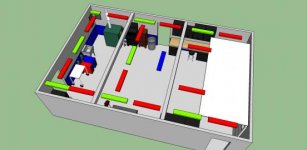
i drew up your recommended layout, and the center looked bare, so i switched it up a little. the different colors are the different zones.

lighting layout.jpg
 
To avoid these ads, REGISTER NOW!

Kevin C

Well-known member
Joined
Aug 4, 2011
Messages
1,653
Location
Portland OR
I didn't read the book.

But I wanted to provide an example of whats working for mel. I used two and four bulb drop fixtures with no diffusers for my 24' x 26' shop and have no regrets. Eight are placed at 9' 6". If by chance I hit them with a long piece of wood they swing out of the way. The lights also have grills on them, I like the look of hanging shop lights with grills.

By the garage doors I have three lights placed parallel to the two doors. One on each side and another in the middle. The outer lights are double bulb 4' T8's the center is a 4 bulb T8. Those light are place even with the door rails at 8 feet.

Despite the wide spacing (11' on center) and 8' height, the light at that end of the shop is very good and there are no issues with evenness. These are standard open bulb low bay fixtures.

To get a bit better output, I upgraded the center fixture with a high output ballast.

For a 24 x 26 shop I have the equivalent of 12 double bulb T8 fixtures. All of these have a ballast factor of about 1.2 (they put out about 20% more light than a standard T8 fixture).

That's around 120 lumens per sq foot. I see about 23 or so fixtures in your diagram vs 12 for my similar sized shop (26 x 24).
 
Last edited:

2ManyProjects

Well-known member
Joined
Jul 18, 2013
Messages
757
i drew up your recommended layout, and the center looked bare, so i switched it up a little.

Not sure what you mean by "bare"; but regardless...

the different colors are the different zones.

Your latest posted image is a bit on the small side for me to be sure; but my impression is that you're now getting well into "overkill" territory.

At 46 tubes, and 2,800 lumens per tube, you're looking at 128,800 total lumens; in 672 ft^2. of space that's over 190 lumens/ft^2. Granted, that's "source" lumens; but with only an 8-foot ceiling, your intensity losses at "working height" won't be all that great (I'd guess maybe 20% or so; but that's just a guess).

Now I realize that (again, mostly due to the low ceiling) you'll probably have to accept SOME degree of "overkill" in order to keep the illumination acceptably even; but this just seems like too much.

Try this:

With the rear-most run now expanded to three fixtures (which I do agree with; so keep that) and moved out to about 24-30 inches off the wall, you really don't need two more running crossways just six feet or so away. And you certainly don't ALSO need yet another four in the middle section, on top of that.

Drop out the two "Dark Red" fixtures near the middle of the the rear section.

Also drop out the four fixtures in the middle section, in favor of ONE run of three fixtures, placed about where you're now showing the two "Bright Red" fixtures. Notably, this should put them in an almost perfect position to light up the engine compartment of whatever vehicle you're working on in there. And the middle fixture in this run is also very well-positioned to serve as (at least part of) your "walk-through" lighting. By "fudging" their placement toward the rear of that section, these three fixtures should also adequately cover the space between there and the rear-most row. (You could probably even get away with just two fixtures here; but given all the "double duty" benefits you're getting out of this particular location, I think the third fixture is justifiable.)

Optionally, turn the two "Bright Red" fixtures near the door 90 degrees, and maybe bring them just slightly more toward the rear of the space. They should remain at least 8 feet or so apart from each other, so as to clear the sides of a centered vehicle (for which, they will provide a bit of additional illumination).

The fixture near (and which will be completely blocked by) the overhead door is your call. I'd probably drop it; but as long as it is on the "least frequently used" switch bank (or separately switched, for that matter), it's no big deal.

Speaking of switching... You are apparently showing two switch banks, with the lights split almost exactly evenly between them. That's better than "all or nothing", but it ignores the walk-through lights. I'd probably also make the two "Main" banks somewhat less evenly matched, if feasible; but the final decision on this depends a lot on the precise fixture layout.

The above suggestions will still provide you with something over 150 (source) lumens/ft^2. So, if anything, it's still "overkill"; but not quite so much so that it will be a problem.

 
OP
8

87jeepwrangler

Well-known member
Joined
May 23, 2013
Messages
195
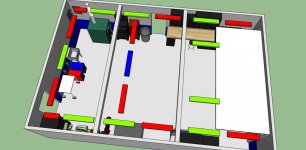
i think i've got it how you suggested, and it seems fairly logical to me.

(i can't figure out why it's limiting my image size so small)
lighting layout.jpg

as for the zones, i actually planned on 3, but left the "walkthrough" zone out of the previous picture since it was probably only going to be 1 fixture anyway. sticking with the premise that i don't want to frequently switch the flourescents, i will probably put the walkthrough zone(zone 1) as a single light, similar to the utilitech LED from lowes you suggested (pictured in blue). the red fixtures will be my primary lighting zone(zone 2), and green will be the final lighting zone(zone 3).

l'm planning (2) 15 amp circuits for the lighting, the 1st feeds zone 1 and 2, and the 2nd circuit to feeds zone 3. in addition, zone 1 will be a 4-way switch circuit with a switch at each of the 3 doorways. zone 2 and 3 will only be switchable from 1 location.
 

2ManyProjects

Well-known member
Joined
Jul 18, 2013
Messages
757
i think i've got it how you suggested, and it seems fairly logical to me.

Definitely looking better.

(i can't figure out why it's limiting my image size so small)

Well, just do whatever you did the first time. That puts a small thumbnail in the post, which auto-links to the full size image when clicked on.

as for the zones, i actually planned on 3, but left the "walkthrough" zone out of the previous picture since it was probably only going to be 1 fixture anyway. sticking with the premise that i don't want to frequently switch the flourescents, i will probably put the walkthrough zone(zone 1) as a single light, similar to the utilitech LED from lowes you suggested (pictured in blue).

I really would not worry about the "frequently switched fluorescent" issue, at least for this particular application. While that theory has some basis in fact, with modern electronic ballasts it's nowhere near as much of a practical issue as it used to be. Worst case, you'll replace one pair of $3.00 tubes a little more often than the rest of them. You can buy a LOT of $3.00 tubes for the cost of that one LED fixture.

the red fixtures will be my primary lighting zone(zone 2), and green will be the final lighting zone(zone 3).

You're definitely on the right track; and you now have a much better "balance" between the two main lighting banks. I suspect that the "Green" bank might well wind up getting used more often than the "Red" bank; but that's something you'll figure out as you go. I might be tempted to "finesse" this still further; but I don't want to discourage you from what is, really, a pretty good plan.

l'm planning (2) 15 amp circuits for the lighting, the 1st feeds zone 1 and 2, and the 2nd circuit to feeds zone 3.

As long as the two main banks are fed from different breakers, the rest doesn't really matter because the loads aren't even close to approaching the current limits. You'll also have some task lighting, which can be tacked on to one or the other as convenient.

in addition, zone 1 will be a 4-way switch circuit with a switch at each of the 3 doorways. zone 2 and 3 will only be switchable from 1 location.

You can go that way; and you probably WON'T cuss at it in the years to come. But if you want better control, consider putting one Insteon keypad:

http://www.smarthome.com/2487S/Keyp...pad-with-On-Off-Switch-Dual-Band-White/p.aspx
2487sbig.jpg


at each of those locations, then (optionally) using as many of these:

http://www.smarthome.com/2475SDB/In...ontrol-In-Line-On-Off-Switch-Dual-Band/p.aspx
2475sdbbig.jpg


as needed to actually control the lighting. With this approach, you eliminate the complexity of the "4-way" switching setup; and the actual fixture/switch assignments can be changed "on the fly" so to speak, for the ultimate in flexibility and "future-proofing".

 
OP
8

87jeepwrangler

Well-known member
Joined
May 23, 2013
Messages
195
i reworked things just a little more, but i'm not so sure that its any better than before, but maybe.

zone 1: i abandoned the walkthrough light as a separate type of fixture, and conceded to using the center fluorescent as the walkthrough light(blue, zone 1).

zone 2: i also partially agreed that the previously laid out green zone almost seemed to be better aligned to my workspaces and like you mentioned, might be the go-to zone for basic shop work. with that in mind, i changed zone 2 to be the green lights, and also re-arranged a couple of the light's zoning. when zone 2 is on, zone 1 will also always be on. zone 2 lights were chosen based on their location, they are located near the areas i will frequent the most (workbenches, tools, toolboxes, welding table).

zone 3: the rest, all red lights. zone 2 and zone 1 will be on when zone 3 is on.

light layout.jpg

as for the switches you suggested, it is definitely cool, but i am still leaning toward the way i mentioned in my last post. not sold either way yet though.
 

2ManyProjects

Well-known member
Joined
Jul 18, 2013
Messages
757
i reworked things just a little more, but i'm not so sure that its any better than before, but maybe.

I hate to say this; but I think that, with the exception of ditching the "dedicated" walk-through fixture, you were closer to the mark on the previous iteration.

zone 1: i abandoned the walkthrough light as a separate type of fixture, and conceded to using the center fluorescent as the walkthrough light(blue, zone 1).

This I agree with, no question.

zone 2: i also partially agreed that the previously laid out green zone almost seemed to be better aligned to my workspaces and like you mentioned, might be the go-to zone for basic shop work. with that in mind, i changed zone 2 to be the green lights, and also re-arranged a couple of the light's zoning.

Here is where I think you derailed a bit. First, let's consider just the "front" (i.e., nearest the overhead door) half of the garage. You now have all of the "green" lights in a single row running across the garage (albeit, with the fixtures themselves pointed the other way). Particularly if you focus on just one side or the other of this area, you're effectively "doubling up" the lighting in the middle of this section, but leaving the rest of it more-or-less completely uncovered. The corners in particular will likely be dark & dingy.

The simplest "fix" would be to put the "inner" green fixtures on the red circuit, and leave it at that.

The next-simplest fix isn't really all that simple, because it fosters a major case of "one thing leads to another". But for sake of completeness...

Leave the "inners" as green, but swap the switch assignments of the other six fixtures in that half of the garage -- i.e., green becomes red, and red becomes green. However, if you go this route, then you'll then have three "green" fixtures in a row on each side of the (rear half of the) garage. That's a little too "bunched up" for my taste. So I would ALSO change the next fixtures back (i.e., the two rear-most ones in the middle section) to red.

The two fixtures on each side which are in the rear section of the garage can stay as they are, switch-wise. BUT... I might be tempted to swap the fixtures themselves, putting the four-footers in the rear-most position, and the two-footers more toward the center of the space. In this way, you'll still be throwing SOME light onto the toolchest and such when only the "green" bank is on; but you can still light up those corners very well with the reds.

Like I said, the second approach is a much more complicated "fix"; but you might like the final result a bit better.

when zone 2 is on, zone 1 will also always be on.

That's not an unreasonable assumption; but it's not carved in granite, either. My take is, it would (and should) depend on what you actually need at the moment. But even so, it's only one fixture, so not worth putting major worry into.

zone 2 lights were chosen based on their location, they are located near the areas i will frequent the most (workbenches, tools, toolboxes, welding table).

It's always good to consider what will be happening in each specific area, when designing the lighting layout.

zone 3: the rest, all red lights. zone 2 and zone 1 will be on when zone 3 is on.

Again, I would not carve this presumption into granite. Sure, it MAY work out that way; and any time you need it to, it can. But there's no "rule" which says you MUST operate it this way.

as for the switches you suggested, it is definitely cool, but i am still leaning toward the way i mentioned in my last post. not sold either way yet though.

Keep chewing on it for a bit. The Insteon stuff is very nice in many ways; and it's actually SIMPLER (read: "cheaper") to wire if you have a lot of "zones" and/or a lot of control locations. But for a relatively simple lighting plan in a shop/garage the size of yours, I would not consider it essential.

If it will help make your decision, you might put some thought into what you're doing in the way of the home's exterior lighting. The automation and remote control provided by an Insteon system is IDEALLY suited to that application; and if you're already using it for the exterior lighting, then it makes more sense to ALSO use it for some of the interior/garage stuff, as there are "economies of scale" (so to speak) to be had -- for example, those same keypads in the garage can also control some/all of the exterior lights, as desired, with no additional switching necessary.

Then there's things like this:

http://www.smarthome.com/71928/Minotaur-Engineering-LS2-Light-Dusk-Dawn-Sensor/p.aspx
71928big.jpg


http://www.smarthome.com/2842-222/INSTEON-Wireless-Motion-Sensor/p.aspx
2842-222big.jpg


http://www.smarthome.com/2342-232/INSTEON-Mini-Remote-4-Scene/p.aspx
2444a2wh4_animatedbig.gif

2444bwhvisorbig.jpg

2444bwhtbltopbig.jpg


FWIW, and all that.

 
OP
8

87jeepwrangler

Well-known member
Joined
May 23, 2013
Messages
195
i'll have to figure out if i can switch the 4' and 2' fixtures after i get the chimney installed (i haven't figured its final location yet). (2) 4' fixtures would fit in the area if it weren't for the chimney.

here's the latest layout. it's pretty self explanatory with the exception of the striped light (i changed the coloring just for my own visualization reasons).

light layout.jpg

since i'm on such a tight budget right now, i'm not sure that i can swing the insteon stuff at this time, but i could upgrade to it later if i wanted to. i definitely see the benefits of the system.

do you think it is wise to run 14/3 from the zone 2 and zone 3 light switches to each fixture so that i could potentially change the zones around in the future if i ever change the layout of the garage, or if i wanted a specific light to come on with a different zone? i probably have enough 14/3 that it wont cost me any extra.
 

2ManyProjects

Well-known member
Joined
Jul 18, 2013
Messages
757
here's the latest layout. it's pretty self explanatory with the exception of the striped light (i changed the coloring just for my own visualization reasons).

With one minor caveat, I think you've got a pretty good plan at this point; and you should PROBABLY walk away from it for a while (even if for only a day or two), then come back and see if you still feel the same way about it with a "refreshed" set of eyes.

As for that caveat...

Earlier, you stated that the "Green" fixtures would be your first-step "go to" lights on those occasions when you want "some" lighting, but don't need "everything", and that the "Red" ones would only be used when you want maximum brightness/coverage. I daresay, with the plan as you've currently conceived it, odds are it will work out precisely the opposite to that. Step back a moment and look at your plan, presuming that ONLY the "Red" (and MAYBE the walk-through) lights are on. That actually gives fairly decent coverage in the most critical areas. Where it lacks is mostly near the overhead door; and odds are, many of the times you'll want that "good but not everything" level of lighting, that door will be open so natural daylight will come flooding in to take up (at least some of) the slack.

None of this is to imply that you should actually CHANGE the lighting plan in any way. It's just further confirmation of what I said earlier about not carving your usage assumptions into granite.

since i'm on such a tight budget right now, i'm not sure that i can swing the insteon stuff at this time, but i could upgrade to it later if i wanted to. i definitely see the benefits of the system.

Up to a point, that's true. But if you hard-wire now for such things as "4-way" switching circuits (which Insteon needs no special wiring to mimic), that money will already be spent, regardless of whether or not you "upgrade" later.

do you think it is wise to run 14/3 from the zone 2 and zone 3 light switches to each fixture so that i could potentially change the zones around in the future if i ever change the layout of the garage, or if i wanted a specific light to come on with a different zone? i probably have enough 14/3 that it wont cost me any extra.

I'm kind'a of two minds on this. While I can appreciate the "future-proofing" aspect, it also strikes me as a bit of a hack/kludge solution. It might also lead to some confusion later when troubleshooting/repairing/expanding the lighting circuits (especially if YOU are not the one doing that work).

I think that, if I were really that unsure about fixture/switch assignments, I'd stick to 14/2, and EITHER:

-- Commit to Insteon, with a #2475SDB In-LineLinc-Relay module on EVERY fixture (or at least, every one which is in doubt). Expensive, but the ultimate in flexibility and future-proofing.

-- "Home run" everything to a patch panel of some sort (where the final connections/assignments could be made (and therefore changed at any time).

 
OP
8

87jeepwrangler

Well-known member
Joined
May 23, 2013
Messages
195
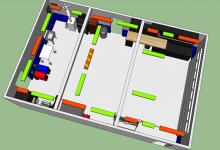
after quite a bit of mulling it over, and making some necessary changes due to minor oversights, i have what i think to be a pretty reasonable layout.

the two oversights are as follows:
1. although i had the garage door drawn in on the ceiling in earlier renditions, the track supports were just wide enough to force me to split two of my 4' lights into four 2' lights, or to move my main rows closer to the walls (not an option in my opinion). i don't believe the effect of this change to be negative.

2. after figuring out where i had to put my chimney, it also ended up forcing my hand to change one other 4' fixture to a 2' fixture. while it would be better to have kept the 4' fixture, i don't think i lost that much changing one fixture to a 2 footer.

with these changes, i made a few minor zone changes as well. in short, it might look like this...

(zone 1) - striped light, walk-through (or supplemental for other zones).

(zone 2) - green, my go-to zone for basic shop work such as drilling, cutting, sanding, wood-top bench work, etc. (zone 1 not really needed with this circuit in most instances), although this would be an excellent zone to use when working on a vehicle with the addition of zone 1.

(zone 3) - orange, used when working on heater, electric panel, or for additional lighting to really "bring-it".

my take on the pro's and con's...

zone 1 is really only useful for walk-through or to supplement another zone. this one is pretty straight forward.

zone 2 has quite a bit of fixtures, and most of them are aligned with key working areas, including metalworking tools, welders, toolbox, and a good portion of my fine-working bench (the wood top bench). it should do a fairly good job of lighting up most areas, with the exception of the corners of the garage (but that is probably ok, since those are seldom used areas with my given layout).

zone 3 doesn't have a lot of fixtures, so it may not be all that useful by itself, unless it covers a task specific area that other zones do not.

garage lighting.jpg
 

2ManyProjects

Well-known member
Joined
Jul 18, 2013
Messages
757
after quite a bit of mulling it over, and making some necessary changes due to minor oversights, i have what i think to be a pretty reasonable layout.

And I tend to agree. ;)

Don't forget to post pics of the finished project, when the time comes!

 
OP
8

87jeepwrangler

Well-known member
Joined
May 23, 2013
Messages
195
Don't forget to post pics of the finished project, when the time comes!

will do. i will probably start a garage build thread at some point, because i believe i have a lot of neat space saving tricks and other ideas that will be worth sharing.

anyone know if the ballasts in the depot and/or lowes 4' and 2' fixtures are offset to one side? i'd hate to rough in all my wires only to find out they land right where the ballast sits inside the fixture. i planned on dropping wires to each fixture near the center of each. should that work?
 

2ManyProjects

Well-known member
Joined
Jul 18, 2013
Messages
757
will do. i will probably start a garage build thread at some point, because i believe i have a lot of neat space saving tricks and other ideas that will be worth sharing.

Looking forward to it.

anyone know if the ballasts in the depot and/or lowes 4' and 2' fixtures are offset to one side? i'd hate to rough in all my wires only to find out they land right where the ballast sits inside the fixture. i planned on dropping wires to each fixture near the center of each. should that work?

No way to be sure, without inspecting the particular fixture(s) in question. And given that many of these are "private label" products built to order on a batch basis, I would not necessarily count on the one you buy today exactly matching (except perhaps in external appearance) the ones you buy next month, next year, etc.; so my suggestion would be to go ahead and buy ALL the fixtures you intend to install before you actually start the installation process (which would include those rough-ins). In fact, given the relatively low cost of these fixtures, and the desirability of KEEPING them all matching for years to come, I might even make an argument for buying at least one "spare" unit in each size, with the intention of leaving it "on the shelf" until/unless needed.

 
OP
8

87jeepwrangler

Well-known member
Joined
May 23, 2013
Messages
195
In fact, given the relatively low cost of these fixtures, and the desirability of KEEPING them all matching for years to come, I might even make an argument for buying at least one "spare" unit in each size, with the intention of leaving it "on the shelf" until/unless needed.

agreed. thanks.
 
To avoid these ads, REGISTER NOW!
Top Bottom