To avoid these ads, REGISTER NOW!

Liquid Vapor Barrier Primers

Hnines

Active member
Joined
May 13, 2017
Messages
26
I posted a recent thread on polyuria/polyaspartic floor coatings. Looks like I have at least some minimal moisture issues along the expansion cuts during times of excessive heavy rain. I'm doing the plastic sheet test now in various locations, and I'll be conducting calcium chloride tests in various locations of the slab within the next few weeks to try to determine the exact level of moisture.
My plan is to do a full flake Polyurea/Polyaspartic floor coating, and now I am leaning heavily toward using a liquid vapor barrier as a primer coating, but I have a few questions about the vapor barrier primers.......
1. Does using a vapor barrier primer make the Polyurea floor coating less strong than if the Polyurea/polyasartic was used on bare concrete? I know that the Polyurea actually sinks into the concrete to form a solid bond on a properly grinded floor, so does the vapor barrier kind of do the same thing, or does the primer sit more on top of the concrete like an epoxy? Mainly wondering if using the vapor barrier primer will compromise the strength of the Polyurea adhesion vs just straight Polyurea to grinded concrete?
2. What are some of the best vapor barrier primers available? Any specific recommendations?
3. How much hydrostatic pressure can the vapor barrier primers withstand before the integrity of the bond is compromised?

Thanks in advance. This forum has been extremely helpful in helping me learn about all this stuff!
 
To avoid these ads, REGISTER NOW!

Shea

Well-known member
Joined
Sep 19, 2012
Messages
2,867
Location
California
Most moisture vapor blocking coatings are epoxy. They can control moisture vapor Emission rates up To 20 Lb/24hr/1000 Ft2, depending on the product being used. The limit for most standard coatings is 3-4 Lb/24hr/1000 ft2. The concrete must be properly profiled via aggressive grinding or shot blasting for it to be most effective. They are specially formulated to penetrate the concrete surface. You can expect an adhesion rating of 350 psi or greater.

Using a moisture vapor blocking epoxy primer properly will not make the coating less strong. Epoxy primers are used on many occasions to facilitate better overall adhesion to the concrete before a high solids epoxy or fast-curing polyaspartic is applied. I'm not sure what polyurea polyaspartic coatings you plan to use. Some cure fairly quickly which can hinder good adhesion to the concrete if it's not prepped via grinding. Applying it to an epoxy primer during the recoat windows ensures chemical bonding between the two coatings which can be stronger than the bond to concrete.
 
OP
H

Hnines

Active member
Joined
May 13, 2017
Messages
26
Update.....
I taped down half a dozen plastic sheets two nights ago. Yesterday we got about another 3 inches of rain, with the ground already saturated, water laying everywhere outside. It is typically drier around here than this, we have had more rain than usual over the last couple months.
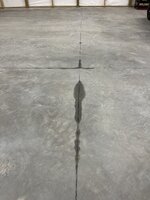
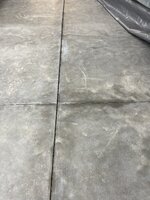
I removed the plastic sheets last night. Four of the sheets were in various places over the slab, and two of the sheets were directly over the expansion cut lines where the concrete looks damp after these heavy rains. None of the sheets had any water or dampness whatsoever, all were completely dry. The expansion cuts were showing some dampness in a few areas, as you'll see in the pics attached. The one sheet was placed over top of where the expansion joints cross (the area of the first picture), and this has been the "wettest" spot of the whole floor, but there was no water on the plastic when I removed it.
Thoughts?
 

Attachments

  • IMG_6644.jpeg
    IMG_6644.jpeg
    979 KB · Views: 9
  • IMG_6648.jpeg
    IMG_6648.jpeg
    774.3 KB · Views: 9
Last edited:
To avoid these ads, REGISTER NOW!

FJ4FUN

Well-known member
Joined
Jul 28, 2014
Messages
624
Location
NorCal
"Thoughts?"... Last time (I promise), perform anhydrous calcium chloride test/s and follow the directions precisely. Most of your questions about which vapor barrier or coating system to use will hinge on these test results.
 

red

Well-known member
Joined
Feb 20, 2009
Messages
720
Location
Hudson Valley, NY
Update.....
I taped down half a dozen plastic sheets two nights ago. Yesterday we got about another 3 inches of rain, with the ground already saturated, water laying everywhere outside. It is typically drier around here than this, we have had more rain than usual over the last couple months.
I removed the plastic sheets last night. Four of the sheets were in various places over the slab, and two of the sheets were directly over the expansion cut lines where the concrete looks damp after these heavy rains. None of the sheets had any water or dampness whatsoever, all were completely dry. The expansion cuts were showing some dampness in a few areas, as you'll see in the pics attached. The one sheet was placed over top of where the expansion joints cross (the area of the first picture), and this has been the "wettest" spot of the whole floor, but there was no water on the plastic when I removed it.
Thoughts?
My brother just installed an outside sump pump to lower the water table to keep his basement dry. (It's at least a foot and a half lower than his basement floor.) You may want to consider that idea to keep your garage floor dry?
 
To avoid these ads, REGISTER NOW!
Top Bottom