bareass172
Well-known member
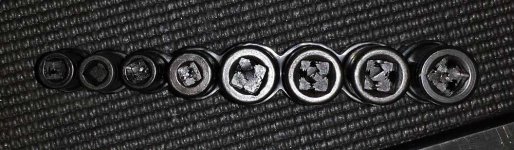
So as part of my Christmas shopping I decided to pull the trigger and get a set of the Lisle Tap Sockets (#70500) for myself. I'm sure many of you know that occasionally you get in a spot and need them, so they've been on my wish list forever. I considered the Irwin adjustables, but have always been happy with my Lisle stuff. I got them in and noticed what looked like cracked steel in the base of all of them. I knew that this wasn't integral to the socket working and was sure it was just some by-product of the manufacturing process that I wasn't familiar with, but having never seen this before I was curious so I dropped Lisle an email. This was the reply I got:
"What you are seeing down inside the Tap Sockets are broaching trees. With our equipment we use a square broach and press it into a round hole to make the 3/8” and 1/4” square drive openings on the socket. Most manufacturers have forging equipment to make sockets. Unfortunately Lisle Corporation does not have forging equipment. This is the process Lisle has used to make the Tap Sockets for over 20 years. Our manufacturing process doesn’t look as pretty as a forging process, but we are able to manufacture these sockets here in our plant in Clarinda, IA instead of having them made overseas."
I found this interesting and thought you guys might also, so I asked permission to post the response and here it is. Just a little piece of info on the process, pretty neat if you ask me.
On a side note, the engineer from Lisle who answered my question said he lurks here sometimes.
"What you are seeing down inside the Tap Sockets are broaching trees. With our equipment we use a square broach and press it into a round hole to make the 3/8” and 1/4” square drive openings on the socket. Most manufacturers have forging equipment to make sockets. Unfortunately Lisle Corporation does not have forging equipment. This is the process Lisle has used to make the Tap Sockets for over 20 years. Our manufacturing process doesn’t look as pretty as a forging process, but we are able to manufacture these sockets here in our plant in Clarinda, IA instead of having them made overseas."
I found this interesting and thought you guys might also, so I asked permission to post the response and here it is. Just a little piece of info on the process, pretty neat if you ask me.
On a side note, the engineer from Lisle who answered my question said he lurks here sometimes.