To avoid these ads, REGISTER NOW!

Little issues with house

Bert_

Well-known member
Joined
Dec 24, 2016
Messages
9,715
Location
NW Iowa
If that is a galvanized pipe going into cast iron, it may well be an oakum/lead joint. I was able to take a punch and tap the lead further down into the oakum, sealing up a small leak. I did it 32 years ago when I moved into this house and it never leaked again. I just worked my way around the joint several times. Just another trick I learned from dear old depression-era dad.

Sounds like the most reasonable solution to me. Not sure why this is practically being ignored.
 
To avoid these ads, REGISTER NOW!

Kaizen

Well-known member
Joined
Jan 9, 2015
Messages
6,948
Location
New England
Sounds like the most reasonable solution to me. Not sure why this is practically being ignored.
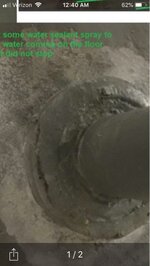


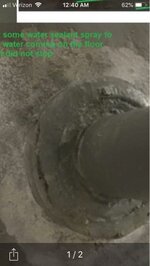
Look close. Not a straight pipe in pipe oakum lead joint. At least not ones I’ve seen. Looks like the ring of the cast is not complete. Also not sure what the flat thing is.

c935f2ba0b6044aebd9c73474c0b0551.jpg


Sent from my iPhone using Tapatalk
 

Attachments

  • c935f2ba0b6044aebd9c73474c0b0551.jpg
    c935f2ba0b6044aebd9c73474c0b0551.jpg
    38.3 KB · Views: 0

johnnyradiant

Well-known member
Joined
Mar 27, 2017
Messages
833
Location
Vancouver, BC
I don't think there is any 'repair' from the surface that will be anything more than a bandaid. It looks almost like a toilet flange and lead sitting on the floor in which case any vibration or movement of the pipe will never allow for a permanent watertight seal. Maybe you can get better performance out of it by replacing the pipe and making sure it goes into the floor fitting a few inches below the surface. Maybe it is currently on the short side for the type 'seal' here, or maybe the pipe has rotted out just below the surface. Out of the bandaids suggested I'd think a good cleaning and epoxy would yield the best potential. But I think I would cut the pipe on the 'horizontal' and take look see at what is going on at/in the fitting first. Then either put the last little bit back as new or re-use and (re)join at your cut with a zip coupler.
 
To avoid these ads, REGISTER NOW!

flat350

Well-known member
Joined
Jan 1, 2009
Messages
1,006
Location
illinois
It's a galv. pipe in a C.I. hub,repacking may stop it.If repacking doesn't stop it chisel out the old lead and oakum and start fresh.You may find that it's leaking because the galv. pipe is rotted away at the floor,if so cut it out and add a new piece with a Fernco coupling or a No Hub coupling,and a new lead joint.The oakum gets packed to 1" from the top of the hub and capped with lead,pack it real tight,the lead only acts as a cork for the lead.Try to use white oakum not brown,the white has Bentonite in it and is made to swell as it gets wet to seal off leaks.


These are the various tools used on lead joints,you can try to fashion your own out of something.You really only need the broad curved nose one.See the link below,and I probably have 2 or 3 of every style listed out in the garage after being a new const. Plumber in Chicago for years.

https://www.mephistotools.com/caulking-irons.htm
 
Last edited:
To avoid these ads, REGISTER NOW!
Top Bottom