To avoid these ads, REGISTER NOW!

Load-bearing Triple 2x6 stud boring

ibilisi

Member
Joined
Aug 28, 2009
Messages
16
Hey all, I just am looking for a sanity check on my rough electrical plan.

I have a 4 7.5x2.5e LVL supported by triple 2x6 as per engineer's plan.

I am planning on running 2x 12/3 MC cables, one for lighting, one for outlets.

I know that IBC R602.6 allows for boring provided that the diameter of the resulting hole is no greater than 40 percent of the stud width. However, given that this flat roof is loaded with a live roof system I'm a bit cautious.

Anyone see any issues here or know of caveats that I might have missed?

Thanks in advance.

Image attached.
IMG_wall.jpg
 
To avoid these ads, REGISTER NOW!

Elginz

Well-known member
Joined
Dec 29, 2014
Messages
431
Location
Oconto, WI
it is no longer a stud, it is a column, I believe columns are not to be compromised. Some one more up to date can chime in.
 
OP
I

ibilisi

Member
Joined
Aug 28, 2009
Messages
16
Right below is a 18x4 LVL so that ***** (partially over office in adjoining basement).

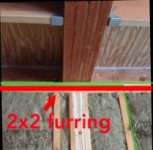
Since I am running MC, I could create a "service" cavity for the cable by installing a 2x2 into the first of the doubled top plate. That would give me the ability to get around the LVL without boring that triple 2x6. Running mc up the stud, through the top plate and in the cavity.

I guess a "mini-soffit".
 

Zeke

Well-known member
Joined
Aug 13, 2009
Messages
17,176
Location
Long Beach CA, the sewer by the sea.
You can't put a 2 x 2 as part of the double top plate. You are wrong about the 40%. For load bearing it's 25%. What you can do is bore the top plate on either side and bore the LVL right above the plate. Run your loop up and through and back down.

Also (I can't see your pic well enough) if the blocking or joist is set back to one side of the plates, you can just run your MC along the top of the plate along side.
 
To avoid these ads, REGISTER NOW!
OP
I

ibilisi

Member
Joined
Aug 28, 2009
Messages
16
You can't put a 2 x 2 as part of the double top plate.


I guess I should be more clear, I meant to say furring if that helps at all. I couldn't find reference to that anywhere in code.

I had planned for the furring to attach to the bottom top plate but if an issue I could go below that right at the wall and make a "shoe" for the LVL. I don't mind running a furring strip up there because I have to run lighting anyway. Red line is 2x2 furring, the green lines are the MC.

IMG_wall2.jpg


You are wrong about the 40%. For load bearing it's 25%
I thought 25% was for notches not bore holes. Am I reading that wrong?
 
Last edited:

mm08822

Well-known member
Joined
Jan 13, 2012
Messages
5,909
Location
NJ
Consider adding a 2x6 to each side of the three that you have in the wall cavity. Bore a single hole in the center and run your cables. Make sure you properly nail each 2x6 to the existing. If you can nail through the sheathing to further secure all 2x6's together.
 

Mustang51js

Well-known member
Joined
Jan 24, 2014
Messages
1,734
Location
Haskell nj
You only need to drill a 3/4 inch hole, I don't see an issue,it's usually when you drill closer to the bottom edge I've heard of people having issues.
 

600SL

Well-known member
Joined
Apr 26, 2012
Messages
1,794
Location
Connecticut
The outer fibers of the beam carry all bending loads. If you drill a small hole through the center of the beam you do next to nothing. Drill it or notch it near the edge of the beam on the tension side and you will compromise the structure.
 

David C

Well-known member
Joined
Mar 10, 2014
Messages
157
Location
Northern California
I believe 40% of the stud width is too large a hole without further evaluation.

Normally the structural design, the details on the plans, provide a typical allowable hole diameter in studs and in this case your built up column. Check the typical detail section of your plans. If it isn't on the plans call your engineer.

Larger holes in framing may be allowed based upon further evaluation of the loads in the framing member. Your engineer could provide this calc for you and make a recomendation.

Generally holes should be in the middle width of the framing member with the smallest allowable holes near the middle of the span and allowable hole size inreasing as the hole gets closer to the supports. (though you would not want a large hole in the very end of the stud or column where it is end nailed to the plates) Note that studs (and this column) support out of plane forces from wind loads, or seismic loads if they are applicable to your area, ie studs are beams as well as compression members.

Regardless of allowable hole diameter you would almost always want the penetration centered in the width of the member and the hole drilled clean and neat.

Notches in structural framing are a far different animal as a notch destroys the outer fibers of the member and considerably reduces the moment capacity (or shear capacity at the supported ends). Stress concentration factors for notches decrease the load capacity beyound what would normally be expected. Notches in structural framing should be avoided unless specifically detailed on the plans.
 
To avoid these ads, REGISTER NOW!
Top Bottom