My posts arent posting, im not sure why - if im breaking a rule please tell me so I can address it.
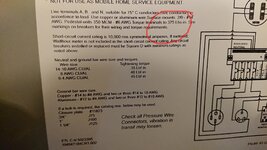
Im looking for someone qualified people to chime in to make sure my system is safe. I am installing a few 50/30/20 RV panels off of a 200a load center. The panels are fused at the main at 60 amps. my longest 240ft run uses 0/1-0/1-0/1-2 aluminum URD for 60 amps. the other panels are 180ft or less and use 2-2-2-4 aluminum mobile home feeder wire for 60 amps. The load center is already wired with the exception of I still need to connect the ground wire and grounding electrodes. The subpanels are prewired, all i need to do is mount them and connect the 2 hots, neutral, and ground from the loadcenter. I will post some pictures tommorow once the loadcenter is properly grounded to get feedback if everything looks correct. I have a few questions though.
1) how do i determine the correct ground wire size? I plan on using 4awg bare copper on the load center with 2 8 ft copper ground rods spaced 8 ft apart. I plan on using 6awg bare copper on the subpanels with 2 8 ft copper ground rods spaced 8 ft apart. I plan do get one of those ground clamps and ensure that im less than 25ohm resistance. im guessing on this wire size, hopefully its sufficient, and bigger is going to be a pain. I plan on burying these rods 1-2ft below ground level so that I can drive over them. I have super sandy soil.
2) Is mixing copper and aluminum okay in this case? My ground lug in the main is compataible with both metals. All of my wiring connecting the loadcenter to the subpanels is aluminum. the only copper wire in my load center is the grounding electrodes and the actual "earth" grounding wire. Everything is slathered in novolox. the copper ground wire will have its own dedicated ground lug hole.
3) Aluminum wires like to walk out of their terminals. I am torquing my wire to 50lbs as indicated on the breakers. how often do i need to check these connections and retorque?
4) How can I stress test these connections? I plan on checking the voltages across my plugs when i am done. I plan on torquing everything down. I plan on retorquing all the prewired connections (though im not sure to what spec yet) I want to ensure that all connections are solid and that the system can handle a 12,000w draw and perform as expected before I plug a $100,000+ Rv into it. is there any realistic way to do this? I dont know how i would even begin to simulate this load with hairdryers.
I live in the middle of nowhere. I planned on getting all my work inspected by the city when I was finished. I called them today and asked about getting an inspection to get certified and make sure i was up to code. They told me that the only thing they do is come out and mark their own records wherever power lines are buried accoring to the electricians plans and any inspections are handled by the power company. The power company told me that they dont do inspections and to just "do it however your electrician tells you to". To me it seems like inspections dont exist out here? Im not really sure with how to proceed on making this "legal"
Im looking for someone qualified people to chime in to make sure my system is safe. I am installing a few 50/30/20 RV panels off of a 200a load center. The panels are fused at the main at 60 amps. my longest 240ft run uses 0/1-0/1-0/1-2 aluminum URD for 60 amps. the other panels are 180ft or less and use 2-2-2-4 aluminum mobile home feeder wire for 60 amps. The load center is already wired with the exception of I still need to connect the ground wire and grounding electrodes. The subpanels are prewired, all i need to do is mount them and connect the 2 hots, neutral, and ground from the loadcenter. I will post some pictures tommorow once the loadcenter is properly grounded to get feedback if everything looks correct. I have a few questions though.
1) how do i determine the correct ground wire size? I plan on using 4awg bare copper on the load center with 2 8 ft copper ground rods spaced 8 ft apart. I plan on using 6awg bare copper on the subpanels with 2 8 ft copper ground rods spaced 8 ft apart. I plan do get one of those ground clamps and ensure that im less than 25ohm resistance. im guessing on this wire size, hopefully its sufficient, and bigger is going to be a pain. I plan on burying these rods 1-2ft below ground level so that I can drive over them. I have super sandy soil.
2) Is mixing copper and aluminum okay in this case? My ground lug in the main is compataible with both metals. All of my wiring connecting the loadcenter to the subpanels is aluminum. the only copper wire in my load center is the grounding electrodes and the actual "earth" grounding wire. Everything is slathered in novolox. the copper ground wire will have its own dedicated ground lug hole.
3) Aluminum wires like to walk out of their terminals. I am torquing my wire to 50lbs as indicated on the breakers. how often do i need to check these connections and retorque?
4) How can I stress test these connections? I plan on checking the voltages across my plugs when i am done. I plan on torquing everything down. I plan on retorquing all the prewired connections (though im not sure to what spec yet) I want to ensure that all connections are solid and that the system can handle a 12,000w draw and perform as expected before I plug a $100,000+ Rv into it. is there any realistic way to do this? I dont know how i would even begin to simulate this load with hairdryers.
I live in the middle of nowhere. I planned on getting all my work inspected by the city when I was finished. I called them today and asked about getting an inspection to get certified and make sure i was up to code. They told me that the only thing they do is come out and mark their own records wherever power lines are buried accoring to the electricians plans and any inspections are handled by the power company. The power company told me that they dont do inspections and to just "do it however your electrician tells you to". To me it seems like inspections dont exist out here? Im not really sure with how to proceed on making this "legal"