To avoid these ads, REGISTER NOW!

Loctite - Which ones?

To avoid these ads, REGISTER NOW!

thebeekeeper1

Well-known member
Joined
Sep 5, 2012
Messages
1,011
Location
Illinois
There are many of them but the most common are red for permanent locks and blue for removable. The red can be removed with heat, but that's not always an option. They make others, but those are probably 75% of their sales (just a wild guess). :)

Edit: Missed the second part--they are good for a number of years, but they do have an expiration date on the bottle. The red in particular is very liquid so it should last a LONG time.
 

bfm336

Well-known member
Joined
Sep 12, 2014
Messages
380
Location
St. Louis, MO
Blue is typically your standard for keeping things from coming loose, but bolts and screws can still be removed (i.e. it is sticky). Red requires a torch/heat I believe.
 

Spudland_Dave

Well-known member
Joined
Mar 12, 2010
Messages
3,025
Location
Maine
There are many of them but the most common are red for permanent locks and blue for removable. The red can be removed with heat, but that's not always an option. They make others, but those are probably 75% of their sales (just a wild guess). :)

Nothing tweaks me more then people using color as the "type"....maybe if all you do is shop at Walmart and work on Huffy's color is fine, out here in industry there is a mind blowing assortment of types and colors... WAY more then just one type which happens to be red. There are thread lockers, sealants, primers, etc.. so use the correct formula numbers otherwise its like shopping for motor oil using nothing more then brand and color...gotta go get me some "Valvoline Amber" :lol_hitti Just like motor/lubricating oils, there are many formulations for many applications.

I'm gonna take an educated guess and say when you guys say "red" your really referring to 262. 271 is also red & permanent but different....272, 277, etc are also all other red ones. And we're just talking threadlockers right now, There are some red thread sealers, etc..

Without knowing more about your application the only question I can answer from your OP is to your question on shelf life. Yes there is a technical shelf life...each bottle has a "Best when used by" date on it.
That being said, out here in the real world where I'm not working on space shuttles or nuclear reactors on submarines, I've used them well past the advertised dates with no ill effects.
 
Last edited:

CJM8515

Well-known member
Joined
Mar 8, 2014
Messages
9,292
Location
NJ
I use blue a lot, mostly on motorcycles, atvs, things that might vibrate apart. Red is only to be used when you dont want it to come off and needs a torch to get it off.
 

FigureItOut

Well-known member
Joined
Sep 14, 2015
Messages
3,267
Location
Bentonville AR
Nothing tweaks me more then people using color as the "type"....maybe if all you do is shop at Walmart and work on Huffy's color is fine, out here in industry there is a mind blowing assortment of types and colors... WAY more then just one type which happens to be red. There are thread lockers, sealants, primers, etc.. so use the correct formula numbers otherwise its like shopping for motor oil using nothing more then brand and color...gotta go get me some "Valvoline Amber" :lol_hitti Just like motor/lubricating oils, there are many formulations for many applications.

I'm gonna take an educated guess and say when you guys say "red" your really referring to 262. 271 is also red & permanent but different....272, 277, etc are also all other red ones. And we're just talking threadlockers right now, There are some red thread sealers, etc..

I didn't realize all that but there's certainly more than just the color. There's different consistencies and different applications, like penetrating for already installed fasteners etc. The bottle gives a good description and you may see two very different products in the same color package. At HD and the like, yeah red and blue will be your main ones, but check the packaging. I'm looking at high strength permanent variety right now in a blue tube, and have green and red elsewhere around here somewhere.

Sent from my SAMSUNG-SGH-I337Z using Tapatalk
 

MFolks

Well-known member
Joined
Feb 3, 2013
Messages
1,045
Location
Springfield Mo.
Thread Locking Compounds

Loctite #222MS PURPLE, low strength thread locker
For screws under ¼”.

Loctite #242 BLUE, Medium strength thread locker
For ¼” to ¾” bolts.

Loctite # 262 RED, High strength thread locker permanent
For up to ¾” bolts (can be loosened by 300 F heat).

Loctite #271 RED, High strength thread locker for sealing plugs, nuts and bolts (can be loosened by 300 F heat).

Loctite # 272 RED, High strength, high temperature(450 F) thread locker.

Loctite # 272 RED, High strength, high temperature(450 F) thread locker.

Loctite #565 Pipe Joint Compound.

Loctite #567 High Temperature Pipe Joint Compound

Loctite #6749 Primer

Loctite #515 Flange & Gasket Sealers

Permatex # 24310 Low strength thread locker, PURPLE, fasteners under ¼” diameter.

Permatex # 22210 Medium/high strength thread locker, BLUE, ¼” to ¾” fasteners, surface insensitive (can be used on oily fasteners).

Permatex # 24210 Medium strength thread locker, BLUE, ¼” to ¾” fasteners.

Permatex # 27710 High strength thread locker, RED, 3/8” to 1 inch fasteners, may require heat for removal.

Permatex # 26210 Permanent strength thread locker. RED, 3/8” to 1 inch fasteners, will require heat for removal.
 

JerryC

Well-known member
Joined
Apr 28, 2012
Messages
244
Location
Memphis TN
I use red almost exclusively...even though it says you need heat to remove, I've never needed to.

Same here. Going by memory red has a higher break away torque than blue. I suppose that if mechanical plus thread locker torque exceeds the fastener strength then you would need heat to prevent breaking the fastener during removal.
 

T45

Well-known member
Joined
Nov 20, 2014
Messages
3,250
Which are the most useful?

How long are they good in the bottle?

Bill

OP, this is back to you...usefull for what jobs?

As noted above, loctite is a brand not a product. there are alot of SKUs.

If you are clueless, stay away from red.

If you re looking for a p/n for a standard formula, 242 is typical blue

If you are looking to make sense of "loctite" in all its formulations

...get some popcorn :beer:

1) loctite is plastic
2) loctite is a plastic company
3) lotso of types of plastics, because tradeoffs
4) plastic problems = contamination, heat, hardware irregularities

the variety of loctite forumulations is mainly a function of (3) and (4).

in plain english, slightly different types of plastic are needed to do different functions when joining two machined metal interfaces together

quick example - type 3

thread sealer - so nothing leaks (eg, water pipe threads) but not locked
thread locker - so nothing vibrates loose (locker), also a sealer in many case
press-fit locker - so nothing vibrates loose (locker), but no threads in metal

quick example - type 4 problems

heat resistant - say in a motor that gets hot, you need a special plastic
oil resistant - say you cannot clean every bolt perfect, you need special plastic
gap resistant - say you have a loose-spec hw interface, you need special plastic

basical this grid applies to both types of problems -> 3x3=9 and that is why a decent shop might have 10 or 12 types of loctite around...oh, and now lets add a weak, strong, and medium bond to the lockers and retaining compound choices...and now you might have to double that number

TLDR loctite sku proliferation is inevitable :lol::lol::lol:
 

thebeekeeper1

Well-known member
Joined
Sep 5, 2012
Messages
1,011
Location
Illinois
Nothing tweaks me more then people using color as the "type"....maybe if all you do is shop at Walmart and work on Huffy's color is fine, out here in industry there is a mind blowing assortment of types and colors... <snip>

If you weren't so busy being "tweaked" you would have actually read my post and discovered I acknowledged that, but the OP is clearly not "in industry" and only needs a basic amount of information. I would guess he is much more likely to be working on "Huffy's"(sic) than "in industry"--otherwise he wouldn't need to ask.
 

ibedayank

Well-known member
Joined
Feb 2, 2011
Messages
2,619
Location
Columbia TN
loctite don't fix leaky roofs or clogged sewer pipes or broken waterlines also does not clean houses. Might want to think about just what should be important before the city CONDEMS
that shithole pigpen you call a house!!
 

T45

Well-known member
Joined
Nov 20, 2014
Messages
3,250
If you weren't so busy being "tweaked" you would have actually read my post and discovered I acknowledged that, but the OP is clearly not "in industry" and only needs a basic amount of information. I would guess he is much more likely to be working on "Huffy's"(sic) than "in industry"--otherwise he wouldn't need to ask.

Don't take it personal, but color ... is a mess agree with above poster

1) color is inconsistent (eg, green loctite? green 200 vs 600 series?)

2) color is non-intuitive (eg, green not safe or low strength)

2) color of pkg and color of product are inconsistent (blue in red, red in blue)

3) generic brands of loctite (permatex) are inconsistent with name brands.

I'm too lazy to post pics, but pics would illustrate this pretty easily.

respectfully.
 
Last edited:
To avoid these ads, REGISTER NOW!

RichWentFishing

Well-known member
Joined
Feb 26, 2016
Messages
48
I have a blue locktite in glue stick dispenser in my box for the last 7 years. Much handier than the drop bottles. Still good last I checked.

Sent from my iPhone using Tapatalk
 

Bielio

Well-known member
Joined
Apr 30, 2013
Messages
148
Location
Of
I have a small 6mL bottle of Blue Loctite.
Has been around for a while. Every once in a blue moon i'll walk by it, shake it. Place it back down.
Great Stuff for locking threads which can be loosened later with proper tools (no heat).

I even used it to repair plastic scales on swiss army knife (even though that's not recommended)
 

Super Mech

Well-known member
Joined
Feb 19, 2011
Messages
1,806
Location
Bronx,NY
What is the orange stuff that Ford uses and the yellow stuff GM uses? They are both really good and would like to know if they are available to the general public.

I see both of those colors on various brake and suspension components.
 

anndel

Well-known member
Joined
Oct 28, 2015
Messages
3,270
Location
Hawaii, USA
Blue, it's not permanent but minimizes removal from vibration. It'll last about 3-4 months in the bottle till it solidifies.
 

bob15

Well-known member
Joined
Dec 8, 2011
Messages
6,863
Location
Northeasten, CT
What about green? It's intended for not coming apart without damage.

Again, color doesn't mean much......it is applications and Loctite/Prematex part numbers

So which green are you referring to?

Retaining compound (and there are multiple grades of green depending on the fit) or wicking? And all require effort for part removal, if used for their intended purpose.

And yes, we have three different greens at work (and I have 2 at home as well). This is why numbers are used.
 

Leaflessshadetree

Well-known member
Joined
Aug 1, 2013
Messages
7,147
Location
Don't ask.
While I do acknowledge the variety of products specialized for different applications.
Also realize that different companies make similar products. Most of these the average guy at home will never find on a store shelf, nor will they be found in any one professional shop.
For the average guy the most common general duty thread locker will be blue (in every brand I've seen). The permanent thread locker will be red.
Less common, but I like having it, is the green. It is a penetrating thread locker applied after assembly.
I use the low strength purple on very small screws (such as eyeglasses).

For those that want to be specific to the Loctite brand the following numbers:
Blue = 243
Red = 263
Green = 290
Purple = 222
 

zmotorsports

ALLIANCE MEMBER
Joined
Oct 20, 2009
Messages
21,350
Location
Northern Utah
I have a few that I usually use:

* Loctite 242 (Blue) is low/medium strength for removing without heat. This is probably the one I use the most, just to keep things in place.
* Loctite 262 (Red) medium/high. I use this depending on the size of the fastener as well as the application.
* Loctite 271 (Red) high strength when I don't want it coming apart. Things like ring gear bolts (automotive) and clutch components (motorcycles).
* Loctite 290 (Green) I use this for things like carburetor adjustments as it wicks into the threads after the screw is in place.
* Loctite 680 for pressed fit of bushings, etc.
* Loctite 545 Hydraulic fittings

I know there are many, many more but those are what I have sitting on my workbench that get used the most frequently.

Mike.
 

MoonRise

Well-known member
Joined
Nov 5, 2010
Messages
4,028
Location
NJ
For me, for general purpose thread locker usage, I like to have available:

'blue' (medium strength liquid, removable with hand tools)

'red (higher strength liquid, usually 'need' heat to remove)

'green' (medium strength wicking liquid applied after assembly, removable with hand tools)

Loctite numbers changed in the past couple of years.

The 'blue' used to be Loctite 242, now it's Loctite 243 (still have an 'old' bottle of 242, still use it, still works just fine).

The 'red' used to be Loctite 262, now it's Loctite 263.

The 'green' used to be Loctite 290, it's still Loctite 290. :D

These are all general purpose anerobic thread locking compounds made by Loctite. Used for general purpose 'non critical' applications.

The 'purple' is usually a low strength version (Loctite 222, used for 'small' fasteners).

For 'critical' applications, you might need to use different formulas and/or primers. There are higher temperature versions as well. Loctite has those too.

And there are other brands out there beside Loctite brand. :D

Go to the Loctite website and read up all about thread lockers and thread sealers and bearing retaining compounds and assembly adhesives and all sorts of other things. :D


www.henkelna.com/loctite

especially the "Adhesive Sourcebook" (yes, thread lockers are a type of 'adhesive')

http://www.na.henkel-adhesives.com/us/content_data/382071_LT3355_ASB_v19_2015.pdf
 

martin666

Well-known member
Joined
Apr 15, 2015
Messages
425
Location
New Jersey
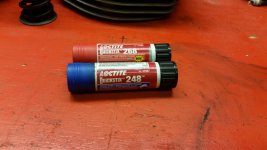
I'm a motorcycle mechanic and over the years have used many different numbered Loctite products. These 2 are my current favorites, like the sticks much better than the bottles. Used to use a yellow Loctite ( can't remember the number ) but it needed a primer and an activator ). Was great for a temporary fix on stripped studs and bolts, can't remember exactly but it took up something like .050 gap , stuff was great
 

Attachments

  • 20160601_134440.jpg
    20160601_134440.jpg
    139.8 KB · Views: 18

JZiggy

Well-known member
Joined
Dec 1, 2014
Messages
990
Location
Atlanta
Just to make things more confusing, other thread locker suppliers may use different color codes. For example, I often use Honda's Hondalock (probably made by Henkel Loctite too) and they work like:

Blue = low strength
Orange = medium
Red = medium, high temp
Green = strong, high temp

Regardless of brand, a simple mechanic's kit should probably have a "medium" and "strong" threadlocker, a thread sealant, and a bearing/shaft/sleeve retaining compound. Covers most of the bases in my shadetree experience.
 

Jeeper

Well-known member
Joined
Dec 25, 2006
Messages
2,124
Location
Round Rock, TX
Has anyone seen a cross reference from what GM (or other automaker) uses compared to Loctite or Permatex brands?
 

ttpete

Well-known member
Joined
Mar 8, 2011
Messages
6,737
Location
Dearborn, MI
Has anyone seen a cross reference from what GM (or other automaker) uses compared to Loctite or Permatex brands?

The auto industry uses a type of threadlocker that's applied to fasteners when they're made. It hardens so it doesn't rub or flake off, and when the fastener is installed, the friction of assembly activates the threadlocker.
 

rlitman

Well-known member
Joined
Oct 18, 2010
Messages
24,591
Location
Long Island
The auto industry uses a type of threadlocker that's applied to fasteners when they're made. It hardens so it doesn't rub or flake off, and when the fastener is installed, the friction of assembly activates the threadlocker.

You can get that in crayon or "lipstick" form. The threadlocker is contained within micro-encapsulated beads that break under pressure.
 

theoldwizard1

Well-known member
Joined
Feb 22, 2011
Messages
43,125
Location
SE MI
Loctite #565 Pipe Joint Compound.

Loctite #567 High Temperature Pipe Joint Compound
These are AWESOME especially for pipe fitting carrying pressurized air (like an air compressor). Seals incredibly well, although the cure time is long (24+ hours for some metals).

The Chinese are now using something like this on a lot of the fittings on portable compressors. YOU WILL DESTROY BRASS FITTINGS WITHOUT HEAT ! Likely damage aluminum also.
 
To avoid these ads, REGISTER NOW!
Top Bottom