To avoid these ads, REGISTER NOW!

Loft Floor Suggestions Please

Joined
Oct 16, 2014
Messages
7
Location
Chatsworth, California and Clearwater, Florida
Accompanying picture shows my loft space: 8' wide by 2'6" high. Joists are 2X6, 24" O.C. What thickness plywood could I get away with? This area will be used for lightweight storage - not much room for anything else.

With 24" O.C. I realize 1/2" plywood will sag slightly but the garage ceiling will be drywalled so any sag would not be visible. Also can I get away without adding width edge support (4' side) for the plywood?
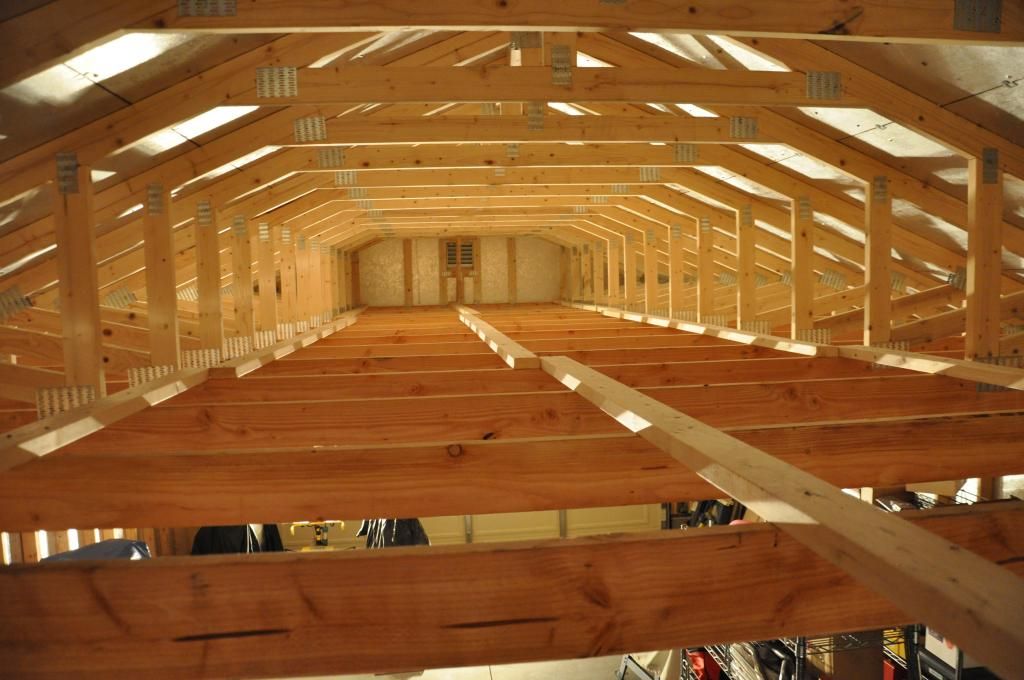
DSC_7764.jpg
 

Attachments

  • DSC_7764.jpg
    DSC_7764.jpg
    141.2 KB · Views: 81
Last edited:
To avoid these ads, REGISTER NOW!

Cyberbear

Well-known member
Joined
Nov 23, 2013
Messages
1,524
Location
California
I did something very similar using 5/8" plywood to store our boxes and misc. stuff. I didn't use short edge support and wish I had as I do not like the amount of sag over time. It's always better to over build rather than skimping, since it will be too difficult to up grade later. Better too strong than too weak.
 

Hesketh

Well-known member
Joined
Oct 21, 2011
Messages
217
Location
Scotland
I would suggest putting some 2x6 between the joists as that will help with the support between the joists then just floor it as you have suggested?
 

kelpaso1

MEMBER EMERITUS
Joined
Sep 28, 2009
Messages
3,962
Location
New Brunswick
I knew I was trying to get away with something by not supporting the short edge. There's no free lunch. The original plans called for 5/8" but I don't look forward to loading 5/8" plywood into the loft space; but oh well.

I don't understand. Are you planning on putting the sheets parallel with the joists? If so just nail 2x6's at the ends of joists to support the ends of the sheets.

I would put the sheets perpendicular to the joists and since they are 24" OC the ends of the sheets should land on half of the joist and the next sheet on the other half of the joist. Not sure if I'm clear enough for explanation. Basically like how drywall is hung on walls and ceilings.

I think 1/2" plywood would be a little bouncy between joists since they are 24" OC. If they were 16" OC I think you would be ok.
 

Costner

Well-known member
Joined
Jul 24, 2009
Messages
339
I've walked on enough roofs to know 5/8ths will deflect simply by walking on it. That is why code requires H clips between rafters - to prevent sag under loads. It is in your best intersts to add blocking or nailers between any unsupported seam - you won't regret it later. Even if you upgraded to 3/4" (which is overkill for light storage) I would still suggest supporting all seams.

I have a small finished space in my garage attic but I used 1"x10" boards the prior owner had used for shelving (a mixture of pine and MDF). Sure it is overkill, but it is what I had available so the cost was free. No deflection with 1" material although the weight of doing a full space like yours would be higher so that may be a consideration.

If you really want to stiffen things up - lay down a bead of construction adhesive on each truss chord and all blocking before you nail/screw down the plywood. It wil help distribute loads across the trusses - but obviously won't do anything about potential sag between the trusses.
 

Nowater

Well-known member
Joined
Nov 29, 2011
Messages
744
Location
Southwest Florida
I don't think you have joists at all, I think you have a truss system. Find out how much live load on the bottom chord the truss system was designed for first. That is a different value from the live load the upper chord (think roof) is designed for. The upper chord usually can bear the weight of a roofing installation crew and things like snow if that applies to you.

Usually the bottom chord is not designed for any appreciable live load, perhaps five or ten pounds per square foot. If that is the case, any plywood only adds to the dead load. Exceeding that load can weaken your trusses, and potentially give reason for your homeowners insurance to cancel or refuse a claim.

Then after the trusses are weakened, the next owner send his daughter in right when the trusses fail. He gets mad and uses you for target practice.... Heck, maybe he should just shoot you know and save some trouble!

Do the homework first, and let that information determine the plywood size. Are you going to be crawling around up there to get to your stuff, or are you going to reach for it from a ladder? You MAY be Ok with intermittent loads of someone being up there to get stuff, but say children making a inside tree house, may not.
 
To avoid these ads, REGISTER NOW!

Costner

Well-known member
Joined
Jul 24, 2009
Messages
339
I don't think you have joists at all, I think you have a truss system. Find out how much live load on the bottom chord the truss system was designed for first. [...]

Not bad advice to find out, but you can clearly see by the photo they are storage trusses which are engineered for this very purpose. Traditional trusses don't have the storage area nor do they contain the much stronger lower chord (which per the photos appears to be a 2x6 or perhaps even a 2x8 rather than the typical 2x4).

In short - I'm sure they are engineered to support a subfloor and a reasonable load of 'stuff'. He just can't go crazy and start storing his vast collection of antique tractor weights up there. :D
 

sublime68charger

Well-known member
Joined
Sep 9, 2014
Messages
5,415
Location
SW Wisconsin
Could you just put 2x4 on top at the edge and run screws up from the bottom to them?

Would help take the flex out and give you a rub rail for sliding things around up there

Save you the Time cutting and fitting between the trusses

Also run 2x6 flat down the middle

Just a thought

Sublime out
 
Last edited:
OP
I
Joined
Oct 16, 2014
Messages
7
Location
Chatsworth, California and Clearwater, Florida
Not bad advice to find out, but you can clearly see by the photo they are storage trusses which are engineered for this very purpose. Traditional trusses don't have the storage area nor do they contain the much stronger lower chord (which per the photos appears to be a 2x6 or perhaps even a 2x8 rather than the typical 2x4).

In short - I'm sure they are engineered to support a subfloor and a reasonable load of 'stuff'. He just can't go crazy and start storing his vast collection of antique tractor weights up there. :D

This is exactly what happened. The storage area was originally incorporated in the design. The original intent was for the builder, Tuff Shed, to construct the loft floor but LABDS insisted the plans show no plywood floor in the loft leaving me to do it after final inspection. BTW bottom chord (joist to me) is a 2X6.

I think I should just call the engineer to find out how much weight this thing can bear.:willy_nil
 

finn

Well-known member
Joined
Mar 27, 2005
Messages
16,204
Location
The UP, God's country
I have storage trusses similar to that.

I elected to use 1/2 inch osb perpendicular to the bottom chord.

It flexes when I walk up there every six months or so. but weighs a lot less than 5/8" or3/4" osb or plywood. The dead load is more important, to me at least.
 

DynoDave

Well-known member
Joined
Mar 25, 2005
Messages
1,685
Location
Michigan
Good topic.

My storage trusses also form a storage area like this. I've been wondering what the thinnest (IE: lightest) material was that I could use up there.
 

Fyrme

Well-known member
Joined
Nov 28, 2012
Messages
2,231
Location
Green country, Oklahoma
What I did to save some $ and weight in my lofts was deck the whole floor in 3/4" T&G OSB, and then went over the areas I will install my shelving with 5/8" OSB, and made sure all my joints were offset. That way there is more beef where the weight will be concentrated and the rest is only for foot traffic.
15678194732_4ec1f543f7_b.jpg
 
To avoid these ads, REGISTER NOW!
Top Bottom