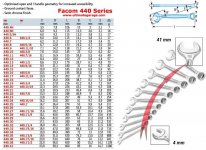
I'm trying to remember what vehicles I've run into this on (maybe rear calipers on GM trucks?) but the thin wrench is needed to hold the slider pin on a floating caliper from turning when you loosen the bolt... Most cars have a tab or big square or something that hits part of the casting to keep it from turning, but some don't. It *shouldn't* be a high torque application. I know, shouldn't...
The thinner German wrenches are beefier in the head area e.g. China Craftsman "lobster claws" presumably to allow them to withstand more torque than a traditionally shaped wrench ground down to fit.
On the VW's I'm referring to, their is no tab. It is meant to be free spinning. You are correct it is not a high torque setting, but rusted, frozen bolts become "high torque" applications.
Just to reiterate the OP is talking about the slide PIN, not the bolt. You don't need to put much torque on it at all, just hold it in place while you thread the bolt in or out, and if its rusted in place then you don't have the problem of it free-spinning.
I understood the OP was talking about the pins that the caliper slides on. What I mentioned should be a good example of that.
I'm guessing you are not familiar with the types of calipers I was referring to.
Caliper I am referring to:
Better look at the bolts:
When those bolts freeze up inside the pin, it all just spins around and around. Using a "slim line" type wrench, AKA Tappet wrench can result in the wrench spreading or breaking.
I have had occurrences where the pin would spin freely, but the bolt be frozen inside the pin. In most cases, the bolt will break off inside the pin and both will have to be replaced, but not before ruining a "slim line" wrench.
My snap on standard type wrench fits in their nicely and is thick enough not to spread before the bolt breaks off in the pin.
Luckily I don't live in the rust belt as I'm sure it is a much more common occurrence there. I have no idea where the OP is located.