Your total load comes to a little under 3 amps.
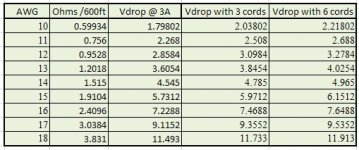
Using the resistance of different diameter copper wires, with a total path length of 600ft (300 each way), I get the numbers in the attached table.
With 14AWG wire, you will have a voltage drop of about 4.5V, so 120V at the beginning of your cord will turn into 115.5V at the end. This comes from the middle column
However this does not take into account the resistance of the plug contacts. Generally contact resistance can be assumed to be 0.01 ohms per contact. With 3 cords, you have 4 plugs between the source and your instruments with 2 contacts each. With 6 cords, you have 7 plugs with 2 contacts each.
The right two columns show the voltage drop including contact resistance.
The big question is, how low of a voltage can your equipment accept. If you have a variac, I would test out each piece of equipment at 100-110VAC to see if it still works properly.
If you don't have the ability to test the equipment, I would say that any equipment rated for 120V (or 117V) should work fine at 110V and probably even 105V as well. While the calculations would allow the use of 16 AWG wire. You also have to remember that the length and size of wire from the transformer on the utility pole to your panel and then to the outlet you plug the extension cords into will be a factor.
Therefore I think 14AWG is the way to go.