
You are using an out of date browser. It may not display this or other websites correctly.
You should upgrade or use an alternative browser.
You should upgrade or use an alternative browser.
Looking for a torque wrench
- Thread starter unclemoak
- Start date
mrholeshot
MEMBER EMERITUS
- Joined
- Jun 22, 2010
- Messages
- 8,043
You just have to make sure to zero it out after you use it. The Snap-On PI style don't have to be zeroed out. If you use it quite a bit or drop them ocasional calibration should be done. When it comes to cost and accuracy it's still hard to beat a 29 dollar Craftsman beam style torque wrench. Never has to be calibrate, will be as accurate 50 years from now as it is today. It's biggest downfall is you have to be able to see the scale. Back when I used a beam style in the 60's I put a clothes pin on the scale where the torque topped out for what I was doing the needle hit the clothes pin and I knew where it was so I didn't have look directly at the scale.
You just have to make sure to zero it out after you use it. The Snap-On PI style don't have to be zeroed out. If you use it quite a bit or drop them ocasional calibration should be done. When it comes to cost and accuracy it's still hard to beat a 29 dollar Craftsman beam style torque wrench. Never has to be calibrate, will be as accurate 50 years from now as it is today. It's biggest downfall is you have to be able to see the scale. Back when I used a beam style in the 60's I put a clothes pin on the scale where the torque topped out for what I was doing the needle hit the clothes pin and I knew where it was so I didn't have look directly at the scale.
I heard at one time that the Snap On torque wrenches are actually made by CDI Torque products. Is there any truth to that?
http://buy1.snapon.com/catalog/item.asp?P65=&tool=hand&item_ID=55262&group_ID=954&store=snapon-store&dir=catalog
The similar CDI wrench is like half the price.
billymade
Well-known member
Snapon now owns CDI.
Principal Subsidiary Companies: Snap-On Inc. operates an extended network of subsidiaries, dealers, and representatives throughout North America, including Snap-On Tools Co.; mechanical collision repair equipment maker Nu-Tech Industries, Inc.; torque measuring products and calibrating equipment maker Consolidated Devices, Inc.; mechanical collision repair equipment maker Hein-Werner Corp.; Mitchell Repair Information Co., which handles vehicle repair information and business management systems; industrial power tool maker Sioux Tools, Inc; Snap-On Industrial Group; Snap-On/Sun de Mexico S.A. de C.V.; Snap-On Tools of Canada Ltd.; Snap-On Tools Puerto Rico; Snap-On Diagnostics; and Wheeltronic Ltd., which manufactures vehicle lifts. Snap-On also operates subsidiaries in South America, Europe, Asia, and Africa.
I get the feeling that PI has always made the split beam style and CDI made the clickers... I'm sure they have changed OEM's over the years.... but thats what I have always thought.... I'm sure others can correct me if I am wrong!
http://www.torqwrench.com/
http://www.cditorque.com/
Principal Subsidiary Companies: Snap-On Inc. operates an extended network of subsidiaries, dealers, and representatives throughout North America, including Snap-On Tools Co.; mechanical collision repair equipment maker Nu-Tech Industries, Inc.; torque measuring products and calibrating equipment maker Consolidated Devices, Inc.; mechanical collision repair equipment maker Hein-Werner Corp.; Mitchell Repair Information Co., which handles vehicle repair information and business management systems; industrial power tool maker Sioux Tools, Inc; Snap-On Industrial Group; Snap-On/Sun de Mexico S.A. de C.V.; Snap-On Tools of Canada Ltd.; Snap-On Tools Puerto Rico; Snap-On Diagnostics; and Wheeltronic Ltd., which manufactures vehicle lifts. Snap-On also operates subsidiaries in South America, Europe, Asia, and Africa.
I get the feeling that PI has always made the split beam style and CDI made the clickers... I'm sure they have changed OEM's over the years.... but thats what I have always thought.... I'm sure others can correct me if I am wrong!
http://www.torqwrench.com/
http://www.cditorque.com/
Last edited:
Charles (in GA)
Well-known member
Are there any downsides to a click style as opposed to a beam or dial style one?
If you have a need to measure running, rotational, or breakaway torque, you cannot do it with a clicker. If all you are doing is torquing bolts and nuts, then clickers are fine.
For the average Joe homeowner, car fiddler/fixer, GJ type, probably the best choice is the Precision Instruments split beam 3/8 drive and 1/2 drive flex heads. They work well, are accurate, click so they are easy to use, and by nature, like an old beam type don't lose their calibration easily, and are forgiving as you don't have to remember to "zero" the torque setting to min torque after use, plus the flex head will make work much easier, and the price is right.
Precision Instruments 3/8 drive split beam 20 - 100 ft lbs
Precision Instruments 1/2 drive split beam 40-250 ft lbs
These keep getting cheaper, I paid $115 for the 3/8 dr from TT and $152 on the 1/2 dr, and that was a couple of years ago.
Charles
Last edited:
GeorgiaHybrid
Well-known member
Tooltopia has the 1/2" PI on sale right now for $150.00. PI is the company that makes the split beam TW for Snap-on. As noted above, CDI was bought by Snap-on and they build the Tech and TechAngle wrenchs for Snap-on
GeorgiaHybrid
Well-known member
Try one of these:
http://www.tooltopia.com/precision-instruments-m1r200hx.aspx
http://www.tooltopia.com/precision-instruments-md1f35h.aspx
Remember to get from in-lbs to ft-lbs, divide by 12.....
http://www.tooltopia.com/precision-instruments-m1r200hx.aspx
http://www.tooltopia.com/precision-instruments-md1f35h.aspx
Remember to get from in-lbs to ft-lbs, divide by 12.....
Seanbev24
Well-known member
Do they make the equivelant wrench in a 1/4 drive? I'm looking for a quality torque wrench that will go down to about 5 ft/lbs. I didn't see one on that website.
For working around 5 ft-lbs, you want to be using an in-lb torque wrench. Much more accurate at that low range. This one starts at 30 in-lbs (2.5 ft-lbs)
http://www.tooltopia.com/precision-instruments-m1r200hx.aspx
If you have a need to measure running, rotational, or breakaway torque, you cannot do it with a clicker. If all you are doing is torquing bolts and nuts, then clickers are fine.
For the average Joe homeowner, car fiddler/fixer, GJ type, probably the best choice is the Precision Instruments split beam 3/8 drive and 1/2 drive flex heads. They work well, are accurate, click so they are easy to use, and by nature, like an old beam type don't lose their calibration easily, and are forgiving as you don't have to remember to "zero" the torque setting to min torque after use, plus the flex head will make work much easier, and the price is right.
Precision Instruments 3/8 drive split beam 20 - 100 ft lbs
Precision Instruments 1/2 drive split beam 40-250 ft lbs
These keep getting cheaper, I paid $115 for the 3/8 dr from TT and $152 on the 1/2 dr, and that was a couple of years ago.
Charles
Pardon my ignorance, but what type of situation would require you to know the running, rotational, or break away torque?
The most useful torque wrench to you as your first one is probably going to be that $95 PI one on tooltopia, 20-100 ft #. After that I would look for something on the low end, 5-20 or so. You can always get a cheapo HF one for the 50-200 range, anything over 100 doesn't have to really be THAT accurate at least right now. The most important accuracy is going to be on the lower end of the scale, and most fasteners on a car are between 20-100. Below that you can use the German tightening method "gudentight" by feel.
Sears does sell a 3/8" beam style for $25 at their stores, I don't have one currently but am going to pick one up "just because" it will never lose calibration and there is an art in using it, bonus is it's USA made. I'd like to get a 1/4" one too eventually. They also sell a 1/2" version but I find the scale is more difficult to read (it's more compressed).
Sears does sell a 3/8" beam style for $25 at their stores, I don't have one currently but am going to pick one up "just because" it will never lose calibration and there is an art in using it, bonus is it's USA made. I'd like to get a 1/4" one too eventually. They also sell a 1/2" version but I find the scale is more difficult to read (it's more compressed).
and most fasteners on a car are between 20-100. Below that you can use the German tightening method "gudentight" by feel.
That is how people manage to F-up aluminum cylinder heads, and valve bodies...
Realistically though, I doubt to many home mechanics are messing with their valve bodies, but I'm sure there are some.
Charles (in GA)
Well-known member
Pardon my ignorance, but what type of situation would require you to know the running, rotational, or break away torque?
I'm an aircraft mechanic by trade, and in that business, we quite frequently have to measure force required to rotate some component (such as the control yokes during a flight control test) or amount of friction a self locking nut generates (then add the required torque to that to get the proper torque of the nut), or as noted, setting up auto and truck differentials would require such to measure bearing preload or friction. Not a lot of uses in the auto world, but they are there.
Charles
Charles (in GA)
Well-known member
There are a number of things that I consider it necessary to have a torque wrench for, cylinder heads, intake manifolds, transmission work, axle nuts on front wheel drive vehicles. Lots of other things that and experienced mechanic can do by feel quite well. With the aluminum oil pans on new engines, I've taken to using one on those too. (torque is noted on a label I put on my radiator support so I don't have to keep looking it up).
Charles
Charles
That is how people manage to F-up aluminum cylinder heads, and valve bodies...
Realistically though, I doubt to many home mechanics are messing with their valve bodies, but I'm sure there are some.
Someone who is replacing the head is going to know to use a torque wrench...plus it was a freaking joke...get it "gudentight"...German method? I thought it was funny.
I'm an aircraft mechanic by trade, and in that business, we quite frequently have to measure force required to rotate some component (such as the control yokes during a flight control test) or amount of friction a self locking nut generates (then add the required torque to that to get the proper torque of the nut), or as noted, setting up auto and truck differentials would require such to measure bearing preload or friction. Not a lot of uses in the auto world, but they are there.
Charles
I wrote up a thrust lever quadrant once because it was really tight pushing it forward even with the lock completely off, the A&P's used some sort of spring device they hooked up to them and pushed. Not sure how it worked but seemed pretty complicated!
Someone who is replacing the head is going to know to use a torque wrench...plus it was a freaking joke...get it "gudentight"...German method? I thought it was funny.
You would think that, but sadly the world is full of ...well, you get where I am going. If you saw some of the stuff Ive had to fix this week...
Anyway, I wasn't taking a shot at you, just clarifying that people that employ that method often end up paying for it.
I'm an aircraft mechanic by trade, and in that business, we quite frequently have to measure force required to rotate some component (such as the control yokes during a flight control test) or amount of friction a self locking nut generates (then add the required torque to that to get the proper torque of the nut), or as noted, setting up auto and truck differentials would require such to measure bearing preload or friction. Not a lot of uses in the auto world, but they are there.
Charles
Thanks for the info. I understand perfectly why a click style wrench won't work.
griff99
Well-known member
I heard at one time that the Snap On torque wrenches are actually made by CDI Torque products. Is there any truth to that?
http://buy1.snapon.com/catalog/item.asp?P65=&tool=hand&item_ID=55262&group_ID=954&store=snapon-store&dir=catalog
The similar CDI wrench is like half the price.
I purchased 2 CDI wrenches off E-bay and their great. I really like the solid metal handle and they are really smooth and easy to use. As others have said you just need to make sure you set them to their lowest setting before storage.
I purchased 2 CDI wrenches off E-bay and their great. I really like the solid metal handle and they are really smooth and easy to use. As others have said you just need to make sure you set them to their lowest setting before storage.
My experience with CDI was the same. The manufacturing plant that I interned at this past summer used a lot of CDI and Proto torque wrenches and I found that even after months of abuse, they still held up pretty well. I especially like the all metal construction of the handles.
griff99
Well-known member
My experience with CDI was the same. The manufacturing plant that I interned at this past summer used a lot of CDI and Proto torque wrenches and I found that even after months of abuse, they still held up pretty well. I especially like the all metal construction of the handles.
The solid metal handle sold me as well. I had a POS PRC Husky, that I bought at HD before the CDI wrenches, when it broke (the ratchet started slipping and binding), I returned it they gave me another one, I just went to another HD and returned it for store credit and went and bought the CDI ones. ***A LOT*** of people on here advised me to go with the split beam wrenches from PI, and maybe I will pick one up at some point, but the CDI ones are extremely well made and are a great price for what you get and I have no regrets from ordering them. Well maybe one, I kind of wish I hard ordered the 3/8" flex head instead of the fixed head I ordered. BTW, I have the 752MFRMH and the 2503MFRMH. Seemed like a good combo for my use, the 752 is 5-75 ft lbs and the 2503 is 30-250 ft lbs so there is a nice overlap. I have been considering picking up an in lb wrench too, and it most likely will be another CDI, and although I don't have an immediate need for one, I'd like to have one.

SWT Racing
Well-known member
For the average Joe homeowner, car fiddler/fixer, GJ type, probably the best choice is the Precision Instruments split beam 3/8 drive and 1/2 drive flex heads. They work well, are accurate, click so they are easy to use, and by nature, like an old beam type don't lose their calibration easily, and are forgiving as you don't have to remember to "zero" the torque setting to min torque after use, plus the flex head will make work much easier, and the price is right.
Precision Instruments 3/8 drive split beam 20 - 100 ft lbs
Precision Instruments 1/2 drive split beam 40-250 ft lbs
These keep getting cheaper, I paid $115 for the 3/8 dr from TT and $152 on the 1/2 dr, and that was a couple of years ago.
Charles
The Precision Instruments are also the same as my 15 year old Snap-On, which is by far the best torque wrench I have ever used. . .and it was $400 when I bought it. I sent it out to calibration a few years ago before I built my last race engine and it was not off by more than 0.5 ft-lb over the entire range.
RbrtAWhyt
Well-known member
it was a freaking joke...get it "gudentight"...German method? I thought it was funny.
Oh yeah, thats also what they call a german virgin, right...

wafrederick
Well-known member
I have been told not to set to zero on a clicker type torque wrench when not in use by the Snap On dealer down the road in my area including my Matco dealer.You set them down to the lowest number for a reason.Will ruin the clicker mechanism when set to zero.I have a Matco which has held up so far and is about 3 monthes old.
griff99
Well-known member
I have been told not to set to zero on a clicker type torque wrench when not in use by the Snap On dealer down the road in my area including my Matco dealer.You set them down to the lowest number for a reason.Will ruin the clicker mechanism when set to zero.I have a Matco which has held up so far and is about 3 monthes old.
I haven't seen one that goes down to zero, but if the lowest setting on your wrench is 30 ft lbs, then it should be stored at 30 ft lbs, if it is 50 then you shouldn't go below 50, if you go beyond the lowest setting and you can throw it out of calibration, and if you go too far you can break the wrench.
A good exploded view can be found here...
http://www.tegger.com/hondafaq/torque_wrench/index.html
Charles (in GA)
Well-known member
The only issue I had with the PI split beams is that the new ones have the plastic grips on the handles. This was done to save a production step of resizing the rectangular tubing to a round shape at the handgrip. The body of the torque wrench is made of a rectangular tubing and by using the plastic grip (which has to be cheap) it saves a metal working step. I did call and complain to PI about this, got the "everyone we asked wanted a more ergonomic handle grip" and I told them I wanted a more durable one, that a round grip was plenty ergonomic for me.
Charles
Charles
So what kind of torque wrench is appropriate for measuring rotational torque?
this flavor:

Attachments
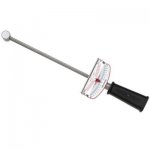
this flavor: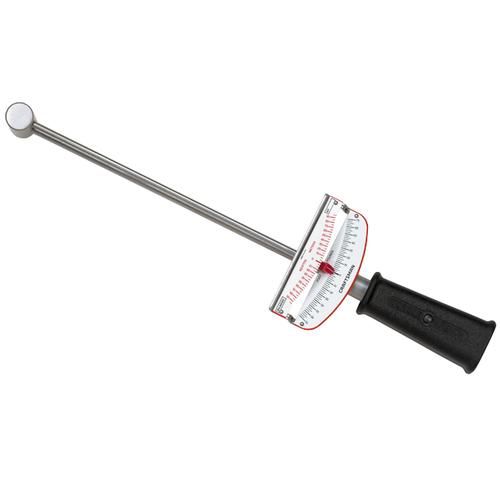
So you have to try to watch the needle deflect while you're slowly turning the whole assembly around? How do you ever stay lined-up rightside up and without parallax?
So you have to try to watch the needle deflect while you're slowly turning the whole assembly around? How do you ever stay lined-up rightside up and without parallax?
yes just pull the assembly and watch the needle move to your desired torque. also if you notice it the pic, the handles on these pivot side to side. so when you are pulling, you also need to make sure the handle is centered for the best accuracy. and as you've seen parallax is an issue. the best method that i can think of is fashioning some sort of stopper (clothes pin was mentioned earlier) on the torque setting you are going to.
Last edited:
pirana
Well-known member
The only issue I had with the PI split beams is that the new ones have the plastic grips on the handles. This was done to save a production step of resizing the rectangular tubing to a round shape at the handgrip. The body of the torque wrench is made of a rectangular tubing and by using the plastic grip (which has to be cheap) it saves a metal working step. I did call and complain to PI about this, got the "everyone we asked wanted a more ergonomic handle grip" and I told them I wanted a more durable one, that a round grip was plenty ergonomic for me.
Charles
I'm glad I got mine when I did then. I don't know why they couldn't just weld on some round tubing as opposed to forming during the manufacturing process. That would be more acceptable to me than plastic.
crewchief888
Well-known member
ive been using SO split beam flex head 3/8" & 1/2" dr for most of my work for 20 years or so.
also have a SO 3/8" dr flex head micrometer type that goes down to 5 ft/lbs,
and a CM 3/8"dr beam type.
also have a SO 3/8" dr flex head micrometer type that goes down to 5 ft/lbs,
and a CM 3/8"dr beam type.
iagsxr
Well-known member
I've done rotational torque maybe twice in my life, wasn't life or death components.
So I just backed off my click type SO til it clicked while turning.
How far off do you suppose my method was?
I have my digital 3/8" Mac at my house. At first I really didn't like using it, but it's got the biggest range of all my wrenches and I like being able to toggle between in. lbs., ft. lbs. and Nm. Some of my bike manuals are all Nm, my brain still thinks in lbs..
So I just backed off my click type SO til it clicked while turning.
How far off do you suppose my method was?
I have my digital 3/8" Mac at my house. At first I really didn't like using it, but it's got the biggest range of all my wrenches and I like being able to toggle between in. lbs., ft. lbs. and Nm. Some of my bike manuals are all Nm, my brain still thinks in lbs..
SWT Racing
Well-known member
So what kind of torque wrench is appropriate for measuring rotational torque?
I use one like this. The only time I've used it is for settting up bearing preload on 9" Ford rearends.
http://buy1.snapon.com/catalog/item_Lg.asp?picFile=/18500/18484.JPG
Would one of the new electronic ones that records maximum torque work just as well? Apply pressure evenly until the assembly begins to rotate, then stop and look at the number. That way you wouldn't have to be on-axis to make the reading.
wafrederick
Well-known member
The electronic versions are more money in price and can tell if you overtorqued a fastener.Light turns red and green is good.You can overtorque a bolt or nut without catching it with a non electronic version.
dragonle87
Well-known member
- Joined
- Sep 10, 2010
- Messages
- 210
What about electronic torque wrench?
would it last longer & more durable over the click-type?
would it last longer & more durable over the click-type?