BigGMC
Well-known member
Dont' you love the titles where you're not sure what you'll find when you open the thread..... 
Warning, this is a long one.
Anywho, asking for help from the flooring gurus and those who've had experience with products for concrete crack filling.
Some background:
My 32x44' 6" monolith pad was done last summer. It is 3500# mix with wire mesh and fiber additive, nearly 50yds worth. Sits on a base of well compacted gravel, 6 mil plastic, and 3" xps. Site prep required much material removal (cut into slope), but once down to grade, native soil was untouched. Pad was not control cut, suggested that it would be fine with the fiber additive. Was left up to me if I wanted it cut or not.
Hired a general contractor whom I've know for years and routinely does concrete work - sidewalks and 4" pads, not foundations ect. He performed all the site excavation/prep and did hire out to another local concrete guy (which is all this second guy does) to assist with the concrete portion as the GC didn't have enough men/forms/ect for job this size.
Placement happened early in the day. First two trucks emptied barely filling the perimeter haunch area - mix seemed super sloppy to me and I heard the contractors bitchin about how loose it was. I questioned about sending them back and was told it'll be fine. Dont know how much extra water was added, a slump was not performed - perhaps I should have demanded it.
Pad was power troweled and I was advised against covering with plastic as it would leave stains (guess what I learned, power trowling leaves markings anyway...). It was sprayed with a seal/cure type of product. Daytime temps in the 80's, next day temps climbed to low 90's. Worried about the bad advice and the hot weather, I sprayed with water and covered with plastic the next morning anyway. At that time, I noticed I already had some fine cracking from the corners of my rectangular drain. Figured they were curing cracks due to the fast set in the hot weather. Left it with plastic for a week.
Over the fall into the winter, I was developing more cracking in random directions. Currently, it seems that new cracks have stopped forming and exsisting ones dont appear to get any bigger.
In hind site, (after much reading on this site), I probably would have done things a bit differently and gone against the advice of the contractor.
Perhaps the "wet" mix left some weakness in the lower part of the slab. Maybe I shoulda put up the extra $$$ for rebar instead of mesh.
Shoulda done control cuts.
Shoulda pushed to have those two wet loads sent back (and requested slump test).
Shoulda covered right after trowling.
Perhaps these cracks are due to settling issues and none of the above would have helped. I dont know.
What's done is done
I will repair on my own and Im looking for advice on what product to use. I find alot of crack filler/repair type of products on the market.
Need to get them filled not only so I can seal the floor, but I also wash cars in here. Leaning towards a densifier type of product. I feel that will work best for my garage environment.
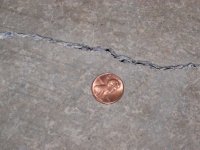
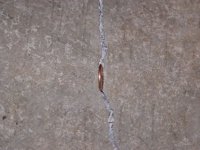
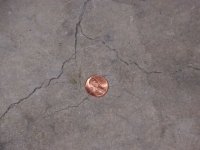
The following pics will give a better idea of what I'm dealing with.
Thanks in advance for info and listening to my ramblings.
Warning, this is a long one.
Anywho, asking for help from the flooring gurus and those who've had experience with products for concrete crack filling.
Some background:
My 32x44' 6" monolith pad was done last summer. It is 3500# mix with wire mesh and fiber additive, nearly 50yds worth. Sits on a base of well compacted gravel, 6 mil plastic, and 3" xps. Site prep required much material removal (cut into slope), but once down to grade, native soil was untouched. Pad was not control cut, suggested that it would be fine with the fiber additive. Was left up to me if I wanted it cut or not.
Hired a general contractor whom I've know for years and routinely does concrete work - sidewalks and 4" pads, not foundations ect. He performed all the site excavation/prep and did hire out to another local concrete guy (which is all this second guy does) to assist with the concrete portion as the GC didn't have enough men/forms/ect for job this size.
Placement happened early in the day. First two trucks emptied barely filling the perimeter haunch area - mix seemed super sloppy to me and I heard the contractors bitchin about how loose it was. I questioned about sending them back and was told it'll be fine. Dont know how much extra water was added, a slump was not performed - perhaps I should have demanded it.
Pad was power troweled and I was advised against covering with plastic as it would leave stains (guess what I learned, power trowling leaves markings anyway...). It was sprayed with a seal/cure type of product. Daytime temps in the 80's, next day temps climbed to low 90's. Worried about the bad advice and the hot weather, I sprayed with water and covered with plastic the next morning anyway. At that time, I noticed I already had some fine cracking from the corners of my rectangular drain. Figured they were curing cracks due to the fast set in the hot weather. Left it with plastic for a week.
Over the fall into the winter, I was developing more cracking in random directions. Currently, it seems that new cracks have stopped forming and exsisting ones dont appear to get any bigger.
In hind site, (after much reading on this site), I probably would have done things a bit differently and gone against the advice of the contractor.
Perhaps the "wet" mix left some weakness in the lower part of the slab. Maybe I shoulda put up the extra $$$ for rebar instead of mesh.
Shoulda done control cuts.
Shoulda pushed to have those two wet loads sent back (and requested slump test).
Shoulda covered right after trowling.
Perhaps these cracks are due to settling issues and none of the above would have helped. I dont know.
What's done is done
I will repair on my own and Im looking for advice on what product to use. I find alot of crack filler/repair type of products on the market.
Need to get them filled not only so I can seal the floor, but I also wash cars in here. Leaning towards a densifier type of product. I feel that will work best for my garage environment.
The following pics will give a better idea of what I'm dealing with.
Thanks in advance for info and listening to my ramblings.