To avoid these ads, REGISTER NOW!

Looking for Ideas - Low Voltage Runs

TheCodeMan

Member
Joined
Aug 26, 2021
Messages
9
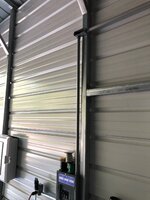
I just had a 24 x 41 metal building installed. About half of the electrical is complete and I'm now looking to run my low voltage. I'm including a couple of pics. I have a small Legrand structured panel mounted on one post opposite my electrical box. I've already run my low voltage lines from the house to the buidling through 1 inch schedule 40 PVC - two Cat6 and a single shielded coax.

Now I'm looking to branch out and run the coax and Cat6 cables in the building. I thought about using the same PVC but wonder if it's overkill? Flexible corrugated split loom would be much cheaper but mounting is a concern. The 3/4 PVC I'm using for electrical already droops slightly between the steel support posts - a little less than 5 ft. apart. I thought about using cable ties to attach the loom directly to the electrical PVC but I'm concerned about interference. If I use the loom away from the conduit I'm not quite sure how best to support it between the supports.

I do plan to terminate the cables in surface mount boxes with wall plates and jacks.

Any suggestions would be great.
 

Attachments

  • 63951953269__2E95D495-B4B0-424F-9C1C-5F9621A5FB78.jpg
    63951953269__2E95D495-B4B0-424F-9C1C-5F9621A5FB78.jpg
    246.2 KB · Views: 43
  • 63951954559__DBEAD58B-5C37-47BC-9F79-BE7E2C7755A0.jpg
    63951954559__DBEAD58B-5C37-47BC-9F79-BE7E2C7755A0.jpg
    241.7 KB · Views: 39
  • IMG_8055.jpg
    IMG_8055.jpg
    237.3 KB · Views: 40
  • IMG_8145.jpg
    IMG_8145.jpg
    243.8 KB · Views: 43
To avoid these ads, REGISTER NOW!

yatg

Well-known member
Joined
Aug 16, 2019
Messages
2,836
Location
Southern Oregon
Attaching stuff to electrical conduit is a no no. You can run your stuff next to it but not tie onto it.

I've used J-hooks in my attic and crawl. Easy to add cables to, but the cables are in the open and you need to put the hooks fairly close together to keep sag to a minimum.

Cleanest solution is to use EMT. The only place long runs of PVC conduit should be used is in the ground or where you won't see it.
 

Tools4Me

Well-known member
Joined
Jun 22, 2021
Messages
546
EMT is the best way to do it if there is going to be a lot of grinding, welding, etc. done in the shop. It will protect the wires from anything flying around. If your shop will be used for more neutral activities, running exposed wire on J hooks would be the fastest and easiest way to run everything. If it were me, I would mount something like a 1x4 piece of wood horizontally high up on the wall. Then screw a bunch of j-hooks to it. Run the wires through the J hooks and drop them down wherever you want a wall box. For a little extra protection, have the data wires drop down into a vertical pvc conduit for each box, so any wires that are down low and more likely to become bumped or accidentally hit with something are protected in conduit.

Something to think about. Your existing horizontal PVC conduit will continue to sag more over time with your support spacing 5 feet apart like that. If you want to keep the PVC as it is, maybe put a 1x4 backer behind it so the conduit can be strapped down more often.

Lastly, PVC conduit expands and contracts with temperature changes. This site shows a graph where you can calculate how much a run of PVC will expand or contract based on your yearly shop temperature swings.


For instance, if the inside of a shop like yours gets down to 40 degrees at night in the winter, and gets up to 110 during the day in the heat of summer, that would be a yearly 70 degree temperature swing as far as the PVC conduit is concerned. According to the chart, a 40 foot length of PVC conduit will want to expand and contract one inch in length from winter to summer. Make sure your PVC conduit layout either breaks up long runs, or it allows for small amounts of expansion and contraction without issue. Also, make sure all the wires inside the conduits have slack in all the termination boxes so nothing ever gets tugged on when the conduit expands a little bit. With your shop size, pvc expansion won't be much of an issue. I'm mentioning it mainly for anyone else reading this and possibly doing the same sort of thing in their own shop or barn. For anyone dealing with really long exposed runs of PVC conduit, they make expansion sleeves that you add into the conduit run to allow the conduit to elongate and shrink without warping the conduit or stressing the conduit terminations at either end. With the expansion sleeve installed, you still need to make sure there is enough wire slack in the conduit termination boxes to handle the length changes.
 

MFortie

Well-known member
Joined
Aug 9, 2010
Messages
904
Location
San Diego County
What about a wireless access point?

If not, then EMT.

And, if you care about following the 568 cabling standard, no more than 180 degrees of bends between pull points and no condulets (yes, I know there are 'Standards approved' condulets, but not your normal, everyday, big box store product...)

One other thing: if your cable is OSP rated and not Indoor/Outdoor (listed) cable, then per Code, you can only run 50' exposed once you enter the building. NEC 800.48.
 
Last edited:

PoorUB

Well-known member
Joined
Mar 29, 2021
Messages
11,730
Location
Fargo, ND
Yeah, I am wondering why anyone would need CAT6 and cable run all over.

Mount an access point high up where the CAT6 comes in and you are done.

Coax for cable TV? Figure out where you want the TV and run it over there in EMT.
 
To avoid these ads, REGISTER NOW!

captaindiode

Well-known member
Joined
Jul 8, 2013
Messages
372
Location
NC
Be sure to add a surge protector to your data lines as they leave the house and as they enter the building. I lost an access point and network card to lightning. It was not a direct hit to the cable, but it hit a tree in the yard.

Something like this:

APC Surge Protector for Ethernet Data Port (10/100/1000 Base-T Ethernet lines)
 

Yankeefarmer

Well-known member
Joined
Jul 25, 2011
Messages
1,203
Location
Connecticut
Yeah, I am wondering why anyone would need CAT6 and cable run all over.

Mount an access point high up where the CAT6 comes in and you are done.

Coax for cable TV? Figure out where you want the TV and run it over there in EMT.
Quite simply, if you want to do a good job of covering the outside of your building with surveillance cameras, you’ll want wired cameras. WiFi won’t cut it if you want enough quality cameras to identify any perps.
 
OP
T

TheCodeMan

Member
Joined
Aug 26, 2021
Messages
9
@PoorUB - POE cameras, have to have the cable.

I do plan to use wireless but I will also likely be streaming 4k to a TV as our gym equipment will be in the building as well. While streaming works over wireless, it does sometimes suffer from drop-outs. And using POE cameras will take a good bit of bandwidth over the wire as well.

@captaindiode - I have a whole home surge protector but will likely install small ones on all the outlets that have equipment plugged in as well.
 

MFortie

Well-known member
Joined
Aug 9, 2010
Messages
904
Location
San Diego County
@PoorUB - POE cameras, have to have the cable.

I do plan to use wireless but I will also likely be streaming 4k to a TV as our gym equipment will be in the building as well. While streaming works over wireless, it does sometimes suffer from drop-outs. And using POE cameras will take a good bit of bandwidth over the wire as well.

@captaindiode - I have a whole home surge protector but will likely install small ones on all the outlets that have equipment plugged in as well.
OK, that makes sense. In that case, I'd run the OSP cable to a small switch inside your Legrand cabinet and run as many CMR (non plenum) CAT6 cables in EMT as needed to your locations. From the size of your building, it doesn't appear length of your runs will be an issue (100 meters max including station cords), but something else to keep in mind.
 

niget2002

Well-known member
Joined
Oct 2, 2012
Messages
11,265
Location
Josephine, TX
I just zip tied mine to the top of rafters. I am lucky in that I have walls to get the cables up and down from the rafters in.
 
To avoid these ads, REGISTER NOW!
Top Bottom