To avoid these ads, REGISTER NOW!

Looking for suggestion on pex layout

gogolf0401

Well-known member
Joined
Mar 25, 2015
Messages
154
Location
West central MN
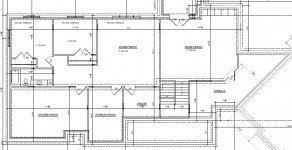
Hey guys, so I know this isn't a garage... but hey worth a try. Looking for advice on how you'd run the pex in this layout. Was thinking I wouldn't run it in the storage room or the utility room, but I know the upper floor would benefit some from the heat rise. Trying to figure out what zones make sense. I was thinking the bedrooms could be separate, and the theater and exercise could be on one zone and then the large rooms and bath would be on one. Makes it hard to place a remote manifold with that split up though.
 

Attachments
  • basement.jpg
    basement.jpg
    109.7 KB · Views: 41
Last edited:
To avoid these ads, REGISTER NOW!

dcg9381

Well-known member
Joined
Jun 20, 2018
Messages
11,670
Location
Austin, TX
I haven't done this yet - but general advice is to keep the "branch" runs short (1/2), no more than 10'. If you're using an instant-on water heater, install a re-circulation pump on the main line connected to a push-button start or timer.

Location and type of water heaters matter are central to answering your question, I think...

Like you, I like the manifold options, but to keep branch lines short - that's often incompatible with manifolds unless you have multiple water heaters.
 
OP
G

gogolf0401

Well-known member
Joined
Mar 25, 2015
Messages
154
Location
West central MN
When you say branch run you are referring to the remote manifold being 10' from the boiler? The dedicated boiler will need to be in the utility room, but I can hide a remote manifold somewhere else. Was thinking 3/4" lines to the remote manifold. Everything else is 1/2"
 

dcg9381

Well-known member
Joined
Jun 20, 2018
Messages
11,670
Location
Austin, TX
Yes, the branches are the smaller lines typically to individual fixtures.
My use case is different - no boiler, tankless water heater, and some limitations of water use.

The idea was to limit energy use by the tankless water heater, so you only re-circulate on demand (push button) or on a timer (say before the AM shower).

Keeping the branch lines small decreases water use and reduces the amount of time that you wait for hot water.

From what I've read 3/4 main (to the manifold) is right for this sort of moderately sized house. Individual fixtures on 1/2 - with the only exception being if you're going to branch the branches (like 2 or 3 head master bath shower).

Again, limited experience here - I'm putting PEX in now and my water use case is different.
 
To avoid these ads, REGISTER NOW!

yeldogt

Well-known member
Joined
Jan 2, 2012
Messages
18,184
Zone it all --- you don't want to leave out heat in any space. Don't over think -- you get one shot. Zone each and you can fine tune when it's all done. A theater and exercise will not want the same temp -- same with bath and bedroom.

PEX and the extra positions at the manifold are cheap ...
 
Last edited:

Scrambler82

Active member
Joined
Jun 8, 2013
Messages
32
Location
North of San Diego
I'm no plumber... but what about a large loop under the floor (Basement Ceiling) and around the whole building, with Thermostatically Control Valves to control the flow into each room.
That way you have a Thermostat for each room and the temp can be set independently.
Also the Basement could tap-off the Loop with down feeds where and IF needed.
The Main Loop would require large enough volume to cover at least a 75% flow (?), and each branch/room could be a smaller feed and return.
Minimal low voltage wiring would be required but could run along side of the Main Hot Water Flow.

If the flow is low then the main body of hot water would return to the source reducing re-heating requirements. Insulation on the piping would be a major help in keeping the main flow hotter.

Just thinking out loud.
 
OP
G

gogolf0401

Well-known member
Joined
Mar 25, 2015
Messages
154
Location
West central MN
I'm no plumber... but what about a large loop under the floor (Basement Ceiling) and around the whole building, with Thermostatically Control Valves to control the flow into each room.
That way you have a Thermostat for each room and the temp can be set independently.
Also the Basement could tap-off the Loop with down feeds where and IF needed.
The Main Loop would require large enough volume to cover at least a 75% flow (?), and each branch/room could be a smaller feed and return.
Minimal low voltage wiring would be required but could run along side of the Main Hot Water Flow.

If the flow is low then the main body of hot water would return to the source reducing re-heating requirements. Insulation on the piping would be a major help in keeping the main flow hotter.

Just thinking out loud.

So you're saying the pex would not be in the slab at all but instead on the basement ceiling? Not sure this makes sense. Even if you tap off of this for each room and run that in the concrete more pex would be used than just completely running it in the concrete.
 

yeldogt

Well-known member
Joined
Jan 2, 2012
Messages
18,184
You can use outdoor reset -- adjust flow at manifold manually to match temp in each space. Can often get very close with this ... fine tune for a few weeks.

Also -- can run thermostat wire to each location in case you want to fine tune with a real zone valve -- the manifolds will take a zone control w/ 24 thermostat. This is great for high limit -- maybe a bedroom not used often .. the Tstat keeps the zone colder w/o any input from you. Turn up when needed.

Need to do a load for building and each zone no matter what you do -- need to make sure you will be providing enough BTU. Proper insulation is a must for both performance and efficient operation
 

75gmck25

Well-known member
Joined
Jul 21, 2014
Messages
1,318
Location
Alexandria, VA
I have a small two-story house, 640 sq ft per floor. We installed a T at the boiler and then ran 1" PEX from the boiler to two (supply/return) radiant heat manifolds, and then ran 1/2" PEX supply/return to each radiator.

The PEX hydronic manifolds I purchased have thermometers in each supply/return, and a flow meter and flow control valve for each radiator feed. I can use the flow valves to limit the flow to any of the radiators. There is also an option to replace the manual flow valves with an electric valve so I could use a thermostat to open/close the valves and zone the system. My radiators were sized in 1940 when the house was built, and the water flow seems similar regardless of how big each one is. My manifolds are similar to these. https://www.supplyhouse.com/Bluefin-PXPKHM-4-4-Loop-Stainless-Steel-Manifold-Package-1-2-PEX

My cast iron radiators even out the temperature quite a bit because they retain heat very well. My boiler is set to maintains a standby temp of 100 degrees when the heat is on. When the thermostat calls for heat it immediately starts up the pump and the gas burner. It runs both burner and pump until the thermostat turns off or the water temp reaches 140 degrees. In most cases the house is completely warm before the boiler reaches 140 degrees.

Bruce
 
Last edited:
To avoid these ads, REGISTER NOW!
Top Bottom