To avoid these ads, REGISTER NOW!

Looking to buy a miter saw

To avoid these ads, REGISTER NOW!

johnre

Well-known member
Joined
Dec 1, 2016
Messages
1,056
Location
Portland, OR
No matter what you end up getting, use the blade that comes with it for all of your "junk" cuts where the finish isn't all that important. And buy a decent finish blade and keep it in reserve for only the cuts where the finish matters. Learn to change blades quickly, and don't ever mix up the use of the two.

Consider getting a dust extractor system with it. I've never seen dust bags work well, and in fact even with dust extraction, a compound mitre-bevel saw will still throw a lot of sawdust out that isn't captured.

And FWIW I have a Dewalt DWS713 10" non-slider, as the small footprint fits my shop well. I sort of wish I had gotten the 12" model, but no more than that - the slider versions have a very large footprint as already noted, and furthermore they never hold quite as steady on a cut as a non-slider. It won't meet your requirement of cutting a 2 x 12, but for that rare occasion I use a crosscut sled on my table saw.
 
Last edited:

Robinson1

Well-known member
Joined
Jun 22, 2015
Messages
834
Location
Kentucky
I think it’s a common belief among homeowners and hobby wood workers that miter saws are general purpose cutting tools. But they are really not. They are designed for finish carpentry and cabinetry applications. Large capacity saws are geared more towards 12 inch ship lap, really wide crown molding, and finished panels.

While they’re certain applications in framing. Cutting 2x12s to length certainly isn’t one of them.

2x12s are heavy and any board over about 8 feet requires out feed tables to be easily and accurately cut on a miter saw. This holds true no matter if you are cutting a 2x12 or a piece of shoe molding.

Large miter saws are heavy and awkward to move around and as such are generally stationary tools in shop settings.

I can’t imagine wresting a stack of 2x12s around on a miter saw. It would be an under taking more labor intensive than the building project itself.

In the real world a framing carpenter is going to have a circular saw, reciprocating saw and maybe a jig saw to finish cuts on stair stringers and rafter bird mouths. Although both applications are totally doable with a reciprocating saw
 

jar944

Well-known member
Joined
Jul 26, 2010
Messages
5,950
Location
Northern VA
There is more inherent flex in a slider than a non slider. So unless you really need the cut capacity I would not buy a slider as your first/only saw.

As mentioned above You can cut 2x12s with a slider but it's a pain to position them.
Screenshot_20231126_081155_Gallery.jpg

Imho get 12" non sliding saw first.
Screenshot_20231126_083031_Gallery.jpg
 

mike93lx

ALLIANCE MEMBER
Joined
Dec 9, 2013
Messages
37,833
Location
Richmond, VA
As mentioned above You can cut 2x12s with a slider but it's a pain to position them.
Screenshot_20231126_081155_Gallery.jpg
I love it. Using a miter saw to hold the board so that the right saw can be used for the cut :)
 

AC-WC

Well-known member
Joined
Jan 22, 2023
Messages
779
Location
NE, Indiana
Unless you plan to use it as a professional I would look at a HF unit. We bought ours (10" slider Chicago Electric at the time) over 20 yrs ago. Used on our deck, all the chair molding in the house, the kitchen rebuild, numerous projects over the years, BIL used on his house for siding, deck. Still works and if you need super accurate angles double check with a miter/angle gauge. If you plan to build furniture that's when you need to step up to something much higher quality.
 

Retroman

Well-known member
Joined
Jan 21, 2018
Messages
1,364
Location
Mojave Desert
Bought a Dewalt 780 12" slider 6 months or so ago, not real happy with it the light for the shadow line died in a couple weeks. Big and heavy more than I needed.
 

AEAdam

Well-known member
Joined
May 27, 2023
Messages
2,784
Location
SE PA
There is more inherent flex in a slider than a non slider. So unless you really need the cut capacity I would not buy a slider as your first/only saw.

As mentioned above You can cut 2x12s with a slider but it's a pain to position them.
Screenshot_20231126_081155_Gallery.jpg

Imho get 12" non sliding saw first.
Screenshot_20231126_083031_Gallery.jpg
Good helpful post. FWIW, not my experience with my slider regarding accuracy. It’s more accurate than any tool I have, and rock solid. The few times when I’ve been disappointed in a cut have always involved dull blades.

Blades make a big difference on every saw, and sliders in particular require very specific negative rake blades. I stupid.y bought a blade at the home center that said it was for mitersaws, but really not for sliders. This is the one I use and recommend:


jar944

Well-known member
Joined
Jul 26, 2010
Messages
5,950
Location
Northern VA
Good helpful post. FWIW, not my experience with my slider regarding accuracy. It’s more accurate than any tool I have, and rock solid. The few times when I’ve been disappointed in a cut have always involved dull blades.

Blades make a big difference on every saw, and sliders in particular require very specific negative rake blades. I stupid.y bought a blade at the home center that said it was for mitersaws, but really not for sliders. This is the one I use and recommend:

Grab a slider and place a small amount of sideways force or rotation to the handle. It will deflect more than any non slider. It's not brand specific it's inherent to the design. The single pivot chop saw will still flex (until you get into the $4000-6000 omga type saws) but it's less flex for the same amount of force.

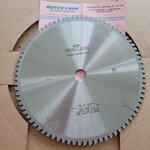
I'm running full kerf tenryu and royce ayr blades, clocked for minimum runout.

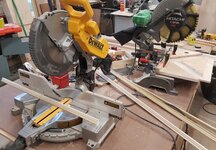
IMG_20230901_084437_780.jpgIMG_20180401_175547_620.jpgIMG_20180430_204212_611.jpg
 
Last edited:

bcradio

Well-known member
Joined
Jan 30, 2012
Messages
6,017
Location
New Mexico
Grab a slider and place a small amount of sideways force or rotation to the handle. It will deflect more than any non slider. It's not brand specific it's inherent to the design. The single pivot chop saw will still flex (until you get into the $4000-6000 omga type saws) but it's less flex for the same amount of force.

I'm running full kerf tenryu and royce ayr blades, clocked for minimum runout.

IMG_20230901_084437_780.jpgIMG_20180401_175547_620.jpgIMG_20180430_204212_611.jpg
This is true. The non sliders are definitely more accurate. I would also say get the 12 non slider as a first saw
 

tyyost

Well-known member
Joined
Jan 14, 2009
Messages
806
Location
Tunkhannock, PA
Not a finish carpenter or really a carpenter. Just a hack that needs a miter saw. Plug in ability to cut 2 x 12. Will be used more for cutting to length and simple trim more than anything. Only thing available locally is dewalt, but can order any on line. Recommendations?
I’m questioning the wide range of uses - 2x lumber and simple trim. I’m in the 2x is far easier to cut for framing with speed squares against the saw or even a a festool mft type table and track setup. No way I’d want to hoist 2x12s of any length onto a miter saw table unless it was a complex series of cuts. Check out some YouTube videos on using a speed square with a handheld saw, I’ll honestly tell you it changed my life. Every one of my circ saws has a Swanson square in the bag or box. A nice 12” speed square and low profile clamp may chance how you use your circular saw.

I prefer non sliding double bevel saws for trim, but unlike many guys the trim in my house is pretty mundane standard stock. If you have wide base or crown moldings a slider is helpful. Good blades from quality suppliers are light years better than big box premium blades. I’d imagine with a minimum of fiddling even a Hf saw would do great work with a good blade.

If I had to buy one saw to do it all I’d definitely consider a bigger saw with a robust stand, with wheels! It doesn’t take much for these things to get heavy, so something like Bosch’s gravity rise system makes dragging it out and setting up that much easier.
 

All

Well-known member
Joined
Mar 28, 2013
Messages
607
Grab a slider and place a small amount of sideways force or rotation to the handle. It will deflect more than any non slider. It's not brand specific it's inherent to the design. The single pivot chop saw will still flex (until you get into the $4000-6000 omga type saws) but it's less flex for the same amount of force.

I'm running full kerf tenryu blades, clocked for minimum runout.
@jar944

The deviation when you force a sideways deflection and or rotation to the handle that you find with your 12" Bosch Glide Saw is in fact somewhat brand specific, and that this deflection is indeed inherent to the design of the articulating arm of the Glide Saw, as well as the orientation of the handle of the Glide saw.

I own the same 12" Bosch Glide saw, on a Bosch T4B Gravity Rise stand, and ironically, also have a Tenryu full kerf blade mounted currently, but have other blades as well. I've owned this saw for about 6 years. I noticed the deflection you describe within the first month.

I added the Bosch arbor mounted laser so that I could visualize the deviation, and make the correlation between what I was observing and the arch of movement of my hand, arm, and shoulder while I was making the cut. The laser amplified visual awareness of the propensity of this design of saw to conspire with body mechanics to induce a deviation from square. More on the Bosch laser later.

The Festool Kapex sliding compound miter saw, on the other hand, mentioned only as a contrasting example, rather than as a recommendation, has physical characteristics in the design of the saw that make it less susceptible to deviate. I will enumerate a few of these design characteristics, as they may be applicable to other brands of dual bevel compound sliding miter saws, including OTHER such saws made and offered by Bosch, with the exception of the unique Glide saw.

1. Vertically oriented handle (as opposed to horizontally oriented handle) when used in the chopping motion

I have to laugh whenever I see a movie or TV show where the handguns are being held horizontally (to look cool) while firing. Sometimes, the shooter holds a gun in each hand, both held horizontally, thrusting one hand in front of the other in a punching motion, while firing away. Since it is just entertainment, and not a real life or death situation, accuracy is not important. But in most real pistol shooting competitions where accuracy is paramount, the pistol stock is held vertically in the hand.

To compare the body mechanics, I stood in front of a mirror and held my dominant hand (right) at about eye level, and brought my hand down to about hip level, using two different hand orientations... simulating a horizontal grip and simulating a vertical grip.

With the horizontal grip, my hand naturally wanted to drift outward in a curve, following my elbow, before it circled back around into the same vertical plane at my hip that my hand started with when it was at my head. It was as if cleaning a window pane in circles. I had to make a conscious and deliberate effort to make my hand go down straight (while my grip was horizontally oriented). Otherwise, my hand naturally wanted to come down in a slight curve.

To keep my grip truly horizontal for the entire travel, (since the handle of the saw remains horizontal, and doesn't swivel to follow the angle of the wrist) some strain in the wrist is induced in the middle of the downward journey, as the forearm must cant outward at an angle to keep the axis of the grip horizontal, true to the fixed axis of the horizontal handle. The outward cant of the forearm is what pushes the elbow outward, and since the length of the forearm is a fixed distance which does not grow to accommodate the lateral deviation of the elbow while keeping the hand traveling downward in the same vertical plane, the hand naturally follows the elbow, which is where I had to make the conscious effort to control, so as to keep my horizontal grip moving in a true vertical plane.

On the other hand (well, the same hand really, just with a change in grip orientation) with the vertical grip, it was vastly easier to bring my hand straight down from head to hip, and I could feel this ease in my arm, with less strain in my wrist and forearm. I also could observe the lack of lateral deviation in the mirror. Most notably, there was no sideways "cocking" of the wrist (connected to the forearm, connected to the elbow) needed to maintain the vertical grip angle.

This was an unexpected discovery that came about from my use of the Glide saw. Had I understood this prior to buying the Glide saw, which otherwise felt FAR and AWAY superior to every other dual bevel compound sliding miter saw available in the big box stores at the time, I would have given more consideration to the Kapex, which was only available in high end, high mark up, boutique tool stores, which were few and far between then, and practically non existent now. There were and are still plenty of other reasons NOT to buy a Kapex, but the handle orientation was/is not one of them, from the accuracy enabled by ease of body mechanics perspective.

The Hitachi also uses a vertically oriented handle. As I recall, the Hitachi introduced the dual bevel compound sliding miter saw back in 1987, at least in my observation. Now with Hitachi's power tool division owned by KKR who combined their purchase of Metabo into one tool brand, Metabo HPT, the Metabo offering likewise sports a vertical handle.

Most of the other brands are made with horizontal handles like the Bosch... with the most popular and common brand of this type of saw being the DeWalt.

2. Large diameter slide tubes. The larger the diameter of tubing, the more resistant to deviation and deflection. Since the Glide saw has no tubes, the Glide is unique in how deviation manifests through the articulating joints. The Kapex appears to have some of the largest diameter slide tubes that I have seen in this type of saw.

3. On center distance between slide tubes. The further the slide tubes are apart from each other, the more resistant the sliding saw head assembly is to deviation and deflection. Again not applicable to the Glide saw mechanism, which makes the Glide saw's source of deviation brand specific. The Kapex appears to have the largest distance between slide tubes.

4. Blade diameter. The smaller the blade diameter, the more resistant to deviation and deflection. This applies to all circular saws, including the Glide saw, which is also available in the 10". The Kapex is only available in the 10" size (blades as large as 260 mm will fit)


But sometimes, a 10" literally can't cut it... at least not in one shot, or efficiently. Especially on large profile crown mouldings at compound angles. Or when cutting headers or other 4x material.

The Bosch 12" Axial Glide saw continues to top the charts of 12" dual bevel compound sliding miter saws, some 13 plus years after Bosch introduced it to North America back in 2010. The 2022 Pro Tools Review of the best 12 inch miter saws once again placed the Bosch GCM12SD on top as "Best Overall." Heck, I voted with my wallet and bought one too. The frictionless, effortless, floating glide action was too smooth to resist.

But it could be easier to cut inaccurately with this saw if not being aware of the influence the hand can exert on the cutting accuracy.

Yet rather than allow this to be a disappointment, I have leveraged it to my advantage. For very tight fit ups, I have sometimes "forced" the saw to slightly deviate on purpose, to make up for a bow in the material, or to counteract a stack of tolerances, or whatever. Just being aware of my ability to influence the cut outcome by body mechanics, puts the control in my hands, literally. The saw can be accurate, or not accurate, at my choosing.


Lastly, returning to the topic of the laser and the Bosch Glide saw... you may have noticed the removable black plastic end piece on the fixed portion of the blade guard on the 12" model only, where the same appurtenance is cast into the metal on the 10" version of this saw.

This difference is due to Bosch being hit with another patent infringement issue (some may remember that Bosch lost a patent suit brought against them by Saw Stop). The European and Australian/New Zealand version of the Glide saw includes a built in laser that goes where that black plastic appurtenance is. Bosch did not wish to license the use of a laser in the saw for the US market, and thus deleted the laser on the saws sent to North America. Since the 10" version of the Glide saw was introduced in 2013, three years after the 12" version, the upper blade guard of the 10" version is case as one piece, without the black plastic "laser housing" that has no laser.

Hence, I bought the arbor mounted laser, which Bosch apparently did license, but reportedly did not keep up on paying, according to the father of the man who wrote the patent (and subsequently fell ill and was unable to manage his business, hence is father took over). That fellow came from the gun industry, and simply applied laser gun sights he had developed to saws.

An even better saw blade to intended cut line alignment system using lights is what DeWalt and some other brands use by illuminating the blade to cast a shadow where the cut will take place. I've often thought of putting an LED light and a battery inside that black plastic piece to create a blade shadow over the work. Such a visual aide can help in a saw that can be more apt to deviate than other designs.

The bottom line here is that the saw operator is most responsible for deviation from the desired cut line. Some saws are more apt to allow deviation, but it is within the power of the operator to avoid it, and this becomes easier to do with awareness of not only when it happens, but why it is happening.

Why it happens with the glide saw is different than why it may happen with a slide saw. And there are basic design differences between slide saws that make some more apt to deviate than others.

That all being said, a simple chop saw (without any slide or glide) is, as you said, more apt to be more accurate, with less moving parts.
 

AEAdam

Well-known member
Joined
May 27, 2023
Messages
2,784
Location
SE PA
Just a little tempering of the posts I agree with:

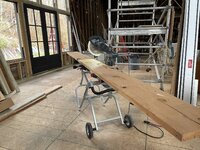
1) You CAN cut 2X12s with a sliding miter saw. This is a 12 footer.

IMG_7897.jpeg

2) I get how theoretically a slider may not be as accurate as a non-slider. I drew the pencil line with my speed square, then left it after the cut. This is a worn 25yr old saw. Looks perfect to me. There may be some technique I’m taking for granted. I use a light touch with saws. But I’m sure none of my woodworking brethren mean to say sliders are inaccurate tools. They sure aren’t that.

IMG_7899.jpeg
 
Last edited:
  • Like
Reactions: All

tyyost

Well-known member
Joined
Jan 14, 2009
Messages
806
Location
Tunkhannock, PA
Just a little tempering of the posts I agree with:

1) You CAN cut 2X12s with a sliding miter saw. This is a 12 footer.

2) I get how theoretically a slider may not be as accurate as a non-slider. I drew the pencil line with my speed square, then left it after the cut. This is a worn 25yr old saw. Looks perfect to me. There may be some technique I’m taking for granted. I use a light touch with saws. But I’m sure none of my woodworking brethren mean to say sliders are inaccurate tools. They sure aren’t that.
Glad you showed that, what do you use for work supports? I’m a fan of the Ridgid flip top work supports. Anything big like that needs to have at least one end supported or the offcut can drop. That gravity rise stand is nice, exactly what I was envisioning when I posted the 1 saw to do it all.
 

Dakotadadv8

Well-known member
Joined
May 30, 2021
Messages
1,489
DIYer we use the Dewalt corded 12 inch to cut 2x4s all the time with roller stands on each side, use the circular saw to cut larger boards and plywood, use the table saw for more precise and repeated cuts, jig saw for irregular cuts, reciprocal saw for demo, angle grinder to cut metal and concrete, chainsaw for logs, and last but not least the cordless oscillating tool. I won't have any excuses not able to finish projects. Need a rotary hammer next tool on the list, right tool for the right job. Dewalt, Makita, Stihls.
 

AEAdam

Well-known member
Joined
May 27, 2023
Messages
2,784
Location
SE PA
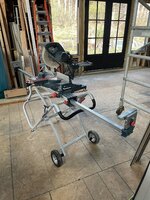
No work stands. The base has deployable arms that extend a total of 8’3” so in theory, you could trim the end of an 8 footer without concern for it tipping up. The saw also has a holdfast for such occasions. I think I paid $350 for the base, which I was more than reluctant about. Well, I’ve had the saw for 25yrs and just bought the stand this summer.
IMG_7900.jpeg
 

Nutria

Well-known member
Joined
Jun 23, 2015
Messages
799
Location
Eastern Sierra
Not a finish carpenter or really a carpenter. Just a hack that needs a miter saw. Plug in ability to cut 2 x 12. Will be used more for cutting to length and simple trim more than anything. Only thing available locally is dewalt, but can order any on line. Recommendations?
Dave, an outside the box thought: If the 12" capacity is important, and your saw needs are otherwise basic, you might think about an older quality-- gasp-- radial arm saw. Lots of capacity, and high quality Dewalts and Delta/Rockwells are often available for small money. They are not good in terms of the space required and portability, so that could be a deal breaker for you.
 
Last edited:

All

Well-known member
Joined
Mar 28, 2013
Messages
607
But I’m sure none of my woodworking brethren mean to say sliders are inaccurate tools. They sure aren’t that.

Correct.

What I am saying is that some sliders, and the gliders, can be more apt to result in inaccuracies... when inattentively operated with a heavy hand or a rushed pull.

Traditional radial arm saws and non sliding chop saws are not necessarily fool proof, but they seem better able to resist inaccuracies (but not injuries) from fool hardy operation, in my limited (and sometimes foolish) experience.
 
To avoid these ads, REGISTER NOW!

legenddc

Well-known member
Joined
Aug 19, 2012
Messages
1,075
Amazon has the Dewalt 12" non-sliding dual bevel saw (DWS716XPS) on sale today for $279.

I'm very tempted to pick it up to replace my inaccurate 10" Craftsman sliding saw. I have one big project before I can start on trim work.
 

jar944

Well-known member
Joined
Jul 26, 2010
Messages
5,950
Location
Northern VA
Amazon has the Dewalt 12" non-sliding dual bevel saw (DWS716XPS) on sale today for $279.

I'm very tempted to pick it up to replace my inaccurate 10" Craftsman sliding saw. I have one big project before I can start on trim work.

Grab it, they are great saws.
 

jives

Well-known member
Joined
Jan 4, 2013
Messages
2,811
Location
Central NY
If it going to be stationary, pick up the awesome DeWalt MBF radial arm saw for $30 in Dayton, MN. It will cut your 12" boards all day long.


johnre

Well-known member
Joined
Dec 1, 2016
Messages
1,056
Location
Portland, OR
Amazon has the Dewalt 12" non-sliding dual bevel saw (DWS716XPS) on sale today for $279.
That is a great price, but it looks like I missed the window.

And it's a reminder that dual bevel is at times quite preferred over single, simply because you can't always just turn a piece of trim over against the fence to get the opposite bevel.

I can't understand why single vs. dual bevel has such price differentiation; it can't be that much more to get the motor up higher out of the way so it works both ways, which I think is most of the design difference, yes?
 

bpwoodworking

Well-known member
Joined
Jul 6, 2023
Messages
254
Just a little tempering of the posts I agree with:

1) You CAN cut 2X12s with a sliding miter saw. This is a 12 footer.

2) I get how theoretically a slider may not be as accurate as a non-slider. I drew the pencil line with my speed square, then left it after the cut. This is a worn 25yr old saw. Looks perfect to me. There may be some technique I’m taking for granted. I use a light touch with saws. But I’m sure none of my woodworking brethren mean to say sliders are inaccurate tools. They sure aren’t that.
They are fine for framing work, especially with a support stand.

They lack the necessary stiffness for finer work, like furniture making or timber framing.

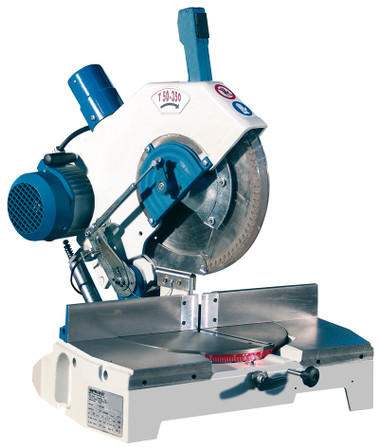
I have an Omga, it’s a brick *********. I set it up 3-4 years ago and use it daily. I randomly check square against my Starrett try squares and it always cuts perfectly. Daily use means sometimes hours of chopping at a time.

By comparison festool could not be relied upon for work requiring more accuracy than trim carpentry. It would always gap the square even after extensive setup.
 

mike93lx

ALLIANCE MEMBER
Joined
Dec 9, 2013
Messages
37,833
Location
Richmond, VA
They are fine for framing work, especially with a support stand.

They lack the necessary stiffness for finer work, like furniture making or timber framing.

I have an Omga, it’s a brick *********. I set it up 3-4 years ago and use it daily. I randomly check square against my Starrett try squares and it always cuts perfectly. Daily use means sometimes hours of chopping at a time.

By comparison festool could not be relied upon for work requiring more accuracy than trim carpentry. It would always gap the square even after extensive setup.
Holy ****.

200+ lbs, 3hp and over $5k? Bet it's made you a lot of money.


AEAdam

Well-known member
Joined
May 27, 2023
Messages
2,784
Location
SE PA
They are fine for framing work, especially with a support stand.

They lack the necessary stiffness for finer work, like furniture making or timber framing.

I have an Omga, it’s a brick *********. I set it up 3-4 years ago and use it daily. I randomly check square against my Starrett try squares and it always cuts perfectly. Daily use means sometimes hours of chopping at a time.

By comparison festool could not be relied upon for work requiring more accuracy than trim carpentry. It would always gap the square even after extensive setup.
With respect, belt drive saws like that don’t belong in this conversation. We’re talking Kia’s and VWs, and you are in Porsche Panamera territory.

My brother worked in a shop with a saw like that, made in Italy or Switzerland IIRC. The cut edge was finish ready. That’s a different beast.

I remember him saying, German and Japanese tools are the best up to a certain level. Past that are Italian and Swiss tools.

Knew a guy with all Felder machines. That’s all next level stuff. Really no comparison between that and the ww equipment normal people buy. I think he said his table saw was $20,000. I could have That wrong,
 

Firebrick43

Well-known member
Joined
May 12, 2015
Messages
14,153
Location
West central Indiana
Holy ****.

200+ lbs, 3hp and over $5k? Bet it's made you a lot of money.

That is just for a simple miter saw, it can’t do bevels.

If you want a single bevel saw it $7800
 

bpwoodworking

Well-known member
Joined
Jul 6, 2023
Messages
254
Holy ****.

200+ lbs, 3hp and over $5k? Bet it's made you a lot of money.


I bought mine used and repaired a couple things. I lucked out and found an older model with a tilt head that is the largest they ever made. It’s about 250lbs

With respect, belt drive saws like that don’t belong in this conversation. We’re talking Kia’s and VWs, and you are in Porsche Panamera territory.

My brother worked in a shop with a saw like that, made in Italy or Switzerland IIRC. The cut edge was finish ready. That’s a different beast.

I remember him saying, German and Japanese tools are the best up to a certain level. Past that are Italian and Swiss tools.

Knew a guy with all Felder machines. That’s all next level stuff. Really no comparison between that and the ww equipment normal people buy. I think he said his table saw was $20,000. I could have That wrong,


Yeah I agree, just commenting since they were mentioned.

This is my opinion:

For woodworking German and Japanese are often the best in their respective tool classes, in my experience. Some Italian (like Omga) are the best of their respective classes.

Older English stuff is often better than German in certain areas, same with early American.

The companies often make their name in a specific area then own it. Japan tends to be excellent at making really heavy well built items that are more modest in sizing. They also make ‘super surfacers’ which no one else does. Japan makes things more perfect than anyone imo. I have Japanese machines that are just absolutely beautifully accurate and precise in areas where no other maker cares. Like a drill press with less than .0005” spindle runout.

Germany, imo is the best at spindle molders, jointers and planers

England and Germany are a match for short stroke sliders, perhaps England might be better.

England or America probably made the best bandsaws.

England, Japan or America makes the best chisel and chain mortising machines

Germany and Italy make the best oscillating/swing chisel mortisers

It’s a toss up on lathes, all depends on the desired features. I have a hapfo, it’s beautiful, excellent copy lathe, mostly cast with a sheetmetal stand, all the parts are heavy as heck. Italy makes 4 spindle gun stock lathes that honestly still are not outdated. England and the US just make massive cast iron lathes for turning.


If there was a t50-350 localy for 1k I'd grab it.

If these were closer.. only $200 for a lower tier model.. and you can get two. Set up a left hand and right hand cutting station.
Screenshot_20231128_072213_Chrome.jpg

The little aluminum Omga’s are excellent machines, I ran one for a few years in my shop and it was accurate as the big one.
 

bpwoodworking

Well-known member
Joined
Jul 6, 2023
Messages
254
That is just for a simple miter saw, it can’t do bevels.

If you want a single bevel saw it $7800
These aren’t made to service the requirements of a jobsite saw. They are made to chop aluminum or wood perfectly. The average user hooks it up to a digital or cnc outfeed table and makes the same cut all day everyday for the next 30 years without doing anything but sharpening the blade.

They are often fitted with air clamps and a self feed so the operate stands away and clicks a foot pedal.

Sometimes they are setup in a pair and set to a specific length and cut that length on repeat.

I can cut square to .001” over 8” with this saw, it’s a precision machine.

The shops that have these have different tools for cutting wide stuff or complex angles. If you need to cut wide, in those shops they might have a big sliding table saw.

Cut long parts or repeat lengths on the chip saw. Cut wide on the slider or on the panel saw.

If you have the work, this type of saw makes its investment back on a hurry. Probably the best ROI of any piece of equipment I’ve ever bought.
 

mepstein

Well-known member
Joined
Sep 17, 2010
Messages
1,290
I think it’s a common belief among homeowners and hobby wood workers that miter saws are general purpose cutting tools. But they are really not. They are designed for finish carpentry and cabinetry applications. Large capacity saws are geared more towards 12 inch ship lap, really wide crown molding, and finished panels.

While they’re certain applications in framing. Cutting 2x12s to length certainly isn’t one of them.

2x12s are heavy and any board over about 8 feet requires out feed tables to be easily and accurately cut on a miter saw. This holds true no matter if you are cutting a 2x12 or a piece of shoe molding.

Large miter saws are heavy and awkward to move around and as such are generally stationary tools in shop settings.

I can’t imagine wresting a stack of 2x12s around on a miter saw. It would be an under taking more labor intensive than the building project itself.

In the real world a framing carpenter is going to have a circular saw, reciprocating saw and maybe a jig saw to finish cuts on stair stringers and rafter bird mouths. Although both applications are totally doable with a reciprocating saw
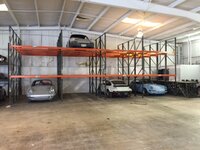
I used a sliding miter saw to cut all the 2x12x32” boards that went between the rails of the pallet racks. 128 pieces of wood. Then 2 weeks later did it again for the rack perpendicular to the one in the pic. Did it sitting on the concrete floor and placed a spacer under the long end of the board.

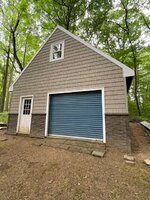
Just recently, I used my 12” Bosch miter saw to cut every vinyl siding panel that I installed on my workshop. I turned the blade around backwards and it worked perfectly.
 

Attachments

  • IMG_0598.jpeg
    IMG_0598.jpeg
    133.4 KB · Views: 21
  • IMG_3015.jpeg
    IMG_3015.jpeg
    117.2 KB · Views: 26

jar944

Well-known member
Joined
Jul 26, 2010
Messages
5,950
Location
Northern VA
These aren’t made to service the requirements of a jobsite saw. They are made to chop aluminum or wood perfectly. The average user hooks it up to a digital or cnc outfeed table and makes the same cut all day everyday for the next 30 years without doing anything but sharpening the blade.


I brought up the omga, and was really only point out that all jobsite saws flex, some more than others. If you want rock solid that is the level of equipment.

I see the omga (type saws) more as a alternative to a upcut saw, which also can cut angles.
 

bpwoodworking

Well-known member
Joined
Jul 6, 2023
Messages
254
That reply was really just to clarify their purpose to another commenter. I appreciate your comment is accurate and a useful comparison, I make the same comparison to students who don't understand the difference between the two similar but different types of saws.

On the surface the Omga looks like a ton of money for just a miter saw, but that is only if its specific niche isn't understood. It's similar to the reason why I have a little 10" ryobi job site planer and also a larger SCM. Same general purpose but one doesn't quite replace the other.

I wouldn't use one for a job site saw, would be pretty impractical. A good job site saw might be an old Hitachi back when they were made in Japan. I haven't used one but I've heard they are excellent.
 

GRB

Well-known member
Joined
May 6, 2014
Messages
828
Location
SoCal
Holy ****.

200+ lbs, 3hp and over $5k? Bet it's made you a lot of money.

I have the OMGA RN700. Cross cut 27" capacity. I moved it to my house and am installing a single phase motor so I can use it while I work on my house. https://www.omgainc.com/products/2071-rn-700.html
 
To avoid these ads, REGISTER NOW!
Top Bottom