To avoid these ads, REGISTER NOW!

Lost a hot leg from the transformer

green.bubbly

Well-known member
Joined
Dec 14, 2008
Messages
2,156
Location
Lafayette, LA
Son called me while I was away today all in a panic. The stove and air conditioner were clicking loudly and some of the lights were going crazy. I instructed him to turn off the main breaker until I arrived.


I was expecting one of the main breakers were bad but it turned out that I only had 31 volts on one of the hot legs coming out the meter. POCO showed up and re-did all the connectors on the pole and stated that there was 120 coming out the transformer on both hot legs. He then pulled the meter and determined that sure enough, only had 30 or so volts at the meter.

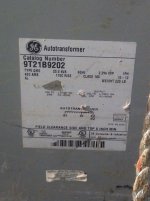
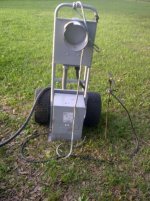
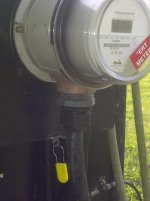
He then concluded that it was an issue with the buried lines and called out the underground crew. He said they would probably not pull a new line but would install a special meter that would turn the 120 into 240. I scratched my head and nodded ok. I left home for a while and sure enough, when I returned, that is what they did. Looks like they ran the one good hot leg through some sort of transformer that evidently is able to generate an out of phase 120 leg.

I would imagine that I would be limited on current draw but no note was left. What I don't understand is how in the hell there could be a problem with this leg. I am not sure what gauge wire it is but it looks like about a 1/2" or 3/4" rope of copper. If this is one continuous wire from the meter to the breaker on the pole, how could the line be bad?
 

Attachments

  • meter 1.jpg
    meter 1.jpg
    128 KB · Views: 161
  • meter 2.jpg
    meter 2.jpg
    72.5 KB · Views: 146
  • meter 3.jpg
    meter 3.jpg
    68.8 KB · Views: 139
To avoid these ads, REGISTER NOW!

jhelrey

Well-known member
Joined
Sep 15, 2010
Messages
7,281
Location
MN
Looks like something temporary to get you up and running until they can come out and fix it. Wonder what broke/ate through the line.
 

Aceman

Well-known member
Joined
Jan 28, 2007
Messages
2,513
Location
Eastern Oregon
Wire goes bad underground all the time. That's why you see most of us preaching about using conduit over direct bury cable.

Secondly, are you sure it's copper? I've only seen power co's use aluminum.

That temporary transformer setup is fairly common in these types of situations. It's been awhile since I talked to the power company about it, but I think they are only good for about 60 amps or so, just enough to keep the critical essentials running until the crew can show up.
 

Gary S

Well-known member
Joined
Dec 27, 2008
Messages
2,972
Location
Bismarck, ND
Wire goes bad underground all the time. That's why you see most of us preaching about using conduit over direct bury cable.

Secondly, are you sure it's copper? I've only seen power co's use aluminum.

.

I too have seen lots of underground lines fail. Around here, the REAs put most of their lines underground to protect them from ice storms. It worked, but now they deal with underground line breaks and burn-throughs. I suspect that our cold winters aggravate the problem with freezing and thawing soil.

As Aceman said, use conduit for your personal installations. Conduit is very cheap, and breaks in conduit are very rare compared to direct burial, and even if you have a break, you simply pull in new wire.
 

Charles (in GA)

Well-known member
Joined
Jan 11, 2006
Messages
12,489
Location
50 mi south of Atlanta
Had this happen one Friday evening. POCO came out with a special adapter they plugged in..... in place of the meter, then plugged the meter into it. It takes the remaining good leg, and rephases it and gives you the two legs you need. Problem is, all the current demand is now thru one of the hot wires, and thus capable of only carrying half of the max load, thus aprox 100 amps if a 200 amp feed originally.

My problem was the old underground feed was failing on both hots and the remaining "good" one, being overloaded, failed about an hour later. Thank goodness the shop has its own meter and is fed from a different transformer.

I ran an extension cord from the shop to the house and ran the fridge all weekend off of it, till they dug up the underground feed on Mon morning and repaired all of the bad spots.

Charles
 

Provincial

Well-known member
Joined
Sep 21, 2011
Messages
6,883
Location
Near Salem, OR
Just count your blessings that it was a hot leg that died, not the neutral! :shocking:

I'll second that comment. I had just that happen and it fried most of the electronics in the house. The UPS's saved the computers, but the TV, A/V, wall warts, cordless vac., and other items that experienced +210 Volts did not fare well. We are just lucky that some of the 60+ year-old wiring did not fail and burn the house down!
 
OP
G

green.bubbly

Well-known member
Joined
Dec 14, 2008
Messages
2,156
Location
Lafayette, LA
It may have been aluminum and now that I think about, from the diameter or the wire, it must have been. The meter and panel are located outside in the middle of the yard under an oak tree and it was pretty crusty inside the panel and meter base.

As far as I know, it is ran in pvc conduit. At least it enters and exits conduit. What happens to the wire that would cause it to fail? I just assumed that wire that thick would last almost forever.
 

Kevin54

MEMBER EMERITUS
Joined
Jan 12, 2005
Messages
29,341
Location
Urbana, Ohio
It is more than likely aluminum. If it is direct burial and not in conduit, it could be a number of things. It could be a tree root stretched the line and broke the sheath around it allowing moisture to get in. A rock could have worked it's way through the sheath. Once aluminum is exposed to the elements it will corrode very fast. Aluminum will burn through once somethings happens. If you have corrosion somewhere chances are the strands have probably arced out and burnt through. That is one reason they don't like aluminum wiring in a house today because in the past there were too many fires. About the only aluminum you are allowed is your main line coming in and at that, you have to coat the connection to prevent corrosion in your panel box.
 

Roots

Well-known member
Joined
Oct 31, 2010
Messages
1,788
If this is one continuous wire from the meter to the breaker on the pole, how could the line be bad?

Sounds like a partial ground on that leg. The distribution grid is seeing it as load rather than a ground, and it's not big enough to blow the fuse on the pole.

Chances are the line is direct buried and an animal chewed on the insulation or roots/rocks damaged it. It's sort of akin to a small hole in a waterline, you're still likely receive water but at a reduced pressure/voltage. They'll likely either dig the whole run up or with the right equipment, attach a scout to the line and find out where the issue is and repair that section of the line.
 
Last edited:

Alchymist

Well-known member
Joined
Mar 1, 2009
Messages
4,423
Location
Central PA
Why?

That same transformer will also create a neutral if you only have 240v. :)

Damage is already done before the temporary transformer is installed. The minute you lose the neutral, the 120 v goes haywire. 200 volts on a 120 volt circuit is somewhat detrimental to whatever is on that circuit!
 
To avoid these ads, REGISTER NOW!

Roots

Well-known member
Joined
Oct 31, 2010
Messages
1,788
Damage is already done before the temporary transformer is installed. The minute you lose the neutral, the 120 v goes haywire. 200 volts on a 120 volt circuit is somewhat detrimental to whatever is on that circuit!

+1. If the neutral goes, shut everything off including your main breaker, with a quickness. It's a serious hazard that can destroy equipment and start a fire.
 

MoonRise

Well-known member
Joined
Nov 5, 2010
Messages
4,045
Location
NJ
Had it happen to me (underground service lost a hot leg).

Wasn't expecting it, and thus it took me a few minutes to figure the problem out. Then had to briefly argue with the PoCo 'help' line to get them to dispatch a truck/tech to 'diagnose' the problem (which I just spent a while telling them what the problem was. Sheesh.)

Truck/tech comes out, nice guy, listens politely when I tell him the house lost a hot leg, he spends a few minutes checking the PoCo side of things and verifies it. Puts the meter-bypass 'jumper' in place (I didn't 'need' 240 at that time, so he used the small and simple 120V onto both legs bypass and not the bigger 'phase-splitter-jumper'). Then he had to put in a dispatch call to have a different (underground work) crew eventually come out and do some digging and then repair/replace the failed underground splice/wire.

Upside, with no actual meter (just the PoCo special bypass jumper) in place, there was a $0 bill until the underground work was finished and a regular meter was reinstalled.
 

Roots

Well-known member
Joined
Oct 31, 2010
Messages
1,788
Had it happen to me (underground service lost a hot leg).

Wasn't expecting it, and thus it took me a few minutes to figure the problem out. Then had to briefly argue with the PoCo 'help' line to get them to dispatch a truck/tech to 'diagnose' the problem (which I just spent a while telling them what the problem was. Sheesh.)

Truck/tech comes out, nice guy, listens politely when I tell him the house lost a hot leg, he spends a few minutes checking the PoCo side of things and verifies it. Puts the meter-bypass 'jumper' in place (I didn't 'need' 240 at that time, so he used the small and simple 120V onto both legs bypass and not the bigger 'phase-splitter-jumper'). Then he had to put in a dispatch call to have a different (underground work) crew eventually come out and do some digging and then repair/replace the failed underground splice/wire.

Upside, with no actual meter (just the PoCo special bypass jumper) in place, there was a $0 bill until the underground work was finished and a regular meter was reinstalled.

I understand your frustration when dealing with the customer service department, I've had similar experiences. Please keep in mind though that they generally have no or very little technical knowledge and training and generally just serve to administratively put in the initial trouble report, with the proper address being generally the only important thing when the linemen or techs come out.
 

Jagmandave

Well-known member
Joined
Nov 6, 2011
Messages
6,307
Location
Overland Park, Ks.
Whenever I've seen this happen, it's always at a splice. Last time it happened to me they ran a whole new cable, as that one had already been spliced a bunch of times!

But, unless they were short on wire that day, why would they need a splice in the first place? :dunno:
 
OP
G

green.bubbly

Well-known member
Joined
Dec 14, 2008
Messages
2,156
Location
Lafayette, LA
This morning around 5:30 a poco truck shows up and just parks there. As I left for work around 7:00, the guy who marks underground lines showed up. I went chat with the poco guy and he stated that they would find the bad section and repair it.

I called the wife earlier and she said the power was off less than 30 minutes.

Over all, I have been very pleased with SLEMCO. We were without power for a total of two hours Saturday and 30 minutes this morning. If the first guy that responded would have had his back up meter/transformer (which he normally does but had installed it some where else on Friday), I would have only lost power for 30 minutes on Saturday as well.
 

Provincial

Well-known member
Joined
Sep 21, 2011
Messages
6,883
Location
Near Salem, OR
Another reason for failure of an underground wire is damage to the insulation during installation by abrading the plastic or kinking the cable enough to weaken the insulation layer. When the conductor arcs during the failure it can damage the adjacent conductors/insulation and the techs need to inspect the cable near the break very closely or they will be back soon doing it over again.
 

Roots

Well-known member
Joined
Oct 31, 2010
Messages
1,788
Whenever I've seen this happen, it's always at a splice. Last time it happened to me they ran a whole new cable, as that one had already been spliced a bunch of times!

But, unless they were short on wire that day, why would they need a splice in the first place? :dunno:

Its far cheaper (material costs) to perform a splice than run new cable or a service drop. Having one or two splices isn't a really a big deal nor does it reduces the cables integrity, when installed properly. Although often it's easier and quicker to run a new drop though, and the labor savings more than makes up for the increased cost.
 

Tscott

Well-known member
Joined
Oct 17, 2006
Messages
1,484
Location
Keystone Heights, FL.
Its far cheaper (material costs) to perform a splice than run new cable or a service drop. Having one or two splices isn't a really a big deal nor does it reduces the cables integrity, when installed properly. Although often it's easier and quicker to run a new drop though, and the labor savings more than makes up for the increased cost.

Agreed, splices these days are no longer a week link as long as they are properly installed. We routinely install splices in our high voltage cable (25 KV Ø-Ø) during initial construction. As long as the crews clean the connection and don't damage the conductor they are basically as reliable as the cable is.

Tom
 

Gary S

Well-known member
Joined
Dec 27, 2008
Messages
2,972
Location
Bismarck, ND
The line failures I've seen were not at a splice. The wire failed for other reasons. After the repair, there were splices there from the repair, and the splices were never the site of a second failure.
 

Aceman

Well-known member
Joined
Jan 28, 2007
Messages
2,513
Location
Eastern Oregon
I've done A LOT of underground aluminum repairs. In my experience, if you have to splice it more than once or twice, it's going to keep happening. Yeah, sometimes they nick it or it's a bad spot and it's a one time deal, but most of the time it's ends up being a yearly fix and just needs to be replaced. By something in conduit.

There are a lot of underground aluminum wires feeding irrigation circles out here, so I get a lot of practice come spring time. We have some circles that have more than 10+ splices in them just because the farmer doesn't want to replace it, I'm talking 1500-2500' runs though. We've had times where we have to put 3-5 splices in one run in a single day just to get it up and running.
 

Dusty Floor

Active member
Joined
Feb 20, 2011
Messages
34
The transformer shared by our house and one neighbor is about 400' of direct buried cable away from the street. One evening a couple summers ago we heard a loud BANG followed by the silence of the refrigerator, etc., stopping. Long story short, the bang was the fuse about a quarter mile away blowing when our feed shorted out (we heard it again while they were isolating the problem to our line). We spent about a day and a half on an "extension cord" bypassing the buried cable (with a guy sitting in a truck "guarding" the not-very-secure connection in the pit near the street the whole time).

What impressed me was when they dug a 4x6' hole almost perfectly centered on the fault. I'm assuming some type of TDR was used, but didn't see that part of the operation. The sad thing is that the first marking crew marked the cable tv route as if the electrical was in the same place. It wasn't, but the PoCo guys were smart enough to know that and called another crew out.
 

marklandon

Active member
Joined
Jul 12, 2008
Messages
39
Location
Bullhead City AZ
The thing that the power comp. installed was a step up transformer called my the maker an Add a Phase I have installed this tool several times in my time working for the power comp. in Los Angeles it is a quick fix till the open in the hot leg is found and fixed or in our system (all cables are in conduit) pulled and replaced. It work great just don't load up the 240 volt stuff in the house.
 
To avoid these ads, REGISTER NOW!
Top Bottom