
You are using an out of date browser. It may not display this or other websites correctly.
You should upgrade or use an alternative browser.
You should upgrade or use an alternative browser.
Lovely connection
- Thread starter JohnDeere
- Start date


Shiftless
Well-known member
OSHA not approved because there is no ground wire.
Also, the black wire shouldn’t be in the neutral slot.
Also, the black wire shouldn’t be in the neutral slot.
snickers muncher
Well-known member
I've seen that on more than one job site.
It doesn’t really matter , this was for temporarily testing an electric motor.OSHA not approved because there is no ground wire.
Also, the black wire shouldn’t be in the neutral slot.
b-boy
Well-known member
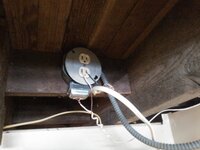
Found this in my basement ceiling.
This was permanent. It powered all outlets and lights in the basement,
Probably why the dehumidifier kept tripping the breaker.
I can't understand why someone took the time to run the wire to a junction box, but not actually hook it up.
This picture is deceptive. They did wrap some electrical tape around it to keep the wire in place. I took it off for the photo.
And kudos to them for getting the polarity right.
This was permanent. It powered all outlets and lights in the basement,
Probably why the dehumidifier kept tripping the breaker.
I can't understand why someone took the time to run the wire to a junction box, but not actually hook it up.
This picture is deceptive. They did wrap some electrical tape around it to keep the wire in place. I took it off for the photo.
And kudos to them for getting the polarity right.
Attachments

dutchgray
Well-known member
I knew a farmer who ran his stick welder like that after the plug had got hot and melted (might have been a clue they were pushing it in the first place)
Problem was the workshop supply had been tagged directly into the Henley blocks coming off the meter, and it didn't have a distribution board, or fuses or anything.
The only overload protection was the main 100A supply fuse in the utility cutout ahead of the meter.
Problem was the workshop supply had been tagged directly into the Henley blocks coming off the meter, and it didn't have a distribution board, or fuses or anything.
The only overload protection was the main 100A supply fuse in the utility cutout ahead of the meter.
wyliesdiesels
Well-known member
are you referring to the transformer cutouts on the primary side? those wouldnt be anywhere close to 100a and they surely wouldnt trip with a welder load... theyre sized at primary voltage so the amp rating is much lower than you would think...I knew a farmer who ran his stick welder like that after the plug had got hot and melted (might have been a clue they were pushing it in the first place)
Problem was the workshop supply had been tagged directly into the Henley blocks coming off the meter, and it didn't have a distribution board, or fuses or anything.
The only overload protection was the main 100A supply fuse in the utility cutout ahead of the meter.
Duke74
Well-known member
It’s ok to just stick the wires in like that if you’re testing something. OHS wouldn’t like it but everyone does it.
are you referring to the transformer cutouts on the primary side? those wouldnt be anywhere close to 100a and they surely wouldnt trip with a welder load... theyre sized at primary voltage so the amp rating is much lower than you would think...
100a at 7.2kv is enough power to weld 50" thick steel in a single pass. lol
fitter30
Well-known member
Im ready boss just getting ready100a at 7.2kv is enough power to weld 50" thick steel in a single pass. lol

dutchgray
Well-known member
No.are you referring to the transformer cutouts on the primary side? those wouldnt be anywhere close to 100a and they surely wouldnt trip with a welder load... theyre sized at primary voltage so the amp rating is much lower than you would think...
Secondly side.
UK domestic (also smaller 3 phase supplies).
The power comes in on a concentric cable, inner is about an 1/8" solid aluminium wire for the live, outer is several cores of copper for the neutral.
The "cutout" is where they make off this wire and join it into the meter (they don't have separate meter bases so connections have to be directly made)
The cutout has a fuse holder which can be a 60A to 100A fuse depending on the supply on the live, the neutral has the grounding connection joined in as well.
Henley blocks are large plastic cased brass terminal blocks that allow you to join up to 4 25mm square wires, the stuff we use from the meter to the distribution board, you need them when you are splitting your power to more than one main board.
So the farmer had fed their workshop (which only had a couple lights and a half dozen 13amp sockets for power) just by tagging a single cable in to an open spot in the Henley blocks.
If they had a short it would have tried to pull 100A at 230V which would have been interesting, there obviously was no RCD protection of any type.
Mr onetwo
Well-known member
OMG....that brings back memories.We used to have those crappy plugs to repair cords.I see nothing wrong with the temporary wiring?
wyliesdiesels
Well-known member
Awww okNo.
Secondly side.
UK domestic (also smaller 3 phase supplies).
The power comes in on a concentric cable, inner is about an 1/8" solid aluminium wire for the live, outer is several cores of copper for the neutral.
The "cutout" is where they make off this wire and join it into the meter (they don't have separate meter bases so connections have to be directly made)
The cutout has a fuse holder which can be a 60A to 100A fuse depending on the supply on the live, the neutral has the grounding connection joined in as well.
Henley blocks are large plastic cased brass terminal blocks that allow you to join up to 4 25mm square wires, the stuff we use from the meter to the distribution board, you need them when you are splitting your power to more than one main board.
So the farmer had fed their workshop (which only had a couple lights and a half dozen 13amp sockets for power) just by tagging a single cable in to an open spot in the Henley blocks.
If they had a short it would have tried to pull 100A at 230V which would have been interesting, there obviously was no RCD protection of any type.
Here in the US there is no protection on the secondary side between transformer and meter
dutchgray
Well-known member
In the UK on most supplies getting the utility to pull the main fuse is the only way to disconnect the supply (newer installations have an isolator switch that allows the user to disconnect)Awww ok
Here in the US there is no protection on the secondary side between transformer and meter
I have known electricians that remove the feeds into distribution boards live (which they really are not supposed to) when doing replacements, because its less hassle than getting the utility to remove and replace, or just cut the utility seal and pull it yourself.
The utility will also remove the cover and remove the neutral wire feeding the meter for a full isolation.
The other thing we have is its normal for the transformers to be as large as possible and feed as many supplies as possible, I believe there are only 4 transformers in my town and we have 16,000 residents.
nadogail
Well-known member
Every place has their own way of doing things, different is not necessarily wrong.