To avoid these ads, REGISTER NOW!

Low flow in radiant system

jdcompman

Well-known member
Joined
Oct 2, 2008
Messages
658
Location
South Dakota
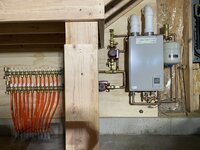
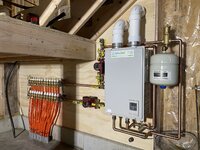
I'm looking for some help in troubleshooting my radiant system that I just put together. The problem I'm having is that I'm only getting about 3.5gpm through the entire system. System is 12 loops of 1/2", all less than 300' and very similar lengths. Everything is on one zone (big open building). With this flow, it nets about .29gpm through each loop, which seems extremely low. Based on my calculations and circulator setup, I feel like this system should have no problem running upwards of 12gpm. I just can't figure out what is causing all of the restriction. Circulators are both UPS 15-58 FC. I have very thoroughly purged the air from each loop individually as well as the rest of the system. All of the copper piping is 3/4" except the runs to the manifolds, which are 1". Hopefully someone smarter than me can help point me in the right direction. The system is currently working and heating the space, I just feel like it's not efficient at all.

First picture is of the system as it stands today (boiler output is 100 now) and the other pictures were as I was building it, just shows more angles.

Thanks in advance for any help.

34C2DD8B-5BA3-4E9D-97FC-4C3B014A553C.jpeg
 

Attachments

  • 919CD91B-B1FA-4ACB-B499-EFE53610C3E7.jpeg
    919CD91B-B1FA-4ACB-B499-EFE53610C3E7.jpeg
    361.2 KB · Views: 86
  • 4667F8BF-E9A7-4434-B091-C06073CA079A.jpeg
    4667F8BF-E9A7-4434-B091-C06073CA079A.jpeg
    398.7 KB · Views: 73
  • 81AF2820-2070-41C1-9199-5C16600E12EB.jpeg
    81AF2820-2070-41C1-9199-5C16600E12EB.jpeg
    344.2 KB · Views: 69
  • DD829E38-62D2-45F3-8C7E-4B91D0D92B7D.jpeg
    DD829E38-62D2-45F3-8C7E-4B91D0D92B7D.jpeg
    340.1 KB · Views: 72
  • EDD1AD75-DEC3-4558-8D57-AB5C2D424BBB.jpeg
    EDD1AD75-DEC3-4558-8D57-AB5C2D424BBB.jpeg
    420 KB · Views: 95
To avoid these ads, REGISTER NOW!

chinboys

Well-known member
Joined
Jun 20, 2011
Messages
434
Perhaps too much of a head loss per circuit is my initial diagnosis of your problem that doesn't give you your GPM.

Can you cut the problem in half by isolating one manifold to see if the GPM double up on the remaining one?
Can you increase the pump speed on the pumps (the two shown and the third one in the boiler?)

I use Grundflos circulators also but mine were\are a high-end adaptable-variable flow, pressure type (Magna spec), and now a three-speed one (Alpha2).
Depending on how many circuits are asking for their respective GPM flow will have my pump auto adapting to the headloss and then provide the pump speed to get me the GPM.
 

PoorUB

Well-known member
Joined
Mar 29, 2021
Messages
11,622
Location
Fargo, ND
The Grunfos 15-58 has to low of head for floor heat. Are you running the pumps on high speed?
I would replace the floor loop pump with a Grunfos UPS26-99FC, it will produce twice the head of the 15-58.
The boiler pump should be ok, but a 26-99 would not hurt there either.

That 15-58 on a good day on a fairly free flowing system will never do 12 GPM!
 

MoonRise

Well-known member
Joined
Nov 5, 2010
Messages
4,028
Location
NJ
300 ft of 1/2" PEX should have a head loss of about 5-6 ft of head loss just in the PEX. Add in some more for each and every fitting, and the copper, and the elbows, and the valves, and the manifold, and the flow inside the heat exchanger and you are probably up in the 10+ ft of head loss range.


You wanted ~12 GPM of flow in the system, or 1 GPM per each of the 12 loops. I think you are asking too much from that circulator pump. A 15-58FC on high speed (3 speed pump, right?) is rated to flow 12 GPM but at only 6 ft of head loss. You have that much head loss just in the PEX.

specs on a UPS 15-58FC pump:


You are saying you show 0.3 GPM through each loop (measured how?), or total system flow of ~4 GPM. 4 GPM of flow from a UPS 15-58FC is indicating about 16 ft of head loss.

So even with two circulators running in series (push-pull), you don't have enough flow at the system head loss.


Your pictures show the valve between the hot and 'cold' circulator pumps in the "open" position? Making the pumps not flowing through tankless burner (not counting head loss differences in the different piping directions)?
 
OP
J

jdcompman

Well-known member
Joined
Oct 2, 2008
Messages
658
Location
South Dakota
300 ft of 1/2" PEX should have a head loss of about 5-6 ft of head loss just in the PEX. Add in some more for each and every fitting, and the copper, and the elbows, and the valves, and the manifold, and the flow inside the heat exchanger and you are probably up in the 10+ ft of head loss range.


You wanted ~12 GPM of flow in the system, or 1 GPM per each of the 12 loops. I think you are asking too much from that circulator pump. A 15-58FC on high speed (3 speed pump, right?) is rated to flow 12 GPM but at only 6 ft of head loss. You have that much head loss just in the PEX.

specs on a UPS 15-58FC pump:


You are saying you show 0.3 GPM through each loop (measured how?), or total system flow of ~4 GPM. 4 GPM of flow from a UPS 15-58FC is indicating about 16 ft of head loss.

So even with two circulators running in series (push-pull), you don't have enough flow at the system head loss.


Your pictures show the valve between the hot and 'cold' circulator pumps in the "open" position? Making the pumps not flowing through tankless burner (not counting head loss differences in the different piping directions)?
Thanks for the detailed reply. To answer a few of the questions, yes I'm running both pumps on the High speed. I was using the pump curve here with the two pumps in series:


According to that, it seems like it should easily do it. I've never built one of these systems before though, so I was just going off of the data I could find.

I'm measuring the system flow with the readout on the boiler. It shows right at 3.5 gpm. I just divided this number by 12.

I also have closed the mixing valve as it didn't seem to be doing much in my setup because my flows were so low.

I had suspected either the circulators or the boiler being the restriction in the system. Sounds like the consensus is that it is likely just that the circulators are undersized.

I'll look through those links and do the calculations there and see what I come up with.
 

PoorUB

Well-known member
Joined
Mar 29, 2021
Messages
11,622
Location
Fargo, ND
Your pictures show the valve between the hot and 'cold' circulator pumps in the "open" position? Making the pumps not flowing through tankless burner (not counting head loss differences in the different piping directions)?
He has a boiler loop and a floor loop with two closely space tees. It is correct other than the pump.
 

fitter30

Well-known member
Joined
Jun 23, 2019
Messages
2,967
Location
Peace Valley,mo
Pump ur using 15-58 at 12 gpm is at 6' of head. You have 12' head @12 gpm grundfos

up 26- 64 f​

would be a better match
 

Montyx5

Well-known member
Joined
Mar 5, 2017
Messages
45
Location
Kankakee IL. area
I could be wrong, but it looks like you are drawing the fluid through your restrictions. If that is the case, rearrange so you are pushing fluid through your boiler and floor loops.

On second look your floor loop pump is pointed correctly but should be after the "H" arrangement. Also check strainer while its apart.
 
Last edited:

yeldogt

Well-known member
Joined
Jan 2, 2012
Messages
18,184
You will only get around 40k btu and 6.5 gpm through 3/4 pipe

does not the manual for the boiler show the primary pump close to the inlet and pumping into the boiler -- with the safety close to the hot exit ?

Also, the secondary pump should be pumping into the manifold and pulling the water from the primary


The water feed and Spirovent can be on the secondary prior to the pump -- couple way to do it.

With 1" copper -- it's in the 10 range for flow. PEX does create resistance --- and 11 loops through 1" at 300' is pushing it.

I have one of my floor setups with 11 loops 3/8 PEX 150' all fed with 1.25 copper. Some manufacturers don't sell above 8 loop manifolds for this reason -- depends on connection size. I was fine with 1ish flow in that setup through the loops
 
Last edited:
OP
J

jdcompman

Well-known member
Joined
Oct 2, 2008
Messages
658
Location
South Dakota
You will only get around 40k btu and 6.5 gpm through 3/4 pipe

does not the manual for the boiler show the primary pump close to the inlet and pumping into the boiler -- with the safety close to the hot exit ?

Also, the secondary pump should be pumping into the manifold and pulling the water from the primary


The water feed and Spirovent can be on the secondary prior to the pump -- couple way to do it.

With 1" copper -- it's in the 10 range for flow. PEX does create resistance --- and 11 loops through 1" at 300' is pushing it.

I have one of my floor setups with 11 loops 3/8 PEX 150' all fed with 1.25 copper. Some manufacturers don't sell above 8 loop manifolds for this reason -- depends on connection size. I was fine with 1ish flow in that setup through the loops
Thanks for the feedback! I double-checked the manual and it shows exactly as I have mine setup. What boiler are you using with your 11 loops? Max I'm finding is 11gpm through the bigger boilers.
 

Attachments

  • One zone example.PNG
    One zone example.PNG
    119.4 KB · Views: 82

yeldogt

Well-known member
Joined
Jan 2, 2012
Messages
18,184
Thanks for the feedback! I double-checked the manual and it shows exactly as I have mine setup. What boiler are you using with your 11 loops? Max I'm finding is 11gpm through the bigger boilers.
Shure enough they have that piping in the manual .... illogical - and I have no idea how the temp/pressure protects the boiler all the way over there. The pressures are off as far as wanting to flow fluid through high head PEX.

Don't mix up flow and primary /secondary -- You only need enough flow through the primary to take the heat away. That will depend on the load .... higher temps - lower GPM needed.

As for my 11 loops .... the boiler does not care what happens on the secondary .... it's just worried about it's flow and making hot water.

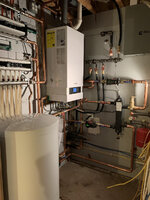
My primary is 1" and the secondary is 1.25" .... all running off two pumps. One pump for the primary (lower) and the secondary (upper) feeding the 4 manifolds. Both Alpha II's -- there is a standard pump on the lower left -- hidden by the white indirect tank. That is for the indirect loading.
 

Attachments

  • IMG_2878 copy.jpeg
    IMG_2878 copy.jpeg
    352.7 KB · Views: 79

Montyx5

Well-known member
Joined
Mar 5, 2017
Messages
45
Location
Kankakee IL. area
This unit is activated by flow through the system and has no control over the rate of flow. Usually high efficiency boilers have control over both flow and fire rate to achieve max efficiency. Since they left it to the consumer to add the pump and all the other variables that come into play, their guidance for pump placements gives the best chance of success for their boiler.

If you were to move the floor pump to feed directly into the manifold you may see a increase in flow, but not enough to go through the trouble. I am using an AquaMotion SMART Einstein pump that has similar specs to yours on a 11 circuit near 300ft loops of 1/2 pex. My flow rates are only a little better than yours, 0.35GPM. There is a lot of pressure drop through 300 ft. of 1/2 pex plus the bends at their individual radius. This really is not a problem though. Once your floor is up to normal operating temps the floor loops will only have the ability to disperse so much heat over time. When your system has been running for say 10 min. look at the difference of the inlet and outlet of both the floor and boiler. Then play around with the speed setting of the floor and you will find the difference in temps change very little. My floor is gives me a difference of between 30-35 deg depending on how long its been running and outdoor temps. When I see the difference in temps drop to around 25 deg, I know that I have a gel coating from the coolent on my Y-strainer screen restricting flow. Also think of it this way, as the fluid enters the floor it looses heat until it is the same as the concrete it is passing through and as it approaches the exit out of the concrete it will pick up heat since the input of heat is high where all your tubes enter the slab. So adding larger pump would not increase efficiency to the system and would shorten the time to heat the slab.
 
To avoid these ads, REGISTER NOW!

yeldogt

Well-known member
Joined
Jan 2, 2012
Messages
18,184
Wall hung boilers want a static flow -- they want what they need. The adjustment is all in the burner ...... they are all modeled after the early german ones. The best german ones also monitor the Low Loss header -- so now they know the mixed value.

1" pipe will carry a max of 8gpm at full boiler temp .... 80k. Do the math when you split the max into 11 loops ?

Ideally once a floor is up to stable temps you want a delta of around 11 ... remember ... more flow reduces the delta.

I always advise it's better to split the manifolds -- now w/ 1" to each the there are 6 and 7 loops with that 8gpm to each. Even better is to add loops and bring the total length down to 250 per loop and pipe with 1.25. Now you have less head -- more flow and lower delta.

Lots of cheaper manifolds only have 1" pathways .... so max of 8gpm gets you 1gpm through each and a max of 10k BTU (that you never need -- or should never for a floor) -- but 1gpm is not enough for say a couple panel radiators. So you need 1.25 manifold.
 

Innovate1

Well-known member
Joined
Jul 28, 2014
Messages
4,285
Location
Illinois near St. Louis, Missouri
My guess is your loop through the boiler is fairly good and it's the floor loops that are low flow. 300' is a long loop. Think we did about half that when we did our system. I am guessing the heater is not putting out full BTU output because the water is returning to it still fairly hot. You could check how warm the pipe is where water enters the heater. Then do the same on the floor loops. I am guessing the water into the floor loops is hot and coming out is cool. That's pretty normal for the floor loops but not for the heater loop. My system can pull down the temp of my 130kBTU heater. Check out the temps at different points in the system - that should tell you a lot. You will need a large pump to get decent flow through 300' loops. Although if it's heating the space ok that seems like the main thing.
 

PoorUB

Well-known member
Joined
Mar 29, 2021
Messages
11,622
Location
Fargo, ND
My guess is your loop through the boiler is fairly good and it's the floor loops that are low flow. 300' is a long loop.
300' is not a long loop depending on the PEX diameter. It is a very typical loop for 1/2" PEX. We would run out to 400' on 1/2" pex all the time even though most maunufacturers say 300' max. The pump needs to be sized properly for the flow and head.
 

Innovate1

Well-known member
Joined
Jul 28, 2014
Messages
4,285
Location
Illinois near St. Louis, Missouri
300' is not a long loop depending on the PEX diameter. It is a very typical loop for 1/2" PEX. We would run out to 400' on 1/2" pex all the time even though most maunufacturers say 300' max. The pump needs to be sized properly for the flow and head.
Just because people do it doesn't mean it's a good idea. If the manufacturer says 300' max I would call that long. More shorter loops will give more flow/less pressure and give more uniform temp over the floor area. Or you can use a bigger pump.
 

yeldogt

Well-known member
Joined
Jan 2, 2012
Messages
18,184
300' is not a long loop depending on the PEX diameter. It is a very typical loop for 1/2" PEX. We would run out to 400' on 1/2" pex all the time even though most maunufacturers say 300' max. The pump needs to be sized properly for the flow and head.
Have seen all types of systems .... More pipe (closer spacing) and shorter loops gives a lifetime of better performance.

PEX today is cheap and so are manifolds ---- manifolds used to be expensive. PEX has always been cheap in long rolls. A few hundred bucks more upfront make for a much better system
 

PoorUB

Well-known member
Joined
Mar 29, 2021
Messages
11,622
Location
Fargo, ND
Well, what I am saying is 300 foot runs of 1/2" are common place.

For years the shop I worked for ran 300 foot runs with 1/2". Then the owner built a new building, 10,000 sqft and he wanted to see how badly one could screw up and still have a functional heating system. We ran 400 foot loops of 1/2" where we would have normally run 5/8" or longer runs of 3/4". The building heats just fine. We have had boiler failures. It seemed it always happened on Thursday, nobody noticed on Friday as the building was still warm, but by Monday morning the shop had dropped 5-10 degrees. Get the boiler fixed and buy Tuesday the shop was satisfied again.

After that we would generally run up to 400 feet on 1/2".
 

yeldogt

Well-known member
Joined
Jan 2, 2012
Messages
18,184
Well, what I am saying is 300 foot runs of 1/2" are common place.

For years the shop I worked for ran 300 foot runs with 1/2". Then the owner built a new building, 10,000 sqft and he wanted to see how badly one could screw up and still have a functional heating system. We ran 400 foot loops of 1/2" where we would have normally run 5/8" or longer runs of 3/4". The building heats just fine. We have had boiler failures. It seemed it always happened on Thursday, nobody noticed on Friday as the building was still warm, but by Monday morning the shop had dropped 5-10 degrees. Get the boiler fixed and buy Tuesday the shop was satisfied again.

After that we would generally run up to 400 feet on 1/2".
It's all a question of flow. With enough power you can get the flow -- as flow gets over conventional wisdom for the pipe size you can have noise. This will not matter as much unless it's a house.

Long runs will have more delta and slower response ... with constant circulation eventually it will equal out and in an area with stable winter temps one will not notice as much. In PA we can have temps going from 10 degrees to 45 in a day and the reverse ..... have the quicker response is better IMO.

Radiant is very forgiving ..... There are people who are very happy in a space where they never run the system enough to equally heat the slab ... the hot part is trowing off enough heat. With long runs on start up most systems put hot water into the supply line and if using an air temp sensor the heat can trip the system before the slab is uniformaly warm. Less likely in a cold temp area where you want a 68 degree interior.

In my mind the added cost of a bigger manifold is so small why do the longer loops .... It's also easy to engineer warmer areas with more pipe and that typically is a nice addition for most works areas.

The OP is up against the 1" pipe flow -- getting 11gpm though an 8 gpm pipe so he can get 1gmp to each of the 11 loops is going to be a challenge.
 
Last edited:

Montyx5

Well-known member
Joined
Mar 5, 2017
Messages
45
Location
Kankakee IL. area
The only thing that will change by increasing (GPM) pump size is the rate at which the slab will increase in temp. Ex., If you are inputting 100 deg. fluid into a 300 ft. 1/2" loop in a 70 deg. slap at the start of the heat cycle there is a place in that loop where fluid is equal to slab temp. This point will steadily move along the loop as the slab temp increases before that point allowing additional heat to advance forward. Ideally in this scenario you would want 70 deg. fluid entering the boiler, but since the fluid input/output is local to each other in the slab the fluid temp will increase before exiting the slab shortly after the heat cycle starts. Check and compare the difference in fluid input/output temps. at the manifolds and boiler. If the differences are with in a few degrees of each other all is good, if boiler difference in fluid input/output temps. is substantially higher than the difference in fluid input/output temps. at the manifold, then you need further analysis. I use DS-60P by Azel Technologies to do this where I don't have gauges or gauges that I don't trust, just mount sensors under short piece of pipe insulation and change battery annually.
 

TimeNMoney

Member
Joined
Jan 10, 2022
Messages
7
I'm looking for some help in troubleshooting my radiant system that I just put together. The problem I'm having is that I'm only getting about 3.5gpm through the entire system. System is 12 loops of 1/2", all less than 300' and very similar lengths. Everything is on one zone (big open building). With this flow, it nets about .29gpm through each loop, which seems extremely low. Based on my calculations and circulator setup, I feel like this system should have no problem running upwards of 12gpm. I just can't figure out what is causing all of the restriction. Circulators are both UPS 15-58 FC. I have very thoroughly purged the air from each loop individually as well as the rest of the system. All of the copper piping is 3/4" except the runs to the manifolds, which are 1". Hopefully someone smarter than me can help point me in the right direction. The system is currently working and heating the space, I just feel like it's not efficient at all.

First picture is of the system as it stands today (boiler output is 100 now) and the other pictures were as I was building it, just shows more angles.

Thanks in advance for any help.

34C2DD8B-5BA3-4E9D-97FC-4C3B014A553C.jpeg
That model of tankless probably has around 30 ft of head when flowing at the Max of 7gpm. The difference between the supply and return temp determines the flow through the tankless that’s why the readout is saying 3.5 gpm. What do the flow meters on the manifold say? The way that is piped, the floor loop can’t “steal” flow through the common piping so it is limited by what the boiler pump can provide.
 

Wheelingit

Well-known member
Joined
Jul 28, 2020
Messages
330
Location
Maryland USA
I installed a radiant system for a customer years back. Had the same problem. Went to a higher velocity circulator and problem was solved.
 

yeldogt

Well-known member
Joined
Jan 2, 2012
Messages
18,184
I just can't get past the piping .. while I was only an engineer for one semester -- the flows make no sense to me. Also -- I have never seen that arrangement on any low mass condensing boiler. It's fighting itself at every turn.

You want the circulator to be pumping towards the head ..... the restrictions in the boiler is the max head -- pump towards it.

You want the circulator to be pumping toward the head in the secondary -- the exit to the PEX. Why pump into the close "T" -- you want to be pulling? It's illogical

Expansion tank on secondary before circulator w/ water fill connected -- steady pressure at the close spaced "T"

Also the primary does not need a huge GPM flow -- it does depend on the water temp. On bigger PEX systems you have to use a Low Loss Header -- either buy or make using a larger central pipe. That's how you keep the flow to the loops in large systems
 

GarageTroll

New member
Joined
Apr 17, 2020
Messages
4
Location
Ohio
I just can't get past the piping .. while I was only an engineer for one semester -- the flows make no sense to me. Also -- I have never seen that arrangement on any low mass condensing boiler. It's fighting itself at every turn.

You want the circulator to be pumping towards the head ..... the restrictions in the boiler is the max head -- pump towards it.

You want the circulator to be pumping toward the head in the secondary -- the exit to the PEX. Why pump into the close "T" -- you want to be pulling? It's illogical

Expansion tank on secondary before circulator w/ water fill connected -- steady pressure at the close spaced "T"

Also the primary does not need a huge GPM flow -- it does depend on the water temp. On bigger PEX systems you have to use a Low Loss Header -- either buy or make using a larger central pipe. That's how you keep the flow to the loops in large systems
I just can't get past the piping .. while I was only an engineer for one semester -- the flows make no sense to me. Also -- I have never seen that arrangement on any low mass condensing boiler. It's fighting itself at every turn.

You want the circulator to be pumping towards the head ..... the restrictions in the boiler is the max head -- pump towards it.

You want the circulator to be pumping toward the head in the secondary -- the exit to the PEX. Why pump into the close "T" -- you want to be pulling? It's illogical

Expansion tank on secondary before circulator w/ water fill connected -- steady pressure at the close spaced "T"

Also the primary does not need a huge GPM flow -- it does depend on the water temp. On bigger PEX systems you have to use a Low Loss Header -- either buy or make using a larger central pipe. That's how you keep the flow to the loops in large systems
You are ahead of me by a semester, I was never an engineer but I do use TACO Flo Pro for my system design and LoopCad for Heat Loss and pipe layout. Both are free to use for over 20 years now. ½" PEX 250' is a good target length. Hydraulic separation of supply and demand is a must especially for zones with flow rates that are lower than the boilers trigger. Many places suggest that small water heaters are a great substitute for a boiler; not true. It is like trying to **** the Atlantic through a straw. The high head loss and maintenance would make you crazier than me.

I am about to install a Vitodens w-100 for a friend using a cross manifold and and Alpha 15-58 circulator. If you could share your experience with your fine looking system I would greatly appreciate it.
 
To avoid these ads, REGISTER NOW!
Top Bottom