To avoid these ads, REGISTER NOW!

Low spot on Quarter panel

Joined
May 31, 2013
Messages
18
Location
Gresham Oregon
I have a semi circular low spot on my cars quarter panel. I can push it out from inside the trunk but it springs back in.

What would be the best way of getting this back to where it belongs?

Pull it out around center and then hammer and dolly the slight rises back down?
Heat and cool it around the perimiter?
Heat and cool it in the center?

Here is how it looks.

View media item 31302
View media item 31301
View media item 31300
Thank you for all suggestions and comments.
Jon
 
To avoid these ads, REGISTER NOW!

aggierailroad

Well-known member
Joined
Jan 8, 2012
Messages
581
Location
Houston, TX
Shrinking/stretching hammer and dolly set would work nicely. The metal has stretched and you need to form it back.

I think heating in the middle will cause it to relax and raise back up... Verify this with someone before you try it. This is an art form in itself that I never got my head wrapped around.
 

MP&C

Well-known member
Joined
Oct 21, 2009
Messages
4,401
Location
Leonardtown, MD
The first thing you'll need to do before addressing any oil can such as that, is to figure out what caused it. There are two kinds of oil cans, a loose oil can and a tight oil can, and they use different methods of repair. Pick the wrong one and you just compounded your problems....

A loose oil can may be caused by either welding, which causes a shrink of the immediate area, or fatigue of a panel over the years may cause a panel to loose some of it's shape to hold the crown (think of an old car hood, no damage but sometimes they can get floppy), or other outside forces, as will be explained later. The loose oil can is noted by a panel that easily flops back and forth.

A tight oil can is one usually seen as a result of body damage, a dent or glancing blow will take the crown that the panel used to have, and push those forces elsewhere. The oil can is noted by a tight flop. In other words, you can push it one direction but it will require a bit of force, and then when released will typically spring back to the original position, but not in all cases.

It is crucial to determine which you have as they use opposite repair methods. The loose oil can will need to be stretched to restore the crown of the panel, the tight oil can will need shrinking to remove the excess panel shape caused by the dent or body damage.

Where the long crease shown on your panel leads one to believe there is a tight oil can there, it is also possible to have multiple oil cans in on panel. For example (NOT saying this has happened in your case, only a possibility to verify) the crease you show causes the immediate area to stretch and displace the original crown into other outlying areas. This may include pulling the crown down from an adjacent area into a loose oil can. So in this example, you would have a tight oil can caused by body damage that induced a loose oil can by pushing the forces that hold the shape of the panel into other areas. The point of all this rambling is that first caused the second. In this example you will typically correct the issue in the loose oil can by fixing the tight oil can which is what caused it. So we would leave the loose oil can alone and shrink the immediate area of the crease caused by the side swipe.

The other possibility is that you have multiple dents. One is a side swipe crease, the other caused from a direct blow, whether a softball injury, a bumper strike, or other outside forces to stretch the metal. Both in this case would need shrinking.

This has not been written to tell you what has occurred there, but to give some possibilities only. Now you need to look a little closer and determine if in fact the low spot is a dent or caused by displaced forces from elsewhere. The repairs to correct are two different methods. (yes I've repeated that a few times, it was intentional)

I've got my thoughts on what has occurred but don't want to sway yours. Besides, it's difficult for anyone to tell you what you have there over a computer monitor three thousand miles away without knowing how those areas react to pushing/cycling the oil can, etc.
 
Last edited:
To avoid these ads, REGISTER NOW!
OP
H
Joined
May 31, 2013
Messages
18
Location
Gresham Oregon
I would say it is the tight version because you can push it out from inside the trunk but as soon as you release, it pops back in. Here are two move pics from a little further away.
View media item 31323
View media item 31322

I assumed I would need to hammer and dolly that crease out prior to working the oil can itself. As you can see, this is the same quarter that I am replacing the front half on, but since I am waiting on some tools to arrive I started looking at this dent and wanted to start planning that attack too. More info is always better before I start I figure.

Way back in the very end there is some slight damage by the emblem holes and right up to the very body edge but I can't get a hammer in there so I will need to weld studs and pull that a bit but I don't think that is affecting anything up by the oil can.

As to the cause of the oil can itself, I swear it looks like it took a direct hit from a knee or a softball rigtht there. I think the long crease was a seperate accident. The crease isn't very deep at all, maybe 1/16" so it was probably a stupid thing like backing out of a garage and dragging against a bike or something.

Next week I will be getting my stud welder and slap hammer and hopefully get some time to start working on it again.
Thanks again for your time.
Jon
 

MP&C

Well-known member
Joined
Oct 21, 2009
Messages
4,401
Location
Leonardtown, MD
Is the quarter panel still straight at the body line just above the side swipe crease, or is that pulled in as well?
 
OP
H
Joined
May 31, 2013
Messages
18
Location
Gresham Oregon
Above the body line feels pretty straight. Other than the slight wrinkles back at the very back end, it is really just that oil can dent.

I was going to hold a dolly on the outside and bump the inside of that slight crease out a bit, and was thinking the oil can dent would be simple, but wanted a little direction so that I don't make it worse by doing the opposite of what it needs.

Being the first time I have worked on auto body, I expect it to need some filler on this panel, but I just don't want to end up with the over half inch of bondo it had up front and they just filled that oil can spot in with about 3/8" of mud too. Turned my whole shop dusty stripping that **** away, and I want to keep all bondo to under 1/8" at all places. If I can get it down to just a skim even better.
 
Last edited:

MP&C

Well-known member
Joined
Oct 21, 2009
Messages
4,401
Location
Leonardtown, MD
Suggestions in blue


Above the body line feels pretty straight. Other than the slight wrinkles back at the very back end, it is really just that oil can dent.

I was going to hold a dolly on the outside and bump the inside of that slight crease out a bit,

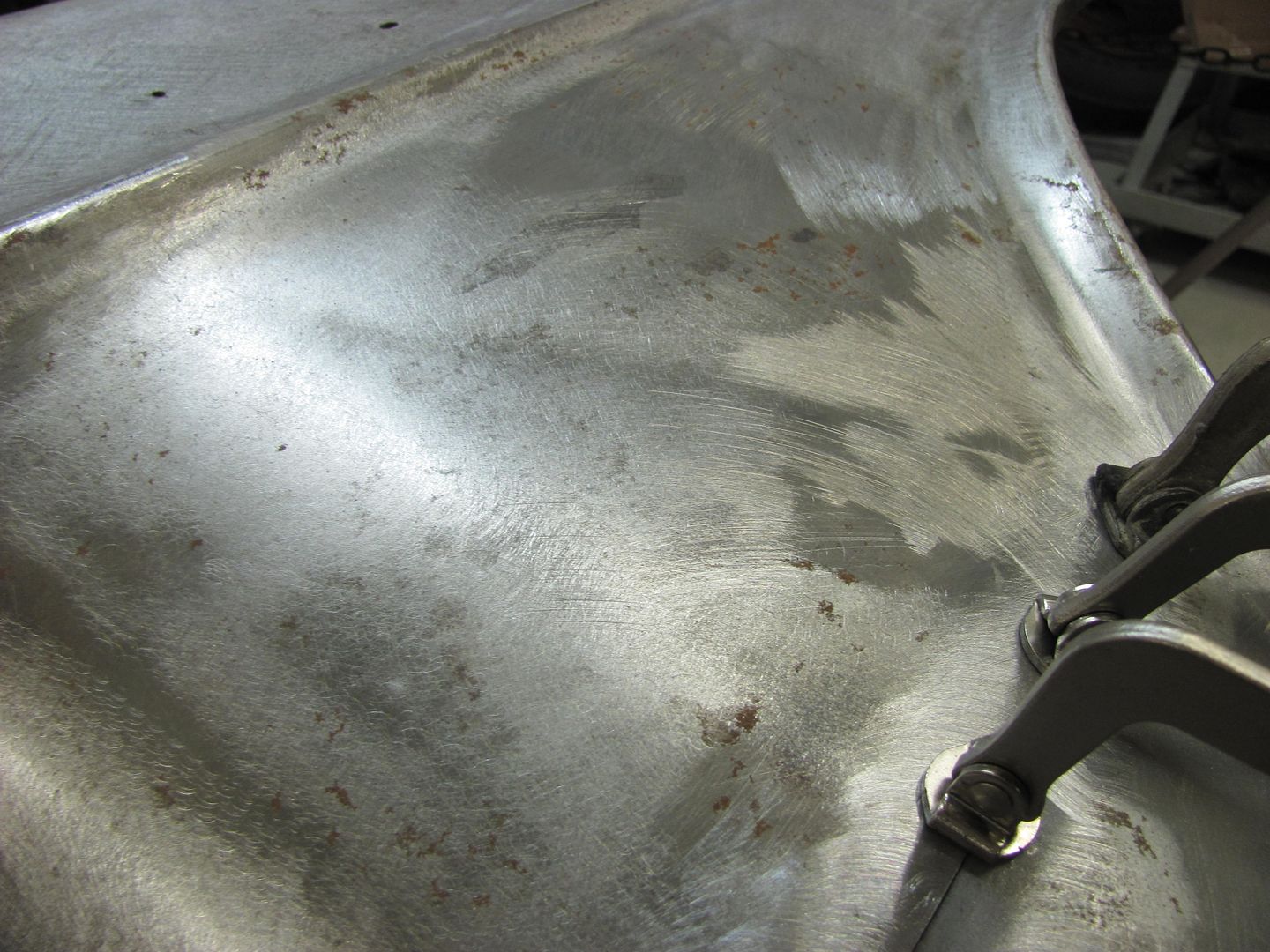
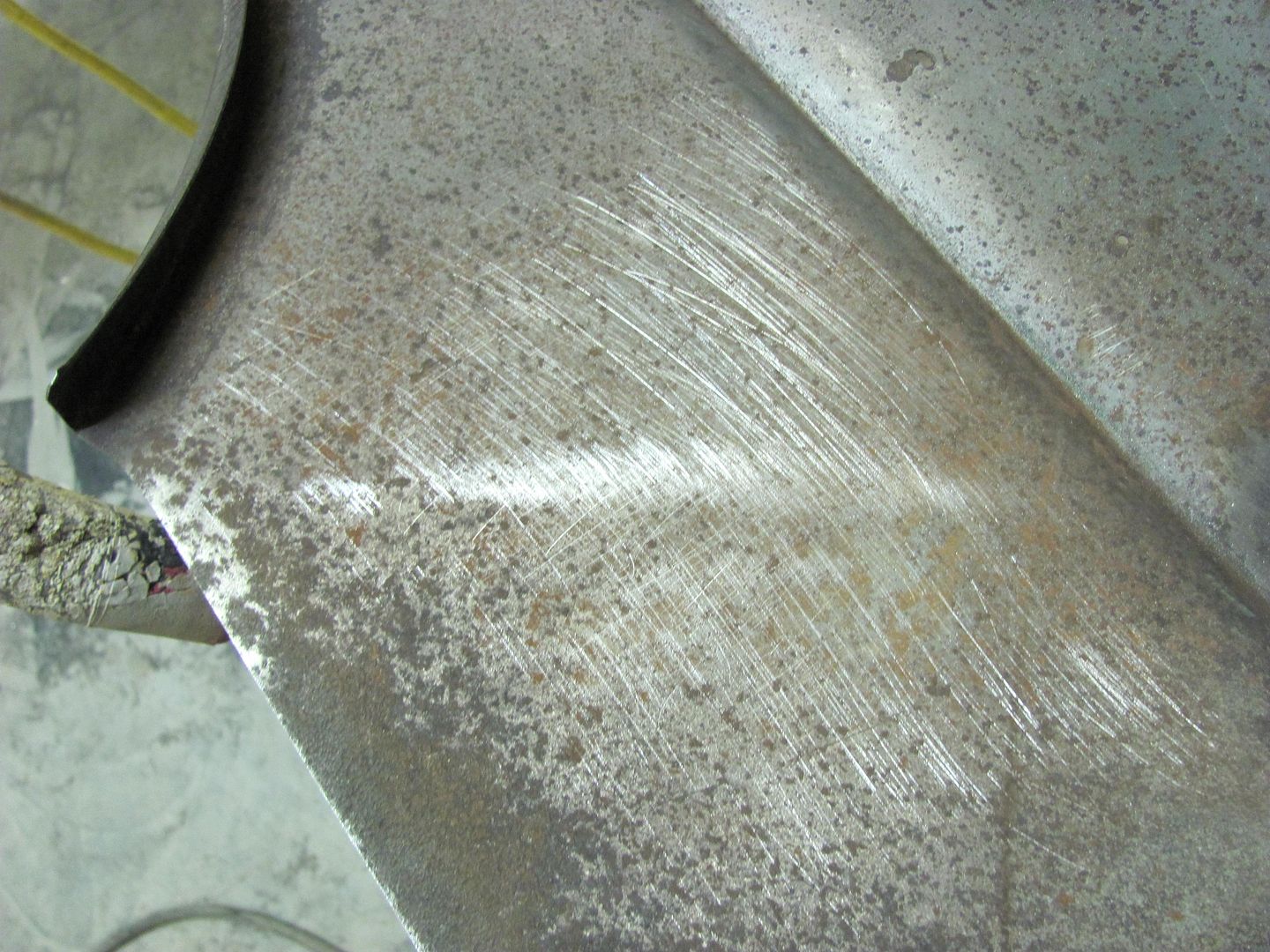
The area of your crease is stretched, as evident by the wavy panel. Find your high spots inside (target area for the hammer strike) by using a roloc disc in your hand and just scuff across the panel...as shown in the pics below....

Notice the crease in this fender just above the vise grips..

Picture143-1.jpg


A 3" roloc disc scuffed across the lower crease on the inside of the panel quickly shows the area that needs to be bumped outward...

Picture145-1.jpg


Next, your quarter panel is already stretched along that crease, so IMO you want a method that doesn't add any more stretch. To me this means hammer on-dolly is a last resort, as it will add more stretch. I would suggest a donut dolly or a small shot bag. For details, look in either my shop thread or the welding in patch panels thread.

and was thinking the oil can dent would be simple, but wanted a little direction so that I don't make it worse by doing the opposite of what it needs.

On the dent, I was thinking a knee or softball, and it should be a stretch based on your description. I would address the crease first, and then see if helped the dent any, but in all likelihood it won't change much. It would appear you are going to need to shrink this area. To insure you don't chase an oil can around the panel, do this little test. Using a sharpie, draw a circle around the perimeter of the oil can. Now, using your thumb, apply some pressure on a point on this circle and cycle the oil can again. If it cycles as it did before, move your thumb slightly around the perimeter and repeat. Continue around and cycle until you find a spot that the thumb pressure will "lock" the dent from cycling. This is the spot you want to shrink first. After shrinking, repeat. This will likely need shrinking around the inside of the dent as well. You have a considerable dent there, and I would guess that you'll get to a point after all the shrinking that you will end up with a loose oil can from going too far. It's here that I would use the shot bag on the outside of the panel and the hammer inside to bump the panel until the crown is once again restored. Have you figured out your method of shrinking yet? I like the heating tip on a dent puller, they provide a small area of shrink so you don't get too carried away, and it is very user friendly as a one person operation. Using a torch, laying it down, then grabbing a hammer and dolly to tap down the swell can be a bit challenging to do without burning the shop down so if you're working by yourself, the heating tip works nice. If you have a helping hand, then the torch might be a better option. All depends on what tools you have available, too.


Being the first time I have worked on auto body, I expect it to need some filler on this panel, but I just don't want to end up with the over half inch of bondo it had up front and they just filled that oil can spot in with about 3/8" of mud too. Turned my whole shop dusty stripping that **** away, and I want to keep all bondo to under 1/8" at all places. If I can get it down to just a skim even better.
 
Last edited:
OP
H
Joined
May 31, 2013
Messages
18
Location
Gresham Oregon
I am getting the heating tip for my stud welder gun because I figured I would need it on this panel.

The pushing my thumb against it and finding the non-cycling spot is a fantastic idea that I would never have come up with on my own. I will also see if I can't find a round face hammer for the donut dolly or shot bag in craigslist or ebay.

Thanks again for your help on this, it gives me great ideas and a good path to start on.

Sincerely,
Jon
 
Last edited:

MP&C

Well-known member
Joined
Oct 21, 2009
Messages
4,401
Location
Leonardtown, MD
Any body hammer or dolly that you use should closely match the shape the panel is supposed to be. The flat body hammers actually have a very minor crown to help eliminate marks from the edge of the hammer, so a flat hammer would be better suited to what you're doing in this instance.

Here is an online reference that discusses body tools and procedures, this may help out also...

http://www.hnsa.org/doc/pdf/metal-body-repair.pdf
 
Last edited:
To avoid these ads, REGISTER NOW!
Top Bottom