To avoid these ads, REGISTER NOW!

low voltage light control

willlgord

Active member
Joined
Sep 8, 2011
Messages
43
Location
Fort Mill South Carolina
switching lights with relays

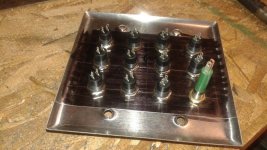
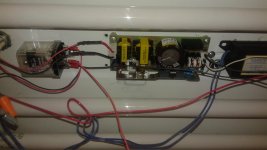
I recently installed 11 2x4 4 bulb t8 light fixtures in my 32x24 garage. I wanted to be able to switch each one on or off independently without a huge bank of switches and a ton of romex so I decided to try using low voltage relays. I installed a 24vdc relay in each fixture which is controlled by a pushbutton switch. Each light fixture draws about 1 amp and the relay contacts are rated at ten amps, the power for the relay coils is supplied by a 24vdc switching power supply I mounted in the first fixture which is controlled by one regular light switch (also powers up all the lights). The amp draw on the 24v relay circuit is very low so I used runs of 8 conductor plenum wire I had laying around. I bought the relays and switches off a site called electronics goldmine, the relays were 99 cents each and the switches were 79 cents each. The 24v switching power supply was bought off a site called all electronics for under $5. So far this is working like a charm though the switch plate was a soldering challenge but it was worth the trouble. I also added an led indicator light to show the 24v is present. Has anyone else controlled their lights this way?
 

Attachments

  • 20150301_190536.jpg
    20150301_190536.jpg
    138.1 KB · Views: 43
  • 20150325_200440.jpg
    20150325_200440.jpg
    151.1 KB · Views: 48
  • 20150325_200451.jpg
    20150325_200451.jpg
    150.8 KB · Views: 50
  • 20150325_200428.jpg
    20150325_200428.jpg
    139.7 KB · Views: 48
Last edited:
To avoid these ads, REGISTER NOW!

slodat

ALLIANCE MEMBER
Joined
Feb 6, 2010
Messages
3,682
Location
Central-ish, WA
Re: switching lights with relays

I bought an 8 pole 30a lighting contractor with a 120vac coil, a 120vac coil impulse contractor (it switches between two states each time the coil is energized) and momentary push buttons. Plan is to have a push button by each entrance. One push and lights on. Another and lights off. The lighting contractor is mechanically held with a separate close and open coil. The contractor will switch several lighting circuits, ceiling fan circuits, compressor electric auto drain power and the low voltage power to compressor starter so the compressor won't run when I'm not at the shop..

I'm currently awaiting parts.
 

LifeLongWNYer

Well-known member
Joined
Oct 23, 2013
Messages
1,231
Location
South of Rochester, NY
Interesting, I did something like that in a garage where I used to live, but used GE low voltage relays. Work great, but a little expensive.

I like LV switching because you can easily have multiple switch locations, and as the need arises, it is easy to swap the fixtures which are on any given circuit.


.
 

Two Sheds

Well-known member
Joined
Jan 16, 2014
Messages
101
I'd be concerned that this won't meet code with low voltage and line voltage mixed within the same enclosure. I've wired many of my lights with GE RR-9 relays which are listed for this purpose, and snap into a knockout, with the line voltage connection on the inside, and the low voltage on the outside. The GE relays are latching with one coil for On and one coil for Off. Pass & Seymour (formerly Sierra) relays are interchangeable with GE, but Touchplate relays have one coil for a push-on, push-off one button control. The relays are expensive, but you can often find them cheaper on Ebay.
 
To avoid these ads, REGISTER NOW!

LifeLongWNYer

Well-known member
Joined
Oct 23, 2013
Messages
1,231
Location
South of Rochester, NY
I've handled the LV/line voltage deal in two different ways.

In one location, I mounted a couple of 4x4 boxes with an extender ring. The relays go through the knockout holes with the coil outside the box and the line voltage portion inside the box. The 110 supply and the lines to the fixtures go into the box through a knockout and clamp, all the LV wiring is outside of the boxes.

There is also a divided box available. It is 12"x12" or so with a metal partition in the middle. The partition has holes for the relays, all the LV wiring is on one side of the partition, all the 110 is on the other.

Another way I've done it is to run the 110 inside the fluorescent fixtures, from one to the next, and so on. I punch a knockout out of the side of the can, and put the relay through the hole. Splice the 110 from the feed, to the relay, then to both the ballast and the next fixture.

Outside of the fixture, use multi-conductor LV, like 12 conductor intercom wire, to run from the low voltage switches to the relays. This is good, because to can use different combinations of the LV wire to different relays so you can group certain fixtures to be switched together. If you want to change the grouping, just swap the wires leading to the relays.

Make sure you keep the LV wires for the "off" relay and the "on" relay together, or know which colors they are. I lost track once, and one LV switch turned on a group of lights, and different one turned them off, and the group that was turned on, didn't match the once turned off. ( I pair colors, always red/green for a circuit, blue/yellow for another, etc... )

I can post pictures, but not if you need to see them right away, busy weekend coming up. Let me know.


.
 
OP
W

willlgord

Active member
Joined
Sep 8, 2011
Messages
43
Location
Fort Mill South Carolina
I ran the 120v from light to light like you normally would and just added the relays between the power and the ballast, the 24v supply is also in the first fixture and the 24v is fed back to the low voltage switch box. I did consider whether or not this is against code but I don't see any real safety concern unless someone working on it in the future doesn't understand what I did. The relays are concealed under the cover that goes over the ballasts and all the other electrical connections. I like the idea of using momentary pushbuttons. I have to admit the on-off pushbuttons I used are low quality (what should I expect for 79 cents) and probably won't last long but so far everythings working great.
 

hd54kh

Well-known member
Joined
Jul 19, 2012
Messages
131
Location
Mooresville N.C.
I went with the GE RR9 route. I can move the switching configurations around as needed, highly reliable but $$$$.

The reason at first was my shop is over 100 feet away from the house and wanted to be able to control the exterior lights from the house, if I was back at the house and forgot to turn an interior light off, or wanted to turn on the heater before heading out........

I had a M66 communication block on both ends so it was so easy to just add the switches in the house and use the comm line for switching.

Savings in larger copper conductors, conduit, terminations etc.... probably offset the cost of the rocker switches and relays. I have never replaced any parts yet and have been in service for nearly 25 years.

One pic is the switch plate inside the house and the other is why I wanted to be able to control from the house as well.

Terry
 

Attachments

  • DSC_5052.jpg
    DSC_5052.jpg
    136.4 KB · Views: 9
  • Feb 17 2015 (1).jpg
    Feb 17 2015 (1).jpg
    127.2 KB · Views: 8
Last edited:
To avoid these ads, REGISTER NOW!
Top Bottom