To avoid these ads, REGISTER NOW!

Lubing sheaves on Backyard Buddy

Quickstep192

Well-known member
Joined
Aug 16, 2025
Messages
106
My Backyard Buddy makes a screeching sound going up and down. After reading another account about a BYB that had a cable jump off a sheave, I verified that my cables are on the sheaves.

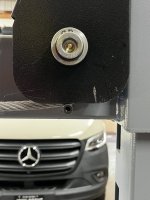
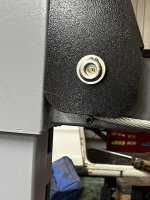
But, I can’t see a way to get to the shaft to lube them.

Are there any BYB owners out there who can guide me?
 
To avoid these ads, REGISTER NOW!

matt_i

Well-known member
Joined
Mar 14, 2008
Messages
10,802
Location
SE Michigan
Don't know 100% of the details of your machine but possibly this can help. If you can get this style of squeeze bottle and fill it with any ATF, you can "overlube" any interface between stationary and rotating to the point of dripping off, ideally you'd have catchment (rags, cardboard, PIG mats). The ATF is a lightweight hydraulic oil in its basic form and will eventually run to the place it needs to be and solve any problem like that. A "better" machine design would use rolling element bearings or bronze plain bearings which don't "squeak" or "squeal" except in extreme circumstances of damage.

1787163447889.png
 

finn

Well-known member
Joined
Mar 27, 2005
Messages
16,614
Location
The UP, God's country
A light grease might be best. A needle fitting on your grease gun may work. Otherwise, figure out how to brace the lift so the pulleys are unloaded, (may be as dimple as having the lift carriage be resting on the safety locks), then remove the pulleys one at a time and drill and tap for a zerk.
 

matt_i

Well-known member
Joined
Mar 14, 2008
Messages
10,802
Location
SE Michigan
Like the idea of a zerk but the other guy had a shaft snap/twist/fatigue to full cross section failure. I could not see it in enough detail to make a better guess as to why. However, drill and cross drill reduce cross section especially at the center of the span where bending stress is peak. Also critical to carefully deburr the cross-drill where it enters the circumference to avoid creating draggy burrs.
 
OP
Q

Quickstep192

Well-known member
Joined
Aug 16, 2025
Messages
106
I can’t picture how I’d drill a sheave for a Zerk.

The sheaves turn in a narrow space, so I’m not sure how I’d attach a grease gun, but I’d still be interested to know how to drill the sheave just in case.

A shaft with a small pathway down the center and a zerk in the end might be ideal, if it didn’t weaken the shaft too much.
 

whateg01

Well-known member
Joined
Mar 13, 2006
Messages
11,887
Location
doo dah, kansas, usa
Like the idea of a zerk but the other guy had a shaft snap/twist/fatigue to full cross section failure. I could not see it in enough detail to make a better guess as to why. However, drill and cross drill reduce cross section especially at the center of the span where bending stress is peak. Also critical to carefully deburr the cross-drill where it enters the circumference to avoid creating draggy burrs.
Then put the zerk in the pulley, not the shaft!
 

whateg01

Well-known member
Joined
Mar 13, 2006
Messages
11,887
Location
doo dah, kansas, usa
I can’t picture how I’d drill a sheave for a Zerk.

The sheaves turn in a narrow space, so I’m not sure how I’d attach a grease gun, but I’d still be interested to know how to drill the sheave just in case.

A shaft with a small pathway down the center and a zerk in the end might be ideal, if it didn’t weaken the shaft too much.
Several ways to possibly do it but I'm not familiar with these particular sheaves. Maybe a pic would help
 

matt_i

Well-known member
Joined
Mar 14, 2008
Messages
10,802
Location
SE Michigan
Ye olde "pulley tap" comes to mind. Grease will choose the path of least resistance so may have to put one in each side of the sheave.
 

finn

Well-known member
Joined
Mar 27, 2005
Messages
16,614
Location
The UP, God's country
Like the idea of a zerk but the other guy had a shaft snap/twist/fatigue to full cross section failure. I could not see it in enough detail to make a better guess as to why. However, drill and cross drill reduce cross section especially at the center of the span where bending stress is peak. Also critical to carefully deburr the cross-drill where it enters the circumference to avoid creating draggy burrs.
I don’t remember much about my statics class from over fifty years ago, but the center of a rod doesnt add much to the strength of the piece. It was common to drill axle shafts at one time.. The highest bending moment would be at the root, longitudinally.

I don’t recall seeing any pictures of the broken pieces, but in my mind, I would expect the shaft wasn’t hardened, or lubricated resulting in wear, and the reduced cross section then led to failure.

just a guess, though.
 
Last edited:

matt_i

Well-known member
Joined
Mar 14, 2008
Messages
10,802
Location
SE Michigan
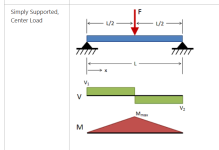
The way I envision the design is that the shaft is vertical and a cable sheave runs at the midpoint. Its loaded in a horizontal plane.

Here is bending moment supplied by the internet for a simply supported beam (although rotated 90 degrees), I think that's the correct application here as the ends of the shaft are unlikely to both be fixed. The statics class I attended agrees with the below graphic, max bending stress (Moment-max) is at the center, which is where a drilled grease passage is exacerbating the problem at the most critical area by taking away material for both the axial drill and the cross-drill plus introducing sharp corner stress risers.

Its not that a shaft can't ever be drilled but that has to be accounted for in the design. A guy posting on same type of lift had a full cross section failure (with no reduction of the area) and so it might be wise to proceed with caution. Redesign for larger diameter shaft, higher strength material (I recommended genuine 4140) or fit bronze plain bearings are all directionally correct in my mind. Lubing with oil as I suggested earlier, although inconvenient, has no danger of introducing new failure modes.

1787305934573.png
 
To avoid these ads, REGISTER NOW!

finn

Well-known member
Joined
Mar 27, 2005
Messages
16,614
Location
The UP, God's country
The pins on my Advantage 4 post.

I don’t recall for sure, but I think they’re drilled, with an annular grove under the pulley bearing surface.

Edit: I just checked my BP 10 K 2 post lift. And there doesn’t appear to be grease fittings on the pulley shaft. Is carriage is lifted directly by the rams, though, and I think they’re drilled cables are just for equalizing, not lifting per se.

The pins are much smaller in diameter, too.
 

Attachments

  • IMG_0732.jpeg
    IMG_0732.jpeg
    654.2 KB · Views: 16
  • IMG_0733.jpeg
    IMG_0733.jpeg
    820.5 KB · Views: 15
Last edited:
OP
Q

Quickstep192

Well-known member
Joined
Aug 16, 2025
Messages
106
My BYB has no Zerks and no real way to get heavy grease into the fittings.

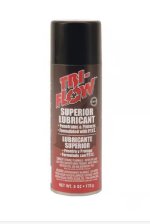
The Tri-Flow starts out thin so it can wick into crevices, then leave lubricant behind when the solvent evaporates. It appears to have worked; the squeal is gone! :)
 

finn

Well-known member
Joined
Mar 27, 2005
Messages
16,614
Location
The UP, God's country
My BYB has no Zerks and no real way to get heavy grease into the fittings.

The Tri-Flow starts out thin so it can wick into crevices, then leave lubricant behind when the solvent evaporates. It appears to have worked; the squeal is gone! :)
Sounds like the only way to get something that will provide a film in there is to remove the pulley and add some EP grease on the surfaces manually. The spray seems like a light oil that isn’t going to do much to provide a boundary layer that will actually prevent galling and metal to metal contact.

Better than nothing, I suppose, but not a long term solution.
 
OP
Q

Quickstep192

Well-known member
Joined
Aug 16, 2025
Messages
106
Agreed; pulling the pulleys will require a lot of disassembly.

If BYB were still in business I might try to get some shafts with zerks, but they’re not so…
 

Glss

Member
Joined
Aug 23, 2026
Messages
5
Location
Northampton County, PA
My Backyard Buddy makes a screeching sound going up and down. After reading another account about a BYB that had a cable jump off a sheave, I verified that my cables are on the sheaves.
But, I can’t see a way to get to the shaft to lube them.

Are there any BYB owners out there who can guide me?
A screeching or squeaking sound when lifting and starting is a classic sign of a dry pulley, which occurs when the original factory lubricant inside the bronze bushing has worn out.
 

finn

Well-known member
Joined
Mar 27, 2005
Messages
16,614
Location
The UP, God's country
Agreed; pulling the pulleys will require a lot of disassembly.

If BYB were still in business I might try to get some shafts with zerks, but they’re not so…
There shouldn’t be tension on the cables I’d the carriage is sitting on the locks. If there’s no tension, I suggest removing one pulley at a time, then add grease.

Just be aware that some greases may not play well with bronze bushings. Synthetic should be fine, though.

One of the little irritants see things are built to a price point, with my Advantage is that the cables tend to sag if I store a car up top for extended periods, then I rub my scalp on the offending cables. Easy fix… just raise the lift a notch on the locks. Point is, there’s no tension on the cables, and hence the pulleys when the lift is on the locks.

Ideally there would be either zerks or rolling element bearings, but these things are built to a price point, by small companies.
 
OP
Q

Quickstep192

Well-known member
Joined
Aug 16, 2025
Messages
106
I don’t think mine was built to a price point. The owner of BYB at the time spoke at length about their focus on quality and US sourced materials and how that costs extra. And… at the time, it was one of; if not the most expensive lift of its type. I was impressed by the failsafe design and heavy construction.

Shame what’s happened.
 

finn

Well-known member
Joined
Mar 27, 2005
Messages
16,614
Location
The UP, God's country
I don’t think mine was built to a price point. The owner of BYB at the time spoke at length about their focus on quality and US sourced materials and how that costs extra. And… at the time, it was one of; if not the most expensive lift of its type. I was impressed by the failsafe design and heavy construction.

Shame what’s happened.
The fallacy is that US sourced materials and apparent beefy construction have very little to do with actual quality.

You have to consider what I like to think of as economy of design, ie optimizing use of materials, as opposed to the old “build it stout”, or what one professor fifty years ago called it, “woods engineering”.

It’s the difference between true engineering optimization and simple fabricating. These little companies in cottage industries don’t have the resources to really engineer things, so they add material Willy Nilly, never knowing if it solves or creates a problem.
 
To avoid these ads, REGISTER NOW!
Top Bottom